


 Wall Street Journal: Iran’s leader launched an anti-Western broadside as global powers resumed negotiations on curbing Tehran’s nuclear program, injecting fresh uncertainty into a diplomatic process viewed as crucial to Middle East stability.
The French President Said Comments by Iran’s Supreme Leader Were Likely to Raise Tension
By Jay Solomon, Stacy Meichtry and Farnaz Fassihi Connect
The Wall Street Journal
GENEVA—Iran’s leader launched an anti-Western broadside as global powers resumed negotiations on curbing Tehran’s nuclear program, injecting fresh uncertainty into a diplomatic process viewed as crucial to Middle East stability.
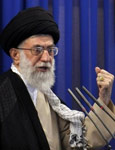
Supreme Leader Ayatollah Ali Khamenei’s verbal attacks on Israel, the U.S. and its allies during a speech in Tehran Wednesday—he referred to the Jewish state as a “dirty rabid dog”—also tested the unity of the six international powers holding talks with Iran in Geneva this week.
The French government quickly challenged Mr. Khamenei, calling his speech “unacceptable,” while the Obama administration offered a much milder response.
This divergence mirrored the differing tactics Paris and Washington displayed two weeks ago during negotiations in the Swiss lakeside city.
Then, French Foreign Minister Laurent Fabius publicly broke from the U.S. and other international powers and called the terms of the agreement being pursued with Tehran a “fool’s game.”
French officials said Wednesday that the tone and timing of Mr. Khamenei’s comments vindicated the skepticism Paris has displayed toward Iran. American officials, conversely, said they didn’t view the supreme leader’s words as necessarily undermining their pursuit of a deal aimed at preventing Iran from developing nuclear weapons.
“I would hope that neither in the U.S. nor Iran would leaders use rhetoric that may work well in a domestic constituency but add to the decades of mistrust on both sides,” said a senior U.S. official.
Mr. Khamenei’s televised speech to tens of thousands of members of the Basij, a conservative nation-wide paramilitary organization, sharply broke from the conciliatory line Tehran has pursued since the August inauguration of President Hasan Rouhani.
It also rekindled questions in Western capitals about whether Mr. Rouhani will be able to deliver on an agreement to roll back Iran’s nuclear program, when Mr. Khamenei is the last word on all of Iran’s national security decisions.
“The content of Khamenei’s speech was one of the most destructive he’s ever given in the realm of foreign policy, even if he meant it for domestic use,” said Roozbeh Mirebrahimi, an Iran expert in New York.
Mr. Khamenei accused Washington and Paris of being lackeys of the “Zionist regime” in Israel. He went on to recount what he called American war crimes in Iraq and Japan and claimed the U.S. was trying to destabilize his country.
He also reasserted his position that Iran wouldn’t stop enriching uranium, as demanded by the U.N. Security Council, or succumb to harsh international sanctions imposed over its refusal to halt enrichment.
“The imperialists have a tendency to cloak their crimes as service to people,” Mr. Khamenei said. “The Americans claim that if they hadn’t killed 200,000 people in Hiroshima and Nagasaki, then World War II wouldn’t have ended….Therefore the U.S. has served humanity by attacking Japan.”
He sent conflicting signals on just how much independence he’s granting Mr. Rouhani and Iran’s foreign minister and chief nuclear negotiator, Javad Zarif.
Mr. Khamenei stressed that he wasn’t interfering in the day-to-day running of the talks, but he also said the Iranian officials must stick to his red lines.
“I insist that not one step backward should be taken with regard to the Iranian nation’s rights,” Mr. Khamenei said, a reference to Iran’s claim that it has a right to enrich uranium. “Some red lines and limits exist which must be respected.”
The speech cast a pall over the start of the third round of talks since Rouhani took office. Tehran negotiates with the international negotiating bloc known as the P5+1.
U.S. and European officials believe they were close two weeks ago to reaching an interim agreement with Iran that would have seen the country cap portions of its nuclear program in exchange for an easing of international sanctions.
The deal was seen as a “first step” in achieving a broader and final agreement ending any threat of Iran developing a nuclear weapons.
The deal didn’t materialize, however, because of continued differences between the negotiating parties over certain elements of Iran’s nuclear program, these officials said.
France, in particular, is demanding a complete dismantling of Iran’s heavy water reactor that will be capable of producing weapons-usable plutonium inside of two years. The P5+1 countries are also seeking greater limits on enrichment of uranium and the centrifuge machines Iran uses to produce the nuclear fuel.
“What we’re focused on now is getting back to the work…and to see if we can narrow the remaining gaps necessary to conclude such an agreement,” said the senior U.S. official taking part in the Geneva talks.
The Obama administration’s Iran outreach is facing strong opposition from the U.S. Congress and Washington’s closest Mideast allies, particularly Israel and Saudi Arabia.


