


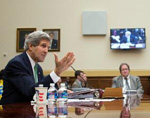
 AFP: Secretary of State John Kerry on Tuesday openly admitted that a hard-won nuclear deal with Iran may still fail in the coming months, as he faced a fierce grilling from US lawmakers seeking to impose new sanctions.
By Jo Biddle
Washington (AFP) — Secretary of State John Kerry on Tuesday openly admitted that a hard-won nuclear deal with Iran may still fail in the coming months, as he faced a fierce grilling from US lawmakers seeking to impose new sanctions.
The top US diplomat helped hammer out the accord with Tehran under which it will freeze parts of its suspect nuclear program in return for some sanctions relief as global powers seek a final agreement to dismantle its atomic weapons capability over the next six months.
But he acknowledged to US lawmakers: “I came away from our preliminary negotiations with serious questions about whether or not they’re ready and willing to make some of the choices that have to be made.”
“Has Iran changed its nuclear calculus? I honestly don’t think we can say for sure yet. And we certainly don’t take words at face value,” Kerry told the House foreign affairs committee.
Washington has seized upon overtures from new Iranian President Hassan Rouhani as raising the chances of ending a decade-long standoff over Iran’s nuclear program.
But Kerry met a storm of criticism from lawmakers on both sides of the aisle who accused him of being “naive,” of “grovelling” to Iran’s supreme leader Ayatollah Ali Khamenei and endangering both the US and its ally Israel.
“Believe me this is not about trust,” hit back Kerry, who it has been revealed helped instigate secret talks with Iran — still dubbed the world’s top sponsor of terrorism.
“Given the history we are all rightly skeptical about whether people are ready to make the hard choices to live up to this.”
He stressed Iran’s seriousness would be put to the test over the six months laid out in the November 24 interim deal reached in Geneva.
Iran has denied it is seeking to acquire a nuclear weapon and says its atomic program is strictly for civilian energy purposes.
Under the first phase deal Iran will neutralize its stock of 20 percent, or weapons-grade, enriched uranium, halt construction on its heavy water reactor at Arak and agree to daily inspections by a UN watchdog.
In return, global powers offered $7 billion in sanctions relief such as unfreezing some Iranian funds in overseas accounts and allowing limited oil sales to help the struggling Iranian economy.
The deal also states that the US administration “will refrain from imposing new nuclear-related sanctions” as the negotiations continue.
Kerry insisted again that the core sanctions, carefully crafted over years by Congress, remained in place.
He however urged lawmakers not to impose new sanctions while negotiations with the group known as the P5+1 are continuing, saying that if needed, new sanctions could be put together “in a week.”
“I’m not saying never … If this doesn’t work we’re coming back and asking you for more. I’m just saying not right now,” he said.
Two US senators — Democrat Robert Menendez and Republican Mark Kirk — are finalizing a new Iran sanctions measure they hope to introduce before Congress goes on its year-end recess.
Senator John McCain, who said he hoped senators could “get an agreement in the next day or two,” dismissed the idea that new sanctions legislation could scupper the interim deal.
Fellow Republican Senator Lindsey Graham said any new sanctions would not take effect until after the six months were up.
“The Iranians are saying if there’s another round of sanctions coming from the Congress they’ll get out of the deal. Well my view is that they would never be at the table without the sanctions,” Graham said.
Kerry said the world faced “a hinge point in history” — one path could lead to a resolution of global concerns about Iran’s nuclear program, the other to conflict.
If the US went ahead with new sanctions, it risked angering Washington’s negotiating partners and could give Iran an excuse to flout the deal, Kerry warned.
Number two Senate Democrat Dick Durbin said it was unlikely that new sanctions would be passed this week, before the holidays.
“There’s this notion that we should let the negotiations progress to the point where we can get a clear indication of whether Iran is pursuing them in good faith,” he told reporters.


