


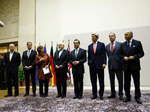
 New York Post: Less than a month after it was hailed as “a great diplomatic coup,” the so-called Geneva accord to halt Iran’s nuclear ambitions seems to have come unstuck.
New York Post
By Amir Taheri
Less than a month after it was hailed as “a great diplomatic coup,” the so-called Geneva accord to halt Iran’s nuclear ambitions seems to have come unstuck.
The official narrative in Tehran is that Iran signed nothing. “There is no treaty and no pact,” says Foreign Ministry spokeswoman Marzieh Afkham, “only a statement of intent.”
Originally, Iran’s official media had presented the accord as a treaty (qarardad) but it now refers to a “letter of agreement” (tavafoq nameh).
The initial narrative claimed that the P5+1 group of nations that negotiated the deal with Iran had recognized the Islamic Republic’s right to enrich uranium and agreed to start lifting sanctions over a six-month period. In exchange, Iran would slow its uranium enrichment and postpone for six months the installation of equipment for producing plutonium, an alternate route to making a bomb. A later narrative claimed that the accord wasn’t automatic and that the two sides had appointed experts to decide the details (“modalities”) and fix a timetable.
On Sunday, an editorial in the daily Kayhan, published by the office of “Supreme Guide” Ali Khameini, claimed that the “six month” period of the accord was meaningless and that a final agreement might “even take 20 years to negotiate.”
It was, therefore, no surprise that Iran decided to withdraw its experts from talks in Geneva to establish exactly how to implement the accord. “Now we have to talk about reviving the talks on modalities,” says Deputy Foreign Minister Abbas Araqchi.
Translated into plain language, the new Iranian narrative is that talks about implementing an accord that is not legally binding have collapsed and that, in the words of the head of the Iranian Atomic Energy Agency, Ali-Akbar Salehi, there is no change in the rhythm and tempo of Iran’s nuclear project. “Our centrifuges are working full capacity,” Salehi said last Thursday.
Having claimed that he had halted Iran’s nuclear project, Secretary of State John Kerry might want to reconsider. He and his European colleagues, like many of their predecessors, may have fallen for the diplomatic version of the Three Card Monte played by the mullahs since they seized power in 1979.
Khomeinist diplomacy has never aimed at reaching agreement with anyone. Instead, the regime regards negotiations as just another weapon in the jihad (holy struggle) for ensuring the triumph of “true Islam” across the globe.
The regime can’t conceive of give-and-take and compromise even with Muslim nations, let alone a bunch of “Infidel” powers. If unable to impose its will on others, the regime will try to buy time through endless negotiations.
In Three Card Monte, suckers stay in the game in the hope of getting it right next time. A similar hope ensures outsiders’ participation in Khomeinist diplomacy’s version of the trick.
Thus Tehran has been in negotiations with Russia and three other littoral states over sharing the resources of the Caspian Sea since 1992. Talks with Iraq over implementing Resolution 598 of the UN Security Council and reopening the Shatt al-Arab border estuary have been going on since 2004. Other talks over sharing water resources have been going on with Afghanistan since 2003; talks over joint exploitation of gas resources with Qatar have been going on for 25 years.
And for more than 30 years, Iran and the United States have been negotiating the settlement of mutual claims in accordance with the Algiers accord of 1980.
The series of nuclear negotiations that started in 1993 resumed with the European Union in 2002 and have already taken four years in their current format, which opened in 2009.
The tactic of delay has several advantages for the mullahs.
First, hopes of a negotiated solution make it more difficult for anyone to advocate military action to thwart Tehran’s ambitions. As long as talks are going on, “all other options”, the cliché favored by President Obama, remain off the table.
Endless talks also force Iran’s adversaries are forced to sacrifice policy to process. Under the Geneva deal, for example, the US and its European partners not only set the military option aside, but also undertake not to impose additional sanctions. Instead of hiring expensive lobbyists in Washington, the mullahs can use Obama, Vice President Joe Biden and Kerry to lobby Congress on their behalf.
The mullahs have reaped other benefits from their three-card trick. The perception that the crisis is cooling down has already halted the Islamic Republic’s economic free fall. The national currency, the rial, lost 80 percent of its value over four years, but now appears to have stabilized.
The mullahs also use the prospect of normalization, especially with the United States, to divert attention from their increasingly repressive rule. While Iranians are bombarded with talk of President Hassan Rouhani’s “diplomatic miracle,” an average of 10 people are executed in Iran every day.
Here is how Khamenei’s daily mouthpiece put it Sunday: “If our centrifuges do not continue to turn, no other wheel shall turn for our dignity, independence, power and security.”
The message from Tehran to Washington is clear: You talk, we act.


