


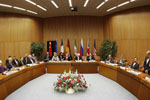
 Wall Street Journal: Diplomacy over Iran’s nuclear program gained momentum on two key fronts Thursday, but the advancement was tempered by differences over the scope of negotiations in coming months.
Agreement on Timetable for Negotiations
The Wall Street Journal
By Jay Solomon and Laurence Norman
VIENNA—Diplomacy over Iran’s nuclear program gained momentum on two key fronts Thursday, but the advancement was tempered by differences over the scope of negotiations in coming months.
Iran and global powers set ambitious goals for the timeline of the talks, while United Nations inspectors said they’ve gained improved access to Iranian nuclear facilities.
But at talks with the five permanent members of the United Nations Security Council plus Germany, a bloc known as the P5+1, Iranian officials opposed a U.S. proposal for negotiations over caps on Tehran’s ballistic-missile program.
Iranian Foreign Minister Javad Zarif argued that Tehran’s military capabilities were nonnegotiable.
U.S. officials countered that the world powers were required to discuss the missile program because of U.N. Security Council resolutions that demand Tehran suspend its missile program until it addresses evidence the program is being developed to deliver nuclear warheads.
Tehran has refused to stop testing the weapons. Iran argues the missiles are defensive and aren’t designed to carry nuclear warheads.
Last week, the Iranian military announced it launched two ballistic missiles with ranges of at least 1,500 kilometers, about 900 miles.
“Nothing except Iran’s nuclear activities will be discussed in the talks with the P5+1, and we have agreed on it,” Mr. Zarif told reporters at the end of three days of talks in Vienna.
A senior American official disagreed. “Every issue of concern to us has been discussed, will be discussed, is on the table,” the diplomat said.
The Vienna negotiations were the first between Iran and the P5+1 since a landmark interim agreement was reached in November.
Under terms of the deal, Iran has frozen some of the most advanced parts of its nuclear program in exchange for an easing of Western sanctions.
Iran and the global powers are now seeking to forge by July a final deal to end the nuclear dispute.
Mr. Zarif and the European Union’s foreign-policy chief Catherine Ashton —who leads the P5+1—announced a stepped-up calendar of meetings, including a new round to be held March 17-20 in Vienna.
Still, American and Iranian officials acknowledged that no new text had been drafted and signed this week to guide the negotiations over the next four months.
This raised the potential of continuing disputes over the parameters of the talks.
U.S. officials said November’s agreement, the Joint Plan of Action, clearly identifies the issues that need to be resolved.
“We have a framework to continue our deliberations. We know all of the issues that need to be addressed,” said the senior U.S. official. “They are all covered in one way or other in the Joint Plan of Action.”
The U.N.’s nuclear watchdog, the International Atomic Energy Agency, said in a report on Thursday that Iran has been complying with the commitments it made under its November agreement.
This included stopping the production of near weapons-grade fuel, which is uranium enriched to 20%, and the opening of more nuclear sites to IAEA inspectors.
The agency said it had increased its monitoring of Iran’s Arak heavy-water reactor, which could produce weapons-grade plutonium once commissioned.
But the IAEA said Iran’s production of low-enriched uranium, which is processed to around 5% purity, has expanded over the past three months to 7,609 kilograms, or approximately 16,775 pounds.
Under terms of the November plan, Iran’s stockpile of this nuclear fuel is supposed to remain flat.
But U.S. officials have warned the amounts might fluctuate over the course of the six-month agreement.
The Vienna-based agency also said it was intensifying efforts to get Iran to respond to evidence it had secretly been developing atomic weapons based on studies conducted before 2003.
The IAEA praised Iran’s commitment this month to address one piece of evidence that focuses on the development of a detonating device called an Exploding Bridge Wire.
But the agency said Tehran has continued to deny access to military sites, scientists and documents suspected of being tied to an illicit weapons program. The IAEA again voiced its concerns that Iran was sanitizing one military site called Parchin.
“Since the Agency’s first request for access, extensive activities have taken place…that will have seriously undermined the Agency’s ability to conduct effective verification,” the report said of Parchin.


