


 Reuters: Despite apparently reducing illicit purchases that breach U.N. sanctions, Iran is pursuing development of ballistic missiles, a confidential U.N. report says, posing an acute challenge to six powers negotiating with Tehran to rein in its nuclear program.
By Louis Charbonneau and Parisa Hafezi
VIENNA (Reuters) – Despite apparently reducing illicit purchases that breach U.N. sanctions, Iran is pursuing development of ballistic missiles, a confidential U.N. report says, posing an acute challenge to six powers negotiating with Tehran to rein in its nuclear program.
On Sunday, Iranian Supreme Leader Ayatollah Ali Khamenei described as “stupid and idiotic” Western expectations for his country to curb its missile development. He decreed mass production of ballistic weapons, striking a defiant tone just before nuclear talks resumed on Wednesday in Vienna.
The high-stakes negotiations aim for a deal by a July 20 deadline to end a long stand-off that has raised the risk of a wider Middle East war.
Tehran’s often repeated view that missiles should not be part of the nuclear talks appears to enjoy the support of Russia, one of the six global powers.
But a senior U.S. official made clear this week that Tehran’s ballistic capabilities must be addressed in the negotiations since U.N. Security Council resolutions on Iran “among many other things, do say that any missile capable of delivering a nuclear weapon must be dealt with.”
A ban on developing missiles suited to carrying a nuclear warhead is included in a 2010 Security Council resolution, its fourth – and toughest – imposed on the Islamic Republic for defying council demands that it suspend uranium enrichment and other nuclear activities of potential use in bomb-making.
The new report by the U.N. Panel of Experts, seen by Reuters, said Iran’s overall attempts to illicitly procure materials for its banned nuclear and missile programs appear to have slowed down as it pursues negotiations with world powers that it hopes will bring an end to sanctions.
But the same report makes clear that, apart from holding off on test-firing one type of rocket, Iran shows no sign of putting the brakes on the expansion of its missile program.
“Iran is continuing development of its ballistic missile and space programs,” the experts said. “A new missile launch site 40 km (25 miles) from the city of Shahrud was identified in August 2013. A larger launch complex is assessed to be close to completion at the Imam Khomeini Space Center at Semnan for ballistic missiles and satellite launch vehicles.”
The report also cited what it described as the June 2013 opening of the Imam Sadeq Observation and Monitoring Center for monitoring space objects, including satellites.
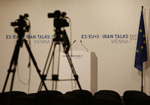
The dispute over missiles has already surfaced behind closed doors in Vienna. On Wednesday, the first day of the latest round of the nuclear talks, the U.S. delegation made clear that it wanted to discuss both Iran’s ballistic missile program and possible military dimensions of its past nuclear research.
But in a sign of the wide divergence between the U.S. and Iranian positions, Iranian Foreign Minister Mohammad Javad Zarif merely laughed and ignored the remarks, according to an Iranian official present. An American official declined to comment but referred to remarks from a senior U.S. official earlier this week, who said “every issue” must be resolved.
ARMS EXPERT: LEAVE MISSILES ASIDE
Diplomats close to the talks say Britain, France and Germany agree with the U.S. view. But Russia, which has engaged in missile-technology trade with Iran, appears to disagree. Russian Foreign Minister Sergei Lavrov was quoted by Iranian media as saying that Tehran’s missile program was not on the agenda.
The Islamic Republic denies accusations that it is seeking the capability to make nuclear weapons. It insists that its missiles are part of its conventional armed forces and rules out including them on the agenda for the nuclear discussions.
Daryl Kimball of the Arms Control Association, a Washington-based research and advocacy group, said that missiles should not become a deal-breaker.
“The best way to address Iran’s potential to exploit nuclear-capable missiles is to ensure that Iran’s nuclear program is sufficiently limited and transparent,” he said.
“To seek Iran-specific limits on conventional weapons that Iran regards as vital to its self-defense would jeopardize the negotiations’ key objective.”
An Iranian official confirmed that the ballistic missile program would not be interrupted. “Iran purchases parts from various countries, including Russia and China and then assembles missiles in Iran,” he said.
“Some Gulf countries have been involved in the missile delivery to Iran. Iran has never stopped its missile program and has no intention to do so; it gives Iran an upper hand.”
The U.N. Panel of Experts, which monitors compliance with the U.N. sanctions regime against Iran, said in its 49-page report that monitoring Iranian missile work was not easy.
MISSILE WORK MORE HIDDEN THAN NUCLEAR ACTIVITY
“Analysis of Iran’s ballistic missile program remains a challenge. With the exception of several launches, periodic displays of hardware and one recent revelation of a new ballistic launch facility, the program is opaque and not subject to the same level of transparency that Iran’s nuclear activities are under IAEA safeguards.”
It said procurement for the missile program continues, with no apparent changes in the type of materials Iran seeks.
“Among the most important items Iran is reportedly seeking are metals as well as components for guidance systems and fuel,” the panel report said. “Similarities between Iran’s ballistic missiles and space programs can make it difficult for states to distinguish the end-uses of procured items.”
The experts said it was unclear why Iran appears not to have test-fired a Sejil, Iran’s longest-range, solid-fuelled ballistic missile, since 2011. This might be due to satisfaction with its performance, an inability to procure components or ingredients for solid fuel, or a shift to other missiles considered to be of higher priority, according to the report.
“Iran may also have decided to suspend further testing which could be interpreted as inconsistent with the spirit of the (six power) negotiations,” the experts assessed.
Nevertheless, the panel said that proof Iran is continuing to develop the Sejil came from a 2013 parade of their launchers.
On February 10, Iran test-fired the Barani, which the experts said the Iranian Defence Ministry had described as “a new generation of long-range ballistic missiles capable of carrying multiple re-entry vehicle (MRV) payloads.” A MRV payload deploys multiple warheads in a pattern against a single target.
Iran had announced no other ballistic test, the panel said.
According to Jane’s Defense Weekly, Iran recently unveiled an indigenous copy of the Lockheed Martin RQ-170 unmanned aerial vehicle as well as “other, potentially more significant, revelations” – including new versions of the Fateh-110 tactical ballistic missile known as the Hormuz-1 and Hormuz-2.
Military analysts say, however, that Iran has exaggerated its military achievements, including its missile capabilities.
(Editing by Mark Heinrich)


