


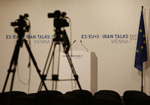
 AFP: Time is running out for Iran’s negotiations with the so-called P5+1 group, which includes the five permanent UN Security Council members Britain, China, France, Russia and the United States, plus Germany.
AFP – Iran and the United States go into a second day of talks Tuesday on Tehran’s contested nuclear programme, with Washington warning of “tough choices” ahead of a July deadline for a deal.
The closed-door two-day meeting in Geneva, which began Monday, marks a new effort to find common ground between Tehran and Washington, amid concerns that tensions between the two could damage efforts to strike a deal between the Islamic republic and world powers.
As the first day of talks drew to a close, Washington acknowledged that time was running out.
“We think we’ve made progress during some rounds, but as we said coming out of the last one, we hadn’t seen enough made. We hadn’t seen enough realism, quite frankly, on the table,” said deputy State Department spokeswoman Marie Harf.
“We know we don’t have a lot of time left. That’s why we’ve said diplomacy will intensify,” Harf said.
“People need to make tough choices, but we are very focused on that July 20th time.”
Iran’s deputy foreign minister and nuclear pointman Abbas Araqchi said Monday’s dialogue “took place in a positive climate and was constructive,” in comments carried by Iran’s ISNA news agency.
The Geneva meeting marks the first time since the 1980s that Tehran and Washington have held official, direct talks on the nuclear issue outside of the P5+1 process.
For Iran, the goal is to make a leap towards ending the international sanctions that have battered its economy.
Washington and its fellow powers are seeking solid commitments that will ensure Iran’s stated desire for a peaceful atomic power programme is not a covert attempt to build a nuclear bomb.
Time is running out for Iran’s negotiations with the so-called P5+1 group, which includes the five permanent UN Security Council members Britain, China, France, Russia and the United States, plus Germany.
A deadline of July 20 has been set to turn a temporary deal struck in November in Geneva into a permanent agreement.
“If this does not happen, we’ll have to resort to extending the Geneva agreement for another six months so the negotiations can continue,” Iran’s IRNA news agency quoted Araqchi as saying earlier Monday.
Both sides had already raised the prospect of an extension.
– ‘Ball in Washington’s court’ –
With the last round of P5+1 talks in Vienna in May yielding little, the stakes are high.
Chinese foreign ministry spokeswoman Hua Chunying said the negotiation had “entered the deep-water zone”.
“All parties need to take a flexible and practical attitude in order to seek common ground and shelve differences,” she added.
French Foreign Minister Laurent Fabius said Paris would hold direct talks with Iranian officials this week.
“After these discussions, there will also be discussions between the Iranians and the Russians. There may be others,” he added
Iran was also expected to meet Russian negotiators in Rome on Wednesday and Thursday and hold talks with German officials on Sunday in Tehran, before a P5+1 session in Vienna from June 16-20.
However, Araqchi has said the ball is in Washington’s court.
“Most of the sanctions were imposed by the US, and other countries from the P5+1 group were not involved,” IRNA quoted him as saying Sunday.
The US side in Geneva was led by Deputy Secretary of State Bill Burns and Jake Sullivan, a top White House adviser — part of a small team who spent months in secret talks in Oman that finally coaxed Iran to the negotiating table last year.
The overall P5+1 talks are chaired by the European Union, whose political director Helga Schmid took part in a session of the Iran-US meeting Monday.
After decades of hostility since the 1979 Islamic Revolution, Iran and the US took tentative steps towards rapprochement after the election of self-declared moderate and former nuclear negotiator Hassan Rouhani as president last June.
Rouhani called his US counterpart Barack Obama shortly after taking office, before US Secretary of State John Kerry met with Iran’s Foreign Minister Mohammad Javad Zarif.
– ‘Stubbornly recalcitrant’ –
The interim deal struck last November led the US and its partners to release $7 billion (5.1 billion euros) from frozen funds in return for a slowdown in Iran’s uranium enrichment.
Cyrus Nasseri, a member of Iran’s negotiating team under Rouhani between 2003 and 2005, told AFP that Washington now had to drop its “stubbornly recalcitrant” outlook.
“It’s all a matter of whether the US will be prepared to take the next step to accept a reasonable solution which will be win-win for both,” he said.
“The US has to bite the bullet after 10 years of wrongful accusations. It has to accept Iran will at the end of day, no matter how the settlement is made, have peaceful nuclear fuel production.”
The session will resume Tuesday at 9:00 am (0700 GMT), Araqchi said.


