


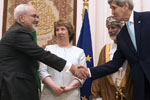
AFP:US Secretary of State John Kerry (R) and Iranian Foreign Minister Javad Zarif (L) shake hands as Omani Foreign Minister Yussef bin Alawi (2nd R) and former EU top diplomat Catherine Ashton watch in Muscat on November 9, 2014© Pool/AFP Nicholas KammUS Secretary of State John Kerry (R) and Iranian Foreign Minister Javad Zarif (L) shake hands as Omani Foreign Minister Yussef bin Alawi (2nd R) and former EU top diplomat Catherine Ashton watch in Muscat on November 9, 2014
AFP: US Secretary of State John Kerry (R) and Iranian Foreign Minister Javad Zarif (L) shake hands as Omani Foreign Minister Yussef bin Alawi (2nd R) and former EU top diplomat Catherine Ashton watch in Muscat on November 9, 2014© Pool/AFP Nicholas KammUS Secretary of State John Kerry (R) and Iranian Foreign Minister Javad Zarif (L) shake hands as Omani Foreign Minister Yussef bin Alawi (2nd R) and former EU top diplomat Catherine Ashton watch in Muscat on November 9, 2014
Muscat (AFP) – The United States and Iran held high-level talks in Oman Sunday ahead of a looming deadline for a nuclear deal, but President Barack Obama warned that a “big gap” remained.
US Secretary of State John Kerry met Iran’s Foreign Minister Mohammad Javad Zarif in the Gulf sultanate, with both sides facing political pressure at home over the long-running negotiations which have appeared close to deadlock for months.
Iran and world powers have set November 24 as a deadline to turn an interim agreement into a long-term settlement, but Obama warned it may not be possible.
“Are we going to be able to close this final gap so that (Iran) can re-enter the international community, sanctions can be slowly reduced and we have verifiable, lock-tight assurances that they can’t develop a nuclear weapon?” Obama told CBS News in an interview broadcast Sunday.
“There’s still a big gap. We may not be able to get there.”
Despite the deadline, Iran and the P5+1 group — Britain, China, France, Russia and the United States plus Germany — are far apart on what capabilities Iran’s nuclear programme should have.
The West has as yet been unconvinced by Iran’s denials that it has never sought a nuclear weapon, while Tehran insists its atomic activities are for peaceful, civilian energy purposes only.
A deal, for the West, aims to put a bomb forever beyond Iran’s reach.
Kerry and Zarif met for three hours in Muscat with former EU foreign policy chief Catherine Ashton, the lead negotiator in the talks, also present. Both sides then broke for lunch and separate private discussions with aides.
No statements were made before the main talks resumed at 6:00 pm (1400 GMT).
At issue is the number of uranium-enriching centrifuges Iran should be allowed to keep spinning in exchange for sanctions relief and rigorous inspections at its nuclear sites.
Iran wants “industrial grade enrichment” beyond its current capabilities while the world powers want a reduction.
Domestic politics overshadow talks
The meeting follows the revelation that Obama reportedly wrote to Iran’s supreme leader Ayatollah Ali Khamenei to push for a deal, arguing that the Islamic republic and the West have shared regional interests.
This apparent reference to the fight against Islamic State group militants in Syria and Iraq was played down by Kerry, however, with the US diplomat saying in Beijing on Saturday “there is no linkage whatsoever” with the nuclear talks.
Domestic politics are hanging heavily over the process, given the loss in midterm elections of the Senate by Obama’s Democrats to the Republican party, members of whom have consistently bridled at the White House’s negotiations with Iran.
If talks go sour in the coming weeks it is thought the US Congress may respond with fresh sanctions on Iran.
Obama has the power to veto them, but the prospect of new penalties could disrupt an already protracted process and push the negotiations toward being untenable for the Iranian government.
Zarif and President Hassan Rouhani are already under pressure from lawmakers sceptical of the interim deal who have also demanded that any final agreement must be ratified by parliament.
As if to drive that message home on Sunday, 200 Iranian MPs signed a statement demanding that Zarif’s negotiating team “vigorously defend” the country’s nuclear rights and ensure a “total lifting of sanctions”.
Although officially supportive, hardliners in Tehran have often been ambivalent about the negotiations, which officially resumed last autumn after earlier secret talks in Oman with US officials set the wheels in motion.
On the plane to Muscat on Saturday, Zarif told reporters Iran and the P5+1 have concentrated on “solutions rather than differences” since talks on the sidelines of the UN General Assembly in New York in September.
The surprise election last year of Rouhani, who had pledged to revive Iran’s sanctions-battered economy, was a turning point on the nuclear issue. But progress has been elusive since the interim deal came into effect in January.
After Sunday’s meeting between Kerry and Zarif, the political directors of the P5+1 powers will hold talks in Muscat on Tuesday. The main negotiations then move back to Vienna on November 18 for a final push towards the deadline six days later.


