


 The Economist: With its shutters down and shops closed, Tehran’s usually bustling Grand Bazaar has been quiet of late. In the first weeks of July Iran’s powerful merchants went on strike because the government tried to raise their annual income tax by 70%. Even when the government hastily agreed to lift taxes by only 15% after the protests spread to other cities, businesses stayed shut for several days.
The Economist
Iran’s muttering merchants
Jul 29th 2010
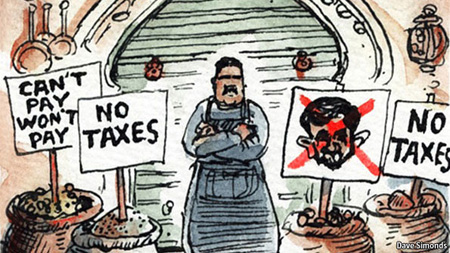 WITH its shutters down and shops closed, Tehran’s usually bustling Grand Bazaar has been quiet of late. In the first weeks of July Iran’s powerful merchants went on strike because the government tried to raise their annual income tax by 70%. Even when the government hastily agreed to lift taxes by only 15% after the protests spread to other cities, businesses stayed shut for several days.
The strikes have now ended but the threat of big reforms to Iran’s tax system still looms over the bazaar. Merchants argue that as the economy slows and inflation increases, they should pay less, not more, in taxes. But with lower oil prices, the government wants more money from a wealthy group that at the moment pays relatively little. Iran imposes valued-added tax (VAT) at 3% on large corporations but not on smaller and unincorporated businesses, so until now many of the bazaaris have escaped. The administration wants that to change. A report by the IMF in March detailed Iran’s plans to extend VAT and to modernise the tax system more broadly.
The bazaaris’ power has dipped since the 1970s. After Iran’s draining war with Iraq from 1980 to 1988, large chunks of the economy ended up in state hands. That, as well as Dubai’s emergence as a regional commercial hub and the free-trade zones that the Iranian government has set up on the country’s periphery, has moved the centre of commerce away from the Tehran bazaar. But its merchants still play a vital part in Iran’s economy.
Their political backing is important too. In the past, dissent among the bazaaris has often gone along with political upheaval. Their abandonment of the shah helped the Islamist revolutionaries prevail in 1979. But in recent years some of the bazaaris have gravitated towards the reformists. This is not, argues Arang Keshavarzian of New York University, who has studied relations between bazaar and state, because they are democrats or liberals but because they are hardheaded pragmatists who crave integration into international trade networks.
Strikes in the bazaar have been rare. This is only the second since the revolution. The first was in 2008 when President Mahmoud Ahmadinejad’s government first proposed VAT. The bazaaris may not be allied to Mr Ahmadinejad’s political opponents, but their disgruntlement means that the president is obliged to fight on yet another front. The merchants have chafed at the growing political and economic influence of the Revolutionary Guard under Mr Ahmadinejad, sensing a threat to their own interests. Their hesitation in accepting the 15% deal suggests a growing lack of trust in the government and a further erosion of its authority.
Middle East & Africa


