


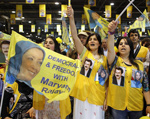
 EurActiv: What is missing from the US presidential discussions is a strategy that acknowledges the Iranian people’s desire for democratic change, whilst at the same time recognising the role that the Iranian resistance will play in the future of the country, says Brian Binley.
EurActiv.com
By Brian Binley
 “With the US presidential election fast approaching, one foreign policy issue remains as prominent and difficult as ever.
I refer, of course to the Iranian question. The dilemma regarding Iran has been around since the Regan era, with each administration engaging in a mixed bag of negotiations and sanctions, but with none achieving a permanent solution. As both candidates discuss the options, the debate remains locked between the two poles of military action and soft diplomacy.
Meanwhile, the Iranian people have continued to take a stand against the regime, demonstrating again on the streets earlier this month in protest of the government’s mismanagement of the economy, whilst at the same time demanding that their voices be heard.
What is missing from the presidential discussions is a strategy which acknowledges the Iranian people’s desire for democratic change, whilst at the same time recognising the role that the Iranian resistance will play in the future of the country. The idea of a military conflict in or with Iran thankfully appears to be rejected by all concerned, yet the prospect of the regime possessing nuclear weapons causes deep concern. Sanctions have played an effective role in isolating the regime in Tehran, whilst pressurising the Ahmadinejad government. However, sanctions alone are not enough.
The US also needs to show its support for those fighting for freedom in Iran. The regime, which has one of the world’s highest execution rates, has exported terrorism throughout the region, and should be increasingly recognised as a pariah state.
It’s participation in the Syrian civil war could well be grounds for further sanctions by the UN Security Council. Canada recently took steps to break diplomatic ties with Iran, recalling its ambassador and closing the Iranian embassy in Canada. Other Western nations should take similar steps. Whilst the Arab spring was sweeping through the Middle East, few remember that the Iranian uprising in 2009 was the first of the so called “Twitter revolutions”, and the Iranian people want to finish what they started.
As the tide turns in Syria, the time has come to recognise the power of the Iranian people by providing more positive support for the resistance to bring about internal change. A major step in this direction was achieved through the de-listing of Iran’s largest and most organised opposition group, the People’s Mojahedin Organisation of Iran (PMOI/MEK), but more needs to follow. The inclusion of the PMOI on the US terror list was part and parcel of an appeasement policy initiated by the Clinton administration, with one official acknowledging the move “was intended as a goodwill gesture to Tehran.”
Secretary Clinton took the right decision and removed the group from the terror list just a couple of weeks ago. The organisation has consistently embodied the most serious threat to Tehran over the past 30 years.
It revealed the regime’s clandestine nuclear programme to the world in 2002, and helped to galvanise the protests in 2009. Despite the regime’s brutal crackdown on dissidents, which included the execution of PMOI supporters, the resistance continues.
The regime has even blamed the PMOI for the recent protests in the Tehran bazaar, showing yet again that it maintains a very real presence on the ground. The National Council of Resistance of Iran, which includes the PMOI as its central force, has produced a 10 point plan for a democratic and secular Iran free of nuclear weapons. It also promises a firm and progressive line on the rights of women, together with detailed guarantees for ethnic and religious minorities.
This manifesto is a guiding vision for the future of a pluralistic and peaceful Iran, which will do much to usher in an era where Iran is restored to its rightful place both in the Middle East and the wider international community. In less than a month we will know which candidate will be sitting in the Oval Office for the next four years, but it remains to be seen how the new president will deal with the difficulties associated with the Iran situation.
It is not only a crucial time for the American people, but also for the people of Iran, as they prepare for the next phase of their struggle for freedom and democracy. It is time for the United States to create a more robust approach towards the Mullahs’ regime, which includes a commitment to support the Iranian people and their resistance. A new president can do much to create a new Iran. The free world will expect nothing less.”
Brian Binley is a Conservative member of the British Parliament and a member of the British Parliamentary Committee for Iran Freedom.


