


 Wall Street Journal: Domestic politics and a June election could make the difference in how Iran addresses its main dilemma of the coming year: whether to compromise on its nuclear program or maintain a policy of defiance.
The Wall Street Journal
By FARNAZ FASSIHI
BEIRUT—Domestic politics and a June election could make the difference in how Iran addresses its main dilemma of the coming year: whether to compromise on its nuclear program or maintain a policy of defiance.
Iran is slated to elect a new president amid deep political divisions and rivalries among conservative factions. The issues at the heart of Iran’s standoff with the West—the country’s economy, its isolation and security—will likely dominate the campaign.
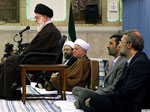
The contest for power will pit candidates seen as loyal to Supreme Leader Ayatollah Ali Khamenei against those associated with President Mahmoud Ahmadinejad. The main reformist parties said they would boycott the elections.
The discord is on daily display in Iranian media, with prominent political figures blaming one another for an economy withering from international sanctions and years of mismanagement, with a plummeting currency and skyrocketing inflation.
For Iran, maintaining the status quo with the West could invite additional sanctions and a possible military strike by Israel to prevent the countryfrom building a nuclear weapon. Iran says its nuclear program is solely for peaceful energy purposes.
Mr. Ahmadinejad’s oppenents say he and his administration have mismanaged the economy and challenged the will of Mr. Khamenei, who has the last word on all state matters. In November, Mr. Ahmadinejad ruffled some feathers when he said the nuclear impasse would be resolved only through direct negotiations with the U.S. Washington has said it was ready for such discussions.
In Iran, the idea is gaining momentum that talks between Iran and the U.S. must proceed in parallel to Iran’s nuclear negotiations with the five permanent members of the U.N. Security Council plus Germany, analysts say. Both sides in those so-called P5+1 talks have indicated a timetable will be set to meet again in 2013, after talks stagnated in 2012.
Iran’s goal, some analysts say, is a grand bargain that recognizes its right to enrich uranium, lays out steps toward relief of sanctions and addresses concerns such as a possible military strike by Israel, a stake in a post-Assad Syria and assurances that the U.S. isn’t plotting for regime change in Tehran.
“In Iran, many people are realizing that nothing will move forward until Iran and the U.S. sit down and discuss their issues. Mr. Khamenei is not opposed to these talks in principle, but he needs reassurances that the U.S. won’t meddle in Iran’s internal affairs,” said Seyed Hossein Mousavian, who was part of Iran’s nuclear negotiating team until 2005 and is currently a visiting scholar at Princeton University.
On the other hand, Tehran has built a legacy of anti-Western rhetoric, and any concessions could diminish its stature at home and among its proxies abroad, specifically Hezbollah in Lebanon and Hamas in Gaza. Mr. Khamenei will consider a compromise only if he feels there is sufficient unity and stability inside the regime so that Iran doesn’t look weak, analysts say.
To that end, the regime will be focused on getting through June’s presidential elections with minimum turmoil, after the demonstrations that followed the 2009 election and the regional uprisings of the Arab Spring.
Mr. Ahmadinejad, who is ineligible to run for re-election, could be another obstacle to progress in nuclear negotiations: The regime, analysts say, is wary of giving the credit and legacy of a political breakthrough with the West to a controversial, lame duck president.
The president’s conservative detractors hope to clip his wings out of fear that he aims to overstep Mr. Khamenei’s powers. Mr. Ahmadinejad’s allies have fought back with smear campaigns aimed at discrediting heavyweight pragmatic figures, such as former president Ali Akbar Hashemi Rafsanjani, who are trying to influence Mr. Khamenei to strike a nuclear deal.
“In some ways, Ahmadinejad’s delusions of grandeur and insubordination are now an asset for U.S. policy. If he’s not accommodated, he could sow divisions and crisis among Iran’s senior political elite,” making it difficult to compromise with the West, said Karim Sadjadpour, Iran expert at the Carnegie Endowment for International Peace.


