


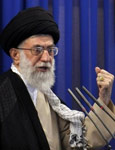
 Weekly Standard: Last month, the Obama administration added seven new Iranian companies to the ever-growing list of sanctioned Iranian entities. Yet one crucial category of Iranian entities is still missing from U.S. policy—companies owned or controlled by Iran’s supreme leader, Ayatollah Ali Khamenei. The Weekly Standard
To make sanctions bite, the U.S. and its Western allies should target companies controlled by Ayatollah Ali Khamenei.
By EMANUELE OTTOLENGHI and SAEED GHASSEMINEJAD
 Last month, the Obama administration added seven new Iranian companies, because of proliferation concerns, to the ever-growing list of sanctioned Iranian entities. Yet, as important as this latest move is, one crucial category of Iranian entities is still missing from U.S. policy—companies owned or controlled by Iran’s supreme leader, Ayatollah Ali Khamenei.
Despite his aura as the aloof religious guide of the Islamic Republic, Khamenei belongs to a long tradition of business savvy clerics. Like many of his predecessors, he has used his position of authority for his own personal enrichment. Since the establishment of the Islamic Republic, clerical foundations have developed into veritable business empires— thanks in part to political connections, but also due to a generous tax-exemption status. Many of these clerics, and other regime figures, owe their wealth to the supreme leader himself.
Khamenei owns or controls hundreds of businesses, but none have so far fallen under the scrutiny of the international community, let alone made it onto the sanctions’ list. There are at least two reasons why the United States and its Western allies should target Khamenei’s business empire.
First, the supreme leader is the decision-maker in all matters of national security, nuclear policy first and foremost. If sanctions are meant to persuade the regime to change its policy, the man in charge of making that decision should be made to pay personally for stubbornly refusing to compromise.
Second, ordinary Iranians are tightening their belt under the lash of financial sanctions, and shortages are being felt across the entire economy. It is worth highlighting that, in contrast, Khamenei’s business empire is thriving.
For instance, last summer, the Wall Street Journal reported that Tadbir Development Co., an Iranian energy concern, was going to bid for a French refinery, La Petite Couronne, which was otherwise slated to close, thereby costing 500 French jobs.
Tadbir is owned by the Imam Khomeini Foundation, whose majority shareholder is Khameini himself. Because it falls under the supreme leader’s financial domain, Tadbir does not pay any taxes to the government, and the exact value of its assets are unknown. But Tadbir is believed to be the most important player in Iran’s real estate market and has actively purchased companies on Tehran’s stock exchange, including in 2009 Iran’s largest telecommunications network. Tadbir is also a major shareholder of 36 companies on the Tehran stock exchange, including banks and other investment companies.
Ordinary Iranians are suffering at the hands of a callous regime, whose leaders see no conflict in preaching forbearance and sacrifice to the masses while making whopping profits for themselves. Sanctioning Khamenei’s vast empire, and hurting the personal wealth of the man who holds the keys to the nuclear program, might actually begin to give sanctions the bite they have lacked so far with Iran’s decision-makers.
Saeed Ghasseminejad is a Ph.D. candidate at Baruch College, New York. Emanuele Ottolenghi is a senior fellow at the Foundation for Defense of Democracies in Washington.


