


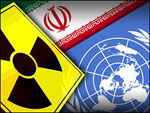
 Washington Post: As the great powers contemplate a solution to the Iranian nuclear conundrum, they would be prudent to appreciate how Tehran uses diplomacy to complement its quest for nuclear arms. The Washington Post
By Ray Takeyh
Optimism and progress are words seldom associated with diplomatic encounters involving Iran. But Tehran’s seeming interest in negotiations during the recent talks in Kazakhstan has led to hope in Western capitals that perhaps economic sanctions have finally produced a reliable Iranian interlocutor. As the great powers contemplate a solution to the Iranian nuclear conundrum, they would be prudent to appreciate how Tehran uses diplomacy to complement its quest for nuclear arms.
The Islamic Republic’s path to the bomb is contingent on its ability to produce vast quantities of low-enriched uranium while introducing a new generation of high-velocity centrifuges. Both are being produced at an unimpeded pace at the Natanz enrichment plant. Tehran insists that the nuclear Non-Proliferation Treaty (NPT) gives it the right to construct an industrial-size nuclear infrastructure involving substantial depositories of uranium enriched to 5 percent and cascades of advanced centrifuges. The developments in Natanz, even more so than the hardened, underground Fordow facility, are likely to pave the way for an Iranian bomb.
Should the Natanz plant reach its optimal production capacity, the Islamic Republic would be well on its way to manufacturing a nuclear arsenal. The lax nature of the NPT’s basic inspection regime makes it an unreliable guide to detecting persistent diversion of small quantities of fuel from an industrial-size installation. Meanwhile, Iran’s mastery of advanced centrifuges will give it the ability to build secret installations that can quickly enrich uranium to weapons-grade quality. The speed and efficiency of these machines means that only a limited number would be required, so the facilities housing them are likely to be small enough to escape exposure. Iran’s nuclear weapons strategy does not necessarily require either the Fordow facility or continued production of uranium enriched to a medium level, or 20 percent.
Iran’s problem all along has been that its illicit nuclear activities were detected before it could assemble such a surge capacity. Tehran knows that as it incrementally builds its nuclear apparatus, it risks the possibility of a military strike. To mitigate this danger, Iranian diplomats insist that the “P5 + 1” — the five permanent members of the U.N. Security Council (Britain, China, France, Russia and the United States), plus Germany — recognize its right to enrich. The purpose of such an acknowledgment is to give Iran’s nuclear apparatus legal cover. Today, Iran’s nuclear program exists outside the parameters of international law, as numerous U.N. resolutions have insisted that Tehran suspend its program and come to terms with the International Atomic Energy Agency regarding weaponization activities. Should the great powers formally acquiesce to Iran’s right to enrich, the bar for a military strike would be set at a much higher level. It is more justifiable for the United States or Israel to bomb illegal Iranian installations than those legitimized by all the permanent members of the Security Council. Iran’s insistence on recognition of its enrichment rights is a ploy designed to provide its nuclear weapons ambitions with a veneer of legality.
To entice such concessions from the West, Iranian officials cleverly dangle the possibility of addressing an issue that is not essential to Tehran’s nuclear weapons objectives: the production of uranium enriched to 20 percent. Iran’s medium-grade enrichment is a dangerous escalation of the crisis, as it brings the material much closer to weapons-grade quality. Western powers would be judicious to focus on stopping it. But prolonged negotiations over this narrow issue and any concessions on Iran’s “right to enrich” in order to obtain that suspension would fall into Tehran’s trap of hampering a U.S. or Israeli military option.
Over the past decade of diplomatic efforts, the Islamic Republic has adhered with discipline and determination to its claim that it is entitled to an elaborate nuclear apparatus. The great powers, on the other hand, have periodically revisited their prohibitions, adjusted their objectives and limited their scope. While Iran has often seemed comfortable with an impasse in talks, the Western states have treated such lulls as unacceptable and have pressed for a resumption of the diplomatic track, usually by reconsidering some aspect of their “red lines.”
To successfully negotiate with Tehran, the P5+1 must demonstrate the same type of steadfastness that guardians of the Islamic Republic have shown. The best means of disarming Iran is to insist on a simple and basic red line: Iran must adhere to all the Security Council resolutions pertaining to its nuclear infractions. This implies establishing serious curbs on its activities in Natanz and not just being preoccupied with Fordow. To suggest or behave otherwise will only whet the appetite of strong-willed clerics sensitive to subtle shifts in their adversaries’ posture and power.
Ray Takeyh is a senior fellow at the Council on Foreign Relations.


