


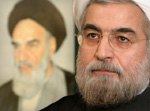
 Bloomberg: There are two main reasons to doubt the possibility of an Iran-U.S. rapprochement, an idea that gained new life after Iran’s charm offensive at the United Nations last week and a phone call between the presidents of the two countries on Sept. 27.
Bloomberg
By Jeffrey Goldberg
There are two main reasons to doubt the possibility of an Iran-U.S. rapprochement, an idea that gained new life after Iran’s charm offensive at the United Nations last week and a phone call between the presidents of the two countries on Sept. 27. The first is general to the Middle East, the second is specific to Iran.
The general reason is easy to understand, and all-encompassing: Nothing at all works in the Middle East, so why should the U.S. find success convincing Iran to give up its nuclear program in exchange for lifting sanctions?
Think about it: Every great, complicated effort meant to bring peace or democracy or tranquility to the Middle East somehow goes off the rails. The Israeli-Palestinian peace process? A 20-year failure. The remaking of Iraq? Also broadly a failure. The effort to bring about an end to the regime of President Bashar al-Assad in Syria? Failure. The entire Arab Spring? At the very least, a promise unfulfilled, and a bitter failure in many countries. The war to defeat Islamist terrorism? So far, a failure, despite intermittent tactical success.
Since nothing works in a zero-sum region where politics is defined by fanatics, I don’t feel particularly optimistic about the current effort. I used to be more of an optimist, by the way, but this is what happens over time. It wouldn’t be surprising, by next spring, if we saw the White House acquiesce to congressional demands for harsher sanctions on the Iranian regime, after several rounds of mostly fruitless negotiations.
The second reason is specific to Iran’s actions last week. Many people are forgetting that Hassan Rouhani, the president of Iran and the commander of Operation Offensive Charm, is a moderate only in comparison to his predecessor, the unhinged Mahmoud Ahmadinejad. Rouhani has been a superior soldier for Iran’s supreme leader, Ayatollah Ali Khamenei, a defender of the regime, and an anti-American propagandist for much of his professional life. (Not often mentioned during last week’s love-in was Rouhani’s post-Sept. 11 commentary, in which he blamed the attacks on the “wrongs and mistakes of American policies,” and argued that the U.S. Air Force shot down Flight 93, which crashed in the Pennsylvania countryside.)
There’s no proof yet that Rouhani’s ultimate goals for Iran are different than those of the hardliners. Let’s look at what he didn’t do at the UN last week: He not only refused to comply with the many Security Council resolutions demanding that Iran cease all uranium-enrichment activities, he also refused to endorse the idea that Iran is obligated to pay any attention to the Security Council’s wishes. (Remember, the many resolutions demanding that Iran cease enrichment passed with the unanimous approval of the five permanent members.)
Until proven otherwise, there’s no reason to think that Rouhani, who is acting on Khamenei’s behalf, is ready to shut down his country’s nuclear program, despite airy statements to the contrary. The Iranian leadership wants to maintain its ability to produce nuclear weapons while at the same time convincing the West to lift sanctions. So far, Rouhani’s difference is one of style, not of substance.
Americans are easily charmed by smiling clerics, and Rouhani understands this. In 2007, he said, “We should talk carefully so as not to provoke the enemy, we should not give them any excuses.”
Who is the enemy? The U.S. is the enemy. According to the Washington Institute for Near East Policy’s Steven Ditto, Rouhani wrote in 2003: “The fundamental principle in Iran’s relations with America — our entire focus — is national strength. Strength in politics, culture, economics, and defense — especially in the field of advanced technology — is the basis for the preservation and overall development of the System, and will force the enemy to surrender.”
Ditto, who has read much of Rouhani’s voluminous output, says the quotation “encapsulates the overwhelming impression gleaned from Rouhani’s history and writings: his identity as a revolutionary ideologue and defender of the Iranian `System.'” Ditto argues that Rouhani is simply a cleverer tactician than some of his colleagues. “What separates Rouhani from traditional ideologues, however — and what fuels perceptions of him as a `reformist’ — is his belief that certain kinds of political and social reform can facilitate the defense, upkeep, and legitimization of the Iranian regime.”
In other words, a pleasant phone call with the president of his chief adversary — and the prospect of extended negotiations — are legitimate if they help advance the goals of the regime.
“In light of this background, there will be no moral, political, or intellectual meeting of minds between Rouhani and the West,” Ditto writes. “In an unusually candid May campaign briefing with Iranian expatriates, he claimed that while he does not wish to see an `increase in tensions’ with the United States, he has no desire to see a `decrease’ in them either: `Today, we cannot say that we want to eliminate the tension between us and the United States… We should be aware that we can have interactions even with the enemy in such a manner that the grade of its enmity would be decreased, and secondly, its enmity would not be effective.'”
President Barack Obama seems somewhat enthusiastic about the possibility of real rapprochement with Iran. But Gary Samore, who was until recently Obama’s chief adviser on Iranian nuclear issues, does not. When I spoke to him this morning, he was acerbic: “The Iranians are going to try to see how far they can get on charm alone.”
That, for now, is the game.
(Jeffrey Goldberg is a Bloomberg View columnist. Follow him on Twitter.)


