Home Blog Page 170

Nikki Haley: The Iranian Regime Can Be Responsible for Any Problem in the Middle East  

In her speech at the National Republican Convention, Nikki Haley stated that the Iranian regime could be held responsible for any problem in the Middle East. The former United States Ambassador to the United Nations said that the dictators who chant “Death to America” in Iran are the financial backers and weapons suppliers of Hamas and Hezbollah.

In another part of her speech, Haley said that during Trump’s time, the Iranian regime was much weaker and incapable of starting any war because they knew Trump was serious and feared him.

Haley also pointed out that lifting sanctions and begging the regime to return to the nuclear deal has resulted in a greater threat from Tehran and its proxy forces in the region.

At the beginning of her speech at the National Republican Convention, Haley declared her support for Trump, saying that Trump invited her to speak at this gathering for unity. She stated, “I strongly support his candidacy.”

In the past few months, Iran’s regime has engaged in a series of provocative actions through its proxies, sending arms and weapons to terrorist groups and trying to take advantage of the ongoing war in Gaza to bolster its hold on power.

From Promising to Kill Trump to Denying It: The Iranian Regime’s Stance  

0

“We are seeking to, God willing, kill Trump and Pompeo.” This statement was made by Amir Ali Hajizadeh, commander of the IRGC Aerospace Force, on a TV program on February 24, 2023. Now, after the assassination attempt on Donald Trump, the Iranian regime has backtracked, claiming it never intended to assassinate him.

Nasser Kanaani, spokesperson for the Iranian Foreign Ministry, said on Wednesday, July 17: “Iran is pursuing legal action against Donald Trump but strongly denies any involvement in the recent armed attack on Trump or claims of intent to do so, considering such claims to have malicious political motives.”

After the killing of Qassem Soleimani, commander of the IRGC Quds Force, in a U.S. operation in Baghdad on January 3, 2020, Iranian regime officials promised “severe revenge.” This phrase has become a key term in subsequent years.

On January 8, 2020, the IRGC targeted a U.S. base in the Ain al-Asad region of Iraq in an operation that resulted in no casualties, later revealed to have been coordinated with the Americans to strike an empty base.

Since then, Iranian regime officials have consistently promised to avenge Soleimani’s death on various occasions.

In December 2020, near the end of Trump’s presidency, Iran’s Supreme Leader Ali Khamenei promised in a speech that “revenge on the orderer and killer of Qassem Soleimani” was certain.

Following these remarks, Khamenei’s Twitter account posted a graphic depicting Trump on a golf course under the shadow of a drone, a veiled reference to his assassination.

This post has now been removed from Khamenei’s Twitter account (now known as X).

Khamenei's Twitter account posted a graphic depicting Trump
Khamenei’s Twitter account posted a graphic depicting Trump

Khamenei’s official website also produced and released an animation showing forces dressed in IRGC uniforms using a robot to assassinate Trump, referencing Khamenei’s promise.

Ismail Qaani, Soleimani’s successor in the IRGC Quds Force, delivered a speech in January 2021 on the anniversary of his death in the Iranian Parliament.

In this speech, he again threatened Trump with assassination, saying: “The American agents involved in the assassination of Martyr Soleimani should learn the secretive lifestyle of Salman Rushdie because the Iranian regime will avenge the unjustly shed blood of Martyr Soleimani.”

Salman Rushdie is a British author whose assassination fatwa was issued by Ruhollah Khomeini, the founder of the Iranian regime, with a bounty placed on his head.

Rushdie was attacked in 2022, losing the sight in one eye and the use of one hand.

Member of Parliament and the Three Million Dollar Bounty  

Ahmad Hamzeh, a member of the 12th Parliament, announced a three million dollar bounty for Trump’s assassination from the parliamentary podium on January 21, 2020. This statement was met with a reaction from Robert Wood, the U.S. disarmament envoy.

Qaani’s Second Threat: Trump is Under the Watchful Eye of the World’s Free People  

On the anniversary of Soleimani’s killing in January 2022, the Quds Force commander again threatened Trump, this time saying: “The enemy thought with the crime they committed and the basest act they performed, it was over, but Trump and others who were with him are all clear to us. From [Mike] Pompeo, whom no one has humiliated as much as Martyr Soleimani, to the President of the United States and all those involved in this crime are under the watchful eye of (not just Muslims, but) the free people of the world.”

Hajizadeh: If We Can, We Want to Kill Trump  

In February 2023, Amir Ali Hajizadeh, commander of the IRGC Aerospace Force, claimed on a TV program: “Killing these people (American soldiers) was not our goal. God willing, we want to kill Trump, Pompeo, [Frank] McKenzie, and the military commanders who issued the order (to kill Qassem Soleimani). But ultimately, they had performed a military action, and we also had to respond militarily.”

UN Special Rapporteur Warns About Threat of Rape and Murder Against Female Iranian Prisoners

The UN Special Rapporteur on Human Rights Defenders called for the immediate release of six women’s human rights activists in Gilan who were recently imprisoned.

Mary Lawlor expressed her concern over the long prison sentences and reports of violent arrests, torture, and threats by Iranian security agents to rape and kill these prisoners during interrogation in a post on Twitter, calling for an end to the repression of women’s human rights activists.

Six civil and women’s rights activists in Gilan province reported to Branch 5 of the Rasht Execution of Sentences office on Saturday, July 13, to begin serving their prison sentences.

Forough Samiinia, Jelve Javaheri, Shiva Shahsiah, Negin Rezaei, Matin Yazdani, and Azadeh Chavoshian were transferred to Lakan Prison in Rasht.

In her latest Instagram post, Forough Samiinia, referring to the start of her and her friends’ prison sentences, stated, “We have not forgotten our dreams and we fight to achieve them.”

The prison sentences for Zohreh and Zahra Dadras, two other prisoners convicted in the case of 11 Gilan activists, were executed on July 10.

In this case, 11 civil and women’s rights activists from Gilan have been sentenced to over 60 years in prison collectively.

These activists have reported being tortured and beaten during their detention.

Zohreh Dadras was sentenced to nine years and six months in prison on charges of “forming a group with the intent to disrupt national security” and “assembly and collusion,” of which six years and one day are enforceable.

Forough Samiinia, Sara Jahani, Yasamin Hashdari, Shiva Shahsiah, Negin Rezaei, Matin Yazdani, Azadeh Chavoshian, and Zahra Dadras were each sentenced to six years, three months, and 17 days in prison on charges of “membership in a group” and “assembly and collusion.”

Two other defendants in this case, Jelve Javaheri and Hooman Taheri, were each sentenced to one year in prison on charges of “propaganda against the regime.”

The issuance of over 60 years of prison sentences for 11 women’s rights defenders and civil activists in Gilan province has faced widespread criticism from hundreds of activists and civil and human rights organizations, including the Iranian Writers Association, the Center for Human Rights Defenders, and the Iranian Teachers’ Trade Association.

U.S. State Department spokesperson Matthew Miller also condemned these sentences as “unjust” and “an attempt to intimidate and silence activists.”

The majority of the U.S. Congress stands with the Iranian Resistance

0

The majority of the U.S. Congress has issued a resolution condemning the Iranian regime, calling for support for Iranian Resistance, and recognizing the right of the Iranian people to choose their own government. This bipartisan resolution, supported by 223 members from both the Democratic and Republican parties, is titled “Condemnation of Iran’s Regime Terrorism, Regional Proxy Wars, and Domestic Suppression.” The resolution, numbered 1148, includes signatures from 11 committee heads and 53 subcommittee leaders in Congress, including the heads of the Intelligence, Budget, and Security Committees.

The resolution asserts that since October 2023, the Iranian regime has increasingly acted as the epicenter of terrorism and regional conflict. It highlights that ignoring Tehran’s direct involvement in various conflicts only encourages Supreme Leader Ali Khamenei and the Revolutionary Guards to escalate these tensions. The survival of the Iranian regime heavily relies on internal suppression and terrorist activities abroad through its proxies.

The U.S. Congress has expressed its support for Maryam Rajavi’s 10-point plan for Iran’s future. The significant protests in 2022, 2019, and 2017 reflect the Iranian people’s rejection of clerical rule and their demand for a republic based on popular vote. The Iranian people have been deprived of their fundamental freedoms and as seen in their slogans, reject both monarchical and religious dictatorships.

The resolution also addresses the repression of religious and ethnic minorities in Iran, emphasizing that the Iranian people’s protests often involve taking control of symbols and power centers of the Revolutionary Guards and the Supreme Leader. The Universal Declaration of Human Rights states that human rights must be protected by the rule of law to prevent people from resorting to rebellion against oppression and tyranny. Similarly, the U.S. Declaration of Independence stresses the right and duty of people to overthrow a tyrannical government and establish new safeguards for their future security.

The Iranian regime is increasingly concerned about the activities of rebellious groups against the Revolutionary Guards and the Basij forces, particularly during the widespread protests in 2022. The regime has also intensified its use of hostage diplomacy as a primary foreign policy tool, using it against Western countries to secure the release of its criminals and terrorists.

In another section of the resolution, the U.S. Congress condemns the release of Asadollah Assadi, an Iranian diplomat implicated in terrorism. It notes that in 2023, the Iranian regime began a sham trial of 104 resistance members, mostly residing in Europe, to fabricate a legal pretext for its terrorist plots against them. The resolution also mentions the 1988 massacre of over 30,000 political prisoners, ordered by Khomeini, targeting those loyal to the People’s Mojahedin Organization of Iran (PMOI) organization, with Ebrahim Raisi being one of the key figures involved.

Among those affected by the 1988 massacre are over 900 residents of the PMOI headquarters in Ashraf 3, Albania. These are former political prisoners who witnessed the Iranian regime’s atrocities firsthand. Many of these individuals are crucial witnesses to Raisi’s crimes and should be fully protected for any potential testimony before international courts investigating these killings. In November 2021, Sweden’s judiciary relocated the Stockholm court to Albania for two weeks to facilitate the testimonies of seven former Iranian political prisoners now residing in Ashraf 3, vital witnesses in trials related to the 1988 massacre.


Power Outages in Iran Reach Pharmaceutical Units

After power outages in some industrial units due to electricity shortages in Iran and unprecedented consumption records in the summer heat, the head of the Tehran Chamber of Commerce has now reported power cuts to pharmaceutical factories.

According to ILNA news agency, Mahmoud Najafi-Arab announced on Sunday, July 14, that the pharmaceutical industry, like other industries in the country, has been affected by electricity imbalances and spends the hot days of the year with power outages.

The head of the Tehran Chamber of Commerce also pointed to the currency supply problems of pharmaceutical companies, stating that these companies are even facing challenges in securing rials and cannot obtain the financial resources needed to provide working capital.

He mentioned that under such conditions, production units in this industry experience power outages for two days a week.

Earlier, the Tehran Electricity Distribution Company had announced that with the unprecedented increase in electricity consumption, on Wednesday, July 10, the power of 65 high-consumption administrative subscribers in Tehran was cut off due to their refusal to reduce electricity consumption.

According to the company’s statement, these offices did not adhere to the government decree requiring at least a 30% reduction in electricity consumption during working hours and 60% during non-working hours, leading to the power cut.

However, with the continued imbalance between electricity production and consumption in Iran and the daily increase in consumption, Mostafa Rajabi Mashhadi, the CEO of Tavanir, the national electricity provider, again reported the possibility of power outages in Tehran.

This comes as some areas in Tehran experienced an unprecedented five-hour power outage on Thursday, July 11.

The increase in temperature and record-breaking electricity consumption have also led to the closure of several provinces.

Media outlets announced, “To prevent widespread blackouts and scheduled power cuts, Thursday has been declared a holiday in 15 provinces to manage the grid by reducing electricity consumption in offices and avoid blackouts.”

At the end of last week, the average temperature in the country increased by about two degrees compared to the same period last year.

According to the Ministry of Energy, the country’s electricity consumption this week increased by about 6,000 megawatts compared to the previous week and was 8% higher than last year’s peak consumption.

On Friday, July 12, Mostafa Rajabi Mashhadi announced that the total consumption was 77,514 megawatts, stating that “this number has not been recorded before, and this year we have exceeded last year’s peak consumption for the fifth time.”

According to the CEO of Tavanir, for every one degree increase in temperature in the country, about 1,800 megawatts is added to the electricity consumption, which is due to air conditioners and cooling devices.

Due to repeated delays in the development of power plants and extensive electricity wastage in the aging grid, Iran faces a deficit of 14,000 megawatts of electricity during the hot seasons, and the electricity deficit increases each year.

The Iranian government had targeted the launch of more than 6,000 megawatts of new power plants last year, but only 2,000 megawatts were realized.

The Minister of Energy had previously announced that the “most important” step for the government to address the electricity deficit is to change office hours and control the electricity consumption of office cooling systems.

Reza Riahi, Vice Chairman of the Board of Directors of power generation companies, stated that if the imbalance in the electricity grid continues in this way, in the next 10 years, 33% of the consumption needs, or in fact, one-third of the country’s electricity needs, will not be met.

Retirees Gathering and Protests in Several Cities in Iran

0

The economic protests in Iran continued on Sunday, July 14, with gatherings of retired steel industry workers in Tehran and Isfahan and retired national and social security workers in several cities.  

According to reports, published on social media on Sunday, protests by retirees took place in at least the cities of Tehran, Isfahan, Kermanshah, and Shush.  

In addition to protesting the lack of attention to their professional demands by the authorities, retired protesters in Tehran also objected to the violation of women’s rights and the pressures to impose mandatory hijab by the regime. They chanted: “Let go of the headscarf, think of us,”  

The protesting retirees also chanted: “Men and women are equal, united and brave,” and “Oppression and cruelty to women are doubled here.”  

In Kermanshah, protesting retirees objected to the arrest and issuance of the death penalty for Sharifeh Mohammadi, a civil activist, chanting: “Sharifeh Mohammadi must be freed.”  

At this gathering, attended by retirees from organizations such as the telecommunications company, the Social Security Organization, and national retirees, other slogans included: “Unity, unity, against poverty and corruption,” “Gathering and protesting is our absolute right,” “Imprisoned teacher must be freed,” and “Imprisoned worker must be freed.”  

Retired steel industry workers in Isfahan also gathered and marched in front of the Steel Retirement Fund.  

In addition, retired protesters in Shush held a protest gathering, chanting: “Promises are enough, our table is empty.”  

The spread of professional protests by various groups, including retirees, workers from different industries, teachers, those who have lost their savings, and nurses and healthcare workers, indicates the increasing economic problems in Iran and the disregard of the Iranian regime’s officials.  

Experts say the living conditions and economic situation will worsen beyond what they are now.  

Additionally, a regime’s economist Hossein Raghfar recently stated that changing the head of government in the Iranian regime is ineffective, saying that there are two governments in the ruling system in Iran: one has “weapons and force” and its actions affect people’s livelihoods, while the other “has no power at all.”

Water Crisis in Iran: 200 Villages in Golestan Province Facing “Water Stress”  

0

Due to the ongoing water shortage crisis in Iran, water has been cut off or become unusable in several cities, and 200 villages in Golestan Province are experiencing water stress.  

Reports indicate that drinking water in the cities of Damavand, Khash, Genaveh, Harris, and Mahshahr has either been cut off or is experiencing a decline in quantity and quality.  

Based on images published on social media, residents in Hersin County, Kermanshah Province, are also deprived of access to potable water.  

Additionally, due to the emergence of water stress in 200 villages in Golestan Province, the drinking water shortage in some rural areas of this province has reached a critical point, and water is being supplied by tankers.  

The state news agency ILNA mentioned that Golestan Province is among the provinces with water stress, adding that 46% of the population in this province lives in rural areas. Ninety percent of the water in Golestan Province is used in agriculture.  

In recent days, some residents of the village of “Esfidan” in the city of Bojnurd, North Khorasan Province, protested the cut-off of drinking water.  

The World Resources Institute, in a report in March 2024, identified Iran as one of the 25 countries facing the most severe water scarcity and water stress, describing it as a consequence of “decades of poor water management and unsustainable water use for agriculture.”  

The continuation of drought and the water crisis in Iran comes as heavy rainfall in some parts of the country has so far caused flooding, resulting in widespread damage and the deaths of dozens of citizens.

Summer, Heat, and Power Outages in Iran; Government Asks People to “Save” Without Explanation  

0

While the Iranian regime has spent a significant portion of the country’s capital over the past 20 years on its nuclear programs under the pretext of “power generation” and the “completion of the Bushehr power plant,” people are facing the recurring problem of widespread power outages as summer temperatures rise in Iran.  

The Bushehr nuclear power plant, which has cost billions of dollars to build and has led to numerous sanctions-related issues for the country, has a capacity of only 1,000 megawatts of electricity, whereas the country’s electricity consumption in recent days has been around 77,000 megawatts.  

Despite the Iranian regime’s propaganda over the past years and the vast amounts of money spent, the Bushehr nuclear power plant is only able to supply one percent of the country’s electricity needs. This amount of electricity could have been supplied at much lower costs through clean energy sources.  

Meanwhile, on Friday, July 12, Mostafa Rajabi Mashhadi, the CEO of Tavanir, the national electricity provider, denied any “planned blackouts,” saying: “We have no plans to publish blackout schedules, and with the cooperation of the people, we will get through this summer without blackouts.”  

However, domestic media have reported widespread power outages in 13 provinces on Thursday and more than five-hour outages in some areas of Tehran on Friday.  

Experts cite the lack of planning and the government’s actions outside economic frameworks in developmental issues as the main reasons for the energy sector’s imbalance, and they believe that with this style of governance, there is no hope for improvement.  

Earlier, the “Donya-e-Eqtesad” newspaper wrote about the reasons behind the current situation: “The discrepancy between income and expenses has led to investors showing little interest in the electricity industry and preferring to invest in other industries. Additionally, the government, which pays heavy subsidies to residential and agricultural consumers, is unable to construct power plants or even pay the claims of power plant owners, contractors, and equipment manufacturers in the electricity industry.”

Iran: 85 Political Prisoners on Hunger Strike in Protest of Sharifeh Mohammadi’s Death Sentence

0

In continuation of the protests against the death sentence issued for labor activist Sharifeh Mohammadi, 85 political prisoners in Evin Prison went on a hunger strike on Thursday, July 11. A number of imprisoned labor activists also described the sentence as “unjust, shocking, insane, and unacceptable” in a statement.

Eighty-five political prisoners held in Evin Prison began their hunger strike at 11 PM on Wednesday, July 10, protesting the “unjust sentence” of Sharifeh Mohammadi and in solidarity with the campaign supporting her.

Thirty of these political prisoners are in the women’s ward, 30 in ward eight, and 25 in ward four of Evin Prison.

These prisoners announced that they would continue their hunger strike until 11 PM on Thursday, July 11.

They had previously called on other prisoners and the general public to join them in this protest movement.

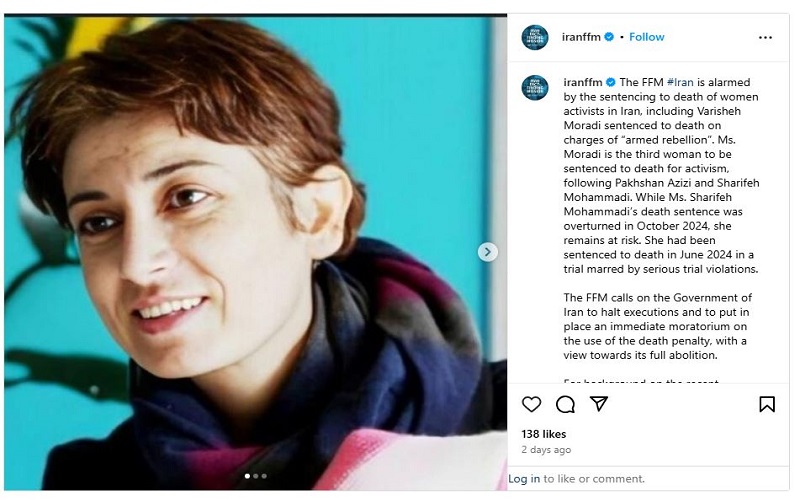
Sharifeh Mohammadi, a labor activist held in Lakan Prison in Rasht, was sentenced to death on charges of “rebellion” by Branch 1 of the Revolutionary Court of this city on July 4.

The judge cited Mohammadi’s opposition to executions under the Iranian regime and a Ministry of Intelligence report about her membership in the “Coordination Committee to Help Form Labor Organizations” as grounds for this accusation.

The issuance of the death sentence for Mohammadi has sparked widespread reactions from labor, civil, and political activists, as well as a number of independent labor unions.

On Tuesday, July 9, social media users expressed their protest against Mohammadi’s sentence using the hashtag #FreeSharifeh, calling for the unconditional release of this labor activist.

Previously, on July 4, sixteen female political prisoners in Evin Prison joined the campaign to defend Sharifeh Mohammadi by publishing a letter and demanding the annulment of her sentence.

They emphasized that Mohammadi, after seven months of temporary detention, enduring torture and interrogation in various detention centers, was sentenced to death “in a threadbare scenario with baseless charges,” and declared that they stand with her and other prisoners whose lives are in danger.

Mohammadi was arrested on December 5, 2023, on charges of “propaganda against the regime” and later faced the charge of rebellion.

More than a month after her arrest, on January 13, 2024, Mohammadi was beaten by Ministry of Intelligence interrogators to extract a forced confession against herself.

Since coming to power, the Iranian regime has consistently arrested, tortured, and imprisoned civil, labor, and political activists critical of the government.

Since the start of nationwide protests against the Iranian regime in September 2022, the repression of civil, labor, and political activists, as well as other protesters by the government, has intensified and continues to this day.

New Zealand Imposes New Sanctions Against Iran’s Regime

0

On Thursday, July 11, New Zealand’s Foreign Minister Winston Peters announced in a statement the imposition of sanctions on individuals and entities associated with the Iranian regime involved in the production and supply of drones for Russia’s use in the Ukraine war.

The statement named three individuals and four entities affiliated with the Iranian regime.

According to New Zealand’s Ministry of Foreign Affairs, Abbas Abdi Asjerd and Seyed Mohsen Vahabzadeh Moghadam, senior officials of several Iranian entities, including Bonyan Danesh Shargh, which is involved in the construction and supply of drones to Russia, have been included in the sanctions list.

The New Zealand Ministry of Foreign Affairs also identified Ehsan Rahat as a senior scientist and former CEO of Chakad Sanat Asmari, a cover company for the Islamic Revolutionary Guard Corps (IRGC) and included him in its sanctions list.

In addition to these three individuals, Alvand Motor Company, Bonyan Danesh Shargh, Pishro Sanat Aseman Sharif, and Saad Sazeh Faraz Sharif (also known as Darya Fanavar Borhan Sharif) have all been sanctioned for their involvement in the construction and distribution of drones.

Ehsan Imani Nejad, CEO of Saad Sazeh Faraz Sharif, had already been sanctioned by the New Zealand government on May 17, 2024.