Home Blog Page 200

Price Surge in Iran’s Automotive Market

0

Simultaneously with the continued turmoil in the currency exchange rate in Iran, the prices of both domestic and foreign cars in the country have risen, with reports indicating an increase in the prices of imported cars to 12 billion rials.

On Thursday, February 1, the regime’s Donya-e-Eghtesad newspaper reported that the upward trend in prices began about a month ago, but in the past 14 days, there has been a significant surge in the automotive market.

The newspaper’s report emphasized that car prices have experienced an average increase of 3.3% in the last two weeks.

Analyses show that the highest price growth is related to used imported cars, with an average growth of 7.1%.

A review of prices indicates that domestic products have, on average, increased by 200 million rials (approximately $345), representing a 3.3% growth, while assembled cars have seen a 290 million rials (approximately $500) increase, equivalent to a 1.87% price growth.

The increase in the price of cars is influenced by the rise in the value of the US dollar, one of the main factors contributing to price fluctuations in the automotive market.

Among other influential factors in the past month are the Competition Council’s withdrawal from car pricing, as well as the government’s decision to determine car prices, taking into account total costs and a 2.5% producer profit from the next year.

Another notable event in the Iranian market is the prices of imported cars. The prices of used imported cars in Iran are several times higher than their global market prices, with the government being the sole beneficiary, allowing the import of used cars and receiving customs duties.

This situation unfolds while a year has passed since the statements and plans of the Ministry of Industry, Mines and Trade for the import of brand-new cars and used car imports, and yet no significant developments have taken place in this area.

A review of news in this sector shows that in the past year, there has been no increase in production performance by domestic car manufacturers, no stabilization or reduction in prices, and the promised imports of cars for market regulation have not materialized.

Low quality, exorbitant prices, lack of warranty and standards, and the pollution of domestically produced vehicles are among the criticisms raised by experts.

Accumulated losses of three Iranian car manufacturers reach 1,740 trillion rials

Reports from Iranian media indicate that the accumulated losses of three major Iranian car manufacturers reached 1,740 trillion rials (approximately $3 billion) by January 2024.

The most indebted among them is Iran Khodro, with its debt reaching 1,040 trillion rials (approximately $1.79 billion)  in January, equivalent to twice its registered capital.

The continued growth of debt for the three Iranian car manufacturers comes as in May 2023, the average price of domestic cars increased by 40%.

The accumulated losses for all three companies exceed their registered capital, placing them on the verge of bankruptcy according to law.

On the other hand, the global automotive market reached nearly $2.9 trillion in the past calendar year and is expected to approach $3.5 trillion by the end of this decade.

In the past year, sales of electric and hybrid cars worldwide experienced a 31% leap, while the Iranian car market still predominantly produces ICE cars.

In 2018, the Iranian regime banned the import of foreign cars, practically monopolizing the entire market in the hands of domestic car manufacturers, subsidiaries of the government.

In the midst of this, car market intermediaries are reaping substantial profits, and the Iranian automotive industry is making no progress.

It is worth mentioning that the main shareholders of Iranian automotive companies are the Islamic Revolutionary Guard Corps (IRGC), and the substantial profits derived from the monopoly of the automotive market in Iran are used to fund terrorism in Middle Eastern countries.

US, UK Impose Sanctions on Criminal Network Linked to Iran’s Regime

0

On Monday, January 29th, the United States and United Kingdom jointly sanctioned 11 individuals for their connections to a criminal network that has been planning assassinations of dissidents abroad at the order of the Iranian Ministry of Intelligence and Security.

Matthew Miller, the spokesperson for the U.S. State Department, said, “

The United States and United Kingdom are taking joint action today to impose sanctions on 11 individuals for their connection to a criminal network that has targeted foreign dissidents and Iranian regime opponents for assassination at the behest of Iran’s Ministry of Intelligence and Security (MOIS). The individuals designated today are believed to be involved in a network that has carried out acts of transnational repression, including numerous assassinations and kidnappings, and has also plotted operations in the United States.”

The U.S. Department of the Treasury is implementing the sanctions on these individuals following the public disclosure of the indictments by the U.S. Department of Justice and the Federal Bureau of Investigation (FBI).

the U.S. Department of the Treasury’s Office of Foreign Assets Control (OFAC) released a statement saying:

“The OFAC and the United Kingdom are taking joint action against a network of individuals that targeted Iranian dissidents and opposition activists for assassination at the direction of the Iranian regime. The network is led by Iranian narcotics trafficker Naji Ibrahim Sharifi-Zindashti (Zindashti) and operates at the behest of Iran’s Ministry of Intelligence and Security (MOIS). Zindashti’s network has carried out numerous acts of transnational repression including assassinations and kidnappings across multiple jurisdictions in an attempt to silence the Iranian regime’s perceived critics. The network has also plotted operations in the United States.”

Brian Nelson, the Deputy Assistant Secretary for Terrorism and Financial Intelligence at the U.S. Department of the Treasury, also stated that the United States, along with its international allies and partners, will continue to use all available tools to hold the Iranian regime accountable for its efforts to expand its repression and ongoing violations of human rights against its own people, as well as its destabilizing actions in the Middle East and beyond.

The Department of Justice, in a statement on Monday, provided further details, stating that an Iranian national and two Canadian nationals have been accused of conspiring to use interstate commerce to lure an individual for the purpose of carrying out a murder.

According to court documents, Naji Sharifi Zindashti, 48, Damion Patrick John Ryan, 43, and Adam Richard Pearson, 29, conspired between December 2020 and March 2021 to plan the killing of two residents of the state of Maryland.

The suspects, one of whom is based in Iran, communicated through the encrypted messaging service Sky ECC. They used this messaging service to discuss the identities and locations of potential victims, plan the logistics and details of the killings, and negotiate the payment amount for carrying out these acts in the state of Maryland.

The targeted victims of this conspiracy, who were living in Maryland at the time, had fled to the United States after one of them left Iran.

Simultaneously with the issuance of the indictment on Monday, January 29, the U.S. Department of the Treasury imposed sanctions on this criminal network led by Zindashti, which targeted opponents and activists opposed to the Iranian government for abduction and assassination purposes at the order of the Iranian regime.

Consequences of the sanctions:
According to the U.S. Department of the Treasury, as a result of this action, all property and interests in property of these individuals that are in the United States or in the possession or control of U.S. persons must be blocked and reported to the OFAC. The sanctions generally prohibit all transactions by U.S. persons or within the United States (including transit transactions through the United States) that involve any property or interests in property of designated or blocked persons.

Furthermore, individuals who engage in certain transactions with the designated individuals today may themselves be subject to the sanctions. Additionally, any foreign financial institution that knowingly facilitates a significant transaction or provides significant financial services for any of the designated individuals may be subject to U.S. sanctions.

What Iran’s Regime is Hiding Behind its Warmongering in the Middle East

0

Iran’s regime has been engaged in a series of conflicts in the Middle East, capturing global attention since October 2023. Initially, questions arose regarding the regime’s role in sparking these conflicts. However, after three months of intense fighting and the evident involvement of Iran’s proxies in the region, it is now widely acknowledged that the regime has inflamed the entire region. But what lies behind Iran’s warmongering? The answer lies in the regime’s desperate attempts to divert attention from its internal problems.

The regime’s Supreme Leader Ali Khamenei, faced with widespread discontent and ongoing uprisings, feared his own overthrow during the 2022 uprising. To safeguard the regime, Tehran’s primary objective in fomenting regional crises is to create a smokescreen that conceals the precarious internal state of the regime and the volatile conditions within Iranian society. This tactic of exporting crises abroad is not a demonstration of strength but rather a means of running away from the regime’s profound domestic vulnerabilities, as the National Council of Resistance of Iran (NCRI) writes in a new analysis report.

Iranian society is a rumbling volcano, characterized by a convergence of socio-economic challenges and escalating political repression. This volatile mix has frequently erupted into significant protests and uprisings nationwide, highlighting the regime’s failure to address the root issues. Insiders within the regime have persistently warned about the inevitable troubles that lie ahead.

One such warning came from Azar Mansouri, the Secretary-General of the Islamic Iran Nation Party, who highlighted the economic hardships faced by different groups within Iranian society. The income for various professions, including workers, teachers, and retirees, falls short of meeting their daily expenses, exacerbating the discontent among the population. Mansouri stated, “If we cannot describe this situation as insecurity, what term would be fitting for this trend of diminishing the resources available to people?”

Hossein Marashi, the Secretary-General of the Kargozaran Party, echoed these concerns, acknowledging that over 75% of the Iranian population expresses dissatisfaction. Marashi warned, “If those dissatisfied take to the streets, no one can put up with them… We have a significant dissatisfied population, a portion of whom actively protest in the streets, and a small fraction might resort to causing disturbances.”

Former intelligence interrogator Abbas Abdi pointed out the negative public sentiment towards the current political and managerial situation in Iran. Abdi cited recent polls suggesting that only 7% of Iranians advocate for the existing state of affairs. He emphasized the urgent need for effective and sustainable resolutions to address the serious disparities within Iranian society, warning of a bleak future if the regime fails to act.

The regime’s own media outlets have also issued stark warnings. The Jomhouri Eslami newspaper cautioned, “Don’t presume the people’s patience is unlimited. Beware of the day when the army of the hungry rises against you.” In a report titled “Heed the footsteps of a crisis larger than 2022,” the state-run Eqtesad24 emphasized that immediate action is required to address inequalities and prevent future unrest.

Despite the calls for change from various factions within Iran, the collective tenure of these officials at the helm of the country’s political and socio-economic affairs has fallen short of meaningful action. Iranians are disillusioned and have moved beyond the regime’s internal factions. Public statements, even those criticizing the regime’s leadership, offer no solace and cannot save the regime from the imminent burst of outrage.

Faced with an unwilling and incapable regime resistant to change, the clerical regime seeks to export its crises by instigating major conflicts in neighboring countries. Unfortunately, due to misunderstandings or the influence of the regime’s deceptive campaigns, the international community has failed to comprehend the true motives behind Iran’s illicit regional activities. The NCRI highlights the need to recognize that Tehran does not require a mere policy change but rather a complete regime change for lasting peace in the Middle East.

Iran-Backed Militias Kill US Forces at Jordan-Syria Border

0

Following the death of three American soldiers and the injury of at least 34 others in a drone attack in the Syria-Jordan border region, several prominent US figures have called for decisive action against Iran.

The US military had announced on Sunday, January 28, an armed drone attack against US forces in the area, and US President Joe Biden attributed it to Iran-backed militias.

In its initial response, Iran’s permanent mission to the United Nations stated that the Islamic Republic has “no connection” to the attacks on US forces and described it as a result of “clashes between the US army and resistance groups in the region.”

Iran’s Foreign Ministry spokesperson, Nasser Kanaani, also stated that Iran is not responsible for the attack on the US base and that “Iran has no involvement in the decisions made by resistance groups to defend Palestine and their own country.”

In response to the killing of three American soldiers in the drone attack in Jordan, Jack Reed, the Democratic chairman of the Senate Armed Services Committee, said in a statement that he is confident that the Biden administration will respond to this attack in a measured and proportionate manner.

Following the drone attack on the US military base on the Jordan-Syria border, The Washington Post reported that the “Islamic Resistance in Iraq,” composed of several Iran-backed militia groups, has claimed responsibility for the attack.

President Joe Biden, in his latest response to the deadly attack by Iran-backed militias that led to the killing of three American soldiers in northeastern Jordan, said, “We shall respond.”

Also Kamala Harris, the US vice president holds the Iranian regime responsible for this attack:

“Today, America’s heart is heavy. Last night, three U.S. service members were killed—and many wounded—during an unmanned aerial drone attack on our forces stationed in northeast Jordan near the Syria border.  While we are still gathering the facts of this attack, we know it was carried out by radical Iran-backed militant groups operating in Syria and Iraq.”

Iran’s regime is backing many terrorist groups in the region. It has been using these proxy groups to attack US forces in the region, especially since the beginning of the war in Gaza in October. Iran-backed forces have carried out more than 150 attacks on targets in the region since the beginning of the war. This is the first such attack that has resulted in American casualties.

Four Iranian Kurdish Political Prisoners Executed in Ghezel Hesar Prison

0

Despite widespread international protests, four Iranian Kurdish political prisoners, Pejman Fatehi, Mohammad Faramarzi, Vafa Azarbar, and Mohsen Mazloum, were executed in Karaj’s Ghezel Hesar Prison.

These four individuals were members of a Kurdish dissident group and were arrested last year in Urmia, accused of spying for Israel, an accusation strongly denied by the four individuals themselves. Their lawyer also protested against the unfair trial process regarding these charges.

Since their arrest in August 2022, these four Iranian citizens have been deprived of meeting their families. The families of these four political prisoners were able to visit them in Evin Prison on January 28, after 19 months of being unaware of their status, and were informed that it would be their last visit.

On Sunday afternoon, these prisoners were transferred from Evin to Karaj’s Ghezel Hesar Prison, where their death sentences were carried out.

Human rights organizations reported on January 16, that the Supreme Court of the country confirmed the death sentences of Mohsen Mazloum, Mohammad (Hazhir) Faramarzi, Vafa Azarbar, and Pejman Fatehi in absolute silence.

On Saturday, January 27, the campaign for the defense of the four political prisoners issued a statement, expressing serious concern about the imminent execution of Pejman Fatehi, Mohammad Faramarzi, Vafa Azarbar, and Mohsen Mazloum, and calling for immediate and effective action by human rights organizations and international forums.

At the same time, Juana Taymasi, the wife of Mohsen Mazloum, wrote in a message on X: “During these 19 months, I have pursued all human rights avenues, international organizations, and even went on hunger strike, but I received no response.”

Earlier, the wife of Mohsen Mazloum had said that the families of the political prisoners should inform Nada Al-Nashif, the Deputy High Commissioner for Human Rights at the United Nations, about the human rights violations in Iran.

Amnesty International and eighteen other human rights organizations and institutions warned in recent weeks about the “imminent” execution of these four prisoners, urging the global community to take immediate action to prevent these executions.

Vedant Patel, the Deputy Spokesperson for the U.S. Department of State, had previously told on Wednesday, January 24, that none of the dimensions of the political system in the Iranian regime are democratic or transparent, including the management, judiciary, and elections. According to him, the world has been aware of this reality for some time.

Protest Gathering of Steel and Oil Industry Workers in Southern Iran

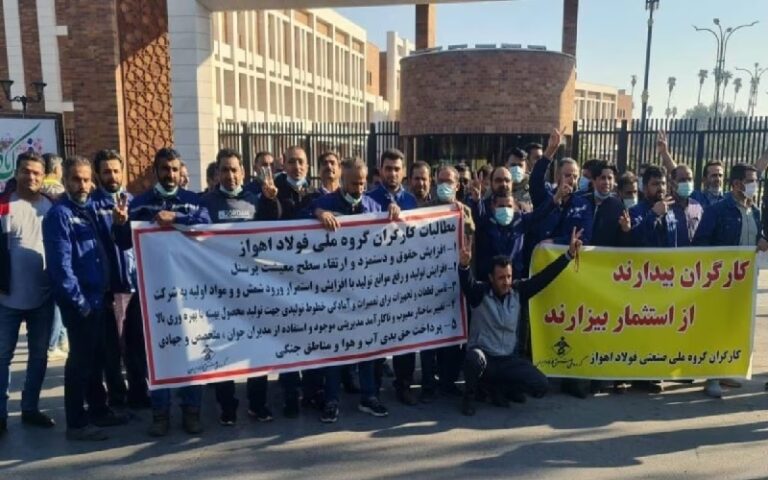
Workers of the National Iranian Steel Group in Ahvaz (Southwest Iran) gathered for the sixth consecutive day of their protests.

The workers of this company marched on the streets of the city on Sunday, January 28, after gathering in front of the Khuzestan Governorate, Ahvaz Governorate, and the central building of the National Bank of the province, chanting slogans.

“We haven’t seen justice; we won’t vote anymore” was one of the slogans chanted by the protesters.

In the past year, the protests and strikes of Ahvaz Steel workers have seen a significant increase.

According to reports, in response to the workers’ protesting the non-implementation of the job classification plan in recent months, the managers of the steel company have suspended dozens of workers in this complex.

The judicial system of the Iranian regime had also announced on September 27, 2023, that it had sentenced 17 protesting workers in this industrial group to flogging and imprisonment or fines.

At the same time, reports have also been published about the protest gathering of unofficial oil workers on Sunday, January 28, in Gachsaran.

The implementation of the employee organization plan, justice in payment of wages and job benefits, and the elimination of contractor workers are among the demands of these workers.

Groups of unofficial workers also gathered on January 27 at the Pars Jonoubi (south Pars) complex in protest against the non-response to their demands for the fourth consecutive week and stopped working.

According to reports, the gatherings of unofficial workers were held at least in five refineries in Asaluyeh, and the protesters demanded the implementation of the job classification plan, job security, and appropriate work schedules.

On January 27, groups of workers from the Iranian offshore Oil Company (IOOC) also held protest gatherings in two operational areas in southern Iran.

The organization of various trade union gatherings in protest against the inappropriate living conditions since the inauguration of the government of Ebrahim Raisi in 2021 has been a growing trend.

Iran’s Regime Launches Satellite Despite Warning from Europe

One day after the three European signatories of the Joint Comprehensive Plan of Action (JCPOA) condemned the launch of the Soraya satellite using the Qaem 100 launcher through a joint statement, Iranian media reported the launch of three new satellites.

According to the regime’s Mehr News Agency, a light satellite from the Iranian Space Research Institute’s satellite series and the CubeSat nanosatellites Kayhan 2 and Hatef 1, developed by the Iranian company SA Iran, were launched into space.

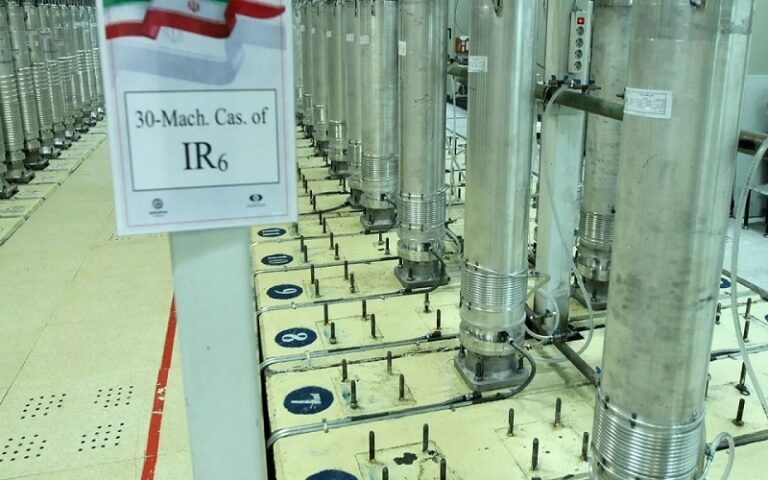
On January 27, Britain, France, and Germany announced that the Qaem 100 launcher uses technology that is vital for the development of Iran’s long-range ballistic missile system, indicating Iran’s disregard for the restrictions imposed by the United Nations.

Britain, Germany, and France stated in their joint statement that they remain committed to taking all diplomatic steps to prevent the development of nuclear weapons by the Iranian regime and to hold Tehran accountable for all destabilizing activities in the region and the world.

The Islamic Revolutionary Guard Corps (IRGC) claimed on Saturday, January 27, that it had successfully placed the Soraya satellite into a 750-kilometer orbit around the Earth. Three European signatories of the JCPOA believe that the actions provide Iran with the ability to test the necessary technology for further development of its ballistic missile program.

Concerns over the regime’s missile program and the potential threat it poses to regional and global countries have prompted the United States to take preemptive measures against these programs.

The Office of Foreign Assets Control (OFAC) of the U.S. Department of the Treasury announced sanctions on 11 individuals, eight entities, and one vessel on Wednesday, January 24, for their involvement in the destabilizing ballistic missile and unmanned aerial vehicle programs of Iran’s regime.

On January 24, the U.S. Department of State stated that the United States has taken multiple actions to address Iran’s nuclear program, missile development and proliferation, terrorism financing, and other concerning and destabilizing behaviors inside and throughout the region and the world.

Although the Iranian regime claims not to have the intention to develop nuclear weapons and describes its nuclear program as peaceful, European Troika members believe that the regime’s ballistic missile program and its missiles capable of carrying nuclear warheads pose a significant threat to regional and global security.

Houthis Continue Attacks on Ships in the Red Sea

0

The United Kingdom Maritime Trade Operations (UKMTO) center announced on Friday, January 26, that it had received a report of two missile explosions in the waters near a ship close to the port of Aden, Yemen.

The center issued an alert stating that the ship and its crew are safe, and no damage has been reported.

According to the alert, the ship is currently moving to the next port, and coalition forces are responding to the incident.

The UKMTO also stated that on Friday, it received a separate report of an incident related to a ship located approximately 60 nautical miles (111 kilometers) from the port of Hodeidah in the Red Sea.

This is an area where Houthi militants have carried out attacks on merchant ships.

The United States Central Command (CENTCOM) also reported on Friday that Houthi militants, with the support of the Iranian regime, launched a missile attack on the destroyer USS Carney.

CENTCOM announced that the American warship successfully intercepted the Houthi missile, and there were no casualties or material damage.

According to CENTCOM, the Houthis fired an anti-ship ballistic missile towards the USS Carney in the Gulf of Aden at around 1:30 PM local time.

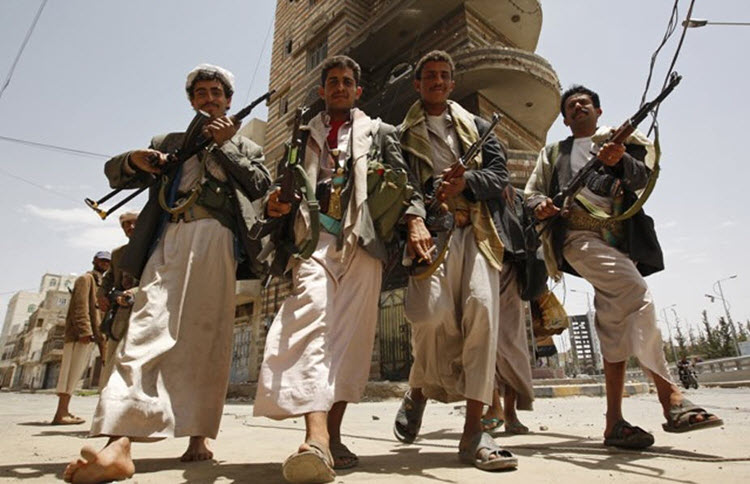
The Houthi rebels, affiliated with the Iranian regime, control approximately one-third of the most populous areas in Yemen.

Since mid-November, they have repeatedly targeted commercial ships with unmanned aerial vehicles and missiles.

Many Western experts believe that the Houthi attacks on ships are carried out at the behest of the Iranian regime and with Tehran’s military and intelligence support. The Houthis claim that these attacks are a response to Israeli military actions in Gaza.

Their attacks have disrupted the global shipping industry and led several major companies to suspend their voyages in the Red Sea, opting for longer and more expensive routes around Africa.

Despite repeated warnings from the United States and multiple airstrikes on their positions by the U.S. and the UK in the past two weeks, the Houthis have not ceased their attacks on commercial ships.

On January 25th, the Office of Foreign Assets Control of the U.S. Department of the Treasury sanctioned four senior officials of the Houthi militia group (officially known as Ansar Allah) for supporting terrorist activities and targeting commercial vessels. Additionally, the UK imposed sanctions on these senior Houthi officials.

On January 17th, Antony Blinken, the U.S. Secretary of State, announced in a statement that the Houthis (officially known as Ansar Allah) would be designated as an international terrorist group on the U.S. list of terrorist organizations within 30 days.

Iran’s Regime Disqualifies Key Figures in Upcoming Elections

0

The official website of former Iranian regime president Hassan Rouhani has announced that the Guardian Council has rejected his candidacy for the upcoming elections of the Assembly of Experts, scheduled for March 1.

The website stated on wednesday, January 24, that the disqualification of the former President of Iran will also be officially announced through the Ministry of Interior.

Unofficial reports of his disqualification were circulated in domestic news agencies in Iran in recent days.

Hassan Rouhani, who is currently a member of the Assembly of Experts, has registered for candidacy in the upcoming elections for the Assembly.

A day before the announcement of Rouhani’s disqualification on his website, Nasrollah Pejmanfar, the head of the Article 90 Commission of the Parliament, had said that “in the previous government, Rouhani and his administration’s efforts were focused on resolving the country’s issues and problems through communication with the United States.” He also threatened to “publicize his dark dossier.”

Rouhani, who served as the President of Iran’s regime from 2013 to 2021 and whose previous government held the parliamentary elections under the supervision of the Ministry of Interior, has previously stated that after the November 2019 protests, the regime has crossed a line and that it is no longer important for high officials if participation in elections is low.

Throughout his more than 40 years in the government hierarchy, Rouhani has consistently held the highest positions in the regime. His resume includes five terms of presence in the Majlis (parliament), three terms (24 years) of membership in the Assembly of Experts, 16 years as the Secretary of the Supreme National Security Council, and two terms (eight years) as President.

The Guardian Council also disqualified the candidacy of Mostafa Pourmohammadi, a former security and judicial figure of the regime and former Minister of Justice, from participating in the elections for the Assembly of Experts.

The news of the disqualification of this regime official was published on January 24, hours after the news of Hassan Rouhani’s disqualification, the former President of Iran.

Mostafa Pourmohammadi was a member of the “Death Committee.” He was also the head of the Center for the Documentation of the Islamic Revolution, and a former Minister of interior. This is the second time he is being disqualified for candidacy in an election.

In the summer of 1988, following a fatwa issued by Rouhollah Khomeini, the founder of the Islamic Republic, a four-member committee known as the “Death Committee” was tasked with reviewing the cases of thousands of political and ideological prisoners who were serving their sentences in prisons.

Pourmohammadi, along with the current regime’s President, Ebrahim Raisi, was a member of this committee. In 1988, they confirmed the death sentences of 30,000 political prisoners and handed them over to execution squads.

In 2019, in a video interview with the weekly magazine Mosaalas, he stated that he should not be held accountable for those executions and should not provide a legal answer. Instead, he said, “the Mojahedin (PMOI/MEK) should tried, and each of them should be dealt with individually.”

Most of the victims of the 1988 executions were members of the PMOI.

Iranian Prisoners on Hunger Strike in Protest to Political Executions

0

Following the execution of Mohammad Ghobadlou and Farhad Salimi, two political prisoners, 61 political and ideological prisoners in the women’s ward of Evin Prison announced on Tuesday, January 21 that “the news of the execution of Iranian youth has sparked a wave of anger and protest in society. Political and ideological female prisoners at Evin Prison will go on a general hunger strike on Thursday, January 25, in protest of the recent executions and to demand the ‘halt of executions.'”

The execution of two political prisoners on the morning of Tuesday, January 23, has sparked anger and protest on social media, with observers considering these executions as the Iranian regime’s “vengeance” against the people of Iran following the “killing of its terrorists” in the region.

Following this hunger strike, a large number of political and civil activists inside and outside Iran declared their support and solidarity with this strike.

On Wednesday, January 24, the Kurdistan Human Rights Network, quoting “one of her close associates,” wrote that political prisoner Zeynab Jalalian, who is serving a life sentence in Yazd Prison, will go on a hunger strike on Thursday in protest of the executions and to demand the “halt of executions.”

According to this close associate of Zeynab Jalalian, despite her “isolated conditions” in Yazd Prison and severe restrictions on her phone calls, she said that on Wednesday, after learning about the execution of political and ideological prisoners in the past few months and in support of the public’s demand to abolish death sentences in Iran, she will also go on a hunger strike along with 61 female political and ideological prisoners in Yazd Prison.

At the same time, more than 110 retired teachers, cultural figures, and labor and civil activists have announced in a statement their support for the protests against the implementation of death sentences in Iran and declared that they will go on a hunger strike on Friday, January 26.

The statement reads: “We, a group of activist educators and labor activists, in protest against the wrong policies of the ruling authorities and extensive injustices, and in solidarity with imprisoned women, civil activists, and political activists who went on a hunger strike on Thursday, January 25, will go on a hunger strike on Friday.”

The signatories of the statement also demanded the “unconditional abolition of death sentences” and referred to it as “one of the fundamental demands in seeking justice and freedom.”

Amirhossein Moradi and Ali Younesi, elite students of Sharif Industrial University who have spent the past four years in prison on false charges, announced that they have joined the hunger strike along with 61 female political and ideological prisoners in the women’s ward of Evin Prison to demand the cessation of executions.

These two elite students were arrested on April 10, 2020, and after enduring severe torture and prolonged detention, they were each sentenced to 16 years in prison by the Islamic Revolutionary Court.