Home Blog Page 25

Iran’s ‘No To Executions Tuesdays’ Campaign Declares Solidarity with Student Protests in 109th Week

0

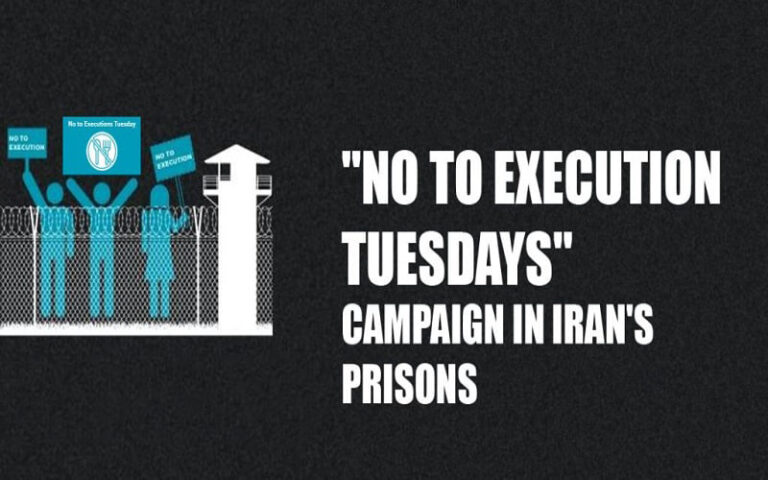
On Tuesday, February 24, 2026, the “No to Executions Tuesdays” campaign entered its 109th week and continued in 56 prisons across Iran.

On this occasion, the “No to Executions Tuesdays” campaign issued a statement. Part of the statement reads:

“We, the members of the ‘No to Executions Tuesdays’ campaign, stand in solidarity with the people of Iran and the families of those killed. We salute the students from Sharif University of Technology, the University of Tehran, Amirkabir University of Technology, the University of Art, Melli University (Beheshti University), and the University of Mashhad (Ferdowsi University). They are courageously standing against the repressors in the universities. We call on the general public to continue supporting and standing with the protesting and revolutionary students to preserve the university as a bastion of resistance against any form of dictatorship and fundamentalism, and we warn against the repression of students.”

Iran: 1,100 Executions Over Three Months; An Ongoing Massacre

The full text of the statement by the “No to Executions Tuesdays” campaign

Continuation of the “No to Executions Tuesdays” campaign in its 109th week in 56 different prisons

The fortieth-day memorial ceremonies for those killed in the January 2026 uprising, held in various parts of the country, became a symbol of the continuation of the uprising and public solidarity. These gatherings, accompanied by anti-regime slogans and the rejection of dictatorship, demonstrated that the memory and names of the victims of repression have become an inspiring force for achieving the overthrow of the regime and the establishment of justice, freedom, and equality.

“We, the members of the ‘No to Executions Tuesdays’ campaign, stand in solidarity with the people of Iran and the families of those killed. We salute the students from Sharif University of Technology, the University of Tehran, Amirkabir University of Technology, the University of Art, Melli University (Beheshti University), and the University of Mashhad (Ferdowsi University). They are courageously standing against the repressors in the universities. We call on the general public to continue supporting and standing with the protesting and revolutionary students to preserve the university as a bastion of resistance against any form of dictatorship and fundamentalism, and we warn against the repression of students.”

In recent days, the executioner regime has held hasty trials and fabricated cases against detainees of the recent movement. While they have been deprived of the right to choose their own lawyers and to defend themselves, and are subjected to torture beyond human tolerance, some of them face death sentences on the baseless charge of “enmity against God.” Among them are 19-year-old Mohammadamin Biglari, sentenced to death by Judge Abolghasem Salavati in Branch 15 of the regime’s Revolutionary Court in Tehran, and 55-year-old Mohammad Abbasi, who was also sentenced to death by the same branch. In addition, Abdollah Parki, who had been arrested a few days earlier by the Intelligence Office in Mehrestan County in Sistan and Baluchestan province, died suspiciously in detention.

As part of these ongoing repressions, the death sentence of Mehrab Abdollahzadeh, one of those arrested during the 2022 nationwide uprising, has been upheld in Urmia Prison, and his life is in danger.

The despotic mullahs’ regime executed more than 350 people between January 21 and February 20, marking a fivefold increase compared to the same period last year. In the early days of month of Esfand (from February 21 until now), 33 prisoners have been executed.

The “No to Executions Tuesdays” campaign calls on the international community, human rights organizations, and awakened human consciences to be the voice of prisoners and the people of Iran and not allow the lives of the children of this land to be taken by criminal oppressors. We urge all families of detainees to widely spread information about the condition of their imprisoned children. Raise your voices; this is the only way to confront the pressures of this dictatorial regime.

Political prisoners who are members of the “No to Executions Tuesdays” campaign are on hunger strike on Tuesday, February 24, in the 109th week of the campaign, across 56 prisons in the country.

Victory Of Public Unity in Abdanan; Release of Detained Teacher After Widespread Protests

This year in Abdanan, a city in Ilam province in western Iran, before the school bells rang, the “first lesson” was taught—not from repetitive textbook pages, but from the streets, backed by unity, honor, strength, and collective perseverance.

On Saturday, February 21, one of Abdanan’s well-known teachers was arrested without a judicial warrant and transferred to an undisclosed location. The news spread through the city like a spark and quickly turned into a wave of reaction. At first, citizens peacefully gathered in front of the regime’s governmental and security institutions, demanding his release, but security agents of Iran’s regime detained him.

The atmosphere in the city was tense but not fragmented; people were united and determined, and they did not back down in the face of promises and threats from the Islamic Revolutionary Guard Corps (IRGC).

Australia Sanctions 20 Iranian Officials, Three IRGC Entities Over Protests Crackdown

During the protest gathering, people stood up against the heavy security presence and, chanting “Death to Khamenei” and “Death to the dictator,” expressed their anger over repression and arrests.

One day later, on February 22, news broke that the teacher who had been arrested and abducted had been released. Within hours, the streets of Abdanan became the scene of a public celebrations, as people gathered to say that this victory was the result of unity, perseverance, and collective resistance.

According to local sources, as he retreated from his earlier claims, the criminal prosecutor had initially set “no public welcome” for the imprisoned teacher as a condition for his release. However, the people of Abdanan rejected this condition and, through their strong presence, demonstrated that a teacher’s freedom is the natural right of society, not a negotiable concession.

What happened in Abdanan was not merely the arrest and release of one individual; it was a display of society’s power and the fruit of resistance, unity, and genuine social bonds. A city that achieved victory through solidarity showed that the true capital of any society lies in its connections and its perseverance against all forms of despotism, manipulation, and dictatorship.

Third Day of Student Protests in Iran

On Monday, February 23, on the third day of student protests, several universities across the country witnessed protest gatherings and memorial ceremonies. Reports indicate simultaneous demonstrations at Alzahra University, the University of Tehran, and Sharif University of Technology, along with an intensified security presence at some educational institutions.

The start of the gathering at Alzahra University

Students at Alzahra University, a women’s university in Tehran, began their protest gathering at 11 a.m. in front of the Faculty of Art, in accordance with a prior call. Participants chanted slogans including “Do not be afraid, do not be afraid, we are all together” and “We did not give our lives to compromise, nor to praise the murderous leader.”

UN Experts Warn About Fate of Disappeared Protesters in Iran

According to published reports, protests at the university continued throughout the day, with students chanting slogans such as “Freedom, freedom, freedom,” “We did not give our lives to compromise, nor to praise the murderous leader,” and “This year is the year of blood, Seyed Ali will be overthrown,” referring to regime supreme leader Ali Khamenei.

Memorial ceremony at the University of Tehran

At the same time, students at the University of Tehran, one of the country’s most prominent universities, held a memorial ceremony at 11 a.m. for “martyr” Raha Bahloulipour, a student of Italian literature at the university. During the ceremony, slogans such as “Woman, Life, Freedom,” “Until the mullah is shrouded, this homeland will not become a homeland,” “Death to the dictator,” “For every person killed, a thousand stand behind them,” “This fallen flower has become a gift to the homeland,” and “All these years of crime, death to this ولایت” were chanted.

Additionally, at the Faculty of Theology of the University of Tehran, a ceremony was held to honor martyr Mohammadreza Moradali, a master’s student at the faculty. According to reports, a group of Basij forces—the paramilitary organization affiliated with the Islamic Revolutionary Guard Corps (IRGC)—attempted to appropriate the ceremony in their favor and portray him as a supporter of the regime. However, students prevented this move by chanting slogans such as “This fallen flower has become a gift to the homeland,” “Woman, Life, Freedom,” and “We swear by the blood of our comrades, we will stand until the end.”

Gathering at Sharif University of Technology

At Sharif University of Technology, one of Iran’s leading engineering institutions, students also gathered on Monday, February 23, in memory of the martyrs and in protest against the regime. According to reports, students chanted the slogan “This year is the year of blood, Seyed Ali [Khamenei] will be overthrown.”

Entry bans and a security atmosphere

Alongside these gatherings, reports have emerged of increased restrictions at the University of Tehran. According to a student-run channel, following the previous day’s protest, a number of students were unlawfully barred from entering the university. It is said that security personnel, holding a list of names, prevented certain students from entering—an action that student activists say contradicts the university’s disciplinary regulations.

There are no precise figures available regarding the number of students banned from entry. The University of Tehran’s Student Council has issued a statement asking students who have faced such restrictions to report their cases.

At the same time, multiple reports indicate the presence of security forces around the Faculty of Foreign Languages and the male dormitory complex of the University of Tehran. According to student sources, a large number of students gathered to attend the fortieth-day memorial ceremony for uprising martyr Raha Bahloulipour, and the atmosphere on campus has been described as heavily securitized.

The third day of student protests comes as demonstrations have spread to several universities, accompanied by reports of disciplinary and security pressures.

Detained Protesters in Iran Facing Serious Security Charges, Risk of Execution

Following the bloody crackdown on the January protests, detainees are now facing severe security-related charges and the danger of being sentenced to death. Mahmood Amiry-Moghaddam, director of Iran Human Rights, an Oslo-based human rights organization, emphasized in an interview with Deutsche Welle, the German international broadcaster, the necessity of raising awareness.

The publication of alarming reports about the attribution of security charges to detained protesters and the holding of rushed trials—without due process and without access to independent legal counsel—has raised serious concerns about the fate of those detained.

Fortieth-Day Memorials in Iran Turned into Nationwide Protests

Amnesty International announced in a statement on Friday, February 20, 2026, that at least 30 people in Iran are facing the death penalty in connection with the January 2026 protests. According to the human rights organization, eight of these individuals have been sentenced to death within just a few weeks of their arrest.

Since the nationwide protests of 2022, Iran’s regime has sought to instill an atmosphere of fear and intimidation in society against any political dissent by bringing heavy security charges and swiftly carrying out certain sentences.

The importance of raising awareness to save the lives of detainees.

The number of detainees is very high, and many of them are being held in unofficial detention centers, placing their lives at risk.

At a time when Iran’s regime, fearing the further spread of protests, has carried out a violent and unprecedented crackdown followed by the arrest of thousands, raising awareness can help break the atmosphere of silence and lack of information favored by the authorities.

Otherwise, ambiguity and lack of information will become tools in the hands of Iran’s regime to further violate the rights of detainees and intensify the repression of opponents, without incurring any immediate cost in public opinion.

Silence and the disruption of information flow increase the likelihood of arbitrary treatment so that, in the view of judicial authorities of the Iranian regime, detainees can be turned into a “lesson” for society.

For this reason, many human rights activists believe that continuous reporting and naming detainees and those killed is a way to neutralize this tool; an action that can keep the issue of Iran at the center of public attention and pave the way for holding accountable those who ordered and carried out the bloody repression of the people.

NCRI reports on the reconstruction of the Iranian regime’s nuclear facilities

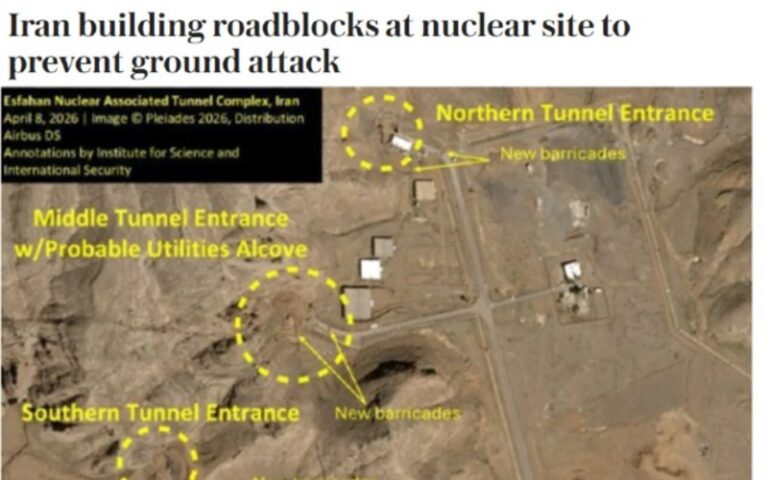
Fox News reported on the reconstruction of Iran’s nuclear program, stating that Alireza Jafarzadeh, deputy director of the Washington office of the National Council of Resistance of Iran (NCRI), citing newly released satellite images, said that the Iranian regime is rebuilding and reinforcing its damaged nuclear facilities — including the Natanz and Isfahan sites and other enrichment centers — and that this reconstruction indicates efforts to restore and increase uranium enrichment capacity. He also stated that these actions are taking place while the Iranian regime continues to participate in nuclear negotiations with the United States and has spoken of the possibility of readiness for war.

Iranian Regime Official Rejects Zero Nuclear Enrichment

Independent analysis of the satellite images also points to activities at Iran’s nuclear and military sites that have been interpreted as reinforcing infrastructure and concealing key facilities — including through concrete coverings and burying tunnel entrances — at a time when tensions with Washington and Israel have increased. Experts believe such measures may be part of efforts to harden the facilities against potential attacks.

Other reports state that new satellite images show Iran has installed roofs over damaged buildings at the Isfahan and Natanz sites, making it more difficult for satellites to observe details inside these structures — an action considered the first visible sign of activity at these centers since previous attacks.

At the same time, both American sources and independent analysts note that Iran’s nuclear activity has not yet returned to the level of fully resuming enrichment at the scale seen before the attacks, and that some of the reconstruction appears to be limited to protective measures and initial repairs rather than a full restoration of nuclear capability.

These reports are being published as nuclear negotiations between Tehran and Washington continue in Geneva and the likelihood of confrontation between the two countries has increased.

Iranian Regime Admits to Abandoned Bodies Left in Alley Behind Tehran Hospital

The Iranian regime’s Ministry of Health has acknowledged the abandoned bodies of victims left in the alley behind Alghadir Hospital in Tehran.

Hossein Kermanpour, head of the Public Relations and Information Center of the Iranian regime’s Ministry of Health, confirmed in an interview with the state-run Shargh newspaper the authenticity of painful and shocking images that were circulated on social media last week from the alley behind Alghadir Hospital in Tehran. The photos showed the bodies of several deceased individuals wrapped in blankets and left in an alley between two buildings.

Aida Aghili

One of the bodies belonged to the late Aida Aghili, a 34-year-old woman whose sister identified her face in the images and announced it on her Instagram page.

When Iranian regime repressive forces shot Aida in the head, the internet had been shut down. When she did not return home, her family searched everywhere and eventually reached the halls filled with bodies in Kahrizak. The halls whose released videos do not show any women.

Chants of ‘Death to Khamenei’ and ‘Death to the dictator’ in Iran’s universities

In one of her notes, Aida had written: “Happy birthday to me. To myself, who is still alive despite all the wounds, who still believes that freedom will come and still knows how to love, even when the world does not fight me. In hope of the freedom of my Iran”

Kermanpour said that on the night of January 8, Alghadir Hospital, which has limited capacity, suddenly faced a massive influx: about 150 injured individuals were taken to the hospital, and the bodies of 36 deceased were transferred there. However, the hospital’s morgue had the capacity to hold only five bodies.

Rainfall in Iran Has Been Higher Than Last Year, But 64% of Dam Reservoirs Are Still Empty

0

The latest statistics on the condition of Iran’s dams show that the volume of water entering reservoirs during the current water year has declined, and a significant portion of the country’s dam capacity remains empty.

On Friday, February 6, the state-run ILNA news agency, reported in a statistical analysis that although rainfall has increased compared to last year, it remains below the long-term average and has failed to compensate for the water resource deficit.

According to the report, as of February 1, 64% of dam reservoirs were empty. In one example, the Amir Kabir Dam (also known as Karaj Dam, located in Alborz Province), with only 1% capacity filled, shows an 81% decrease compared to the same period last year.

The Karaj Dam’s Reservoir Can Only Supply Tehran’s Drinking Water for Two Weeks

From the beginning of the 2025–2026 water year until February 1, the total water inflow into the country’s dam reservoirs reached 7 billion and 340 million cubic meters. This figure shows a 4% decrease compared to 7 billion and 640 million cubic meters during the same period last year.

During the same period, the total water stored in the country’s dams was reported at 18 billion and 770 million cubic meters, which is 16% less than last year. According to these figures, 64% of the country’s dam reservoir capacity is empty, meaning that about two-thirds of Iran’s water storage capacity remains unused, and the unfavorable trend in reservoir levels continues.

Status of dams in Tehran and Alborz Provinces

An examination of the dams supplying drinking water and agricultural needs in Tehran and Alborz Provinces also indicates the continuation of critical conditions.

As of February 1, the Amir Kabir (Karaj) Dam held only 6 million cubic meters of water and, at 1% capacity, shows an 81% decrease compared to the same period last year.

The Lar Dam, with 10 million cubic meters of water and 1% capacity, holds 26% less water than last year.

The Latyan–Mamalou dam complex contains 23 million cubic meters of water and, at 8% capacity, has experienced a 49% decrease compared to last year.

The Taleqan Dam, with 88 million cubic meters of storage and 21% capacity, has seen about a 59% decrease compared to the same period in the 2024–2025 water year.

Rainfall situation

The report indicates that rainfall statistics also present a far from encouraging picture.

Since September 23, 2025, the nationwide average precipitation has been recorded at about 108 millimeters. The long-term average for the same period is about 111 millimeters, while during the same period last year it was about 57 millimeters.

Although rainfall has increased compared to last year, it is still below the long-term average and has not compensated for the water resource deficit.

Tehran Province has been identified as the driest province in the country. Since the beginning of the water year, about 40 millimeters of rainfall have been recorded in Tehran, which is 65% below the long-term average.

According to the report, overall only about one-third of the country’s water needs have been met so far, and recent rainfall has not had a significant impact on alleviating the drought and water shortage crisis.

Experts say this situation could intensify challenges in supplying drinking water and agricultural needs in the coming months, at a time when public dissatisfaction over government and regime inefficiency has reached unprecedented levels, and Iran’s regime is still grappling with the consequences of the bloody crackdown on January protests.

Masoud Pezeshkian, president of Iran’s regime, said on December 23, 2025, in the regime’s parliament that the water problem in Iran is so critical that “Today, provinces are practically involved in disputes and conflicts; like the disagreements between Isfahan, Chaharmahal and Bakhtiari, Kohgiluyeh and Boyer-Ahmad, Khuzestan, and Yazd over water.”

He also acknowledged that “All the laws written since the beginning of the 1979 revolution to control and improve optimal water consumption have, according to statistics, made our water situation worse.”

Iran has faced severe drought for years. In addition, water waste, excessive extraction from underground aquifers, structural weaknesses including inefficient or overly interventionist water management, and the expansion of agriculture have all intensified the crisis in the country.

Paris Conference Ahead of International Women’s Day Highlights Women’s Leadership in Iran’s Democratic Alternative

On February 21, 2026, just weeks before International Women’s Day, a conference in Paris gathered Iranian opposition figures and former ministers, parliamentarians, and international officials around a single proposition: that women’s leadership is not an adjunct to political change in Iran, but its precondition.

Hosted by Maryam Rajavi, President-elect of the National Council of Resistance of Iran (NCRI), the event brought together speakers from Europe and North America who returned repeatedly to three elements: the centrality of women in Iran’s protest movement, the NCRI’s Ten-Point Plan as a governing framework, and the role of organized Resistance Units inside the country. The rejection of both clerical rule and a return to monarchy formed a steady refrain.

Framing the Uprising

Opening the conference, Sarvnaz Chitsaz, chair of the NCRI’s Women’s Committee, tied International Women’s Day to what she described as the bloodshed of the January uprising. She said the NCRI had identified 2,411 dead, including women and children, and stressed that regime authorities are obscuring the scale of the crackdown through internet blackouts.

Quoting a slogan heard in protests — “Death to the oppressor, whether Shah or Supreme Leader” — Chitsaz presented the uprising as a verdict not only on the current establishment but on dictatorship in all forms. Iran’s future, she argued, “does not lie in a return to a monarchy,” but in “freedom, equality, and a republic based on the will of the people.” She pointed to the Ten-Point Plan advanced by Rajavi as a practical political roadmap.

“No to Compulsion”

In her keynote address, Rajavi defined women’s leadership as the “litmus test” separating democratic change from recycled authoritarianism. “No to compulsory hijab, no to compulsory religion, and no to compulsory governance,” she said, summing up the movement’s rejection of state-imposed conformity in both public and private life.

Rajavi described the NCRI as an organization with a women-majority structure and decades of women in command roles. The alternative she outlined included free elections, separation of religion and state, gender equality, abolition of the death penalty, and a non-nuclear republic. On the question of monarchy, she was explicit: Iranians want “neither the crown nor the turban.”

Her remarks set the tone for a conference in which international speakers frequently tied their endorsement of democratic change to the prominence of women in the organized opposition.

International Endorsements

Former French minister Michèle Alliot-Marie linked democracy directly to women’s participation in power. “There is no democracy without the presence of women in all decision-making bodies,” she said, describing the freedoms outlined in Rajavi’s plan as the substance of a democratic Iran that European supporters should defend.

Former U.S. Ambassador to Denmark Carla Sands challenged what she described as nostalgia for the Shah’s era, arguing, “A dictatorship, by definition, cannot offer gender equality.” She framed the Ten-Point Plan as the route to a secular democratic republic “whether crowned or turbaned.”

Former Prime Minister of Finland Anneli Jäätteenmäki focused on sustained repression and international responsibility. She warned of rising executions reported by rights groups and cited European measures targeting the IRGC as evidence of a firmer approach, urging continued support for “Iran’s civil society, independent media, and human rights and women’s rights.”

Colombian former senator Ingrid Betancourt framed women’s rights as inseparable from democratic legitimacy. “Lineage is not legitimacy,” she said, arguing that equality postponed until after political change would remain fragile. She contrasted that with what she described as the NCRI’s internal structure, built around women’s leadership.

Across interventions from lawmakers in Spain, Italy, Canada, Ireland, Malta, the Netherlands, and Portugal, a similar pattern emerged. Speakers described women as “organizers, leaders, and the political engine of the mobilization,” emphasized that democratic change requires institutional preparation, and endorsed Rajavi’s Ten-Point Plan as a structured alternative.

Organization and Preparedness

References to “Resistance Units” inside Iran surfaced repeatedly. Canadian MP Judy Sgro described the prominence of women and youth in recent protests as the result of decades of organizing rather than a sudden development, calling the Ten-Point Plan “a constitution ready to go.”

Former White House official Linda Chavez said the current moment had shifted from whether change would come to “when and how.” She described the NCRI as an organized political movement rather than a single personality and defended the Ten-Point Plan as a practical program.

Italian MP Naike Gruppioni recounted a visit to Ashraf 3, describing it as “not a theoretical abstraction, but a concrete organization,” marked by discipline and long-term planning. Former Portuguese defense minister Helena Carreiras drew a parallel with her country’s post-authoritarian transition, saying “democracy does not rhyme with dynasty” and insisting that legitimacy must rest on democratic choice.

Legal and Multilateral Dimensions

The conference also incorporated a legal framework. Karen Smith, former UN Assistant Secretary-General and Special Adviser on the Responsibility to Protect, warned that the recent crackdown fits a decades-long pattern of systematic state violence. Citing a U.N. fact-finding mission, she said women activists have been specifically targeted and that investigations into possible crimes against humanity should remain on the international agenda.

Spanish senators detailed a unanimous resolution condemning executions, torture, arbitrary detention, and repression of women and minorities in Iran, endorsing Rajavi’s Ten-Point Plan and supporting stronger measures against the IRGC. They framed the cross-party backing as evidence that support for women’s rights and democratic standards transcends political divisions.

Dominique Attias, former president of the European Bars Federation, described Iranian women as “not spectators of history” but its actors, linking the slogan “Woman, Life, Freedom” to what she characterized as a long-standing and organized resistance.

Personal Accounts

Personal testimony punctuated the proceedings. Historian Azadeh Akhbari described being imprisoned as a child after the 1979 revolution and losing relatives executed for ties to the opposition. She referred to her family’s experience as spanning “a century of oppression, first by monarchy and then by the religious dictatorship.”

Vida Niktalean of the Women’s Association for Democracy in Iran traced her activism in exile to arrests and executions among classmates and relatives, crediting Rajavi with building a generation of women trained to lead collectively.

Zinat Mirhashemi invoked images of families singing and dancing in mourning as acts of defiance, arguing that discrimination against women has been a central pillar of the ruling system and that its erosion signals structural change.

A Consistent Message

Across ideological and national lines, the rejection of both clerical rule and monarchical restoration surfaced repeatedly in the phrase: “No to the Shah, no to the Mullahs.” The Ten-Point Plan functioned as the conference’s connective framework, described as a “democratic roadmap” and a “practical political program.”

By the conference’s close, the tone was declarative. Speakers spoke of timing and transition rather than possibility. They invoked parliamentary resolutions, international investigations, organized networks inside Iran, and a leadership structure centered on women.

As International Women’s Day approaches, the Paris gathering presented a coordinated message: that in the view of the Iranian Resistance and its international supporters, the credibility of any democratic future for Iran will be measured by whether women stand at the center of political power — and whether a secular republic replaces both “the crown” and “the turban.”

UN Experts Warn About Fate of Disappeared Protesters in Iran

0

A group of United Nations human rights experts, in an official statement, called on officials of Iran’s regime to transparently disclose the fate and whereabouts of detainees and those who have disappeared during nationwide protests, and to immediately halt the implementation of all death sentences related to the demonstrations.

The statement, published on Thursday, February 20, 2026, warns about the situation of thousands of detained protesters and the widespread concerns of their families. According to the experts, Iranian authorities have so far confirmed 3,117 deaths and around 3,000 arrests, but human rights organizations estimate the real number of those killed and detained to be in the tens of thousands. Among the detainees are children, civil activists, journalists, lawyers, doctors, artists, and even Afghan nationals.

Amnesty International warns of execution risk for 30 protesters in Iran

The experts emphasized that many families are deprived of any regular contact with their loved ones and remain in complete uncertainty. They warned that the government’s refusal to provide information about the whereabouts of detainees intensifies the climate of ambiguity and mistrust and will reinforce “the worst-case scenarios.” The statement reads: People of Iran have the right to know what is happening in their country.

People of Iran have the right to know what is happening in their country

These warnings come as widespread internet restrictions have entered their sixth week. According to reports, full internet access is available only to government-approved users, while a large portion of citizens face severe limitations or must rely on expensive VPN services. At the same time, reports have emerged of street inspections during which security forces check citizens’ mobile phones for protest-related content, including images, videos, and social media activity.

Ms. Mai Sato and human rights rapporteurs described the situation in Iran as painful

The experts also expressed concern over the broadcast of what they described as forced confessions on state media and stressed that labeling protesters as terrorists while they are exercising their fundamental rights constitutes a clear violation of human rights principles.

The statement emphasizes that the prohibition of enforced disappearance, torture, and violations of the right to life are considered peremptory norms of international law and cannot be suspended or violated under any circumstances. The experts called for the immediate halt of all executions, disclosure of the fate of the disappeared, release of arbitrarily detained individuals, full restoration of access to communications, and the conduct of independent and impartial investigations into human rights violations.

Among the signatories of the statement are special rapporteurs and members of several human rights working groups, including the UN Special Rapporteur on the situation of human rights in Iran, the Special Rapporteur on extrajudicial executions, the Working Group on Enforced or Involuntary Disappearances, the Working Group on Arbitrary Detention, the Special Rapporteur on torture, the Special Rapporteur on the rights to freedom of peaceful assembly and association, and other independent experts in the fields of judiciary, minorities, health, privacy, and counterterrorism.

This latest stance has pushed international pressure on Tehran into a new phase following the recent widespread protests and has made demands for transparency and accountability one of the central pillars of the international community’s expectations.

Chants of ‘Death to Khamenei’ and ‘Death to the dictator’ in Iran’s universities

On the first day of the reopening of universities, students at Sharif University of Technology and Amirkabir University of Technology held protest gatherings, turning these two major higher education centers into scenes of protest against the ruling establishment. The gatherings began with chants of “Death to Khamenei”—referring to regime supreme leader Ali Khamenei—and “Death to the dictator,” and at Sharif University escalated into clashes between students and Basij forces, the paramilitary force affiliated with the Islamic Revolutionary Guard Corps (IRGC).

According to reports published by student sources, from the early hours of Saturday, February 21, a group of students at Sharif University of Technology gathered on campus. They voiced their protest against political conditions and ongoing repression by chanting slogans such as “So many years of crimes, death to the mullahs’ rule,” “We did not give martyrs to compromise, nor to praise a murderous leader,” and “Death to the dictator.” The chant “Freedom, freedom, freedom” was also repeatedly heard among the crowd.

Fortieth-Day Memorials in Iran Turned into Nationwide Protests

As the gathering continued, Basij forces entered the campus to disperse the students. This move was met with resistance from the students and led to verbal and physical confrontations. In response to the presence of these forces, protesting students chanted “shame on you, shame on you.” Reports indicate that the atmosphere at the university remained tense for several hours.

At the same time, students at Amirkabir University of Technology also held a protest gathering, chanting slogans against the regime as a whole. Among the slogans heard at this university were “This is the final message, the target is the entire regime,” “This year is the year of blood, Seyed Ali (Khamenei) will be overthrown “and “This fallen flower has become a gift to the homeland,” a slogan often used to honor those killed in protests. Students also emphasized the continuation of protests and their opposition to the current situation.

In another part of the gathering at Sharif University, slogans such as “We will not have a country until the mullahs are buried” and “We fight, we die, we will take back Iran” were chanted. Images published on social media also show a large student presence and a protest atmosphere on the campuses of these universities.

These events come at a time when universities in recent years have repeatedly become centers of student protests. The gatherings on Saturday demonstrate that despite the heavy security atmosphere and the presence of Basij forces, student protests continue, and universities have once again become arenas for raising political and social demands.