Home Blog Page 270

Iran’s President and His Mirage of Returning Blocked Currencies

Iran regime’s president Ebrahim Raisi with a new order to the country’s national bank added a new fact to his case of incompetence and his inability in directing and running a government, especially in the field of the country’s struggling economy.

Last Sunday at the tenth meeting of the Government’s Economic Coordination Headquarters, Raisi obliged the Central Bank to return foreign exchange resources to the country, which may have the least relativity with the central bank’s job description in the current situation, because the country’s foreign exchange resources have been affected by sanctions for several years, and obviously the regime’s Ministry of Foreign Affairs should be obliged to lift sanctions to solve this problem.

Nevertheless, it remains to be seen whether such an order, in a strict way to the head of the Central Bank, can it be a solution to return foreign exchange resources to the country. And it remains to be seen whether the president’s orders can overcome the problems of the country’s foreign exchange resources.

This order was given by Raisi emphasizing the need to stabilize the market and take preventive measures of currency fluctuations, which is mainly due to the regime’s wasting of resources in corrupt and terror activities and the sanctions raised by them.

Iran’s foreign exchange resources are not available to the Central Bank to return them. There are two types of foreign exchange resources, one is foreign exchange resources that are available to international organizations and banks and have been seized because of sanctions, these organizations and banks are still not allowed to return Iran’s foreign exchange resources.

Recently, the U.S. allowed South Korea to give Iran’s regime $7 billion of its foreign exchange reserves in the form of goods. The U.S. government even specified the goods that should be from Samsung and LG brands. The rest of the currencies currently seized are not in the scope of the central bank’s work and authority to return them.

There are other foreign exchange resources, which are the currencies that some of the regime’s elements have taken from the Central Bank under the pretext of importing, some of these currencies have entered the country in the form of commodities, and others have neither been imported into the form of goods nor returned to the Central Bank, which is one of the worst and hidden corruption cases in Iran.

The executive grounds for returning foreign exchange resources to Iran are not provided for the regime at all. On blocked foreign exchange resources, the biggest problem is that it is tied to the JCPOA, which until now the regime did not accept to return to the negotiations while facing with higher demands, that each of them will be the rope around its neck.

And on the other side, no bank will work with the Iranian regime until it solves its FATF issue and its affiliated conventions such as the CF and Palermo are ratified in parliament and formally announced that they have been accepted, i.e. And until Iran’s financial transactions are not transparent and the issue of countering terrorism financing that Westerns believe is not signed, there will no progress in this field for the regime.

This means that even if Iran’s regime is allowed to export, they cannot use the international banking system because it relies on a new JCPOA to be signed and the FATF approved, which means that Iran’s financial transactions must be transparent.

If Iran’s financial transactions are not transparent, international banks fear that a case originating from money laundering or terrorism will be subject to U.S. sanctions, so no bank will take that risk.

Therefore, the hope that even if the JCPOA is signed will create an opening is a false hope, the United States will not remove all the regime’s sanctions and will keep 500 sanctions as its previously said, which are related to the regime’s cases such as its terrorism and human rights violations.

Finally, addressing the central bank to return the regime’s foreign currency resources is not an economic challenge but a political, therefore Raisi’s order to the central to return them is just propaganda for internal purposes to cover up its weakness.
Swiss Court Ruling Halts the Closure of Dr. Rajavi’s Assassination Investigation

0

The Swiss Federal Criminal Court issued a ruling on September 23 which has halted the closure of the investigation of the assassination of Dr. Kazem Rajavi that took place in Switzerland in 1990. Under the statute of limitations of murder, the case was set to close last year after 30 years, following an announcement from the public prosecutor for the Swiss canton of Vaud.

The reconsideration has come after Iranian opposition attorneys have argued in court that Dr. Rajavi’s death could be attributed to a case of genocide, as his assassination came just two years after the 1988 massacre, which saw the mass murders of 30,000 political prisoners at the hands of the Iranian regime.

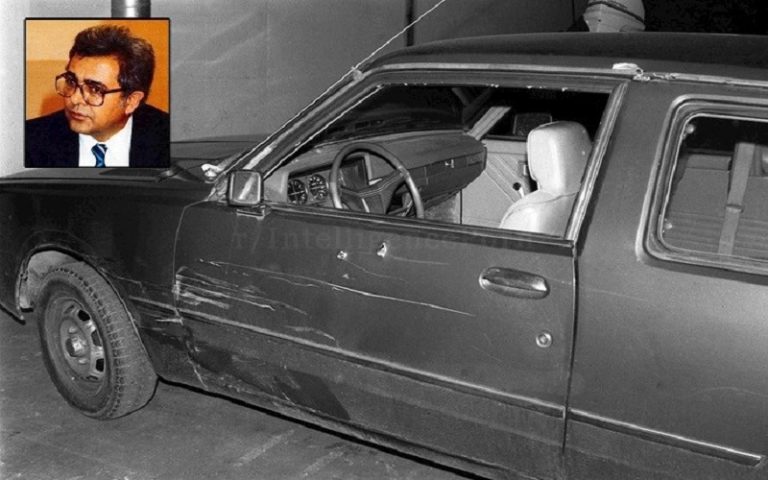
Dr. Rajavi was near his home in Geneva in 1990 when he was gunned down by a 13-member hit squad that had been organized by regime officials. At the time, he had been working as a representative for the National Council of Resistance of Iran (NCRI) to Switzerland. Despite the men involved in his assassination being identified soon after, they fled back to Iran and no authorities have been able to execute warrants for their arrest since.

The assassination of Dr. Rajavi was carried out in accordance with the same fatwa which underlay the 1988 massacre – one in which then-Supreme Leader Ruhollah Khomeini declared that all members and supporters of the Mujahedin-e Khalq (MEK) were guilty of “enmity against God” and should therefore be executed without delay.

As the fatwa issued by Khomeini specifically named the MEK, and those who were in opposition to the regime’s fundamentalist interpretation of Islam, attorneys for the Iranian opposition have argued that Dr. Rajavi’s death can be linked to other assassinations in the same era which signify that the regime was trying to destroy the Iranian Resistance movement.

In a conference in August, participants highlighted that the prosecutions of regime officials could take place in the International Criminal Court on the principle of universal jurisdiction. Two experts who were present for the conference, Professor Eric David from the University of Brussels and British human rights lawyer Geoffrey Robertson, both made statements that the atrocities committed at the 1988 massacre fit the criteria to be labeled as acts of genocide.

That expression of impunity was reinforced at the international level by the presence of a European delegation at Raisi’s inauguration, in the wake of widespread calls for him to be isolated, delegitimized, and ultimately prosecuted for genocide.

Western governments’ methods of appeasing the regime instead of holding them accountable for their crimes against humanity have only reinforced the sense of impunity that the regime has. However, the Swiss court’s decision to halt the closure of the investigation into Dr. Rajavi’s murder seems to be a step in the right direction to finally uncloak the regime’s impunity.

President-elect of the NCRI, Maryam Rajavi has described the court’s decisions as a ‘historic turning point’ and a ‘necessary step in countering the unbridled terrorism of the clerical regime’.

She warned the international community that recent events involving the regime, show that they have not changed how they operate in the past 30 years since the atrocities that they caused in the late 80s and early 90s. In reference to the 2018 bomb plot of an NCRI rally in Paris, and the brutal crackdown of the 2019 uprising in Iran she said, “Terrorism and repression are inherent and indispensable to the ruling religious tyranny.”

These incidents make it clear that as well as defining the regime’s current presidential administration, the legacy of the 1988 massacre represents persistent threats both to the Iranian people and to global security.

Iran’s DANA Contract, Corruption, and Damage to the People

0

The UAE energy company DANA Gas announced on September 28, 2021, that an international arbitral tribunal has ruled that the Iranian government pay a $607.5 million fine to the company.

This dispute is related to a 25-year gas purchase agreement between DANA Gas Company, a subsidiary of Crescent Petroleum, and the regime’s National Iranian Oil Company. DANA Gas says the gas was never delivered.

The damages, which followed a ruling in Dana’s favor in 2014, relating to the first eight and a half years of the 25-year agreement, which was due to begin in 2005. DANA Gas said in a statement that the last hearing of the much bigger claim for the remaining 16.5 years was scheduled for October next year in Paris and that a decision on the case would be made in 2023.

The Crescent contract is a contract signed between The National Iranian Oil Company (NIOC) and Crescent Inc. during Mohammad Khatami’s government, during the Oil Ministry of Bijan Namdar Zanganeh, initial negotiations began in 1997 and eventually led to the signing of the joint memorandum of understanding in 2001.

After reviewing the regulatory bodies, determined that the price of Iranian gas exports was very low and nearly to be gratis. A lawsuit has also been filed for violators of this contract in Iran but without any progress, as many of the violators are high-ranked people of the ruling body.

High-damaging and tainted contracts such as Crescent, Total, Acetate Oil, etc. have often involved bribes, for example, Total is accused of giving $30 million in bribes to a team headed by Mehdi Hashemi during the Zanganeh Ministry in Khatami’s government.

Total was therefore sentenced in a French court to a fine of 500,000 euros. Despite this dark past, another contract was re-signed with Total under Rouhani’s administration, which ended only in the presentation of the South Pars reservoir’s secret information to Total and Total’s subsequent break, while the French company is simultaneously operating extensively in the Qatari part of this large reservoir and has now gained access to Iran’s valuable information about South Pars.

The then President Hassan Rouhani, in 2002 as the secretary of the Supreme National Security Council, in a letter addressing the head of the government at the time (Khatami), described the action of the Minister of Petroleum (Zanganeh) in concluding a contract with the Emirati company Crescent outside the framework of the law, through ‘intermediaries’ and facing many negative effects for the country.

In that letter, Rouhani stressed, ‘Signing a long gas contract with an unreliable company that, according to reports received from the Oil Ministry, has performed poorly over the past years, and with the disregard for Iran’s rights about the Mubarak oil field, is a repetition of the bitter experience that we have been through for many years.

‘The price and contractual terms negotiated are very low and unpopular compared to the region. The Crescent deal is likely to have long-term negative economic impacts on the country’s gas market and will not have any political benefits. Since about a year ago, I have raised questions from the oil minister about the Crescent contract, which despite your order, no response has been received. The contract has been signed through intermediaries and lack of direct governmental communication with an invalid company.’

Then surprising in his presidency Hassan Rouhani appointed Bijan Zanganeh as the minister of oil. With a case of the elimination of the fuel card for four years during this management, period destroyed transparency and intensified the consumption (smuggling) of 20 million liters of gasoline per day, considering 100 billion tomans of smuggling per day, pouring 144 trillion tomans out of people’s pockets into the throats of government’s affiliated smugglers working for the IRGC.

After that, the regime’s shocking decision to suddenly triple the price of gasoline occurred in November 2019, which ended with the November 2019 protests with 1500 protesters killed by government forces.

There were many margins around this contract, including in 2013 a bi-national Iranian living in Britain named Abbas Yazdanpanah Yazdi, who was a friend of Mehdi Hashemi, son of Rafsanjani, was abducted shortly before testifying in the Crescent case in Dubai. And then killed. The prosecutor of the Dubai Criminal Court announced that Yazdanpanah had given evidence about the Crescent contract to the Hague Tribunal shortly before his abduction via internet call.

According to a video released by Iran’s principlist faction, Abbas Yazdanpanah had released the names of those involved in the mafia case, adding that a company called Jabal, represented by Mehdi Hashemi, was formed, seeking a stake in oil contracts with multinational corporations.

According to the evidence, Mehdi Hashemi was one of the initial negotiators of the contract for the sale of gas to Crescent but was later marginalized and did not play a role in the final signing of the contract.

Now, a few years later, it seems that not only none of these government officials have done any good for the Iranian people, but today the Iranian people must pay the price for theft, bribery, and incompetence of the officials by paying heavy compensation. At the same time, the Iranian people are struggling to make ends meet under the burden of poverty, high prices, and inflation.

Protests Continue in Iran in Response to Current Social and Economic Crises

In recent weeks, many protests have taken place across Iran because of society’s agitation at the Iranian regime’s lack of attempts to resolve the current social and economic crises in Iran.

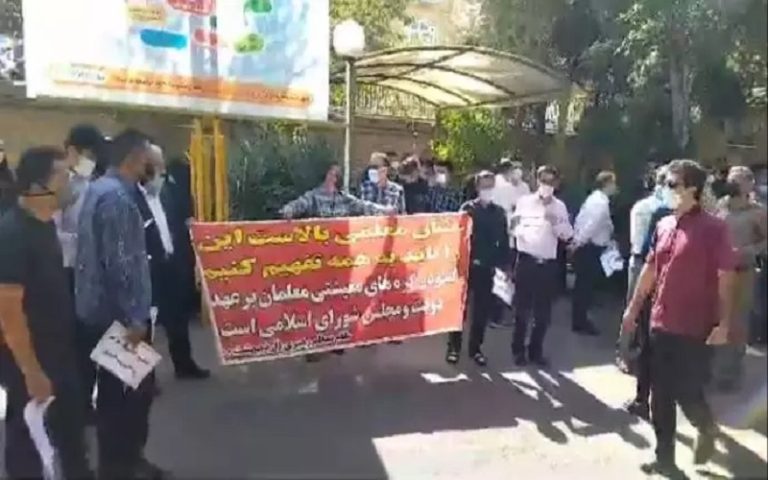
On Tuesday, retirees from Iran’s Health Ministry held protests in cities across Iran demanding that they receive their delayed pensions and bonuses that the regime has refused to adjust to fit the rising inflation rate.

On September 3, just before the start of the new academic year, Iranian teachers began the first of many protests in response to the lack of employment opportunities and low salaries.

The NCRI said, “There have been many protests by the green report card teachers, who have passed the Education Ministry’s employment test. Still, the regime has so far refused to employ them despite the shortage of teachers across Iran.”

The regime is not adjusting pensions and salaries to fit with the current economic situation. Wages were increased in April to 39% but considering the rising inflation rate since then, the rise is nowhere near enough for people to comfortably live on.

In a quote from Ali Aslani from the board of directors of Islamic Labor Councils, the Kar-o Kargar daily wrote, “A 39% increase in salaries in 2021 will cover only 37 percent of the people’s cost of living. A worker’s salary of 4 million Tomans covers only ten days of the month, and after that, the workers barely make ends meet until the end of the month. They have to remove many of the basic expenses of their lives.”

According to the state-run media and officials, Iran’s poverty line is estimated to be around 10 million tomans. Meanwhile, the salary base is 3.9 million tomans.

Etemad daily explained that according to the Statistics Center of Iran, the estimated poverty line figure sits between 11 and 12 million tomans, but many teachers earn less than half of that.

According to Article 41 of the regime’s labor law, it states that ‘salaries should be adjusted with the inflation rate’ and that wages ‘should be enough to provide the minimum of a life.”

In other words, the regime could help Iranians by at least implementing its labor law. But as time passes, it becomes clearer that the clerical regime is not willing to help Iranians.

To date, Ebrahim Raisi, the regime’s new president, along with his administration has yet to establish a plan to resolve the economic issues faced by Iranians or to combat the rising inflation rates. During his tours around the country following his inauguration in August, Raisi has only offered false promises to Iranian citizens, claiming that, “if God wills,” the problems would be resolved!”

Etemad daily stated in their September 28 publication that many of the problems that need to be resolved to need clear legislation to overcome them and they believe that Raisi either lacks the will or the ability to assign tasks that need to be completed to advance the efforts to resolve the crises.

In fact, Raisi’s government is handpicked by the regime’s Supreme Leader for consolidating power in the regime through terrorism and domestic oppression. The regime’s oppression is aimed to reduce protests and control Iran’s restive society.

Iran’s Tax-Exempt Companies Wield Power

0

An economist linked to the Iranian government says that 20 rent-seeking companies under the control of the regime’s supreme leader have a profit of more than 250 trillion tomans ($9 billion) and are exempt from paying taxes.

Hossein Raghfar, an economist, citing statistics from the Central Bank of Iran, has stated that 20 large state-owned rent-seeking companies in 2020 had a net profit of 250 trillion tomans, which, according to him, is equal to the government budget deficit, although other sources, including the report of the Court of Accounts of the Government Parliament, considers the figure of the government budget deficit to be higher than this figure.

According to Raghfar, the country’s trade balance has been positive in the first five months of 2021, but the government is still suffering from a huge budget deficit.

Although according to Raghfar, the government can compensate for this budget deficit from the place of taxation, the experience of previous years in the Rouhani government showed that in practice, taxation is done only from low-income groups and lower deciles of society. The upper deciles of society are tax-exempt due to their relationship with organizations of power and wealth.

Raghfar points out that in practice what will provide for the budget deficit will come from the pockets of the low-income groups, not organizations such as rent-seeking companies with a profit of 250 trillion tomans.

One of the main proposals made in recent years by government economists as a source of income for the budget deficit is to tax the vacant houses and real estate, which according to evidence and statistics about 2.5 million vacant houses in Tehran are at the disposal of banks and other powerful government-affiliated economic entities.

In other parts of the world, however, real estate taxes are one of the main sources of revenue for the budget.

However, due to the collusion of the authorities and despite numerous proposals to collect taxes from these vacant houses, the higher institutions in the government, such as the parliament, never accepted such a proposal.

Referring to the generous corruption of the government to its subordinates, Raghfar states that the governments, one after the other, ‘gave the country’s mineral resources to friends and comrades’ within the three decades after the war and did not receive any taxes from them.

Raghfar adds that the people’s share of these ‘beloved’ should be taken, but there is no will do so, otherwise, the solutions to the budget deficit are very clear.

He adds that today the country’s large mines are owned by non-taxable government’s ‘beloved’ and none of these companies and individuals have productive activities but produce natural resources that belong to all segments of the Iranian people, but they try to keep these cases hidden from view.

The people and the society should not find out about this situation and this secrecy should continue because, in this way, they can pocket huge resources.

Raghfar announces the amount of tax evasion of the power entities as 50 trillion tomans and adds that this tax evasion is not a small number, so why is this amount of tax evasion not stopped?

Referring to the 50 trillion toman tax evasion, Raghfar states that no tax exemptions are reported in this regime and add that when presenting the 2021 budget to the parliament, the government was asked to announce the number of tax exemptions, but the government has not taken any action.

Raghfar argues that part of the institutions and private companies owned by those in power are tax-exempt and pay only 2% tax instead of 20%.

Iranian Government Continues To Violate Nuclear Deal Commitments

0

The Iranian regime has backtracked on its commitments to the International Atomic Energy Agency (IAEA) by refusing to allow United Nations inspectors to repair the monitoring equipment at their nuclear facilities, despite agreeing to the request two weeks prior.

According to the Director-General of the IAEA, Rafael Grossi, the regime’s decision to ban UN inspectors from the TESA Karaj centrifuge component manufacturing workshop ‘is contrary to the agreed terms of the joint statement issued on 12 September’.

Grossi traveled to Tehran in mid-September and reached an agreement with the Iranian regime to proceed with the overdue servicing of its equipment in nuclear facilities. The agreement was meant to avoid further tensions with the international community ahead of the meeting of the IAEA’s Board of Governors and create the grounds to resume negotiations over Iran’s nuclear program.”

The regime has continued to deceive the IAEA at every turn in an attempt to hide their nuclear activities. They have declined to answer questions about traces of uranium that were found at three undeclared facilities and have refused to adhere to the 2015 nuclear deal agreement to reduce their stockpile of highly enriched uranium.

This is just one of a series of recent events that have proven the Iranian regime’s unwillingness to resolve issues surrounding its nuclear program.

Earlier this month, the IAEA issued a report warning the international community of the regime’s growing stockpile of highly enriched uranium, as well as their lack of cooperation in regards to the maintenance of the monitoring equipment at their nuclear facilities.

Grossi stated in a report in August that the inspectors he had sent to Tehran had confirmed that the regime had then produced 200 grams of 20 percent enriched uranium metal. Two months earlier, during a convention of the IAEA board of governors, he had warned that the regime’s unwillingness to answer their questions seriously affects the ability of the IAEA to provide assurance of the peaceful nature of Iran’s nuclear program’.

In February, IAEA inspectors confirmed that the regime had produced 3.6 grams of uranium metal at the Isfahan nuclear plant. The regime claims that it needs highly enriched uranium for civilian purposes.

European members of the 2015 nuclear deal, formerly known as the Joint Comprehensive Plan of Action (JCPOA) have stated their concern over the regime’s production of the uranium metal and confirmed that Iran does not need it for civilian purposes. Instead, it is a ‘key step in the development of a nuclear weapon’.

In his recent speech to the UN General Assembly, Raisi reiterated that his regime would not come under compliance with the JCPOA until all sanctions were lifted. He made no mention of his regime’s dangerous stockpile of highly enriched uranium.

The reality is that the Iranian government has been deceiving the world by hiding its nuclear program, all the while, the international community’s only method of trying to curb their activities is by granting concessions or by showing complacency.

Any agreement that does not completely close down the regime’s bomb-making, enrichment, and nuclear facilities is unacceptable from the view of the Iranian people.

Iran’s Killer Judges, Responsible for Murder and Forced Disappearance of Political Prisoners

0

In the world of Iran’s criminal officials, people like Afshin Mohammadi Darreh Shouri are committing more crimes in dirty competition to reach higher levels and gain more power and wealth.

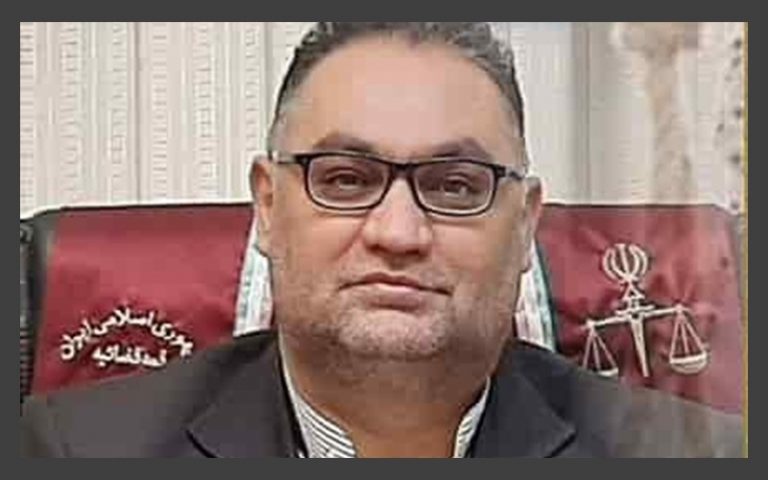
Afshin Mohammadi Darreh Shouri, an infamous human rights violator, who has bestowed on himself the title of a doctor, an event that has become a ridicule common act in Iran’s ruling class, by many officials while having even not a diploma or university educations, is the person who has approved and finally signed the court verdict for Navid Afkari’s execution. He had also threatened political prisoner Shahin Nasseri with death many times.

He is currently the Deputy Prosecutor of Shiraz. Confirmation and signature of investigator Afshin Mohammadi Darreh Shouri in the final order of Branch 10 of the Special Prosecutor’s Office for Criminal Affairs and Security Crimes in Shiraz, eventually led to the issuance of the second death sentence for Navid Afkari by Judge Mahmoud Sadati.

Mohammadi Darreh Shouri has been involved in cases against political and security prisoners for several years as an investigator in Branch 10 of the Special Court for Criminal Affairs and Security Crimes in Shiraz.

Due to these services in favor of the regime’s human rights violations, in mid-July of 2021, he was appointed as the Deputy Prosecutor of Shiraz.

Mohammadi Darreh Shouri is the same person who repeatedly threatened Shahin Naseri with death and threatened to kill him personally. Dissidents believe he is responsible for the ambiguous death of political prisoner Shahin Naseri.

The newly murdered prisoner, Shahin Naseri, had said: “Interrogator Afshin Mohammadi asked me, what did you see in the police station, that you want to testify here? ‘ I began to explain everything I had seen – the torture of Navid Afkari. The interrogator cut off my speech in a very bad tone, insulting and threatening me, and said, you are interfering in a security case, I will make life a living hell for you.”

It is because of these ‘good deeds’ to the regime that he was praised and favored by the repressive groups of enjoining the good and forbidding the evil, and they wrote a letter of appreciation to him:

“Jihadi groups commanding the good and forbidding the evil of the anonymous martyrs and the custodian of the martyrs by sending and delivering letters of support to the esteemed head of the judiciary, Hojjatoleslam Gholam Hossein Mohseni Ejei and the director-general of justice of Fars province Hojjatoleslam Seyyed Kazem Mousavi, announced their thanks and support of the valuable actions of the anti-corruption judge, Dr. Afshin Mohammadi Darreh Shouri, the Honorable Deputy Public Prosecutor and the head of the Shiraz Criminal and Security Prosecutor’s Office and called for a decisive investigation into corruption cases without any tolerance as before.”

Reminder:

Shahin Naseri, a witness to the torture of Navid Afkari, Iran’s wrestling champion who was executed in Iran on September 12, 2020, died under suspicious circumstances at the Greater Tehran Penitentiary.

Shahin Naseri’s brother confirmed the news and said: “His friends told us that he was killed in solitary confinement. But no official has contacted us yet.”

A source close to Naseri’s family said: “A few days ago, coinciding with the first anniversary of the execution of Navid Afkari, he (Shahin) was transferred from the hall where he was held at the Greater Tehran Penitentiary (GTP) to an unknown location. We thought he had been transferred to a security agency because he had been repeatedly threatened by security officials to remain silent about the Afkari brothers‘ case, but a few days ago we found out that he was being held in GTP. Shahin Naseri had no underlying illness, and his abrupt death is quite suspicious.”

In October 2019, Shahin Naseri filed a signed statement with the judiciary in which he said when he was brought into the police station in Shiraz in late September 2018 (soon after Afkari’s arrest), he saw Afkari being severely beaten by two plain-clothed men with a metal bar and a baton, cursing and telling him to confess to their version of the murder of a security guard in August 2018.

Inaction From the West Emboldens Iranian Government To Continue Nuclear Deception

The International Atomic Energy Agency (IAEA) said on Sunday that the Iranian regime refused to honor the terms of the 2015 nuclear deal by preventing inspectors from servicing monitored nuclear facilities two weeks ago.

On the eve of a meeting of the IAEA’s Board of governors, Grossi reached an agreement with Tehran, allowing the IAEA inspectors to service monitoring equipment. This joint statement was released while many western powers were considering adopting perhaps the most serious measures against Tehran’s provocative actions.

The regime has once again dodged the international community’s attempts to thwart their nuclear extortion while they continue to escalate their nuclear program. The only method that Western powers must control the regime’s nuclear program is through negotiations with the mullahs, however, the regime is continuously using those negotiations to bide time and secretly advance its activities.

This was confirmed in an interview with the regime’s current deputy Foreign Minister Ali Bagheri Kani in 2019. He explained how the regime uses negotiations as leverages to advance its nuclear extortion. Kani said, “…we bought some time. But when they were ready to negotiate a deal, the negotiation process expedited.”

In 2015, world leaders made an agreement with the regime, formerly known as the Joint Comprehensive Plan of Action (JCPOA). This deal put supposed limits on the regime to reduce their capability to make any major advance on their nuclear program, but the regime has continued to defy these sanctions every step of the way.

In 2018, Tehran rapidly started violating its commitments under the JCPOA terms. In less than two years, the regime was able to rapidly enrich uranium even higher than 20%. In August 2021, the regime announced it would begin enriching uranium up to 60% purity.

Back in August, the IAEA reported on the regime’s current progress in their production of enriched uranium metal, the only purpose of which is to develop nuclear weapons.

The former head of the regime’s Atomic Energy Organization, Ali Akbar Salehi acknowledged in 2020 that the regime was deceiving foreign powers during negotiations. He stated that while the Western leaders thought they had won the negotiations, the regime had countermeasures in place to prevent them from being ‘trapped in the enrichment deadlock’.

President-elect of the NCRI, Maryam Rajavi stated in 2020 that, “the policies and actions of the mullahs’ regime…leave no doubt that this regime has never given up the project to acquire an atomic bomb and continues the deception and concealment.”

Despite their best efforts, western powers have not achieved their initial goal of curbing the regime’s nuclear programs with their sanctions. The regime has only deceived the international community at every turn, despite warnings and information supplied by the Iranian Resistance.

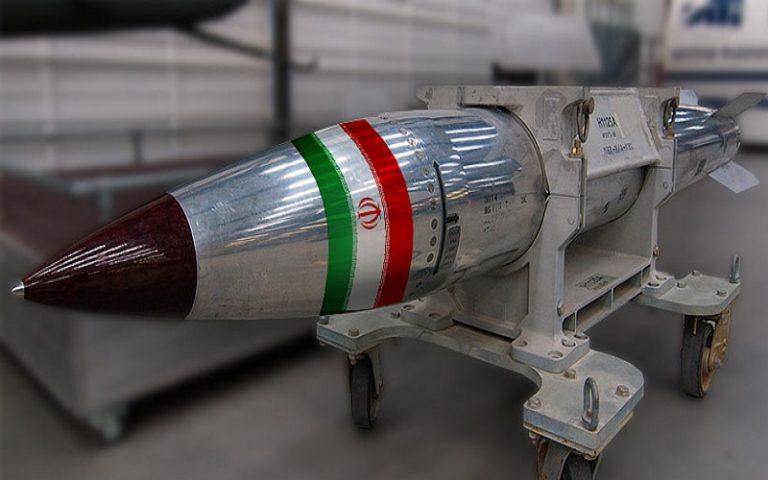
Failing to achieve a nuclear bomb is an existential threat to the mullahs’ regime. The regime obtaining a nuclear bomb would be serious to the world’s peace and security.

Iran’s ‘Strategic Solitude’

0

For many years the Iranian government is witnessing global isolation, and isolation which is because of the regime’s nontransparent and dangerous nuclear project, its malign acts in the Middle East, support of terrorism, its missile project, and finally the most important its human rights violations case.

The advancement of these policies is because of the ruling theocracy’s reactionary and tension-seeking nature, under the pretext of export of its so-called Islamic revolution.

All of them are in line with the repression of the people and hiding its internal crisis from the world. The truth is that in a short time these policies have achievements for the regime, but in the long period, they are to the detriment of the regime.

Even worse they have put the regime in a confrontation with the world and the entire Middle East, in addition, it has increased its internal crises.

The state-run daily Etemad confessed to this isolation in an article entitled ‘Iran’s strategic solitude, De-stressing, and introverted’ and wrote:

“’Iran’s strategic loneliness’ has created many bottlenecks and tragedies for our country, especially in the contemporary history of Iran.

“This loneliness is inherently stressful. Tensions with Turkish neighbors, tensions with Russian neighbors, tensions with Arab neighbors, tensions with Pashtun neighbors, tensions with Uzbeks, tensions with religious and linguistic backgrounds that are inconsistent with the religion and language of Iranian society, tensions with an international order, and, most importantly, contextless tensions with coalitions and political alliances, etc.

“On the other hand, tensions, especially constant tensions with the surrounding environment and the world, are gradually destroying the roots of development and leading the country to poverty and backwardness from its neighbors and peers, conflict and violence, and finally disintegration.” (Etemad, September 22, 2021)

In such a situation, naturally, the speech of the regime’s President Ebrahim Raisi at the UN General Assembly should be in the favor of de-escalation and solving these issues, but to the contrary, he made things even worse so that even the state media mocked him.

The state-run daily Setareh-e-Sobh wrote: “There can be no meaningful connection between Raisi’s presence at the UN General Assembly and the future of the JCPOA. The criterion for the conclusion of the JCPOA is to change the Islamic Republic’s positions on the JCPOA on the one hand, and on the other hand, Western countries, especially the United States, take practical steps to revive the JCPOA, including the lifting of sanctions.” (State-run daily Setareh-e-Sobh, September 22, 2021)

The necessity to take practical steps to revive the JCPOA and essentially improve relations with Western countries is to retreat in three areas of nuclear, regional policy, and cut support of terrorism, and stepping back from the missile program.

Another daily while referring to ‘burnt opportunities’ wrote:

“The president’s words had no positive point. Repeating repeated statements and saying sentences that were more like headlines.

“First, in this text, we should express our firm views on the continuation of negotiations, the need for sanctions relief, the return of blocked money, continued cooperation with the IAEA, the issue of oil and energy, and Tehran’s relations with neighbors, and then in the second step, let’s move on to the issue of Afghanistan, the situation in Yemen and Syria, and finally talk about pandemic conditions in the world.” (Aftab-e-Yazd, September 22, 2021)

Another daily also mocked Raisi and wrote:

“He started with a series of general descriptions that began that we are an old, independent country and we have our own opinions.

“These positions were not very new and had been announced many times before. Since there was no new word or position in Raisi’s speech, some are likely to object, saying that Iran should take advantage of the opportunity to address the General Assembly in a better way.

“There are criticisms, but it is better not to deal with this issue very much at the very beginning of the government’s work and forget it.” (Jahan-e-Sanat, September 23, 2021)

If the regime does not agree on the JCPOA and other matters that major Western countries expect, in addition to nuclear negotiations with its regional interference and missile program, there will be no agreement.

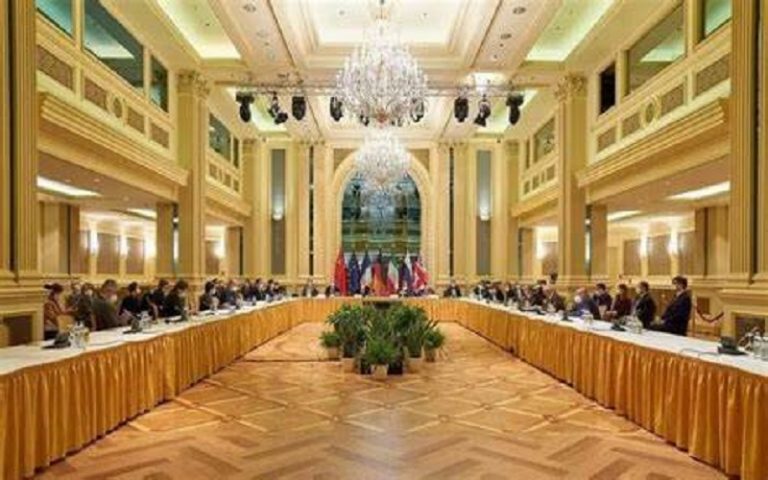
Meanwhile, the United States has stated that the regime will not receive more from the negotiations and must be convinced of the small level of a privilege it has made in the past few rounds of negotiations in Vienna.

Therefore, the regime must either accept something higher than the 2015 JCPOA and accept a JCPOA+ including limitations to its regional and missile programs, or while raising tensions with these countries, its nuclear case will be sent to the UN Security Council, and it must accept the dangerous consequences.

It is not without reason that Jahan-e-Sanat newspaper advised Raisi to take care of his speech and stances on foreign affairs, especially in the field of nuclear and relations with the United States.

“The U.S. political system and its economy have tremendous influence, despite all the threats it faces, and Russia and China never currently have U.S. power. Therefore, it should be noted that we should not say that only costs for Iran and there is no benefit from it.”

The regime is stuck and must choose between bad and worse, and confronting the international community will solve nothing and will create an even more suffocating atmosphere.

Severity of the COVID-19 and Economic Crises in Iran Is Worsening

0

Iran’s state-run media have acknowledged just how severe the Covid-19 and economic crises in Iran currently are.

Jahan-e Sanat daily wrote on September 23 that they have noticed the vast difference in how Iran, compared with other countries, is trying to control the coronavirus pandemic.

They said, “The ominous Covid-19 entered towards the end of 2019 and continued throughout 2020 and 2021. It showed after decades our governing and management of a crisis in the country to the showcase of competition with other countries.”

The regime did not fail in managing the Covid-19 crisis. It deliberately used the virus and its mass casualties as a barrier against the popular protests which broke out in 2018 and continued throughout 2019.

Janat-e Sanat explained that the Iranian people are blaming regime authorities for delaying the vaccination program which has led to an ‘unprecedented death toll over the past two months and a collapsing healthcare system’. They also acknowledged that nobody is buying claims from the regime that sanctions are to blame for the hindrances in dealing with the pandemic, instead, they blame the regime’s corruption and ‘economic mismanagement’.

In January of this year, the regime’s supreme leader Ali Khamenei banned the import of all reputable international vaccines and ordered the production of domestic vaccines instead.

The domestic vaccine was produced by the Execution of Imam Khomeini’s Order (EIKO), a huge financial institution Khamenei controls. Now, state-run media acknowledge a part of Khamenei’s scheme to further plunder people by insisting on producing the domestic vaccines.

In an interview with the Sharq daily two weeks ago, Ali Tajernia said that the company behind the domestic vaccine, Barakat, affiliated with the regime, was receiving 200,000 Tomans per each dose of the vaccine, thus giving the regime a reason to be unwilling to buy vaccines from abroad.

State-run Sepid discussed how the pandemic is amplifying the economic problems faced by Iranian citizens. They stated that no one knows the true figures of how many people have lost their lives due to the Covid-19 crisis and questioned how many people were forced to go without treatment considering the expense of a night in the hospital or because the medication Remdesivir is priced at between 700 and 800 thousand tomans, a figure of which many people simply cannot afford given the inflation and poverty crises in Iran.

Sepid said, “No one knows what happened during the consent Covid-19 peaks in slums in marginalized areas and suburbs. Statistics put the number of slum dwellers at between 11 and 25 million and even more, with an estimated 7,600,000 living on the outskirts of cemeteries.”

Looking at the statistics of the poverty level in Iran, Sepid explained that in terms of urban residents, 15.5% are living below the absolute poverty line, while in rural areas, at least a third of residents are struggling.

The ongoing Covid-19 and economic crisis have increased the society’s restiveness, prompting state-run media in recent days to warn officials about another popular uprising.