Home Blog Page 5

Urban Poverty in Iran: The Collapse of the Economy of Life in Major Cities

Urban poverty in Iran has now reached a stage where it can no longer be explained merely through income indicators. What is now visible in Tehran, Mashhad, Ahvaz, Karaj, and other major cities is a combination of a housing crisis, the collapse of job security, forced migration, marginalization, and the erosion of social identity. Tens of thousands of people are now forced to choose between remaining in the city and preserving a minimum level of human dignity.

For years, the economic structure of the Iranian regime has turned cities into commodities for speculation. In this structure, housing is viewed not as a social right but as a tool for capital accumulation by groups close to power. The result has been exploding rental prices, the gradual elimination of the middle class, and the displacement of millions to the outskirts of cities. Today, even salaried employees and professionals can no longer afford to maintain independent lives.

Food Inflation and the Erosion of the Middle Class in Iran’s Economy

The Collapse of Urban Life Under the Pressure of War and Economic Crisis

The current crisis is not merely the result of inflation or mismanagement. Recent wars and political tensions have also multiplied the speed of urban poverty’s expansion. Many businesses have shut down, economic projects have stalled, and thousands have lost their jobs. Official unemployment insurance statistics show only a small part of the reality. Millions of people who worked in the informal, online, or project-based economy have effectively been abandoned without any support.

Under such conditions, returning to one’s parents’ home is no longer a cultural choice; it is a sign of economic failure and the collapse of personal independence. A middle-aged woman forced to move back to her mother’s house with her child is not merely changing her place of residence; she is losing part of her social identity. Reverse migration from Tehran to smaller cities is also no longer a sign of attachment to one’s hometown, but rather the direct result of being unable to survive in the capital.

Saeed Izadi, a faculty member at Bu-Ali Sina University in Iran, emphasizes that urban poverty is not merely income poverty. According to him, today’s crisis includes housing poverty, insecurity, environmental poverty, cultural poverty, and the collapse of living standards. This definition explains why even areas that appear physically developed are still engulfed in crisis. A city may have tall towers and massive highways, but when its residents lack psychological security, stable employment, and the ability to live with dignity, that city is effectively poor.

The dimensions of this crisis are staggering. According to studies conducted in Tehran, nearly half of the capital’s population is affected by forms of multidimensional poverty. This means the crisis is no longer limited to traditional slum dwellers. Teachers, journalists, office workers, artists, and even sections of the professional workforce are now being pushed into lower social classes.

Marginalization; The Real Face of the Failure of Iran’s Planning System

One of the clearest manifestations of urban poverty is the expansion of informal settlements and impoverished neighborhoods. The marginalized population, estimated at around 11 million people years ago, has now risen to approximately 14 million. Climate crises, water shortages, the destruction of agriculture, and the heavy concentration of resources in a few major cities have also forced millions to migrate.

In fact, over decades, the Iranian regime has destroyed balanced regional development, pushing people toward major cities and then abandoning those same populations on the urban margins. The result has been the emergence of areas lacking proper infrastructure, healthcare services, quality education, and social security.

The crisis of urban poverty has even reached the historical hearts of cities. Many old neighborhoods in Tehran, Isfahan, and Shiraz have been abandoned because of high costs, deterioration, and neglect. In these districts, urban life is gradually fading away, replaced by alienation, insecurity, and poverty.

The regime’s planning structure has for years focused solely on quantity. For the rulers, the number of housing units has mattered more than quality of life. Massive construction projects have been built without regard for urban identity, transportation, the environment, or human needs. The result is cities that may have physically expanded but have become hollow from within.

This crisis has become a threat to social cohesion, mental health, personal identity, and the future of society. War, sanctions, structural corruption, and the chronic inefficiency of the Iranian regime have turned cities into spaces of permanent anxiety. Beneath this heavy dust, not only buildings but also human hope is gradually disappearing.

Gasoline Price Hikes in Iran Trigger a New Battle Over People’s Livelihoods

As Iran’s economic crisis, inflation, and declining purchasing power continue, recent remarks by Hamid Rasai, a member of the Iranian regime’s parliament, regarding the possibility of a sharp increase in gasoline prices have once again heightened concerns about growing pressure on people’s livelihoods. These remarks come at a time when a large portion of society is already struggling under the burden of inflation and rising prices, and any new economic decision could trigger a fresh wave of public discontent.

Rasai wrote in a post on X that there is a faction within the government which, according to him, sees the solution to economic problems in deregulating prices and increasing costs. He claimed that this faction intends to reduce subsidized gasoline quotas and raise the price of non-subsidized gasoline.

Iran’s Employment Crisis: The Increase in Unemployment Insurance Registrations

These remarks come as gasoline price hikes have consistently been one of the most sensitive economic and social issues in Iran in recent years. The experience of the sudden gasoline price increase in November 2019 remains fresh in the public memory, and many citizens view any change in fuel prices as the beginning of a new wave of rising costs for goods and services.

Gasoline Price Hikes and the Continuation of Inflationary Policies

Rasai further blamed the same economic faction for eliminating the preferential exchange rate. He claimed that the result of these policies has been the highest inflation imposed on the people since the 1979 revolution. Without referring to the role of the broader ruling structure in the economic crisis, the parliament member attempted to portray part of the government as directly responsible for worsening pressure on people’s livelihoods.

However, economic experts have repeatedly emphasized that the inflation crisis, the collapse of the national currency’s value, and widespread price increases are the result of decades of structural corruption, administrative inefficiency, and the heavy costs of the regime’s policies. Under such conditions, any increase in gasoline prices could quickly affect transportation costs, food prices, and essential goods, making life even more difficult for millions of citizens.

At the same time, the remarks sparked widespread reactions on social media. Many users expressed concern about a repeat of previous fuel price hike scenarios. Others viewed the renewed disputes among regime officials as a sign of intensifying crisis within the power structure.

Regime Infighting Over Gasoline Price Hikes

In another part of his remarks, Rasai targeted Mohammad Bagher Ghalibaf, the speaker of the parliament. He claimed that Ghalibaf, by unjustifiably sealing off parliament, has prevented lawmakers from overseeing government decisions. According to Rasai, conditions have deteriorated to the point that carrying out parliamentary duties has become difficult, and parliament has been placed in a state of deliberate paralysis.

In recent months, disputes among various factions of the regime over the management of the economic crisis have intensified. Each faction is trying to shift responsibility for the current situation onto the others, while the main burden of these crises continues to fall on the people.

At a time when inflation remains high and living costs continue to rise daily, the renewed discussion of gasoline price hikes has intensified social concerns. At the same time, revelations and verbal clashes among regime officials present a picture of disorder and crisis within the country’s decision-making structure—a crisis whose consequences directly affect the daily lives of the people.

Paris to Host Major Rally Supporting a Free Iran on June 20

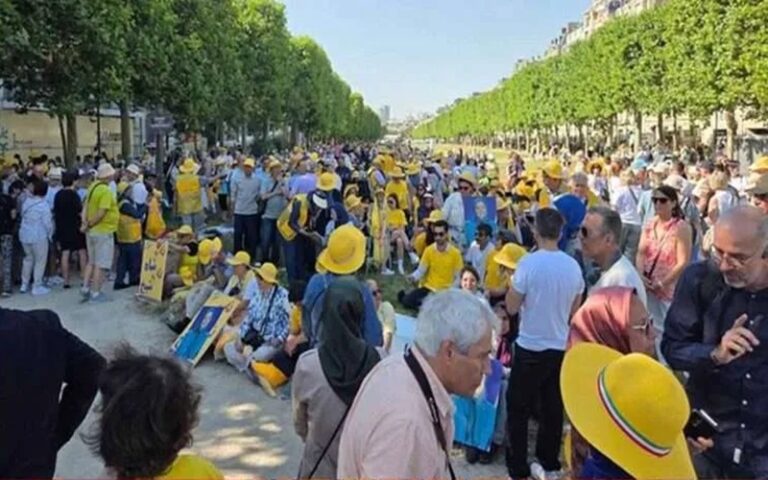
More than 100,000 people are expected to gather in Paris on June 20, 2026, to voice their support for freedom and democracy in Iran. The event will call for an end to executions in Iran and advocate for a democratic republic free from dictatorship.

“No to Executions, Yes to a Democratic Republic”

Supporters of the Iranian Resistance and freedom-loving Iranians from across the world are expected to participate in what organizers describe as one of the largest Iranian gatherings ever held in Europe. The rally aims to condemn the increasing wave of political executions in Iran and highlight the Iranian people’s demand for a democratic future.

The event coincides with the 45th anniversary of the beginning of Iran’s nationwide resistance against the ruling theocracy — a day commemorated as the Day of Martyrs and Political Prisoners in Iran. Organizers say the gathering will deliver a clear message to the international community: lasting peace and stability in Iran can only be achieved through support for the Iranian people’s struggle for freedom and democracy.

Growing Concerns Over Executions in Iran

The rally takes place amid rising international concern over the sharp increase in executions of political prisoners in Iran, particularly members and supporters of the People’s Mojahedin Organization of Iran (PMOI/MEK). Reports indicate that dozens of dissidents have been executed in recent weeks, while many others remain on death row.

Human rights advocates warn that the Iranian regime is using executions and widespread repression to create fear and prevent another nationwide uprising similar to the protests that swept across Iran earlier this year. Many young protesters, students, and athletes arrested during the January 2026 uprising are still imprisoned, and the fate of thousands remains unknown.

For many participants, opposition to executions is closely tied to the broader demand for democratic change. Their central slogan remains:

“No to Executions — No to Shah, No to Mullahs — Yes to a Democratic Republic.”

Rejecting All Forms of Dictatorship

Speakers and participants are expected to emphasize that the Iranian people reject both the former monarchy and the current clerical regime. The movement supporting the rally advocates for a democratic republic based on free elections, separation of religion and state, gender equality, minority rights, and the abolition of the death penalty.

The National Council of Resistance of Iran (NCRI), which supports the event, states that Iran’s future must be determined solely by its people — not through foreign intervention, war, or appeasement of the ruling establishment.

Maryam Rajavi, the NCRI’s President-elect for the transitional period, has repeatedly promoted what she describes as a “third option”: neither dictatorship nor foreign-imposed change, but democratic transformation led by the Iranian people and the organized resistance inside Iran.

International Support and Solidarity

Lawmakers, former officials, human rights advocates, and political figures from Europe and North America are expected to attend the rally in solidarity with the Iranian people.

Organizers believe the large turnout in Paris will reflect growing international support for a democratic republic in Iran and for the Iranian people’s right to resist tyranny and repression.

As preparations continue, activists across social media are encouraging supporters worldwide to take part in what they describe as a historic march for Iran’s future.

On June 20, Paris is expected to become the voice of a nation calling for freedom, justice, and an end to executions.

Amnesty International: 2,159 People Executed in Iran in 2025

In a new report, Amnesty International stated that the Iranian regime carried out at least 2,159 executions in 2025, marking the highest number of executions in more than four decades. According to the human rights organization, this figure played a major role in the sharp global rise in executions.

The human rights organization announced on Monday, May 18, that a total of at least 2,707 people were executed worldwide in 2025, the highest recorded figure since 1981.

The Amnesty International report states that the increase in executions is not limited to Iran; however, the Iranian regime alone accounted for the largest share of this trend and set an unprecedented record.

Amnesty International emphasizes that the rise in executions in Iran has coincided with an intensified security and political climate in the country. According to the organization, Iranian regime officials, following widespread anti-government protests in January last year and after the start of the war with Israel and the United States in February, have turned the death penalty into a tool for political repression and spreading fear in society.

The report states that governments which restrict civic space and silence dissent are increasingly resorting to the death penalty to consolidate their power.

Amnesty International says this trend has intensified particularly in Iran, where executions in many cases are carried out in opaque circumstances and without respect for fair trial standards.

Other human rights organizations have also repeatedly warned in recent months about the rising number of executions in Iran. According to these organizations, some of those executed include political prisoners, detained protesters, and individuals tried in security-related cases.

In conclusion, Amnesty International stressed that due to restricted access to information in Iran, the actual number of executions is likely even higher than the reported figures. The organization called on the international community to exert greater pressure on the Iranian regime to halt the wave of executions in Iran and to prevent the government from using the death penalty as a tool of political repression.

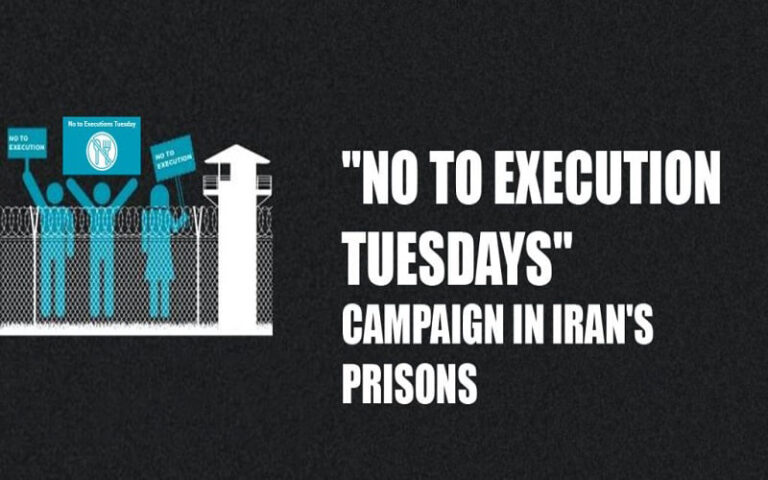
Iran’s ‘No to Execution Tuesdays’ campaign marks 121st week

The “No to Execution Tuesdays” campaign entered its 121st week on Tuesday, May 19. Prisoners participating in the campaign called for global action against executions in Iran.

The prisoners issued a statement on this occasion.

Text of the statement by the “No to Execution Tuesdays” campaign

“No to execution” and the “No to Execution Tuesdays” campaign are an essential principle for defending the right to life.

Continuation of the “No to Execution Tuesdays” campaign in 56 different prisons during its 121st week.

The Voice They Could Not Silence: Vahid Bani Amerian’s Final Testament

Iran’s authoritarian rulers have, for more than two months, occupied city streets through their agents and limited supporters, publicly training people in the use of weapons. By exploiting children in these gatherings, they seek to institutionalize violence and repression against citizens and protesters.

In the past week, the Iranian regime hanged political prisoner and Baluch citizen Abdoljalil Shahbakhsh in Zahedan Prison. In another criminal act, it executed Mohammad Abbasi, one of those arrested during the January uprising, on charges of participating in the uprising. This comes while his daughter, Fatemeh Abbasi, has been sentenced to 25 years in prison and is currently imprisoned in Tehran’s Evin Prison.

The ruling dictatorship, out of fear of being overthrown, pursues no goal other than creating fear and terror in society through issuing and carrying out unjust execution sentences. Alongside political prisoners, we witness the daily execution of young people on non-political charges.

We have repeatedly said that execution, regardless of the type of accusation, is not merely the implementation of an unjust judicial sentence that deprives a human being of the right to life. Rather, it is the regime’s most important tool of repression and state killing, rooted deeply in the political, class-based, and ideological foundations of the system of velayat-e faqih. This tool is used to spread fear among the people in order to force the oppressed into submission; but this is a futile illusion.

If today the government is hanging young people one after another, it is because it knows very well that these young people have deeply experienced class discrimination and are aware of the regime’s systemic corruption and plunder. It executes them to instill fear, but it fails to realize that this violence not only does not silence people, but also plants the seeds of awareness, resistance, and uprising in hearts and minds.

We believe that people must not surrender in the face of these executions. The “No to Execution Tuesdays” campaign is a necessary step toward justice, freedom, and the elimination of all forms of discrimination and oppression in a future Iran.

Open and practical opposition to executions is a highly important and decisive criterion and a true test for today’s activists.

As part of the broader movement against executions, we in the “No to Execution Tuesdays” campaign call on all political, human rights, labor, and civil activists to become even more united in stopping executions. We also ask workers, teachers, students, and retirees, who have so far been the loud voice against executions in streets and public spaces, to carry our message to the awakened consciences of international societies.

The “No to Execution Tuesdays” campaign, with hope for a free Iran free from repression and executions, and in protest against the issuance and implementation of execution sentences in Iran, is holding a hunger strike on Tuesday, May 19, during its 121st week in 56 prisons across the country.

Massive Washington Rally Highlights Growing Pressure on Iran’s Regime

0

Thousands of Iranian Americans, political activists, and former U.S. officials gathered in Washington, D.C. on May 16 for one of the largest recent demonstrations in support of democratic change in Iran. The “Washington Free Iran Rally” focused on Iran’s escalating execution campaign, internal unrest, and the activities of organized opposition networks inside the country.

Held against the backdrop of mounting tensions inside Iran following nationwide protests and a surge in political executions, the event brought together members of the National Council of Resistance of Iran (NCRI), supporters of the People’s Mojahedin Organization of Iran (PMOI/MEK), and several American political and military figures.

Throughout the rally, speakers repeatedly pointed to what they described as deepening instability within Iran’s ruling system. Many framed the increase in executions and security crackdowns as evidence of growing concern among authorities over renewed anti-government protests.

In a televised address broadcast to the gathering, NCRI President-elect Maryam Rajavi said the Iranian regime had reached what she described as a “terminal impasse” following the nationwide unrest of January 2026. She argued that authorities were increasingly dependent on “internet blackouts, arbitrary street searches, and a bloody purge of political prisoners” to contain dissent.

Mrs. Rajavi honored eight PMOI members and 17 protesters reportedly executed in recent weeks, highlighting the words attributed to political prisoner Vahid Bani-Amerian before his execution: “Rest assured, if you execute me and those like me, we shall only multiply.”

She also claimed that the continued activities of the Resistance Units demonstrated that “the regime has failed to obstruct the impending uprising.” Rejecting both engagement policies toward Tehran and monarchist currents abroad, Rajavi described supporters of a return to monarchy as “wolves in sheep’s clothing” attempting to revive the legacy of SAVAK, the Shah’s former intelligence organization.

French Magazine Exposes ‘Shah-Making Factory’: Fascist Networks and Lobbies Grooming the Shah’s Son as an Alternative to the Iranian Regime

Calling for stronger international pressure on Tehran, she urged Western governments to “block all diplomatic concessions,” designate the IRGC as a terrorist organization, and recognize “the Iranian people’s impending march toward a democratic society governed by the ballot box, gender equality, and pluralism.”

Dr. Anahita Sami, an Iranian-American attorney and community organizer, opened the rally by focusing on the human cost of the crackdown inside Iran. She said a “new, fearless generation has looked dictatorship squarely in the eye and refused to kneel before tyranny.”

Reading the names of executed political prisoners, including Pouya Ghabadi, Vahid Bani-Amerian, and Babak Alipour, Sami argued that the authorities’ reliance on executions had backfired, saying “every martyr” had become “an uncontainable wildfire.”

Former U.S. Congressman Patrick J. Kennedy used his remarks to draw attention to the execution of political prisoners, including elderly dissidents and professionals accused of opposition activity. “A confident regime does not rush architectural and electrical engineers to the gallows,” Kennedy said, referring to recent executions of PMOI supporters and activists.

He argued that the execution of longtime opposition figures, including 67-year-old PMOI supporter Abolhassan Montazer, reflected “a deep-seated, paralyzing fear of another domestic uprising.”

Kennedy also referenced reported operations carried out by Resistance Units across multiple Iranian cities in recent weeks, saying the activities demonstrated a level of organization inside Iran that policymakers could no longer ignore. He described the NCRI’s Ten-Point Plan as “a precise roadmap for free elections and an independent judiciary.”

Former U.S. Ambassador to Denmark Carla Sands criticized decades of Western engagement policies toward Tehran, arguing that diplomatic outreach had marginalized organized opposition movements.

“The existence of a highly organized, disciplined democratic alternative like the NCRI effectively shatters the false narrative that the world must choose between the current theocracy or absolute chaos,” Sands said.

She also addressed the debate surrounding monarchist groups abroad, accusing some organizations aligned with former crown prince Reza Pahlavi of glorifying SAVAK. Sands said some monarchist groups in Europe had openly marched with “insignia representing an era defined by torture chambers and political repression.”

Retired General Wesley Clark, former NATO Supreme Allied Commander Europe, approached the issue from a strategic and security perspective. Clark argued that military pressure alone would not resolve tensions surrounding Iran’s regional activities or nuclear ambitions.

“Airplanes flying at 35,000 feet, aircraft carriers, and bunker-busting bombs are merely peripheral,” Clark said. “The root cause of regional instability rests inside the regime itself.”

Referring to the January 2026 protests, Clark argued that previous protest waves had demonstrated the limits of peaceful dissent under current conditions. He said “organized, internal armed resistance” would ultimately determine the country’s future trajectory.

The rally also featured representatives from Iran’s ethnic minority communities. Hejar Berenji, representing the Democratic Party of Iranian Kurdistan (PDKI/KDPI) in the United States, advocated for a political system recognizing the rights of Kurds, Baluch, Arabs, and Azeris.

“Real national unity cannot be built through forced silence or another centralized dictatorship,” Berenji said. He summarized his position with the slogan: “No dictatorship with turban, no dictatorship with crown.”

Berenji also criticized ongoing negotiations with Tehran, calling for “an immediate end to negotiations over the heads of the Iranian people.”

Younger Iranian-American speakers focused heavily on the role of women and youth in recent protest movements. Kimia Arya, a biology student at the University of Houston, spoke about the participation of women during the January 2026 demonstrations and the impact of the subsequent crackdown.

“The current wave of executions does not project state strength,” Arya said. “It exposes a paralyzing weakness from a regime that is deeply terrified of its students and youth.”

She added that younger generations in Iran would accept “nothing less than a forward-looking republic completely free of both the turban and the crown.”

Ali Ziaie, a former Canadian Wushu champion and political science graduate, offered a personal account of growing up in a family affected by political imprisonment in Iran. He said he learned from childhood that “simply uttering the name of the MEK carried the penalty of execution.”

Ziaie argued that every execution carried out by the authorities now served as “an official confession by the mullahs that they have lost control of the nation’s soul.”

The event concluded with a message from former New York City Mayor Rudy Giuliani, who described the current political system in Iran as “rapidly collapsing from both the inside and the outside.” He called the NCRI’s Ten-Point Plan “an essential constitutional guidepost for a post-regime transition.”

Across the rally, speakers repeatedly returned to three themes: opposition to executions and repression inside Iran, rejection of both clerical rule and monarchical restoration, and support for organized networks seeking political change from within the country itself.

French Magazine Exposes ‘Shah-Making Factory’: Fascist Networks and Lobbies Grooming the Shah’s Son as an Alternative to the Iranian Regime

The renowned French magazine Nouvel Observateur has published a comprehensive investigation by Marie Vaton exposing the hidden mechanisms of the “Shah-making factory.” The article highlights how the Shah’s son, who was a marginal figure with no political weight just three years ago, has been artificially elevated. This manufactured rise is the result of aggressive, multifaceted networks, some with close ties to the far-right.

The Return of the Shah’s Infamous Royal Secret Police to the Streets of Europe

Exclusionary Slogans in Paris Squares:

Every Sunday, monarchists gather at the Trocadéro in Paris, chanting exclusionary slogans. They prominently shout, “Death to the three corrupts: the Mullah, the Leftist, and the Mojahed,” clearly targeting the People’s Mojahedin Organization of Iran and progressive forces. These rallies are led by individuals with opaque funding, who suddenly pivoted from fashion and lifestyle to fiercely attacking anyone who opposes the Shah’s son.

Failure of the “Georgetown Committee”:

The magazine recalls the “Georgetown Committee” stunt in Washington in February 2023. There, the Shah’s son tried to exploit the blood of the Velayat-e Faqih regime’s victims to declare himself the leader of the uprising. However, this coalition quickly collapsed because he only wanted to subjugate everyone to serve himself. Sociologist Azadeh Kian confirmed to the magazine that the Shah’s son was previously a nobody, lacking any recognition inside Iran or internationally.

Troll Armies and Shady Funding:

Explaining this sudden rise, the publication reveals the role of cyber armies and anonymous financing. It points to a Haaretz investigation exposing an influence operation using thousands of fake accounts to support the monarchy’s return and create an illusion of popularity. Sources close to the Shah’s son admitted he lacks the funds for this “complex ecosystem,” revealing that his campaign relies on powerful lobbies offering lucrative salaries to recruit activists.

Media Whitewashing and Bribery:

The magazine notes the hiring of professional PR consultants to secure appearances for the Shah’s son on French magazine covers and TV screens. Shadow networks also attempt to recruit “young, attractive victims” of the mullahs’ regime as propaganda tools. Young journalist Nazila Maroofian revealed she received tempting offers of apartments and publishing contracts upon arriving in France, which she bravely refused.

Fascist Terror and Hit Lists:

Nouvel Observateur warns that these groups are transforming into a machine of terror and intimidation against democratic dissidents. Monarchist influencers have published “hit lists” targeting lawyers, activists, and even bookstore owners in Paris, threatening daily to burn down their properties. This toxic climate even reached Canada, where Massoud Masjoudi, a fierce opponent of both the Velayat-e Faqih regime and the monarchy, was assassinated in March by Iranian extremists.

Return of SAVAK and the Shah’s Guard:

The report concludes by highlighting the public demands of monarchists for the return of “SAVAK,” the notorious intelligence agency responsible for thousands of torture cases. It describes a chilling scene in London last April, where a hundred masked men in black marched under the banner of the “Immortal Guard.” The magazine raises a fundamental question: are these fascist militias simply seeking to replace the mullahs’ regime’s suppression apparatus with an equally bloody one?

Iraqi Militia Commander Arrested Over Alleged Plotting of Terrorist Attacks in the U.S. and Europe

An Iraqi militia commander has been arrested on charges of involvement in planning more than 12 “terrorist” attacks in North America and Europe, attacks that judicial officials say were planned in response to war with Iran.

U.S. judicial officials say that Mohammad Bagher Saad Dawood Saeedi, 32, was planning attacks on a synagogue in New York and two Jewish centers in Los Angeles and Scottsdale.

According to the criminal complaint, he faces six terrorism-related charges. His lawyer, however, says he has been targeted in a politically motivated prosecution.

According to U.S. officials, Saeedi is one of the commanders of Kataib Hezbollah, an Iraq-based group that the United States considers a terrorist organization, and which has close ties to Iran.

Saeedi, an Iraqi citizen, was first arrested in Turkey and then handed over to the FBI and transferred to the United States.

Saeedi appeared in federal court in Manhattan and will remain in custody pending trial.

Concerns in U.S. Congress Over Cryptocurrency Transfers to Networks Linked to Iran’s Regime

Two members of the U.S. Congress, Sean Casten and Gregory Meeks, in an official letter to the U.S. government, called for explanations regarding the role of cryptocurrency exchange Binance in large-scale digital currency transfers.

In the letter, published on Thursday, May 14, it was claimed that about $1.7 billion in cryptocurrency had been transferred through Binance to wallets linked to armed groups and forces affiliated with the Iranian regime. According to the lawmakers, part of this financial network was likely used to circumvent U.S. sanctions.

The report also referred to Tehran-backed groups such as the Houthis in Yemen. The members of Congress emphasized that these transactions took place while Binance had been under scrutiny by U.S. authorities following regulatory agreements and commitments to implement strict anti-money laundering regulations.

They also recalled that Binance admitted in 2023 to violating certain U.S. financial laws, but despite regulatory agreements, reports indicate that suspicious transactions have continued, some of which have been attributed to activities linked to the Iranian regime.

The two members of Congress asked the U.S. Department of Justice and the Treasury Department to explain the effectiveness of the controls imposed on Binance and the possible reasons for failing to prevent these financial transfers.

The letter also expressed concern over the use of cryptocurrencies to evade sanctions imposed on the Iranian regime and requested a comprehensive report on how Binance’s operations are being monitored.

IRGC Increases Terrorist Activities in Gulf Arab Countries

At a time when Iran’s regime is pursuing a policy of regional militarism, a broad wave of alleged IRGC-linked terrorist activity is intensifying in Gulf Arab countries.

A recent report by the U.S. newspaper The New York Times has once again drawn attention to Iran’s extraterritorial activities and networks linked to the Islamic Revolutionary Guard Corps (IRGC) across Arab states in the Persian Gulf. The report describes a wave of mass arrests in several regional countries. Security officials in these states have accused detainees of ties to the IRGC and involvement in security cooperation with Iran’s regime. Meanwhile, the region’s political and media environment has also been affected by growing concerns over IRGC-related terrorism.

IRGC Members Arrested in Kuwait, Woman Sentenced to Life in Prison in Bahrain for Cooperation with IRGC

According to the report, more than 100 alleged IRGC operatives have been arrested in Gulf Arab countries. The main charges against these individuals are treason and cooperation with networks affiliated with Iran’s regime. The report states that regional governments, following heightened military and security tensions with Iran, have begun extensive surveillance of groups and individuals close to Tehran.

IRGC terrorism in Bahrain; revocation of citizenship and cleric arrests

Bahrain has been identified as one of the main centers of this security case. According to the published report, Bahraini authorities have revoked the citizenship of 69 individuals. In addition, 41 others have been arrested on charges of links to the IRGC. Among those detained are dozens of clerics aligned with Iran’s regime.

A human rights group has stated that 37 of those detained in Bahrain are clerics. This has triggered widespread reactions in regional media. Media outlets close to the Bahraini government have described these individuals as part of a “soft influence network” of the rule of the Supreme Leader. In contrast, some groups affiliated with Iran’s regime have described the arrests as political.

In previous years as well, Bahrain has repeatedly accused Iran’s regime of security interference and organizing armed groups. The country’s government had earlier stated that some opposition groups were trained on Iranian soil. The latest New York Times report now suggests that concerns over IRGC-related terrorism in Bahrain have entered a new phase.

UAE; publication of suspects’ images and calls for harsh punishment

A similar case is underway in the United Arab Emirates. According to The New York Times report, 27 individuals in the country have been accused of membership in a Shiite terrorist organization. The UAE government has published images of these individuals and described them as part of an organized network.

Some figures close to the UAE authorities have also called for severe judicial action against the accused. Emirati media have described the case as part of Iran’s regime efforts to achieve security infiltration in Arab countries. Security officials in the UAE have stressed that any connection to IRGC-linked networks is considered a threat to national security.

In recent years, relations between Iran’s regime and Gulf Arab states have repeatedly been in crisis. Attacks on oil facilities, arms smuggling cases, and the activities of proxy groups have been among the main points of contention between Tehran and regional governments. Now, the issue of IRGC-related terrorism has once again become one of the central security concerns for Arab states.

Increasing regional pressure against the clerical regime

The New York Times report indicates that Gulf Arab countries have adopted a stricter approach toward networks close to Iran’s regime. Security institutions in these countries believe the IRGC is attempting to exploit sectarian divisions to expand its influence.

In past years, regional governments have repeatedly accused Iran’s regime of creating instability. Many of these countries believe Tehran uses militias and proxy forces to advance its regional objectives. The recent mass arrests now indicate that the IRGC terrorism case has entered a new stage.

Rising tensions in the Persian Gulf are occurring alongside internal crises within Iran’s regime. Iran’s regime is facing waves of public dissatisfaction, an economic crisis, and widespread protests at home. Nevertheless, international reports continue to indicate ongoing security and regional operations by the IRGC outside Iran’s borders.