Home Blog Page 51

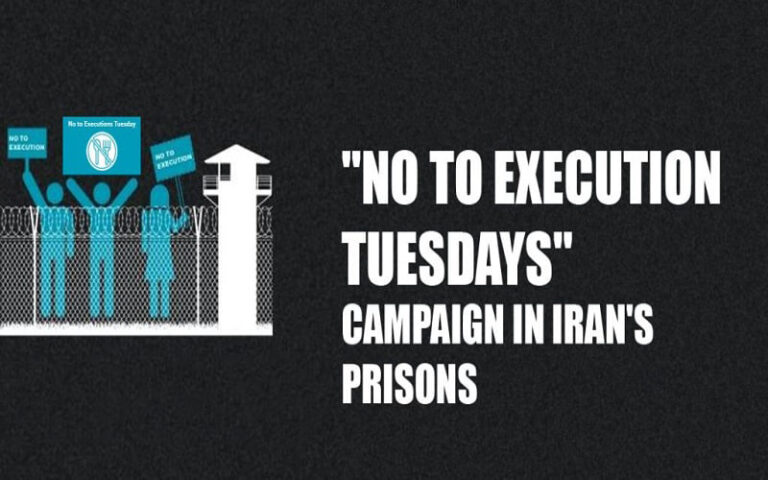
Iran’s ‘No to Executions Tuesdays’ Campaign Expands to 55 Prisons on 96th Week

0

According to reports, the “No to Executions Tuesdays” campaign continued today, November 25, 2025, and with the participation of Birjand Central Prison, the number of prisons joining the hunger-strike campaign reached fifty-five. The participating prisons, in their statement, voiced support for the protests of families of death-row prisoners and called on all people to support them.

Text of the “No to Executions Tuesdays” Campaign Statement

With Birjand Central Prison joining, the “No to Executions Tuesdays” campaign expanded to fifty-five prisons in its ninety-sixth week.

Iran: 304 Executions in One Month, 1,735 In 2025 So Far

The 96th week of the “No to Executions Tuesdays” campaign arrives at a time when the repressive apparatus in Iran has escalated executions at an unprecedented pace in order to preserve itself. The expanding scope of executions, the absence of fair trials, and the systematic use of executions as a tool for intimidation constitute a blatant violation of fundamental human rights and a clear example of crimes against humanity.

This week, Birjand Central Prison joined the 54 other prisons sending the message of “No to Executions” from behind prison walls.

This week, the passage of the seventy-second United Nations resolution condemning human-rights violations in Iran recognized two decisive legal truths:

1: recognition of the 1988 massacre and concern over its recurrence

2: condemnation of the unprecedented pace of executions and the regime’s use of executions as an instrument of intimidation and repression

Nevertheless, the regime continues its executions and killings. The death sentence issued for Mohammad-Mehdi Soleimani—one of those arrested during the 2022 uprising—is not an exception but part of a consistent pattern of eliminating protesters through a politically driven and invalid judicial process. Between October 23 and November 21 alone, there were 311 executions, a number unprecedented since the 1988 massacre. Additionally, 59 people have been executed since last week, and 1,479 people have been executed since March 21.

The families of prisoners sentenced to death, despite threats, summons, arrests, and security pressures, continue to stand in the streets week after week to defend the lives of their loved ones. This protest requires widespread support from the public and the international community.

On Tuesday, November 25, the “No to Executions Tuesdays” campaign entered its 96th week, with prisoners in fifty-five prisons across the country participating in a hunger strike.

Iran: 304 Executions in One Month, 1,735 In 2025 So Far

Executions by Iran’s regime have reached an unprecedented level. According to reports, at least 304 prisoners were executed in various prisons across the country between October 23 and November 21 (the Persian month of Aban); a figure that is assessed to be the highest monthly number of executions in the past thirty-seven years. Observers say this sudden and relentless surge in executions is the regime’s response to growing concerns about the formation of social protests and a popular uprising.

According to officially reported figures, 36 prisoners were executed over four days from Monday, November 17 to Thursday, November 20; in other words, during that period roughly one execution was carried out every ninety minutes. The executions continued on November 22 as well, and at least eight more prisoners were hanged in the prisons of Kermanshah, Karaj, Khorramabad, Borujerd, Hamedan, and Sari.

Life Of Political Prisoner Ehsan Faridi Is in Danger

A look at monthly execution statistics in Iran

According to data from the Iran Human Rights Society (an Iran-focused human rights organization), executions have been rising at an unprecedented rate since March 21, 2025 (Farvardin 1 in the Iranian calendar).

Thus, the total number of executions from March 21, 2025 to the present has exceeded 1,470. At the same time, the tally for the calendar year is also notable: the website Sedaye Bazdasht Shodegan Iran (Voices of the Arrested in Iran), an activist monitoring site, has reported that approximately 1,735 executions have been recorded in the country so far in 2025.

The reports by this organization are based on field documentation and information obtained from inside prisons, courts, and prisoners’ families. The data also indicate that a significant portion of the executions were carried out in provinces such as Khorasan, Azerbaijan, Semnan, Yazd, Hamedan, and Zanjan, and that many of the victims were put to death shortly after sentencing, without public notification and without full access to the ability to defend themselves.

The National Council of Resistance of Iran (NCRI) issued a statement warning about the wave of executions and stressed that the accelerating implementation of death sentences is not a sign of strength but a clear reflection of the regime’s fear of the recurrence of widespread popular protests.

The council emphasized that “Silence, inaction, and dealing and negotiating with the godfather of execution and terrorism in the 21st century violate the universal principles of human rights, which were achieved at the cost of millions of victims. This regime must be ostracized from the international community, and its ringleaders must be brought to justice for nearly five decades of crimes against humanity and genocide.”

The increase in executions in Iran continues despite repeated warnings from international bodies, UN special rapporteurs, and dozens of human rights organizations about widespread violations of prisoners’ rights, lack of fair trials, and the use of execution as a tool of political repression. Nevertheless, the new information indicates that Iran’s regime has turned the enforcement of death sentences into a more central component of its domestic security policy than before.

Life Of Political Prisoner Ehsan Faridi Is in Danger

A group of political prisoners involved in the “Tuesdays No to Execution” campaign in Ghezel Hesar Prison warned in a letter that the life of Ehsan Faridi, a twenty-two-year-old student and political prisoner sentenced to death, is in serious danger.

The letter states that Faridi is “yet another victim of the regime’s brutality, which has intensified after the twelve-day war.”

The signatories of the letter described Faridi’s arrest process as “illegal,” his trial as “unfair,” and his appeal hearing as entirely “formalistic,” warning that his life is in grave danger.

These prisoners described the confirmation of Faridi’s death sentence as “an alarm bell” for all human rights activists and urged them, given the situation, to organize “serious and widespread activity” to “save the life of this innocent human being” and other death-row prisoners.

Iran’s Regime Continue Execution Spree With 13 Hangings in Four Days

Mahmoud Behzadi-Rad, Faridi’s lawyer, said on October 22 that he submitted a request for retrial on October 14, it was sent to the branch on October 15, and was rejected at 12:50 p.m.

The attorney added: “They probably did not even read my eight-page retrial request. I suspect they are dismissing many cases without attention at the end of the month to raise statistics so that benefits will be given to the staff of that branch.”

In the rest of their letter, the prisoners of the “No to Execution Tuesdays” campaign emphasized the need to bring the voices of death-row prisoners to public attention: “We must all be the voice of the voiceless, and we must not stop our efforts until this cruel death sentence is abolished and all innocent convicts are saved.”

In conclusion, these prisoners called on all freedom-seekers not to remain indifferent to the confirmation of Faridi’s death sentence and to bring his story of innocence to the world.

Faridi was first arrested in March 2024 by the Intelligence Organization of Iran’s police force and was released on bail some time later. In June 2024, when he went to Branch 15 of the Tabriz Prosecutor’s Office for questioning, he was arrested again and transferred to prison.

This political prisoner was sentenced to death in February 2025 by Ali Sheikhlou, head of Branch Three of the Tabriz Revolutionary Court. The sentence has been upheld by the Supreme Court at least three times.

On November 12, Faridi’s family announced in an Instagram video that they had met their son behind the bars of the prison visit area.

Parvin Hayati, the mother of this political prisoner, wrote in the caption of the video: “As a mother, I have a question. Is the place of Ehsan and others like him behind prison bars? And for what crime such a sentence?”

Alireza Faridi, his father, also said in an interview: “The prosecutor who drafted the indictment, Seyed Ali Mousavi-Aghdam, was later dismissed for forming a corruption ring. How can my son be sentenced to ‘corruption on earth’ based on an indictment issued by someone removed for corruption? My son does not deserve such a sentence.”

At present, in addition to prisoners convicted of non-political crimes who are hanged daily in Iran’s prisons, about 70 prisoners across the country with political charges are at risk of confirmation or implementation of their death sentences.

More than 100 others with similar charges are facing the risk of receiving death sentences.

Tehran Advances Nuclear Weapons Program with Covert Russian Assistance

0

The news outlet Ynet, citing intelligence reports, wrote that Iran’s regime is secretly advancing its nuclear weapons program with direct and covert assistance from the Russian government.

According to this report, published on Sunday, November 23, a delegation affiliated with the Ministry of Defense of Iran’s regime visited a Russian military technology company that is on the U.S. sanctions list.

Western Powers Submit Resolution to Clarify IAEA Reporting on Iran’s Nuclear Program

Ynet added that the purpose of the cooperation between Tehran and Moscow is “to complete the final stage” of the regime’s plan to “design a nuclear weapon.”

According to Ynet, Iran’s regime is using laser technology and modeling—with covert Russian help—to validate nuclear weapon design without testing, making international monitoring more difficult.

In recent months, reports have emerged about Russia’s role in advancing the nuclear program of Iran’s regime.

The state-run Financial Times reported on November 19 that individuals involved in Iran’s nuclear program traveled to Russia secretly for the second time last year—an action that, according to the United States, was an attempt to obtain sensitive technologies that could be used in producing nuclear weapons.

According to the report, regime operatives met during the trip with representatives of the Russian company Laser Systems.

This Russian company, which works in technologies with civilian uses as well as classified military projects, has been sanctioned by Washington.

Ynet further wrote that cooperation between Iran’s regime and Russia could shorten the time needed for Tehran to acquire nuclear weapons.

Earlier in August, the Financial Times had reported on a trip by an Iranian delegation to Russia and visits to scientific institutions there.

Iran’s Regime Builds Structure Resembling Nuclear Explosives Chamber

U.S. President Donald Trump has repeatedly stated in recent months that following U.S. strikes on the Natanz, Fordow, and Isfahan sites during the twelve-day war, the nuclear program of Iran’s regime has been destroyed.

Nevertheless, speculation continues about the fate of the regime’s nuclear program, especially its stockpiles of enriched uranium.

The recent reports from Ynet and the state-run Financial Times together depict ongoing nuclear cooperation between Tehran and Moscow.

This phase relies on laser technologies, modeling, and dual-use components that, according to these sources, can be used in nuclear weapons research and could shorten the regime’s path toward completing nuclear weapon design.

Iran’s regime has never stopped pursuing its nuclear project, and if it were not for 133 revelations by the National Council of Resistance of Iran over the past thirty-four years—especially the exposure of the secret nuclear facilities in Natanz and Arak in August 2002—the religious dictatorship ruling Iran would already be armed with a nuclear bomb.

On July 14, 2015, after the nuclear agreement between Iran’s regime and global powers, Maryam Rajavi, the elected President of the National Council of Resistance of Iran, said: “Had the P5+1 been more decisive, the Iranian regime would have had no choice but to fully retreat from and permanently abandon its efforts to acquire nuclear weapons. Specifically, it would have been compelled to halt all uranium enrichment and completely shut down its bomb-making projects.… The P5+1 should now insist on evicting the regime from the Middle East and prevent its regional meddling. This is a fundamental principle that needs to be included in any agreement.”

Tehran, Mashhad, And Kerman in Emergency Status as Iran’s Water Crisis Deepens

0

The water crisis in Iran has reached a stage where several provinces, including Tehran, Mashhad, and Kerman, are facing emergency conditions and, in some cases, “de facto rationing.” In the capital, the deputy head of Tehran’s Regional Water Company says the province’s dams have reached their “strategic volume.”

Rama Habibi, deputy head of Tehran’s Regional Water Company, announced on Saturday, November 22, that the reservoirs of the capital’s dams have reached a level where further extraction could endanger the safety of the dams and the supply network.

U.S. State Dept: Iran’s Water Crisis Is Result of Decades of Regime Mismanagement

He said: “I cannot say that Tehran’s dams have reached their dead volume, but they are almost at a level below which it is considered strategic volume, and this volume must remain in the dam.”

According to Habibi, none of the capital’s dams have yet been taken offline, but some have reached levels where even technically extracting water from them is no longer possible.

“Strategic volume” refers to the portion of a reservoir’s stored water that is reserved for crisis management during severe droughts or floods and is not permitted for daily consumption.

According to official statistics, Tehran is now experiencing its sixth consecutive year of drought.

The water level of the Latian Dam has reached its lowest point in sixty years, and the Karaj Dam is at less than 10% of its capacity. As a result, 70% of Tehran’s water now comes from groundwater sources—sources already heavily strained, with many aquifers on the verge of land subsidence.

Water pressure management in Tehran

Isa Bozorgzadeh, spokesperson for Iran’s water industry, announced that “water pressure management” remains one of the main tools of the Ministry of Energy to delay the water crisis in the capital, and reduced water pressure continues across various districts of Tehran.

Bozorgzadeh said that pressure reduction is applied from midnight until the early morning hours, when consumption is lower, and continues with less intensity during the day.

He warned that if citizens do not respond to the Ministry of Energy’s request to reduce consumption by 10%, pressure management may extend beyond the current time window into other hours of the day.

Sharp decline in rainfall; twenty provinces without precipitation

Mohammad Javanbakht, head of Iran’s Water Resources Management Company, announced that in the past fifty days only 3.5 millimeters of rainfall have been recorded nationwide, an amount equal to just 18% of the normal average.

According to him, twenty provinces have received no rainfall at all, and the last water year was Iran’s fifth consecutive dry year.

Javanbakht said: “Last year, Tehran and Bandar Abbas experienced the driest period in their operational history.”

A 40% decrease in precipitation has left the country’s dams with the lowest water levels in more than a decade.

Mashhad: start of rationing and depletion of dam reserves

Nasrollah Pejmanfar, head of Article 90 Commission in Iran’s regime parliament, announced on November 21 that in Mashhad “the Doosti Dam no longer has water to transfer, and the water of Mashhad’s dams has reached zero.”

He confirmed that the metropolis is now under rationing.

Pejmanfar attributed the water shortage to “mismanagement and the absence of watershed and aquifer management,” stating that the country’s drainage basins have a capacity of about 400 billion cubic meters, but much of this water leaves the country due to lack of planning.

Kerman: collapse of qanats and “gradual death” in one of the driest provinces

Field reports from Kerman Province depict a picture of gradual collapse of life in the region.

Qanats are drying up, groundwater has turned bitter and salty, orchards and farmlands have been destroyed, and a large portion of wildlife faces extinction.

In many areas, water flows only through worn-out pumps, while excessive consumption in household and agricultural sectors continues.

Experts say that continued flood irrigation, crop patterns mismatched with the climate, and excessive extraction from aquifers have pushed the situation to the level of an “ecosystem death.”

Drought, mismanagement, or a combination of both?

Although many officials attribute the crisis primarily to drought, water resource experts believe mismanagement, unregulated urban expansion, excessive development pressure, and a lack of consumption management planning play the key roles.

Excessive extraction from thousands of wells around Tehran, massive water loss in the distribution network, expansion of construction colonies, widespread issuance of permits for new settlements, and the minimal use of modern technologies in consumption management all contribute to the worsening crisis.

Water experts stress that continuing the current trend could make water supply impossible for 30% to 50% of Tehran’s population within five to ten years.

Some have also warned that if effective rainfall does not occur in the coming winter, the country may enter a broader phase of rationing and even “localized evacuation” of certain areas.

Fire In One of Oldest Forests in the World Uncontained After 21 Days

0

More than twenty-one days have passed since the fire began in the Elit forest in northern Iran. Local sources report an extremely widespread blaze. Local residents have been trying for days to contain the fire with very limited resources.

The reality is that over the past six decades, more than half of the Hyrcanian forests have been destroyed for various reasons, and the recent fires are yet another recurring point on a long map of devastation. The Hyrcanian forests stretch along the southern coast of the Caspian Sea and are among the world’s oldest broadleaf forests.

Air Pollution in Several Major Iranian Cities May Reach Dangerous Levels

One local resident told reporters: “On the third day of the fire, the teams present were told that a helicopter was needed, but in response they said you are trying to cause public anxiety and are exaggerating the issue.”

This shows that Iran’s regime has responded with complete indifference to these fires and lacks even the most basic equipment.

Amid the ongoing widespread forest fires across Iran, reports indicate that the Dizmār forests in Jolfa County, located in East Azerbaijan Province near Iran’s northwest border, have been burning for three days.

Iranian media reported on Sunday, November 23, that a severe fire in the protected Dizmār area of Jolfa County—near Ali-Abad-Bolaghi and the village of Namnaq—began on the evening of November 21 and has still not been extinguished.

Mohammad-Hossein Hassanzadeh, director-general of the Environmental Protection Office of East Azerbaijan Province, said that three valleys in the area are burning simultaneously and that strong winds have made firefighting efforts extremely difficult.

He added that a helicopter has been requested from the Environmental Protection Organization, but it is still unclear when the equipment will be dispatched to the area.

Hassanzadeh continued: “The area is rugged and consists of deep valleys, and transporting equipment there is impossible. Therefore, crews are forced to extinguish the fire using manual tools. Unfortunately, the wind is strong, and if this weather condition continues, it will not be good.”

Majid Farshi, director-general of crisis management for East Azerbaijan Province, told the state-run ISNA news agency on November 23 that the fire in the rangelands and forests of Namnaq village in Jolfa County is ongoing.

This comes while the Hyrcanian forests in the north of the country are also still burning after twenty-one days.

Despite repeated promises from government officials regarding the dispatch of assistance and equipment, images circulating on social media show citizens still risking their lives using simple, personal tools to contain the forest fires in the Elit region.

Experts believe that the continuation of this fire could inflict irreversible damage on one of Iran’s most important natural reserves. Meanwhile, the government’s inability to contain the fire has sparked a wave of public dissatisfaction and criticism.

In recent days, social media users have criticized the incompetence of officials, the regime’s chronic disregard for the environment, and the lack of accountability.

The Elit forests fall under the jurisdiction of the Natural Resources Office of Mazandaran–Nowshahr, an area with more than 660,000 hectares of forest, rangeland, and coastline, covering 28% of Mazandaran Province.

The Chalus highlands near the village of Elit are among the most sensitive parts of the Hyrcanian forests, which—being among the oldest forests in the world—are recognized as a UNESCO World Heritage site.

The simultaneous spread of fires in the Hyrcanian and Dizmār forests has once again exposed Iran’s regime’s weak crisis management and lack of specialized equipment for protecting the country’s natural resources.

Environmental activists warn that if adequate resources and effective equipment are not provided promptly, the destruction of Iran’s forests will accelerate. The nation’s natural assets are burning more each day, and there is still no sign of fully containing these fires.

Iran’s Power Plants Burning Mazut Despite Ongoing Air Pollution

The state-run Fars News Agency, affiliated with the Islamic Revolutionary Guard Corps (IRGC), reported that the use of mazut has begun in Iran’s power plants, adding that the Mofatteh, Salimi, and Shazand power plants hold the record for consuming this highly polluting fuel. (Fars is one of Iran’s major state-run media outlets linked to the IRGC.)

Fars reported on Sunday, November 23, that mazut consumption reached more than 21 million liters per day on November 14. The length of the tanker trucks required to transport such a volume of mazut would reach 14 kilometers.

Use Of Mazut in Iranian Power Plants Due to Gas Shortage

Last year, due to a shortage of natural gas, mazut consumption in Iran reached a record high.

According to Fars, the Hamedan, Neka (located in Mazandaran province), and Arak power plants have the highest mazut consumption in the country.

About ten days earlier, Abbas Aliabadi, Iran’s regime energy minister, had said that there are 14 mazut-burning power plants across the country and that if “the weather becomes very cold and gas supplies decrease,” the government would burn mazut to generate electricity.

Without acknowledging the impact of this fuel on air pollution and public health, he said: “We are not interested in burning mazut because it damages the power plants and mazut is an expensive commodity. We would prefer to turn it into a product, but in case of a gas shortage, we are forced to burn mazut.”

Officials in Masoud Pezeshkian’s government have repeatedly promised to stop mazut burning in Iran’s power plants and replace it with clean fuel.

Fatemeh Mohajerani, the government spokesperson, wrote in a post on X in November 2024 that for a limited period, “scheduled blackouts” could replace “producing poison” for the public.

These remarks came shortly after the summer blackouts of that same year and coincided with the beginning of gas outages for citizens.

At that time, Iran’s state-run news agencies announced that by order of Pezeshkian, the regime’s president, mazut burning would be stopped at the Arak, Karaj, and Isfahan power plants.

Despite the promise to halt mazut burning, it continued. In some regions, air pollution became so severe that residents took to the streets in protest. In Arak, the protests continued until March 2025.

Three months after the announcement of the order to halt mazut burning, in February 2025, Somayeh Rafiei, spokesperson for the Agriculture Committee of the regime’s parliament, stated that all thermal power plants in the country had turned to burning mazut.

The state-run Tejarat News website reported in August that contrary to previous promises by officials of the Iranian regime, mazut burning has become an “official and reliable” option for the government in managing the energy crisis, and this practice was ongoing even last year.

Deteriorating Conditions of Two Political Prisoners in Iran

Reports from Lakan Prison in Rasht indicate that two political prisoners on death row, Manouchehr Fallah and Peyman (Amin) Farahavar, are struggling with the growth of unidentified tumors, severe pain, and extreme weight loss, while prison authorities continue to refuse to transfer them to specialized medical facilities. Families and informed sources have warned of an immediate threat to their lives. For non-Iranian readers: Rasht is the capital of Gilan Province in northern Iran, and Lakan Prison is known for holding many political detainees.

These two prisoners have been sentenced to death on charges of supporting the People’s Mojahedin Organization of Iran (PMOI/MEK), the largest opposition group to Iran’s regime.

According to the Telegram channel shoureshgarane, at least eighteen individuals are currently under death sentences on the same charge.

Hunger Strike by Three Political Prisoners in Lakan Prison, Rasht

Critical physical condition and suspicion of a serious illness

Manouchehr Fallah and Peyman Farahavar have long suffered from severe stomach pain, internal inflammation, and alarming physical symptoms. According to available reports, more than twenty unidentified tumors have grown in each of their bodies, with some of them reportedly the size of a walnut.

According to those close to them, Peyman Farahavar has lost more than fifteen kilograms due to being unable to eat prison food, and he suffers from severe weakness. Manouchehr Fallah, experiencing similar symptoms, is also in unstable condition and, based on preliminary evaluation, requires urgent specialized tests, biopsies, and medical imaging.

Systematic denial of medical care and security orders preventing transfer

Authorities at Lakan Prison in Rasht, acting on orders from the Ministry of Intelligence, are preventing the transfer of Manouchehr Fallah and Peyman Farahavar to hospitals or diagnostic testing facilities. This measure is widely interpreted as a tool for pressuring political prisoners. For non-Iranian readers: Iran’s Ministry of Intelligence is one of the main security bodies of Iran’s regime.

Former prisoners of this facility have confirmed that the lack of medical care in Lakan is a “systematic approach,” especially applied to detainees with political or security-related cases.

Quasi-solitary confinement and violations of prisoner welfare standards

Manouchehr Fallah and Peyman Farahavar are being held in the “Misaq” ward of Lakan Prison—an enclosed space which, according to informed sources, lacks fresh air, natural light, opportunities for movement, or basic sanitary facilities. Prisoners in this ward are effectively kept in quasi-solitary confinement and denied interaction with other inmates.

The combination of medical deprivation and confinement in such conditions can cause irreversible physical and psychological harm and accelerate the progression of illness.

The families of these prisoners have also stated that they are kept in total darkness and have not received even the slightest communication regarding the prisoners’ medical process or physical condition.

The situation of political prisoners in Lakan Prison, Rasht

Existing reports about the conditions of Manouchehr Fallah, Peyman Farahavar, and other political prisoners in Lakan Prison show that management and oversight practices in this facility fall far short of basic human-rights standards and even the official regulations of Iran’s Prisons Organization.

The behavior of prison guards has in many cases been described as violent and punitive, a factor that worsens the psychological atmosphere of the prison, particularly for political detainees. One of the most significant restrictions is the denial of in-person visits with families—an deprivation that directly affects prisoners’ mental health, social identity, and individual resilience.

Ten-Fold Intensification of Drought in Iran Due To Human Activities

0

A new study shows that the unprecedented drought that has gripped Iran, Iraq, and Syria over the past five years would not have occurred with its current severity without climate change caused by human activities. For non-Iranian readers: Iran, Iraq, and Syria form a region already highly vulnerable to water scarcity and long-term mismanagement.

Scientists from the “World Weather Attribution” (WWA) group announced on Friday, November 21, 2025, that the rise in global temperatures caused by the burning of fossil fuels is the main factor pushing these three countries into an “exceptional” drought.

According to this study, which updates the group’s analysis of the region’s conditions for 2023, “this is the worst recorded drought in Iran.” With data updated to June 2025, researchers identified a stronger link between warming and long-term drought.

U.S. State Dept: Iran’s Water Crisis Is Result of Decades of Regime Mismanagement

The group’s study, based on “strong evidence,” shows that human-driven climate change has increased the risk of drought by more than ten-fold and that these changes have undermined development gains made after regional conflicts.

According to these scientists, in a world without global warming, the ongoing drought—although already underway—would have been far less severe.

The study also emphasizes that structural weaknesses, including inefficient or overly interventionist water management, overgrazing beyond the natural capacity of the land, and agricultural expansion, have aggravated the water crisis in Iran, Iraq, and Syria.

Climate scientists have repeatedly warned since at least 2015 that the Middle East is likely the world’s most vulnerable region to the impacts of climate change.

The group’s new study on Iran states that the current dire situation is part of a longer-term water crisis in Iran and the region, driven by a wide range of factors, including recurring droughts combined with higher evaporation rates, water-intensive agriculture, and unsustainable extraction of groundwater.

These combined pressures have led to chronic water stress in major urban centers, including Tehran. Reports indicate that these cities face the risk of severe shortages and emergency rationing. At the same time, agricultural productivity is affected and competition over scarce resources is intensifying.

Iran’s thirsty dams: an account based on satellite imagery

According to the study, agriculture consumes more than 90% of Iran’s water resources. Water stress particularly affects farmers whose income depends on irrigated crops.

According to the WWA scientists, a five-year drought such as the one experienced since 2020 is no longer unusual under today’s climate conditions. But in a world without global warming, such a drought would be expected to occur only two to three times per century and would have been far less intense.

WWA studies compare the likelihood of a current weather event with the likelihood of the same event occurring in a world without human-driven climate change, allowing scientists to assess the extent of global warming’s impact on present conditions.

Iran is not the only country facing water scarcity. It is estimated that nearly one-third of all major cities worldwide will exhaust their current water supplies by 2050.

The convergence of urbanization, increased demand, and governance-related issues has fueled water shortages worldwide, and climate change has further intensified the problem.

The WWA study concludes that urban water resilience requires diversified water sources, demand management, upgraded and more efficient water infrastructure, and improved institutional capacity to manage limited water resources.

Iran has made headlines in recent months due to extensive government actions, including cloud-seeding attempts to induce rainfall and severe water restrictions across many districts of Tehran and other cities.

Masoud Pezeshkian, the president of Iran’s regime, said in August: “Because of mindless development, today we have no water under our feet and none behind the dams.”

Pezeshkian’s chief of staff, Mohsen Haji Mirzaei, also said recently on state-run television: “Scientific studies, charts, and evaluations show that all water-management policies implemented before and after the revolution have made the situation worse.”

Iran’s neighbor Iraq is also experiencing its driest period since 1933, while Syria is grappling with its worst drought in four decades.

Air Pollution in Several Major Iranian Cities May Reach Dangerous Levels

0

Tehran’s air, due to increased pollutants, is currently at a level “unhealthy for sensitive groups.” The national meteorological organization issued an orange alert for Tehran, Isfahan, Tabriz, Karaj, Ahvaz, and Mashhad, warning that if the stable weather pattern continues and pollution sources are not contained, the air-quality index in these cities may reach the “dangerous” level.

On Friday, November 21, Tehran’s Air Quality Control Company announced that the city’s average twenty-four-hour air quality index, based on PM2.5 levels (particles smaller than 2.5 microns), stood at 103, categorized as unhealthy for sensitive groups.

Air Pollution In Khuzestan Caused More Than 1,600 Deaths In Past Year

The average morning AQI on Friday was 133, also categorized as unhealthy for sensitive groups.

The Air Quality Index (AQI) is divided into five main categories: zero to 50 is clean air, 51 to 100 acceptable, 101 to 150 unhealthy for sensitive groups, 151 to 200 unhealthy for all groups, 201 to 300 very unhealthy, and 301 to 500 dangerous.

Pollution expected to rise next week

The Iranian Meteorological Organization, in issuing an orange alert, announced that in the coming days most regions of the country will experience stable atmospheric conditions and clear skies—conditions that lead to a sharp rise in pollutant concentration in large, industrial, and densely populated cities.

According to the alert, if stationary and mobile pollution sources—especially in high-traffic and industrial zones—are not controlled, the AQI could reach dangerous levels for all age groups.

Tehran, Isfahan, Tabriz, Karaj, Ahvaz, and Mashhad are listed as the cities most likely to experience worsening pollution.

Sadegh Ziyaeian, head of the National Center for Weather Forecasting and Crisis Management, said the stable weather pattern will continue until the end of next week and that “the increase in pollutant concentration in major cities is certain.”

According to him, wind will occur only in parts of the eastern belt of the country and will have no effect on dispersing pollution in major cities.

Ziyaeian also said that in the coming days Tehran’s sky will be clear with local haze and that the air “will be at an unhealthy level for all groups.”

Iran’s regime has so far failed to implement any plan to combat air pollution. One of the most important causes of pollution in major cities is the burning of mazut (heavy fuel oil) in power plants. Although Iran has the world’s second-largest natural gas reserves, the regime is unable to provide clean fuel for its power stations. But this is not the only source of pollution. The drying of wetlands and land degradation, worn-out urban vehicles, extremely heavy traffic, improper waste disposal, and the burning of garbage are among the other contributing factors to Iran’s air pollution.