Home Blog Page 189

10% of Iran’s Gas Lost in Production and Transmission

The International Energy Agency, states in its annual report that Iran ranks third globally in methane emmissions.

According to the report published on March 13 on the agency’s website, Iran experienced six million tons (approximately 8.5 billion cubic meters) of methane leaks in the past year.

This figure is roughly equivalent to the daily production of gas from one phase of South Pars. (The South Pars/North Dome field is a natural-gas condensate field located in the Persian Gulf. It is by far the world’s largest natural gas field, with ownership of the field shared between Iran and Qatar)

For comparison, this mentioned amount is approximately equal to Turkey’s total gas consumption over the past calendar year.

Methane, or natural gas, is the same gas used as fuel in homes and various sectors of the country or as feedstock in petrochemicals.

The International Energy Agency’s statistics indicate that Iran’s methane leaks in the past calendar year grew by about 12% compared to 2022.

World Bank statistics also show that Iran annually burns more than 18 billion cubic meters of gas produced from oil fields (associated gas) due to the absence of gas collection facilities in the production stage, leading to wasteful flaring.

Iran ranks second globally in terms of gas flaring after Russia.

Thus, the total gas leakage and flaring in Iran annually reaches 26 billion cubic meters (71 million cubic meters per day), which is equivalent to three phases of South Pars or 10% of Iran’s gas production.

Such a massive loss of gas is more than half of Turkey’s total gas consumption in 2023

This enormous waste of gas comes at a time when Iran has faced severe gas shortages in recent years during the fall and winter, with the country experiencing a daily gas deficit of around 300 million cubic meters on cold winter days this year.

It is worth noting that Iran possesses the world’s second-largest natural gas reserves.

The International Energy Agency states that approximately 120 million tons of methane emissions from fossil fuels occurred globally last calendar year.

This amount is equal to the total gas production of Qatar in the past calendar year and is a significantly alarming figure.

Methane is one of the most dangerous greenhouse gasses, exacerbating global warming and climate change when released directly without being burned and converted into carbon dioxide.

The direct emission of this gas has 28 times the impact on global warming compared to carbon dioxide, and its persistence is also several times that of carbon dioxide.

In terms of greenhouse gas emissions globally, Iran ranks sixth.

Iran’s Oil Production Declines, OPEC Reports

0

The Organization of the Petroleum Exporting Countries (OPEC) has reported a decrease in Iran’s oil production for the second consecutive month.

According to the latest monthly report published on OPEC’s website, Iran’s daily oil production in February has decreased by 15,000 barrels compared to January and 24,000 barrels compared to December of the previous year.

OPEC statistics indicate that Iran produced an average of 3.148 million barrels of crude oil per day in the past month.

This decline in production aligns with recent reports from the U.S. Congress and some oil tanker tracking companies, all pointing to a reduction in Iran’s oil exports.

Iran’s oil exports have been on a downward trend since the fall of this year, leading to a decrease in oil production over the past two months.

According to U.S. Congress and oil tanker tracking companies, Iran’s average daily oil exports in 2023 were approximately 1.3 million barrels. This figure peaked above 1.5 million barrels in the summer but has been declining since the fall.

Interestingly, despite the Iranian regime including daily oil exports of 1.5 million barrels and setting the price at $85 in the new Iranian budget starting March 21, recent OPEC statistics indicate that the average price of Iranian oil in 2023 was slightly over $80.

In addition to the decline in exports, the U.S. Congress report suggests that Iran is offering significant discounts to Chinese refineries, and international middlemen are profiting from bypassing Iran’s oil sanctions.

Earlier reports from Reuters stated that Iran sold its oil to small and independent Chinese refineries with a $13 discount per barrel in 2023, while large Chinese refineries did not purchase oil from Iran.

This is evident in official customs data, showing that Iran exported $32.59 billion worth of oil and mazut from March 2023 to February 2024.

Considering the daily export of 1.3 million barrels of crude oil at a price above $80 and around 220,000 barrels of mazut, Iran should have generated nearly $41 billion in oil revenue. However, customs data reports a figure below $32.6 billion.

Before U.S. sanctions, Iran used to produce 3.8 million barrels of oil daily, with 2.5 million barrels dedicated to oil and gas exports.

Staggering Price Hikes in Iran

On the eve of the Iranian New Year, Nowruz, the regime’s media report on the relentless increase in the prices of goods, stating that the inflation has led people to prioritize purchasing essential items and food instead of buying new clothes. This has created a discouraging environment for sellers.

The state-run Etemad newspaper reports that “Ramadan has arrived with the prices of consumables for Iftar and Sahur being several times higher than the previous Ramadan.”

Meanwhile, on the eve of the Iranian New Year (March 21), on Wednesday, March 13, Rasoul Shajari, the head of the Tehran Shoemakers Union, announced a 25% decrease in demand and a 30% increase in prices in the shoe market during the New Year’s Eve in Tehran.

The regime’s Ettelaat newspaper also reported on this day from the city of Qazvin that “in previous years, the market for selling pastries would heat up from mid-March, but this year, due to high inflation rates, the demand for pastries is much lower, to the extent that orders for pastries have decreased from 40 kilograms to 5 to 10 kilograms per day.”

According to domestic media, this year, preparing items for the Haft-Seen table (the tradition of putting 7 symbolic objects together whose names start with S) “requires more than 5 million rials (approximately $9),” and with the addition of a dish of herbed rice with fish to the cost of the new year’s table, families will have to spend “16 million rials (approximately $30).”

The minimum wage for workers is about $135.

These reports come as one day earlier, the Tehran City Council announced that in the new year, the entry fare for the Tehran Metro will increase by 16%, the express bus by 21%, and the regular bus by 30% compared to 2023.

Mehr News Agency also reports from Semnan province that statistics released by the monitoring and inspection unit of this province indicate an increase in the prices of some essential items for the people. For example, the price of dates has changed from 1.1 million rials (approximately $2) per kilogram on February 21 to 1.35 million rials (approximately $2.3) on March 5, and white beans have also changed from 850,000 rials (approximately $1.4) per kilogram on February 5 to 10.5 million rials (approximately $1.76) on March 5.

On the other hand, many items in shops and stores differ from what officials claim. According to the IRGC-linked Mehr news agency, for example, the monitoring and inspection unit of Semnan province has announced that veal (mixed) should be sold for 5 million rials rials (approximately $8.4) per kilogram, but in butcher shops, prices are not less than 5.6 million rials (approximately $9.5).

In this situation, on Thursday, March 13, the regime’s Etemad newspaper wrote, by publishing an article titled “Inflation, Unemployment, and Stress are Breaking People’s Nerves Enough; Do Not Further Stomp on People’s Spirit and Psyche,” criticizing the social pressures imposed on the people.

The newspaper mentions that “over the past few months leading up to the elections (held on March 1), drawing lines and threatening unveiled women had diminished.” It criticizes the authorities for not showing clear efforts to avoid exacerbating tensions in this severe inflation situation.

70% of Iranians Either Below Poverty Line or At Risk of Falling Into Poverty

In an interview with the state-run Econegar website Farshad Momeni, an economist and university professor, described the economic situation of the Iranian people as critical.

He pointed out that 30% of the country’s population is below the poverty line, stating that another 40% are on the verge of falling below the poverty line with the current methods of wage determination.

The economist, noting the insistence of employer representatives on considering a 140 million rials (approximately $236) livelihood basket for workers, added: “Since the government, as a major employer, leans towards employers, there is a possibility that this year, like last year, they will have to confront wage determination based on the inflation rate.”

He emphasized, “Today, due to the government’s economic policies, we are facing a very dangerous and alarming tsunami of poor workers in Iran’s political economy. The heads of over 60% of the country’s poor households are actively working, indicating an extraordinary scoring for rent-seekers and usurers, causing a severe crisis in the national production structure.”

“When it comes to the hijab, officials say we don’t care if it’s religious or non-religious; it’s the law. We also say, unless the same law states in determining the minimum wage, the government officials compensate for the lost purchasing power due to the officially announced inflation rate, how can official authorities say not to compensate for the lost purchasing power of the workforce, as they are exposed to the wage and inflation spiral?” Farshad Momeni also stated.

Representatives of workers, employers, and the government all express different opinions before deciding on the minimum wage. However, ultimately, they all overlook the two components of inflation and the livelihood basket in labor law and only consent to the amount of calories needed to survive below the poverty line.

The minimum wage for workers in 2023 was about 80 million rials (approximately $135), while according to official statistics, the normal cost of living for people has been announced to be between 250 to 300 million rials (approximately $421 to $505). Workers’ representatives for 2024 demand the determination of a 190 million rials (approximately $320) livelihood basket, but employer representatives insist on considering a 140 million rials (approximately $236) livelihood basket.

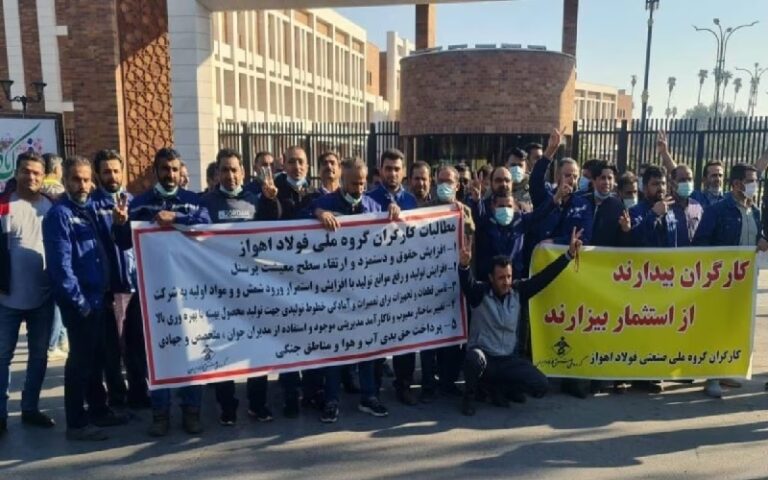
On Tuesday, March 12, a group of retirees nationwide gathered in protest of the living conditions and the authorities’ indifference to their demands in several cities in Iran. Simultaneously, there were reports of worker strikes in Aghajari, protests by nurses in Rafsanjan, and the gathering of municipal employees in SarPol-e Zahab.

The continuation of economic protests in Iran occurs while, according to official statistics from the regime’s Statistics Center, in the three years since the inauguration of the Raisi government in 2021, basic commodity prices have grown between 125% and 290%.

Migration Crisis: 3,000 Nurses Left Iran Last Year

0

Abolghasem Aboutalebi, a member of the Supreme Nursing Council in Iran, has described the situation of nurses’ migration from the country as a “near crisis” and called for finding solutions.

According to Aboutalebi, while approximately 10,000 nursing personnel are trained in the country annually, nearly 3,000 nurses migrated last year.

Officials from the regime’s Ministry of Health state that the destination of nurse migration includes a wide range of countries, from neighboring nations and the Persian Gulf region to Western and European countries, as well as South Africa.

Aboutalebi also criticized the slow hiring of nurses, stating that to meet the standard of 2.5 nurses per bed, the current number of 240,000 nurses in the country should triple.

On December 11, 2023, the regime’s official IRNA news agency, in a report titled “Nurses Migrating, Officials Watching,” quoted Mohammad Sharifi Moghadam, the Secretary-General of the Nursing House, highlighting the consequences of the nursing shortage, including patients losing their lives.

Sharifi Moghadam also reported dissatisfaction among over 90% of nurses in Iran, attributing it to livelihood problems, income disparities, discrimination within the medical staff, improper implementation of tariff laws, staff shortages, mandatory overtime with “very minimal compensation,” and job burnout.

In explaining the income gap between healthcare staff, Sharifi Moghadam stated that the average salary of a newly hired nurse is 90 million rials (approximately $151), which doesn’t even cover the cost of renting a home, while a specialized government-employed physician earns over 1.4 billion rials (approximately $2,345) per month.

Nurses are among the groups that, in recent months, have expressed their job and livelihood dissatisfaction through mass protests to Iranian regime authorities, demanding attention to their grievances.

These protests have faced punitive measures from Iranian officials, including a six-month suspension from service for protesting employees.

While the wave of migration from Iran is not limited to nurses and encompasses a broad spectrum of students, workers, physicians, and specialized professionals, experts have warned about the consequences of the workforce leaving the country.

Morteza Ezati, a university professor and economic expert, recently discussed with the website “Khabar Online,” considering migration as a cause of exacerbating “serious crises” in Iran’s economy and predicting that its consequences will soon manifest in society and the economy.

Long Food Queues and Empty Tables in Iran at the Beginning of Ramadan

The release of various videos depicting long queues for “government-subsidized meat” in Iran during the month of Ramadan has sparked significant reactions. Now, the regime’s media outlets report insufficient meat supply for distribution to the applicants, stating that people, despite hours of waiting, return home empty-handed.

The state-run Khabaronline website has announced that these long queues reflect a bitter reality that has been witnessed for months. With reference to economic indicators and statistics presented by the Statistical Center, it is predicted to persist.

The report emphasizes that while officials claim economic improvement, the reality is that “people’s purchasing power has sharply decreased, and their food basket has shrunk.”

The coupon plan illustrates the depth of the catastrophe, forcing people to wait in these long lines to obtain food.

Reviewing reports published in other media outlets also indicates that the government’s target in this plan is more than 60 million out of Iran’s 85 million population.

On March 12, Ham-Mihan newspaper criticized the government’s supportive policies, stating that the supply of “regulated market meat” is much less than the existing demand. The newspaper questions, “Why do people have to stand in line for hours to get meat, only to sometimes return home without receiving any?”

Media outlets have compared images of various queues, including meat queues in Iran, to the era of the eight-year war between Iran’s regime and Iraq.

In many of these reports, a partisan approach is evident, attempting to attribute existing problems to the government of regime President Ebrahim Raisi. However, a review of reports and economic indicators during the regime’s rule in Iran shows that the economy has never been on a balanced and scientific development path. It is clear that the economic situation has worsened during Ebrahim Raisi’s term.

Statistics indicate that Iran’s economy has been in a downward spiral over the past four decades, and despite reductions in the pace of this decline in various governments, the trajectory has not changed.

Experts believe that given the macroeconomic policies, often considered “mistakes” by many specialists, and the entrenched inflation in the near future, we might witness people lining up for all goods.

Iran’s Regime Draws Money From Pension Funds Without Notifying Retirees

While Iranian media have reported that the government has deducted 10 million rials from the pensions of retirees in March, the head of the Retirees Association of the Social Security Organization says they were supposed to pay the debts of retirees of this organization to the “Petrochemical Shares.”

In this regard, Parsineh newspaper wrote: Retirees’ March salaries have been deposited under conditions where, without notification and permission, 10 million rials (approximately $17 which is around one-eighth of the minimum wage for workers)  have been deducted from their accounts, and text messages have been sent by the Retirees’ High Association of Social Security to retirees and pensioners, stating that the Social Security Organization is in the process of creating a cooperative company for retirees and investing in the shares of companies. This process will be realized through participation in the auction with the allocation of 150 million rials (approximately $252) in cash deductible from the March pension.

In response to this news, the head of the Retirees Association of Social Security Organization told the regime’s Fars News Agency: “It was agreed that 52% of the shares of Amir Kabir Petrochemicals would be transferred to the retirees of this organization, and it was said that pensioners who do not wish to buy these shares can withdraw by sending a withdrawal text message.”

Some experts say, firstly, the Retirees’ High Association has no right to establish any investment institution, and this action is against its articles of association. Secondly, this investment trick can lead to major abuses by creating a layer of capitalists and, with the credit of a trade union, wipe out the meager rights of retirees.

This is happening while, according to reports, a group of retirees from the Social Security and National Pension Organization gathered on March 10 in protest of the economic situation in several cities, including Arak, Isfahan, Ahvaz, Shush, and Kermanshah.

The continuation of economic protests in Iran is happening while an economic media outlet, by examining official data from the government’s central statistics agency, reported that since the inauguration of the government of Ebrahim Raisi in 2021 until now, that is, in the past three years, the prices of essential goods have grown between 125% to 290%.

Iranian Authorities Set 30-Million-Rial Fine for Violating Hijab Rules

0

Babak Negahdari, the head of the Research Center of the Iranian regime’s Majlis (Parliament), has defended the imposition of a “cash fine” for opponents of mandatory hijab instead of dealing with them through the Morality Police. However, the spokesperson for the regime’s State Security Forces (SSF) says that such an order has not been communicated yet.

Negahdari, in a conversation with the state-run ILNA news agency on March 10, admitted that the Morality Police led to “clashes in the public sphere of society” and added that the images of police officers’ confrontation with women “were being exploited by enemies of the revolution and Iran.”

He stated that the Majlis took action to “eliminate the Morality Police and replace it with cash fines to remove the undesirable images created by the clashes in the public sphere.”

While announcing the removal of the Morality Police, he reported on the presence of unmarked police vans in the streets and their confrontation with women without specifying their authority, which has been widely reported this year.

The clash between the Morality Police and Mahsa Amini in September 2022, resulting in her death in detention, marked the widest protests in the history of the Iranian regime.

Last week, Amir Hossein Bankipour, a member of the parliament, announced in a television program the possibility of implementing the “Hijab and Chastity” bill after the Persian New Year, specifying a fine of 30 million rials (approximately $51) for not observing mandatory hijab.

It is worth mentioning that the minimum wage for a worker in the year 2023 was around $135.

He mentioned that this amount would be deducted from the individual’s account by a “system,” and if there was not enough money, the person would become a “debtor” and, in case of repetition, would have to go to “court.”

His statements were met with widespread reactions.

Meanwhile, Saeed Montazer al-Mahdi, the spokesperson for the SSF, said to reporters about the 30-million-rial fine for not observing mandatory hijab: “Such a matter has not been communicated to us yet.”

In the ongoing conflict between the regime and its supporters with women, a video circulated on social media on Saturday, March 9, showing a Mullah filming a mother holding her child in a medical center in the city of Qom.

The prosecutor of Qom, without providing details, announced the formation of a legal case in this regard and stated that an order has been issued to “identify individuals who transferred the image to the media.”

In this case, Iran’s criminal regime again intends to arrest those who have published these images instead of addressing the case.

House Rent Has Become the Main Economic Concern of Iranians

An examination of Iranian citizens’ messages on social media indicates that house rent has become one of the most significant economic concerns for Iranians. A considerable number of messages shared by users on a daily basis on social media focus on issues related to rent, high costs, and inflation in this domain.

The common theme in these messages is the inability to afford house rent and the monthly increasing expenses, especially in the capital.

According to a survey, the average share of rent in the expenses of Tehran households has exceeded 50%, and residents of the capital, on average, spend around 150 million rials (approximately $252) monthly on house rent.

More than 50% of the survey participants declared monthly incomes and salaries of less than 160 million rials (approximately $269).

A March 9th report in Etemad newspaper examines the relationship between rent inflation and overall inflation in Iran, noting that, except for some initial months of the year, in the second six months, rent inflation has surpassed monthly general inflation.

According to the report, comparing rent inflation this year with that of 2022 shows that tenants in 2023 have faced a more challenging year. In late September 2023, the regime’s Donyaye Eghtesad newspaper reported a 12-year record-high annual increase in nationwide rents during the first half of the year, reaching 38.5%.

The report highlights that the recent six-month growth in rents has been unprecedented since 2011. A user on social media, referring to the days before the Persian New Year, wrote: “People are trapped under these skyrocketing prices… Besides house rent and utility bills, they are struggling to fill their stomachs, and whether it’s a holiday or not has become irrelevant to them.”

Another citizen commented on the situation: “Nights close to the Iranian New Year, for some, are reminders of unpaid debts, bounced checks, unmet demands, medical expenses, empty bank accounts, house rent, school fees for children, and a broken-down car.”

Etemad, citing Abbas Akbarpour, a real estate market expert, reported on March 9 that if the declared inflation rate is around 40%, the rent rate exceeds this figure, with the primary reason being the increase in the foreign exchange rate in the market.

According to Akbarpour, in one instance alone, the Euro-to-rial exchange rate has faced a 25% growth in the last two weeks, which has had a significant impact on all items, including rents.

The real estate market expert further stated: “If the increase in rent rates is higher than inflation, landlords in this ailing economy won’t benefit much from these rates, but whether tenants comply with these rates for rent renewal is crucial.”

In August 2023, online news outlet Faraz published a report indicating that many families, due to the inability to pay house rent, have migrated from Tehran and stored their household items in rented containers.

On October 11, 2023, the state-run ILNA news agency reported on income and expenses of workers, stating that on average, about 55% of workers’ salaries in provinces go towards house rent.

According to the report’s data, in the capital, workers’ entire salary is spent on rent.

A social media user on X, referring to the widespread concern about house rent, wrote: “Until around the age of 20, we had no understanding of house rent or the prices of household necessities and expenses. I traveled in a bus with school children and saw today’s 10- and 12-year-olds fully aware of the house prices in their area and knowing that high rent brings them trouble.”

Despite the denial of inflation and skyrocketing prices by Iranianauthorities, some official reports indicate a significant disparity between incomes and citizens’ public expenses.

Babak Negahdari, the head of the parliament’s research center, stated on October 8, 2023, that housing prices and rents had increased tenfold from 2018 to the present.

Based on this, if five years ago, the rent for a small apartment was about 10 million rials, today, a family renting the same, likely older, house must pay at least 100 million rials per month.

Canada Sanctions Iranian Officials Over Women’s Rights Violations

0

On Friday, March 8th, the Canadian government, in conjunction with International Women’s Day, announced sanctions against Masoud Dorosti, the CEO of Tehran Metro, and Zahra Elahian, a representative in the regime’s Majlis (parliament), for their involvement in the suppression of Iranian citizens, particularly women and girls.

According to a statement from the Canadian Ministry of Foreign Affairs, these sanctions were imposed in response to the systematic and severe ongoing violations of human rights, especially those of women and girls, and the continuous actions of the Iranian regime to destabilize peace and security in the region.

The statement further mentions that Masoud Dorosti is sanctioned for enforcing compulsory hijab laws in public transportation, while Zahra Elahian is sanctioned for supporting the execution of protesters during nationwide demonstrations.

Mélanie Joly, the Minister of Foreign Affairs for Canada, stated in relation to the seventh round of Canadian sanctions against Iranian regime authorities and institutions since the start of protests triggered by the killing of Mahsa (Zhina) Amini, that Canada will always defend the rights of women and girls. She emphasized that the message is clear: this behavior must come to an end, pointing to the Iranian regime’s ruthless and harsh tactics against women.

The Canadian Minister of Foreign Affairs pledged that Canada will continue to raise awareness about these severe human rights violations and advocate for accountability for those involved.

Since the beginning of nationwide protests in 2022, the United States, Canada, the United Kingdom, and European countries have implemented numerous sanction packages against individuals and entities involved in the repression of Iranian protesters.