Home Blog Page 287

Retirees’ Protests Mirror Explosive Situation of Iran’s Society

It is not an exaggeration to say Iranian society is on the verge of collapse and a social explosion. At every corner of the country we are witnessing daily protests by all strata. From the students to the workers to the retirees and women, who have nothing more to lose anymore.

One example are the retirees who now for the third time since the Persian New Year have taken to the streets to protest their miserable livelihood situation and low wages, which are breaking their backs under the burden of high costs and inflation.

Their protest this time took place in Tehran and 26 other cities while the regime’s police force was fully prepared and tried to prevent anyone from filming and or joining them by attacking the protesters.

The repetition of the protests and its maturation into three protest movements this year shows the social readiness. This fact is clearly crystallized in the slogan of the retirees.

“For as long as we do not get our rights, we will come here every Sunday.”

“Only on the streets will we gain our rights.”

Reaching the point that only by coming to the streets to gain the rights is a blessed achievement for the social movement and a serious alarm for the regime.

The regime’s options are very limited. On the one hand it cannot repress these protests because it fears the consequences of the spread of these protests. On the other hand, it cannot ignore them because it will have the same effect and more people will join these protests. This is a situation in which the regime is stuck.

In a situation whereby the regime needs a silent society to run its presidential election, such protests are very dangerous. Among the protesters’ recent chants were: “We will not vote anymore, because we have heard too many lies.”

This slogan targeting the regime’s election. Its repetition and expansion is very dangerous for the regime’s legitimacy.

The regime’s officials are well aware that any mistake could well be their last mistake, especially because of a society after the November 2019 protests. Previously the regime’s Parliament Speaker Mohamad Bagher Ghalibaf said:

“Today we face various challenges in the system. We are witnessing economic problems in the system. People’s livelihoods are under pressure to the extent that the issue of supplying and distributing chicken simply plays with the people’s soul.

“These issues are due to poor management, not lack of resources. Today, the enemies enter the economy to weaken the system, so the dichotomy of poverty and wealth has become more important to the system than the dichotomy of war and peace. If the demands are not answered accurately, in a timely manner and quickly, we will face different problems every day.”

He was evidently confessing to the self-made social gap in the society and its danger for the regime, which will lead to more protests as he said that ‘we face different problems every day.’

“The mentioned inefficiencies cause problems that the police have to bear the burden of, and any action in this direction causes various problems.” (ISNA, April 10, 2021)

While requesting more law enforcement and the allocation of more resources to it, Ghalibaf was trying to reduce and cover up the people’s hatred and disgust for these forces and said: “Today, law enforcement is at the heart of people’s lives, and NAJA (police) commanders often meet with people more than their own forces, so it is important to know the phenomena before taking any action. NAJA is successful when it can move actively and ahead of phenomena.”

‘Moving actively and ahead of phenomena’, means that the regime’s forces should have the society’s pulse in their hands, to predict any uprising and prevent it in time.

Tragedy of Iran’s Student Dropouts, An Ominous Gift From the Rulers

Iranian lawmaker Behrouz Mohebi pointed to the 30 to 40 percent rate of student dropouts in Iran and showed his concern about the consequences for the country.

In his opinion one of the reasons for such a phenomenon is ‘the lack of proper infrastructure for using software and internet space for virtual education’ in many cities which forces the students to drop out. (ILNA, April 2, 2021)

The Arman state-run daily pointed to one of the societies’ concerns over ‘the situation of those students’ who are forced, ‘because of the lack of a smartphone or tablet are forced to dropout,’ and spoke ‘about the uncertain educational fate of 6 million students.” (State-run daily Arman, April 3, 2021)

In the Khorasan Razavi province, there are more than 40,000 student dropouts which is indicating a 300 percent increase in students leaving school in this province, while independent watchers are seeing this number much higher than this in this province and of course in the country.

But this situation is not specialized just to the last year and because of the coronavirus outbreak. Many students due to extreme poverty quit their school and are working on the streets as vendors to provide a livelihood for their families, endangered by social hazards and addiction.

Javad Hosseini, Deputy Minister of Education, said that 5 million of the students who drop out are not benefiting from smart devices for their education.

And the state-run daily Mouj which quoted this expression added that this statistic is more than just a news announcement, but a social catastrophe.

This is while in any country, children are the creators of the future of the country, and they must grow in a proper educational system and bear the burden of responsibility, guidance, and growth of the country.

But with the conditions mentioned above, children and students in Iran are far from this goal, because the educational system in Iran is burning out the country’s talents.

And children who are going to school also have to learn in miserable conditions. Difficult living and educational conditions will force them in the future to drop out of school, willingly or unwillingly, joining the working children and street children. The catastrophic situation of the classrooms and schools is further exacerbating this situation.

Eskandar Momeni, Secretary General of the Anti-Drug Headquarters, said: “A careful survey was conducted in the community and the result was that 90 percent of students who drop out the school, they turn to one of the social harms such as addiction. (State-run daily Khabar Fori, January 5, 2021)

Another issue that accelerates the process of children dropping out is frustration about the future after their graduation. Seeing the educated unemployed youth, they prefer to leave school so that they may be able to find work. But because there is no employment for them, they are trapped in various social harms.

What is happening to the children of Iran and their education is not the result of ignorance or negligence, but the result of the government looting and corruption, whose first target are children and adolescents of Iran, dissidents say.

Iran’s Internal and External Security Weaknesses

The Iranian government is facing extreme security crises. The latest explosion at Iran’s uranium enrichment facility in Natanz speaks volumes about this situation. Crises which are now joining the social crises and making the situation even worse for the government. Another fact about its weakness is its isolation in the region.

These situations cumulated show the government is in a process of deep decay. Many of its forces have now defected and are working for foreign services, as it was seen in the assassination of the Mohsen Fakhrizadeh Mahabadi, a commander of the Revolutionary Guards (IRGC) and a senior official in the nuclear program of Iran.

Similarly, the latest explosion in Natanz’s nuclear facility shows how deep the intelligence services of other nations have penetrated the most important security centers, which is alarming for the regime and shows its weakness.

There is also another conclusion to be made from the Natanz explosion. Despite what Iran’s supreme leader Ali Khamenei and commanders of the Revolutionary Guards want to show, their forces are weak in confronting the people.

The state-run daily Setareh-e-Sobh on April 13, describing the current critical situation of the regime in the region, in an article by a government expert wrote:

“With the strengthening of Israel’s military and security alliances with the sheikhdoms in the Persian Gulf, the regime’s security links in the region have become more limited, and the level of pressure from those countries is increasing. Issues such as the Saviz ship, attacks on Syrian positions and the recent incident in Natanz show this.

“Meanwhile, the recent incident in Natanz has another message, and that message is that, unfortunately, the country’s defense and security system is in trouble against foreign sabotage, including the Israeli regime’s attack on nuclear sites, and this major weakness needs to be compensated as soon as possible.”

Ali Bigdeli, a government expert, said about the Joint Comprehensive Plan of Action (JCPOA) talks with world powers in Vienna:

“As livelihood and economic problems put pressure on the Iranian people, the diplomatic team needs to do its utmost to resolve the issue of the JCPOA by taking on the task from within. If the system fails to resolve this issue in the current situation, [US President Joe] Biden would also conclude that he must return to the Arab and Israeli worlds and increase the pressure on (the regime).

“So, my suggestion is that the authorities show more flexibility at this critical juncture. To say that a verification should be done is not in the text of JCPOA at all, and the United States cannot promise that a French or German company, for example, would come and invest in Iran.

“These issues also depend on Iran’s foreign trade policies and the acceptance of certain international rules and regulations, such as the FATF Bills, and to expect countries to commit to Iran’s corporate trade cooperation is an expectation beyond the basics of political science. Therefore, it is hoped that on Wednesday, when the diplomatic team enters a new round of negotiations on the revival of the JCPOA in Vienna, they will negotiate more flexibly.”

The state-run daily Setareh-e-Sobh wrote about the incident at the Natanz nuclear facility:

“This is not the first time that the finger of blame for the events and issues is pointing at Israel. On July 2, 2020, an incident that led to the failure of the Natanz Advanced Centrifuge Assembly Center was announced as Israel’s doing by some media outlets. Also on April 7, this year, the attack on the Iranian ship ‘Saviz’ in the Red Sea was attributed to Israel.

“Mohsen Fakhrizadeh, head of the Research and Innovation Organization of the Ministry of Defense, was assassinated on November 27, 2020 in the ‘Ab Sard’ city of Damavand after a car exploded by firing with a remote-controlled machine gun.

“From 2009 to 2011, prominent Iranian nuclear figures and scientists, including Dr. Majid Shahriari, Dr. Masoud Ali Mohammadi, Mostafa Ahmadi Roshan, and Dariush Rezainejad, were martyred during operations by attaching magnetic bombs to their cars, where the Ministry of Intelligence named Mossad as one of its perpetrators.”

Hesamodin Ashna, security advisor of Iran’s president Hassan Rouhani, showed the extremely weak position of his government as he said: “Iranians will continue their activities in both Natanz and Vienna. In Natanz by increasing the power of enrichment machines and in Vienna by reducing the bargaining power of the western sides.”

Which is a vise versa request for the continuation of the negotiations.

Spying On Iranian Citizens Among the Provisions of Agreement With China

After the Iranian government signed a 25-year contract with China last month, the concerns of Iran’s people are becoming real. Until now many parts of the contract have not been made public and parts of it which are now public are not telling the truth about the dark purpose harming the people and the interests of the country.

Now after two weeks it has become clear that one part of it is the government’s goal of spying on the people with the help of China by gaining full control over the internet.

Iran’s government has a long history of internet censorship and is one of the worst countries in the world for internet freedom. The Telecommunication Company of Iran (TCI), the Ministry of Culture, the Islamic Guidance, the Intelligence Ministry and the Revolutionary Guards (IRGC) are working together to put a strict control on the internet, according to Iran experts. Working alongside native internet service providers (ISPs) to implement content-control software of the websites and email and spying on the people’s communication in the social media.

In 2010, Reporters Without Borders included Iran on its list of 13 countries designated as “Enemies of the Internet”. And on Freedom House’s internet freedom status map, Iran has a score of 15 from 100 which is indicated as ‘not free.’

This score was based on three areas that Freedom House tracked:

  • 7 out of 25 points for obstacles to access
  • 5 out of 35 points for limits on content
  • 3 out of 40 points for violations of user rights.

The report noted that Iranian authorities have a 42,000-strong army of volunteers who monitor online speech. Key internet controls used by the regime included:

  • Social media or communications platforms blocked
  • Political, social, or religious content blocked
  • Progovernment commentators manipulate online discussions
  • Blogger or ICT user arrested, imprisoned, or in prolonged detention for political or social content
  • Blogger or ICT user physically attacked or killed (including in custody)
  • Technical attacks against government critics or human rights organization

By alibis like “counter-revolutionary”, “anti-Islamic” or “anti-social” the government is trying to restrict the people’s access to the internet, while in truth they are fearing the people’s awareness over a free world and their connection with the regime’s opposition. The goal is to prevent any protests and voices against its rule, according to activists.

The application of internet censorship and its enforcement is the responsibility of the so-called Supreme Council of Virtual Space.

In one its latest enactments on September 15, 2020, this council in its 66th meeting approved the so-called ‘Master Plan and Architecture of the National Information Network’, which was informed to the regime’s supreme leader Ali Khamenei, and its start was approved by the Secretary of this council on October 7, 2020.

This is just one of the many levers of Iran’s government to crack down on the people’s access to the internet. The Committee to Determine Instances of Criminal Content (CDICC) makes the decisions on censorship, which is just a cover for the censorship of opponent voices.

In the protests of the past years, there were multiple reports that mobile data and foreign websites were difficult to access, which could be an indication that traffic is being blocked or throttled.

In 2016, Iran invested $36 million to develop “smart filtering” technology. This was based on existing Chinese software. The software would allow authorities to censor the internet access of its citizens selectively.

The 25-year Iran-China contract not only is selling the country to China, but is also taking away the people’s freedoms. In an interview with the state-run Mehr news agency, Mahmoud Nabavian, one of the regime’s clerics and the Vice Chairman of the Commission of Principle 90 of the regime’s parliament, said about the regime desire on internet control:

“At the moment, unfortunately, we do not have control over cyberspace, search engines, social media, and e-mail, and we have lost control of it, and it is very important for us to be able to control our cyberspace by working with the Chinese. Produce tablets, laptops and mobile phones and cooperate with China in the field of artificial intelligence.” (State-run news agency Mehr, April 11, 2021)

For the government of Iran and Khamenei, apparently, it seems that cyberspace is the Achilles’ heel. So, it is using any source to restrict this tool of the free world, mostly with the help of countries who are appeasing this regime.

Iran Sentences Two Protesters to 13 Years

The Iranian Judiciary handed down long prison sentences to two protesters arrested during the November 2019 nationwide protests.

Jalal Namdari, from Kermanshah, and Saeed Khaledi, from Paveh, were sentenced to a total of 13 years in prison for taking part in the anti-regime protests that sprung up following the government’s overnight tripling of fuel prices.

Khaledi will serve three years for “acting against the national security and cooperation with dissident opposition groups” and another year for “spreading propaganda against the establishment”. While Namdari will serve five years on the charge of “acting against the national security and cooperation with the People’s Mojahedin Organization of Iran (PMOI/MEK)” and another three for “assembling and collusion for crimes by participating and encouraging people to participate in the November protests”.

Namdari, currently held in Kermanshah’s Diesel Abad prison, was arrested on December 30, 2020, by the Revolutionary Guards’ (IRGC) intelligence unit. Khaledi was arrested just after and released on bail until the verdict.

This comes at a time of increased worry over human rights abuses of the many thousands arrested during the November 2019 protests, which doesn’t even account for the 1,500 killed by the security forces, as they opened fire on huge crowds.

Amnesty International reported in September 2020: “[Our] research shows that many of the arrests took place during the five days of protests, but, in the days and weeks that followed, the pattern of mass arrests continued, particularly in provinces that had suffered high death tolls in a context in which the authorities had stationed significant numbers of security vehicles and personnel in public places to deter further protests.”

Eight high ranking IRGC figures and three Iranian prisons were sanctioned by the European Union on Monday for their role in the November 2019 protests. This included Revolutionary Guards head Hossein Salami who, according to the EU, “took part in the sessions that resulted in the orders to use lethal force to suppress the November 2019 protests [meaning he] bears responsibility for serious human rights violations in Iran”.

Maryam Rajavi, the President of the National Council of Resistance of Iran (NCRI), welcomed the sanctions saying that “firmness is the only language Iran’s ruling mullahs understand”. She went on to say that the IRGC and Intelligence Ministry (MOIS) should be sanctioned as a whole, with their assets in Europe expelled.

She wrote on Twitter: “They’re not political refugees or ordinary citizens, but MOIS spies and terrorists.”

Iran: Economic With the Truth

Iranian officials alternate from saying that their economy is doing fantastically despite international sanction and saying that it’s failing because of US sanctions. Trouble is, neither of these statements is true and a quick look at the data proves that the economic crisis is down to the mullahs’ misguided policies and institutionalized corruption.

The state-run Jahan-e Sanat daily warned last week that “economic freefall is on the horizon”. In fact, they likened the situation to that of having a “painful and fatal heart attack and [slipping] into a long coma” if nothing is done to cure the problems.

They quoted economist Mohsen Rannani as saying: “Economic and social crisis has driven the country to a dangerous point. If [authorities] do not act quickly to control and manage these crises. In that case, the country will enter an irreversible path.”

Meanwhile, former Minister of Urban Development Abbas Akhundi said that the country’s inflation rate since 1969 is a horrific and disturbing “546845%”. He further explained that national investment growth over the past nine years has been “negative 6.8%”, which means that investment has gone down to 52% compared with 2011 and that the inflation rate increase next year will mean “absolute poverty”.

The Iranian Resistance wrote: “In other words, Iran’s economy under the mullahs’ regime has no solution. People pay the price of the regime’s economic mismanagement and corruption. For example, while Iran is going through the fourth wave of the coronavirus outbreak, thousands of Iranians stand in long lines to purchase poultry at the government-set price.”

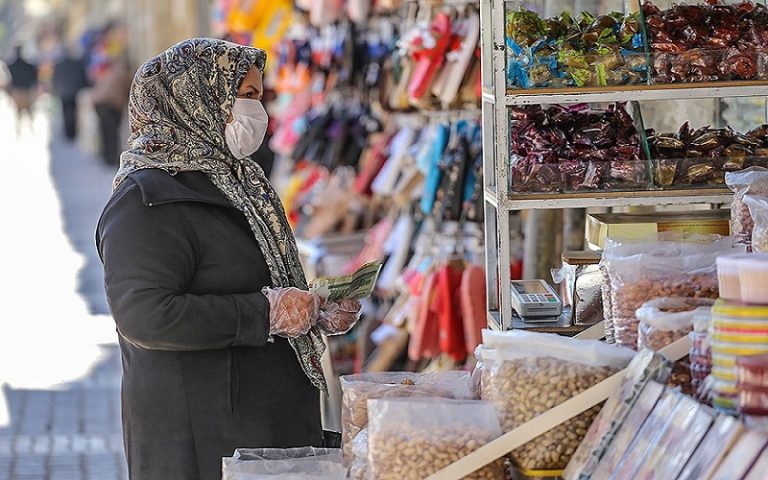
Yes, the Iranian people are finding it hard to buy even basic food items, like chicken, eggs, fruits, and vegetables, because of inflation and price rises above inflation. Their purchasing power has dropped considerably and this is concerning for industries across the board.

Despite this, the government claims to have controlled the crisis, but how can they when the situation is so dire on the streets? And how can they blame sanctions when the rulling system has been wasting money on terrorism and printing bills to meet the budget deficit?

The Siyasat-e Rouz daily wrote Wednesday: “Tying all problems to sanctions is going on for years. Sanctions are not the reason for all of Iran’s economic crises. According to economic and political experts, 30% of problems are due to sanctions, but 70% of problems are due to mismanagement, [wrong] decisions, and governments’ planning. Should we blame sanctions for skyrocketing prices and the scarcity of poultry? [the regime’s] recklessness and disabilities are not involved in this [crisis]?”

Natanz Site a Cemetery for Khamenei’s Aspirations

Iran’s Supreme Leader Ali Khamenei is fast pursuing a goal of announcing himself as a nuclear power by surprising the world, analysts argue. In that case, the nuclear bomb would be in the hands of a government that is known as the main sponsor of international terrorism and fundamentalism and this would be a disaster for the world.

And this is an unavoidable path for Khamenei. He knows that this is the only way to secure his regime. Khamenei’s main nuclear project is at the Natanz site. But since this site is the main focus of Khamenei, it is also raising the attention of other parties in the world, especially intelligence services.

Some reports say this site was attacked for a second time on Sunday, April 11, 2021. The regime’s officials first claimed that the event on Sunday was just an accident, while the power of the site was cut off. But later the head of the Atomic Energy Organization of Iran Ali Akbar Salehi, presented this ‘accident’ as ‘nuclear terrorism’ and said that “we consider our right to take action against agents and advocates.”

He added: “The action today against the Natanz Enrichment Center represents the failure of the opposition of nuclear progresses and negotiations.”

He demanded the international community confront this “nuclear terrorism.” He said that the goal of the perpetrators of this action was to “avoid impressive development of the nuclear industry on the one hand and successful negotiations to eliminate the cruel sanctions.”

Although Israeli sources confirmed the involvement of this country in the Natanz explosion and Salehi had confirmed foreign agents’ involvement, the head of the technical group of the examination of the incident in a conversation with the site “Noor News,” which is close to the Supreme National Security Council, called this ‘media propaganda.’ According to this official, whose name was not disclosed, “The technical group is investigating the occurrence of today.”

The incident on Sunday, April 11, led to the cutoff of electricity at the uranium enrichment facilities in Natanz. Due to this incident, Iran’s ability to enrich uranium suffered a severe blow. Specialists said that the Iranian government needs at least nine months to return to the situation before the blast.

It should be noted that in July 2020 the Centrifuge Assembly Center at Natanz facility was attacked for the first time. But government officials never published a final report on the nature of the attack and damages. Although most of the Natanz nuclear facilities are built underground, it is the second time that due to mysterious attacks, severe damage has hit this site.

The amazing point was that the night before this incident, Salehi in an interview on state TV on April 11 said: “The centrifuge assembly hall was demolished by our enemy a few months ago. But we did not step back, and we constructed a temporarily salon, which was the compensator of the lost salon.”

Israel’s Kan public radio cited intelligence sources, whose nationality it did not disclose, as saying that the Mossad spy agency had carried out a cyber-attack at the site.

Iran’s Misogynous Birth Rate Bill

The current Iranian parliament is only 5.7% female. Even those women who are MPs are from the fundamentalist faction, which is controlled by Supreme Leader Ali Khamenei, and therefore represent misogynous attitudes and cruel policies.

It’s therefore no surprise that they supported the Population Growth and Family Support Plan, which effectively marginalises women by making them stay home to have and raise children in order to raise the birth rate to at least 2.5 children per woman.

Fatemeh Mohammad Beigi, a member of the Presidium of the Parliamentary Health Commission, called it “among the best laws in the Islamic Republic of Iran in history”, but its really just a way for authorities to keep young women at home and away from protests that could spell the overthrow of the dictatorship. (The government has systematically failed to help women over the past four decades, which is why so many of them are rebelling against the mullahs.)

Worse still, 80% of Iranians live in poverty. How can they keep their heads above water with more mouths to feed?

After all, even if the plan requires the government to use its own facilities to provide housing or land to families with three or more children, there’s still a shortage of five million housing units

Mohammad Eslami, Minister of Roads and Urban Development, said: “Statistics show that the number of houses is greater than the number of households. However, housing distribution has major drawbacks. In the meantime, poverty is gradually rising in a society in which people cannot afford to buy or rent a house.”

Low-income families with one or two children will also be worse off in terms of energy costs, taxes, subsidies, tariffs, stimulus payments, wages, and insurance premiums, to name just a few. The promises on maternity leave, job security, and support packages sound great but they don’t gel with the history.

Additionally, article 28 of the bill warns against the promotion of any program that conflicts with population increase and advises that these be changed to help support an increased birth rate. Although, as an important reminder, without programs to improve healthcare, education, and lift people out of poverty, this scheme is flawed from the start.

The Iranian Resistance wrote: “It seems that Parliament’s real role is to maintain Khamenei’s full sovereignty and hegemony. In this regard, women, who are the first victims of this misogynistic regime and suffer the most repression, should stay at home and lose their influence in the protests. This will never happen.”

Iran’s Coronavirus Crisis

Over a year since the coronavirus first found its way to Iran, President Hassan Rouhani is acknowledging the seriousness of the problem as a fourth wave ravages the country due to the failure of the officials’ policy.

He said on Saturday: “We have a hard period ahead of us.”

The biggest issue is that mullahs’ used the pandemic to stop their overthrow, hoping that people would be too terrified of catching a deadly disease that had run rampant because the mullahs enforced no safety precautions to gather in large crowds and overthrow the government.

At first, shortly after the November 2019 and January 2020 major protests, the authorities denied that the virus was in the country at all, allowing it to spread silently. Supreme leader Ali Khamenei even called this virus a “test” and “blessing”, proving that he should not be trusted with the country.

Now, even officials and media outlets are terrified because it is backfiring on them. Predictably, the general public doesn’t like it when their rulers allow them to die en-masse when many deaths were preventable.

The state-run Jahan-e Sanat wrote last month: “Although the coronavirus crisis delays the conflict, delaying it at the cost of overwhelming issues is a challenge in society. In other words, when society is freed from the clutches of this disease, political, social, and economic faults will begin to move with greater destructive power.”

Another reason that anger is burning white-hot in the hearts of Iranians is that the Iranian Resistance has been exposing the government’s cover-up, which includes shifting blame to the people. All of this has increased infighting amongst the mullahs.

Mashhad’s Friday prayer leader Ahmad Alam-ol Hoda said: “Whatever they [Rouhani’s government officials] said was the opposite. They said the coronavirus is over. Then from where this fourth wave come from?”

While Deputy Health Minister Iraj Harirchi said: “The National Covid-19 Combat Task Force refused to use [Persian New Year] holidays to control Covid-19 crisis.”

To sum up, Iranian officials are worried that this crisis will be the last straw and that the people will soon overthrow the government because they are terrified that the situation will only get worse with the mullahs in charge.

The Jahan-e Sanat paper wrote: “If crises pile up and the rulers do not listen to the voices of the protesters, the continuation of such a phenomenon can end the patience of the people. If there is no change in Iran soon, the mental state of the society will soon become more dangerous.”

One Hundred Nurses Emigrate From Iran Each Month

“The rate of nurses’ emigration has become increased in comparison to the past years, and 100 nurses monthly emigrate from Iran on average. Other countries strongly welcome Iranian nurses,” said Mohammad Mirza-Beigi, the director-general of Iran’s Nursing Organization, on Thursday, April 8.

Nurses’ emigration has dramatically grown while the country extremely needs the human resources in health and medical sectors due to the coronavirus outbreak. Iran is the worst-hit country in the Middle East regarding the illness. According to the Health Ministry, 63,884 people have lost their lives to the pandemic as of April 8.

Health professionals, and even members of the country’s Covid-19 combating headquarters, challenge official statistics, reckoning this number is not the whole story. According to Iranian dissidents’ reports, the actual number of fatalities is four times the Health Ministry’s figure.

“Over 246,400 people have died of the novel coronavirus in 535 cities checkered across all of Iran’s 31 provinces,” stated the opposition Mojahedin-e Khalq (MEK).

Why Nurses Emigrate from Iran?

Contrary to other countries, Iranian nurses face enormous dilemmas in various aspects. Despite their sincere work amidst the Covid-19 crisis, thousands of these selfless people have yet to receive their monthly salaries for months. This is while Iranian nurses endure additional hardship due to the country’s lack of adequate health and medical staff, which has made the dilemma more complicated in the past 14 months.

“It seems that [the government] is wasting time. Such behaviors towards nurses are not an inspiration in this status quo,” said Mirza-Beigi. “In addition to 140,000 nurses who care for hospitalized patients, we have 60,000 nursing students in the grade of expert to PhD in the medical sciences universities. Also, we have 30,000 nurses who provide services for home care units in a community-oriented manner.”

The number provided by the head of Nursing Organization is far lower than the global average. It means there are three nurses for each 1,000 citizens while the global average is at least four to eight nurses for every 1,000 people. “In comparison to other countries that have at least between four to eight nurses per each 1,000 people, we have only 0.9 nurses, meaning that we have less than one nurse per every 1,000 people,” Mirza-Beigi added.

The catastrophe, however, is not limited to nurses alone. Their family members also tolerate backbreaking dilemmas in financial and even psychological fields. Iran News Update reported last year that 111 medical staff have died of Covid-19 in Iran as of April 17, 2020. Officials’ refusal to provide necessary equipment is the main reason for the high death rate among Iranian nurses.

In a September 3, 2020 report, Amnesty International announced that over 7,000 health workers had lost their lives globally to the coronavirus. The organization ranked Iran with 164—official figure—as the 11th country in term of fatalities among medical staff.

Also, former Science Minister Mostafa Moeen had already spoken about the high mortality cases among Iranian health workers. “Why should the casualties among our dear medical staff, whether doctors, nurses, or pharmacists, be higher than the international average? Regrettably, over 180 physicians, nurses, and other irreplaceable forces of health and medicine have been martyred, and over 6,000 have contracted the disease,” Moeen said in an interview with Sharq daily on August 2, 2020.