Home Blog Page 296

Misogynous Law Bans Iran Ski Coach From Travelling With Her Team

The head coach of Iran’s national Alpine skiing team was banned from accompanying her team to a competition in Italy because of a Misogynous law that means she had to get her husband’s permission to leave the country.

Samira Zargari was prevented from flying out last month, according to a source in the Ski Federation, despite repeated efforts by the federation to get the exit ban lifted so that she could attend the competition.

She was restricted by Paragraph 3 of Article 18 of the Passport Law, which states that married women can only obtain a passport with the written permission of their husband. Outside of marriage, she needs the consent of her nearest male relative, normally her father or paternal grandfather.

Zargari’s case is far from an isolated incident.

The captain of women’s national futsal team, Niloufar Ardalan, was banned from taking part in the Asian competitions in September 2014 after her husband made a complaint.

While in 2017, archer and Paralympian Zahra Nemati was prevented from leaving the country because of her husband’s refusal. Then, eight women who were on national Iranian sports teams were stopped from taking part in international tournaments following their husband’s complaints, according to MP Tayyebeh Siavoshi.

Read More:

Iran: World Record Hold in Domestic Violence

There are many misogynistic laws and structure in Iran that restrict women in employment. It is part of a system designed to keep men in the workplace and women in the home.

For example, Article 1117 of the Civil Code says that a husband can ban his wife from a job or industry that he deems would be against the interests of the family or the dignity of either spouse.

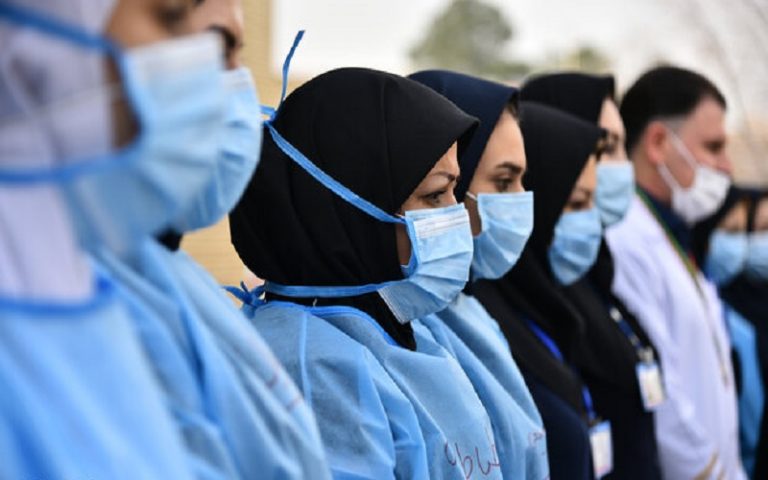
Last October, the Tehran Court of Appeals ruled that a female doctor in the emergency department, who examined 180-200 patients per day for COVID-19, was banned from practising medicine because her husband didn’t want her to do so.

This was the same time that the Iranian medical community was under intense pressure because of COVID-19 deaths among doctors and nurses, of whom there were already too few.

And now a new directive, introduced in 2021, means that married women wanting to take the dental residency exam must get their husbands’ consent. It has even been entered into the test that the husband agrees that, following the training period, his wife may serve in any place that the Ministry of Health and Medical Education wish.

This is presumably because there was a lot of women completing training and then being banned from taking a position, but this was not the way to deal with it.

Amnesty on Saravan Protests

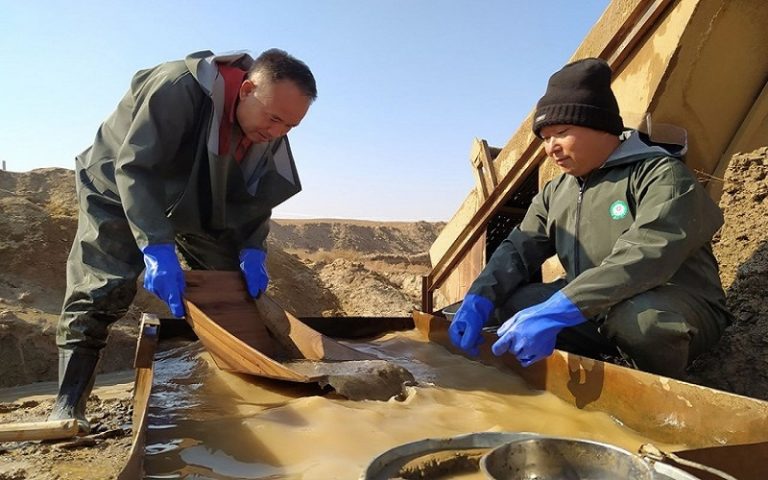
Amnesty International said that Iran’s Revolutionary Guards illegally used lethal force to subdue unarmed fuel porters in Saravan, Sistan and Baluchestan province, last month, in violation of international law.

The rights group used eyewitness testimony and video footage to determine that Revolutionary Guards at Shamsar military base fired live ammunition at unarmed fuel porters from the impoverished Baluchi minority, killing several, including a teenager, and injuring many more.

The porters were protesting the unannounced closure of the border, which left them unable to complete their job and without much food or water.

Read More:

Toiling for Bread in Sistan and Baluchistan

Amnesty’s Deputy Director for the Middle East and North Africa Diana Eltahawy said: “By opening fire on a group of unarmed people, Iranian security forces have displayed a callous disregard for human life. There must be urgent, independent criminal investigations into these unlawful killings, in line with international law and standards. Anyone against whom there is sufficient admissible evidence must be prosecuted in a fair trial, without resorting to the death penalty.”

The province’s deputy governor Mohamad Hadi Marashi said that the security forces’ “honour” was at risk, which is why they started shooting, but this was actually just an admission that they were not at risk of death or serious injury, which is the only time that international law permits the use of lethal force.

Eltahawy said: “The official justification the Iranian authorities have given for their deadly use of live ammunition reflects their complete disregard for international standards on the use of firearms. It also shows a shameless contempt for their obligations to respect and preserve human life and to ensure that public officials do not carry out extrajudicial executions by illegal use of firearms.”

One relative of a victim told Amnesty that families and injured victims were forced to sign a statement saying that the Revolutionary Guards were not responsible before bodies can be released or they were allowed to access medical care.

Eltahawy said: “When security forces wilfully and unlawfully use firearms against unarmed people, they either intend to kill or do not care whether their actions are likely to cause death. In either case, under international law, the killings resulting from their unlawful actions are considered not accidental, but deliberate, and should, therefore, be investigated as extrajudicial executions.”

The Military Prosecutor has reportedly opened a criminal case regarding the killings, but international law does not allow for military courts to investigate human rights violations and, given the lack of an independent judiciary, Amnesty has serious concerns about the impartiality of this trial.

Amnesty urged the international community to push for truth from Iran, including an accurate body count.

Iran’s Lost Dreams About the New US Administration and Its Crises

On the front pages of Iran’s state-run dailies, especially those affiliated with the faction of Iran’s supreme leader Ali Khamenei, while headlining the Houthi attacks on Saudi Arabia, have tried to show the regime to be in a position of power.

But immediately from another aspect, the flood of socio-economic crises and faction disputes over the share of power and their benefits from plundering Iran’s wealth and economy in their so-called upcoming election, on the one hand, and the regime’s gloomy outlook on the international community, on the other, show the chaotic situation.

The regime has faced to two internal crises in recent days: one is the protests of the people of Sistan and Baluchestan Province against the repressive policies of the regime and the other is the coronavirus.

‘On the sidelines of the events in Saravan’ is the headline of an article in Shargh daily which acknowledged the astronomical dimensions of fuel smuggling in Sistan and Baluchestan and admitted that fuel smuggling is completely different from the work of deprived fuel porters who are risking their lives for just a piece of bread accepting such an extreme hard and danger job.

Fuel smugglers are powerful mafias affiliated with the regime’s Revolutionary Guards (IRGC) who control the entire market in all provinces, starting from the north of the country, ending to their exclusive ports, which smuggle fuel and make a huge revenue more than $6 billion annually.

The above-mentioned article wrote: “The main problem is the main sources of fuel smuggling at the national level, not fuel porting at the local level.” (State-run daily Shargh, March 1, 2021)

But the regime’s next crisis, the coronavirus, has reached a point where state-run dailies have acknowledged a series of attempts by the regime to cover up the reality and leave the people alone in this crisis.

In its article titled ‘A year with the coronavirus, Etemad daily, referring to the lack of government support for the people compared to other countries and the people’s hatred for this inaction, referred to the regime’s false statistics on casualties and wrote:

“In 2019 and the first six months of 2020, with the same period of the previous year, showed that the number of the coronavirus deaths is about 2.5 times the official number. The official death toll has risen to 60,000, while the real death toll has risen to about 150,000.” (State-run daily Etemad, March 1, 2021)

This article goes on to refer to the statements made by Khamenei and other government officials about the foreign vaccine and called their expressions, “Completely without competence,” and wrote: “These are absurd professions.” (State-run daily Etemad, March 1, 2021)

Read More:

Iran’s Parliamentary Research Center Warns of an Economic Crisis

Lost dreams about the new US administration

The newspapers of both ruling factions refer to the policies of the new US administration with sighs and regrets of the escalation of the situation since the end of Donald Trump’s presidency.

‘Optimism about the new US administration’ is the headline of an article in the Vatan-e-Emrooz newspaper about affiliated with Khamenei’s faction, which wrote: “The US strategy has not changed compared to the previous administration. It seems that the strategy is the same as the usual strategy of applying maximum pressure and finally attaching the missile and regional issue to the hot stove of the JCPOA [2015 Iran nuclear deal].” (State-run daily Vatan-e-Emrooz, March 1, 2021)

The state-run Aftab-e-Yazd newspaper also concluded, referring to the views of government analysts on the policies of the new US administration: “[US President Joe] Biden’s American behavior is essentially a sequel to Trump’s American behavior. The United States will continue to benefit from leverage such as sanctions, the UN Security Council, and military strikes.” (State-run daily Aftab-e-Yazd, March 1, 2021)

The result of nuclear policy, strange national erosion

Estimates by government newspapers, especially those aligned to President Hassan Rouhani’s faction, of the regime’s nuclear industry expansion policy are fundamentally negative.

“The need for optimal management of the nuclear file”, in the state-run daily Shargh is a clear case, pointing out that since the regime’s nuclear project was exposed, the regime has been caught up in the West’s observation tour and wrote:

“During this time, the country has suffered heavy material and moral damage and experienced various shocks that have brought about a strange national erosion, without that the nuclear program had an astonishing change and progress that would finally justify all these costs.” (State-run daily Shargh, March 1, 2021)

This is a clear confession of wasting the Iranian people’s wealth in the regime’s nuclear furnace.

Pensioner Protests Hint at Bigger Iran Protests

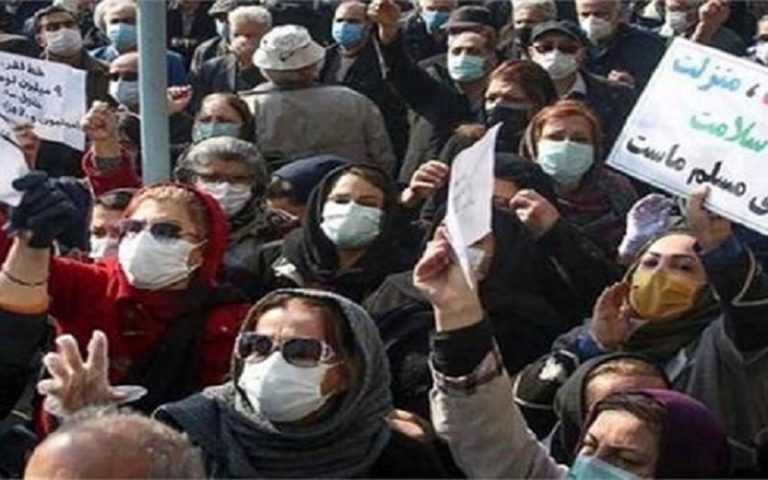
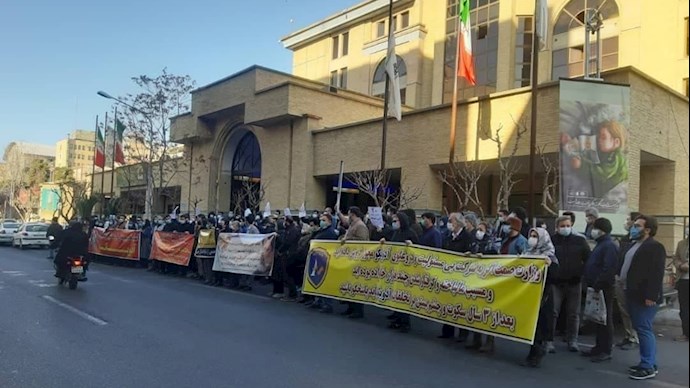
Iranian pensioners held nationwide protests for the fourth week in a row on Sunday, but this time it coincided with the uprising in Sistan and Baluchistan province over the extrajudicial killings of fuel porters.

The retirees protested in Tehran, Arak, Ahvaz, Kermanshah, Khorram Abad, Karaj, Mashhad, Shahrud, Shushtar, Yazd, and Zanjan.

In Tehran, they rallied outside the Social Security Organization and marched to the Budget and Planning Organization, chanting:

  • “We will only get back our rights on the streets”
  • “Yesterday’s toilers are today’s protesters”
  • “Our main demand, salaries adjusted for inflation”
  • “Our salaries are paid in rials, our expenses are in dollars”
  • “We have nothing, you are living in luxury”
  • “No nation has seen such injustice”

The pensioners are angry, much like other groups in Iran because the economy has been ruined by the government’s systematic corruption, mismanagement, and malign policies, like funding terrorism and missile programmes rather than healthcare.

Read More:

Iran Pensioners Protest for 4th Week in a Row

All of this has caused the rial to decline in value, but the authorities have failed to rectify the situation for retirees by increasing pensions, which leaves many under the poverty line. In fact, according to the March 2020 census and economist Gholamreza Kianmehr, the 18 million Iranian retirees make up 96% of those living “under the absolutely poverty line”.

The state-run Mardom Salari daily advised last month that retirees are paid 2.5 million tomans, which is frightening because the poverty line is 10 million. This means that they cannot afford food, housing, clothing, medicine, education, or travel, most of which rises above inflation.

A sociologist Said Madani said that “poverty and unemployment are rampant and, there has been no such discrimination and economic poverty in Iran’s history”. While the deputy director of the Imam Khomeini Relief Committee, Hojatollah Abdolmaleki, said that food costs have quadrupled in just three years.

This is how most Iranians live, but those associated with the government live in luxury because they profit off the systems that keep the poor down. This is just one of the reasons that Iran is a powder keg waiting to explode into a nationwide uprising; something that MPs and the media have been warning about.

The state-run Etemad daily wrote Saturday that “the wild horse of unrest is going from one city to another, leaving many injuries and dangers in the system”, while the  state-run Jahan-e Sanat wrote Sunday that the protests are like “a time bomb under the skin of society. No one knows when it will explode, but its dangers for the [system] are more devastating than an attack by a foreign force”.

Iran Economist Says Mullahs Must Fix Broken System

Iranian regime economist Hossain Raghfar spoke Monday about institutionalized corruption by the mullahs and called for urgent action to be taken.

He said: “If the process of destruction and weakening of the economy and society in Iran is to be stopped, a fundamental decision must first be made and the ‘emergency situation’ must prevail in the country, because without it, [economic] reforms are not possible.”

Raghfar said that specific solutions are needed to improve the economy but that some don’t want to make changes, like fixing the currency exchange rate that allows the regime’s cronies to make money while the people suffer.

This is far from the first time that he’s made such comments.

In July 2020, he said that the regime uses the people’s wealth to pay its expenses and called on the mullahs to raise the exchange rate so that insiders would not be able to line their pockets by buying at the artificially-set government price and selling at the free market price.

Read More:

Iran: “Public Rights”, the 96% of the Majority, Are the “Subset Right of the Special 4%”

In February, Raghfar rejected regime claims that international sanctions caused the economic crisis, saying that the problem was instead the result of a “change in attitude” following the Iran-Iraq war that led to the legal violation of people’s rights. He expanded on this later in the month by saying that “800 trillion tomans of foreign exchange embezzlements and various types of energy rents have been provided to large and private companies” many of which do not pay tax because they are subordinates of financial institutions under the direct control of Supreme Leader Ali Khamenei and the Revolutionary Guards (IRGC).

In April 2020, he said: “While $20 billion disappeared from the country during a major corruption scandal, today we ask the World Bank to give us $5 billion. Yet, no one is accountable for this.”

The Iranian people live in poverty, while the regime and its affiliates live in unrivalled luxury. The state-run media has begun to warn that this may be the cause of another uprising, which could bring down the regime as a whole.

The state-run Jahan-e Sanat wrote Sunday: “If these deprivations and this deep social distance continue in their present form, soon the affluent strata, the small minority with all the gifts of life living in luxury towers and their magnificent villas and palaces, will not feel safe. Such a situation is like a time bomb planted under the skin of our society. When this bomb explodes, there will be no sign of [the regime].”

Suicide Rising Amongst Women and Girls

Death through suicide is rising amongst Iranian women and girls, likely a direct result of poverty and violence, with even government officials and experts admitting to the increase.

Yet, despite all that, the Deputy for Women and Family Affairs, Massoumeh Ebtekar, has said that domestic and other violence against women is “not high” in Iran and the country “is in a better position than other[s]”.

However, Deputy Interior Minister and Director of the Social Affairs Organization Taghi Rostamvandi warned that the current situation was troubling.

He said: “Over the past few years, we have seen an increase in suicides. We have had a 4 percent to 5 percent annual increase in suicide rates. This year, we have the same statistics as last year. But what is remarkable is that we have a significant change in the range of ages among those who have attempted suicide. Suicide has increased in the last year among those under 18 and over 60.″

Read More:

Iran Executes 113th Woman Under Rouhani

The staggering increase was backed up by a source in the Nation Forensic Medicine Organization, who said that the number of deaths from suicide in the period March to October 2020 rose 4.2% compared with the same period in 2019. The source warned that some 15 people die from suicide each day and they are more likely now to choose methods that are faster acting.

Sociologist Khalid Tavakoli, who specialises in social harm, said: “Recently, the suicide rate of married and middle-aged people has been added to the statistics, [and we see] a worrying trend… We witnessed two suicides in Kurdistan: one was a bride; the other was a 14-year-old girl… The number of failed suicides is not usually reflected in official statistics, and the number is higher than what is formally announced.”

Iranian economist Ibrahim Razaghi said that “extreme poverty” was the biggest threat to Iran, with 30 million unemployed and double that living in poverty, while the rich get richer.

Meanwhile, over 38 million Iranians live in slums.

Statistics about the suicides of women and girls over the past year have been shocking and include many horrific methods that we cannot get into here because it would be far too gruesome, especially those involving children as young as 11.

The Iranian Resistance wrote: “The mullahs’ regime of thievery and embezzlement is to be blamed for rampant poverty in Iran and the rising rate and number of suicides in the country. Sixty million Iranians live under the line of poverty due to the regime’s systematic lack of supervision over the economy.”

Iran Pensioners Protest for 4th Week in a Row

Iranian retirees rallied in several cities on Sunday, for the fourth week in a row and despite the increased presence of security forces, to protest the regime’s lack of appropriate response to their demands for their pensions to be increase because of inflation and the drop in value of the rial.

The protests took place in Tehran, Karaj, Shushtar, Mashhad, Kermanshah, Arak, Ahvaz, Yazd, Khorram Abad, Shahrud, and Zanjan.

The Tehran rally began outside the Social Security Organization offices and from there they marched to the offices of the Budget and Planning Organization. They chanted:

  • “We will only get back our rights on the streets”
  • “Yesterday’s toilers are today’s protesters”
  • “Our main demand, salaries adjusted for inflation”
  • “Our salaries are paid in rials, our expenses are in dollars”
  • “We have nothing, you are living in luxury”
  • “No nation has seen such injustice”

The economic decline, caused by government’s corruption and mismanagement, threw many pensioners into poverty because the rial has lost 80% of its value and pensions are not tied to current food prices or inflation. The officials have even admitted that, according to their statistics, over 75% of pensioners cannot afford even their most basic of needs.

Read More:

Pensioner Rally Shows Likeliness of Another Major Iran Protests

The retiree protesters have demanded that article 96 of the welfare law be implemented. This states that pensions must be adjusted so that pensioners can afford to live. They are further demanding free healthcare and that pensioners’ demands be prioritised in the sessions of the Iranian parliament.

The pensioners have been holding protests for years, but the government has not responded to their demands at all.

Sunday’s protest was the sixth nationwide demonstration in just under two months, but retirees are far from the only community that have been taking to the street. Impoverished and marginalised people from every walk of life have been protesting for their rights, which is not to mention the last week’s protests in Sistan and Baluchistan.

The Iranian opposition in this regard wrote: “While the regime has a history of cracking down on organized protests with severe brutality, there was no shortage of participants in Sunday’s rallies. This shows that the people are becoming increasingly bold in face of the regime’s repressive apparatus, and at the same time, the regime is becoming less and less efficient in its capacity to quell protests. This is a true manifestation of a new balance between the regime and the people.

An Overview of Iran’s Complicated Crises

Nowadays, Iran’s economic collapse and its direct effects on political, living, environmental, educational, immigrational affairs have become the main talking points inside the country and abroad.

Furthermore, many Iranian outlets explicitly speak about corruption that has engulfed the entire ruling system and not only has led the people’s livelihood to misery but annihilated the country’s natural resources.

In this context, it is important to shed light on the current crisis in Iran and its elements separately, which have not yet been discussed collectively so far. Notably, these elements are originated from the government and its different apparatuses and officials. However, they have shaped the major political challenge in Iran on the verge of the 2021 Presidential election.

Iran: A Unique Opportunity for Plundering

Since the beginning of the Islamic Republic in February 1979, the ayatollahs considered Iran an opportunity for economic interests. Therefore, besides political monopolization, they applied a totalitarianism policy to gain maximum privileges.

In this regard, they added valuable mines, national funds and properties, and the production reserves to either their own assets or their relatives’ properties.

Read More:

Iran’s Economic Crisis – What Is the Cause?

They initiated this policy for the occupation of Iran’s economic resources and wealth through ‘privatization.’ In other words, the government and its relevant officials monopolized all financial assets to apply their destructive policies on the one hand and prevent an independent opposition movement from shaping on the other hand.

According to observers, following the death of Islamic Republic founder Ruhollah Khomeini in 1989, then-Parliament (Majlis) Speaker Akbar Hashemi Rafsanjani launched the privatizing project. He later became the president for two consecutive terms, which paved the path for him to continue the project forcefully. However, the privatization was followed by other administrations and government-backed mafia bands. It also brought more ruin and hardship to the people.

“During Mahmoud Ahmadinejad’s presidency, the privatization policy continued more unbridled. We witnessed that the public and national assets of the Iranian people have been auctioned under the banner of privatization,” said Foad Shams, a government-linked scholar, in an interview with Mostaghel daily on February 24.

“In [President] Hassan Rouhani’s era, we saw the shock-treatment project alongside the unbridled privatization. For instance, gas prices hiked up three-fold in November 2019. Not only the increase exerted severe pressure on low-income classes, but they were publicly suppressed on the cities and streets.”

He implicitly mentioned that the implementation of this policy was dependent on maximum political suppression. “Officials performed policies for economic reforms by resorting to military and security force,” Shams added.

Privatization through Unscientific Methods

Officials’ enthusiasm for monopolizing all national reverses under the banner of privatizing projects has breached all scientific principles and norms in the financial, health, and educational sectors. Therefore, besides the unrestrained suppression in the political aspect, the government severely attempts to cover hygiene and education institutions. These efforts were even followed amidst the coronavirus outbreak with more power.

“It would definitely be said that we do not see such easy privatization in health and education sectors even in the most capitalist countries like the United States and the United Kingdom,” said the scholar.

“Those governments realize that several aspects like hygiene and education are the country’s basic and infrastructural needs, and the government should not privatize them simply. However, in Iran, we perform far right economic policies,” he added.

Tehran Uses Coronavirus Crisis for Privatization

Since the beginning of the coronavirus crisis in Iran, activists and netizens revealed that the government is exploiting the pandemic for political and financial interests.

However, the people of Iran, who are the foremost victims of the government’s mismanagement, feel this truth with their flesh and blood. Growing public hatred toward the entire government shows the society’s suffering. Nonetheless, officials exploit the health crisis to line their pockets with the people’s meager money through the privatization excuse.

“Privatizing health and education apparently showed its results. During the coronavirus crisis, we witnessed what pressure was applied on the country’s health sector. Because earning more profit is the main issue in the private sector’s logic while in the health sector, ensuring society and people’s health must be prioritized, not profit,” said the scholar.

Students and Teachers Are Primary Victims

The education sector is one of the privatization’s victims. Under the banner of privatization, Iranian officials have filled their pockets with windfall money. This project imposed irreparable blows to Iran’s education system, pushing millions of students to drop out.

This policy has forced children to leave education and turned them into child laborers. “Millions of teachers and education staff fell in severe living dilemmas,” Iranian state-run media wrote, addressing a result of privatizing the education system.

“In the education sector, the deep rift between school and college students is an outcome of privatization. Classes for college entrance exams and relevant problems are the product of privatized education system and creating extreme competition in this sector,” wrote Mostaghel daily.

“Aside from families’ economic inability, millions of teachers and education staff have been stuck in severe living dilemmas. Because the government no longer recognizes investing in the education sector as its own duty,” Shams said. “In a nutshell, privatization is tantamount to putting people’s public assets to an auction.”

Officials Launch Stock Market for Government’s Interests

In the past three months, the Stock Market has become a mystery for the people and the government. Previously, high-ranking officials, including Supreme Leader Ali Khamenei and President Hassan Rouhani, invited society to invest their money in the Stock Market.

“The people should invest in the Bourse,” said Khamenei on November 18, 2019, and Rouhani later added during the August 12, 2020 cabinet session said, “The stock market and oil — not gold and the dollar — are the places to be investing, and we want to help people this way.”

However, according to details disclosed during political rivalries, the government organized the Stock Market to offset its deficits. In this context, the people witnessed a sharp decline in their stocks’ value, which has prompted their anger over the entire ruling system and its institutionalized corruption.

“In the past year, we witnessed millions of small stockholders lose their money during the Stock Market’s experience. Nonetheless, several major stockholders close to government-backed institutions gain stellar privileges. Some believe that the bourse policy was adopted to compensate for the government’s budget deficits. Others think that several government organizations and institutions applied this policy to make their own advantages,” wrote Mostaghel daily.

Contradiction Between Nature and Appearance

The Islamic Republic faces a contradiction between its nature and appearance. While the most fundamentalist figures have monopolized all means of power and have vehemently rejected modern methods in different sectors, they resort to the newest technologies for their establishment to survive.

They justify their illegal and horrific performances by religious explanations and terrify society from a revolt against the theocracy. They shed crocodile tears for underprivileged people, and they have even established an institution for impoverished families. However, the institution uses violence to force impoverished people out of their own properties. It also squanders the country’s national assets on terrorism, warmongering, and improving oppressive apparatuses.

There are millions of dropout students in Iran while officials send their loved ones to the United States, Canada, and other countries to receive their education. At the same time, they sarcastically chant, “Death to America.”

Today, the ayatollahs are the most powerful and wealthy individuals in Iran. Commanders of the Islamic Revolutionary Guard Corps (IRGC) control illicit transactions. They have impounded the spinal sectors of Iran’s economy. IRGC commanders manage oil and petrochemical, automaking, mines, transport, fisheries, advertisement, sports, and all profitable industries in Iran. They have recently granted low-price power to the Chinese for bitcoin mining. In other words, officials’ hypocrisy is likely a spark on society’s powder keg.

“In such circumstances, both principalists and reformists are representing a sole corrupt clique ruling the country. This clique has gained top economic positions through governmental corruption in the past years. Initially, it was a governing manager, then it occupied public assets under the name of privatization, and currently, it has become a capitalist,” Mostaghel daily wrote.

in the runup to the 2021 Presidential election, Shams admitted to the reformist factions’ failure to gain public trust. For decades, Iranian authorities tried to deceive the people by the game of reformists versus fundamentalists.

However, Iran’s society had never forgotten the crimes committed by ‘reformists’ in the 1980s, when they were calling themselves the Followers of the Imam [Khomeini]. Prominent ‘reformists’ like Mir-Hossein Mousavi, Mohammad Khatami, Hassan Rouhani, and others had key positions during the mass killings of political prisoners in the summer of 1988.

“Generally, these reformists do not have any theory, but their political intentions are affected by the general atmosphere. Their transfer between different classes of society should be considered. These people gradually became richer through corruption, and their political positions were changed due to their economic situations,” Shams added.

On the other hand, working classes, who live below the poverty line, have been deprived of fundamental rights. Instead, the government immediately quells any objection and protest with violence. “Workers do not have even one real syndicate or labor union. They do not have media. Their voice would reach nowhere, and they are rapidly suppressed,” the scholar said.

In its February 24 edition, Mostaghel  shed light on the social volcano in Iran, which is on the verge of eruption at any moment. Current rallies, sit-ins, and marches are merely the tip of the iceberg, and further protests are on the horizon due to political-socioeconomic crises that have swept throughout the establishment.

“A crisis does not appear itself in the shape of street protests. The most serious danger that threatens our [state] is the possibility of a complete collapse of social relations—i.e., a nationwide uprising,” Mostaghel  concluded.

Toiling for Bread in Sistan and Baluchistan

A look at the ethnic, linguistic, and national anomalies in Iran always shows the central government as the cause of these problems.

While this was ever present in the governments of Iran, but when it comes to the rule of the Islamic Republic, the imposition of religion and ideological and political totalitarianism is added to the previous wounds.

For these reasons, the aspect of repression and deprivation is far crueler. This repression has not only a political and military aspect, but also imposes instructions including religion, belief in and obligation to Velayat-e-Faqih (the regime’s supreme leader Ali Khamenei), and adherence to the language and textbook compiled according to the standards of the Islamic government.

It is for the above reasons that the ethnic, linguistic, and national crisis has intensified after the domination of the mullahs over Iran. This totalitarianism of the ruling class has led to brutal killings and several massacres by the central forces and the clerical government against areas such as Iranian Kurdistan and Sistan and Baluchistan provinces.

The Velayat-e-Faqih regime has imposed an economic and livelihood embargo on the Iranian people in general, and on ethnic minorities such as the Kurds and Baluchis, due to the allocation of Iran’s economy to a clerical oligarchy with political power.

Hence, a phenomenon such as fuel and cargo porters are prevalent in these provinces. They are forced to live in such a condition just to earn money to buy a piece of bread for their families, forced to pass through the dangerous paths or ambushes by the Revolutionary Guards (IRGC) who enjoy killing them, according to locals.

Due to religious differences, the clerical regime has imposed double cultural sanctions and deprivation on these border tribes in terms of culture and environment compared to the whole of Iran.

Read More:

Iran’s New Year (Eid-E-Nowruz) and the Empty Baskets of Its Workers

After the massacre of Saravani’s fuel porters by the Revolutionary Guards on February 22, the reflection of local, provincial, and social hatred for this crime has caused the state media to refer to the racist, religious, ideological and security views of the government towards the citizens of Sistan and Baluchistan province.

The state-run daily Mostaghel in its February 24 issue, in a note entitled ‘Judgment Day’, admitted that in the last 42 years, under the shadow of such views by the government, no attention has been paid to resolving the problems and bottlenecks in such areas:

“Due to the Sunni religious context, special security attention is paid to the border provinces of Iran. Border provinces, like the suburbs of large cities, suffer from poverty and injuries stem from poverty. The specific injuries of these provinces have not been considered worthy of attention by the capital’s officials for many years.

“The first reason for these problems is the elimination of these provinces from the perspective of the country’s industry and trade managers. If you work for sustainable development only in Sistan and Baluchistan province, you will quickly notice the terrible gap between this province and the rest of the country.”

While the regime provides super-standard water, bread, and housing for Hezbollah in Lebanon; while it spends billions in Syria trying to keep a war criminal (Bashar Assad) afloat, and while it hands over the keys of Iran’s economy to the Revolutionary Guards, ‘children in Sistan and Baluchistan are deprived of education,’ they are frustrated with access to online classrooms, and their illiteracy rate is skyrocketing:

“During these years, the issue of education of children in Sistan and Baluchistan has been neglected. According to statistics published in ISNA in August last year, the illiteracy rate in Sarbaz county is close to 37 percent. The same report states that there are no accurate statistics on the access of women in this province to schools. Statistics show that the situation of Sistani children’s access to technology for accessing online classrooms has been very disappointing.” (State-run daily Mostaghel, February 24)

The effects of such hardships that the government has imposed on the society and the people and families in these provinces, on the one hand have provoked the inevitable struggle of the people and youth for the right to survive, and on the other hand have uncovered an organized crime:

“Sistan and Baluchistan province is culturally completely abandoned, and this vicious cycle is repeated until it reaches an irreversible point. It seems that Sistan does not matter [to the authorities].” (State-run daily Mostaghel, February 24)

Determining the Subsistence Basket at 6.895 Million Tomans, a Step To Destroy Iran’s Workers

0

A tripartite committee, the representative of the government, employers and workers, has determined the livelihood basket to be 6.895 million Tomans in Iran. This committee can be described as another step towards the extermination of Iranian workers. Reaching the final days of the year, consultations to determine the livelihood basket, followed by the determination of the minimum wage, usually increase.

The experience of the past years has shown that these actions have no acceptable result for Iranian workers, and this year, as in previous years, what was not clear was the livelihood of the workers who are among the most deprived sections of society.

On February 22, the Wage Committee for 2021 was convened in the presence of what is called within the Iranian government, government representatives, employers and workers. At the end of this meeting, the subsistence basket figure of 6.895 million Tomans was approved as an indicator of the second paragraph of Article 41 of the Labor Law of the Government of Iran.

The representative of the workers stepped back from his previous statement

Surprisingly, Faramarz Towfiqi, who was present at this meeting as a representative of the Iranian workers, agreed and confirmed this figure. Before this, he had repeatedly talked of the subsistence basket figure equaling 10 million Tomans.

Read More:

Iran’s New Year (Eid-E-Nowruz) and the Empty Baskets of Its Workers

The bitterness of this confirmation and agreement by the workers’ representative is that this number is referred to the “Supreme Labor Council” of the government as the basis for wage negotiations. Where, with last years’ experience, the minimum wage is less than half the agreed subsistence level. Between the parties to the wage committee, it figured out the fate of Iranian workers as we see it today in terms of the rampant inflation.

For 2020, the official livelihood basket was priced at 4.940 million tomans. But the salary with all its accessories was approved only 2.611 million tomans.

“This basket should be called a minimal or very minimal basket. The aim of the workers in agreeing on this number was to reach a consensus and agreement with the social partners,” Tawfiqi said after registering the deal with all its dire consequences.

Livelihood basket figure

While he holds the title of Chairman of the “Wage Committee of the Supreme Council of Islamic Labor Councils”, on February 11, he announced the livelihood basket as equal to 8.985 million Tomans and added: “With every meter and criterion they calculate, the result will be more than eight million Tomans”, but on February 22, he accepted the 6.895 million tomans.

Before that and on December 11, 2020, Tawfiqi had announced the subsistence basket figure of 9.800 million Tomans.

The result of these statements, and finally agreeing is a step back by such people who call themselves the representative of the workers. This can also be considered as part of the policy of pressure from the hardline government in Iran.


On February 20, Kazem Farjollahi, a labor activist, had also announced: “Monthly income is within the poverty line for a family of three based on various estimates between 8 to 10.5 million tomans. And there is a gap of 6 to 7 million Tomans between the salary and the livelihood basket.”

Government pressure on workers

Beyond the figure set for the livelihood basket, in recent months, the Rouhani government has also sought to record bargaining wages, eliminate wage levels, and ignore all the benefits of veteran workers.

Recently, the legal deputy of Rouhani had written a letter requesting the subject mentioned above. However, this was seen as a lever to push the livelihood basket issue of the workers to the margin. But determining this small amount of income showed that 2021, like previous years, will be a year of misery for the workers.

In the meantime, the employers’ community, under another pretext, in line with the Rouhani government and to reduce the minimum wage for 2021, claimed that, many households no longer have the size of a 3.3-person household to pursue the lowest possible minimum wage.

Take a look at the statistics

A look at the experience and statistics of previous years may also show us some facts. In 2018, the subsistence basket figure was set at 2.645 million Tomans and the minimum wage was finally approved at 1.114 million Tomans.

In 2019, the subsistence basket was 3.759 million Tomans. But the minimum salary was 1.527 million Tomans and in 2020, the subsistence basket was 4.940 million Tomans. But the minimum salary was set at 1.911 million tomans.

In other words, in the last three years, the ratio of the minimum wage to the announced livelihood basket shows that in 2018 the minimum wage to the subsistence basket was 42.2 percent, in 2019 equal to 40.4 percent and in 2020 it was equal to 38.7 percent. It has decreased by 1.5 to 2 percent annually.

With this calculation, with the announced figure of 6.895 million Tomans, as the livelihood basket of 2021 and the calculation of a decrease of 1.8 percent of this ratio it can be expected that the minimum salary for 2021 should be approved in the amount of 2.544 million Tomans. That is a quarter of the poverty line, and that in itself is a great disaster for the workers.

The experience of the huge difference between the set figure of the subsistence basket and the minimum wage of workers in the past years shows that despite all the peaceful efforts of labor activists and guilds, Iranian workers are being pushed below the poverty line day by day rather than on a monthly basis.