Home Blog Page 306

Pensioner Rally Shows Likeliness of Another Major Iran Protests

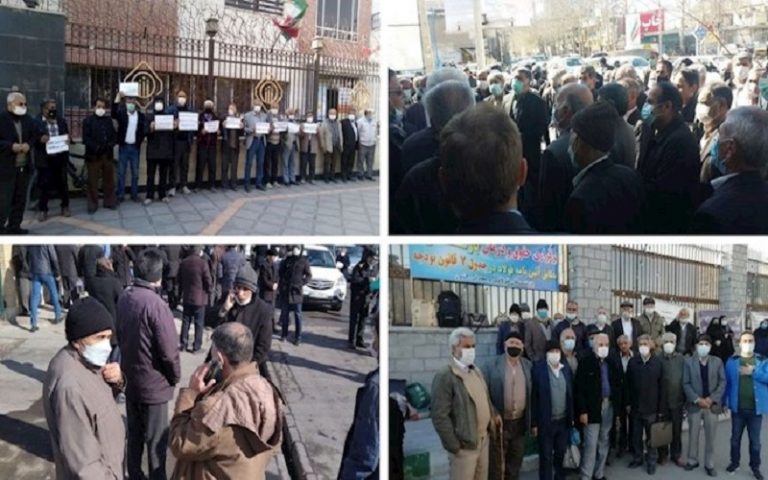
Iranian pensioners have been holding protest rallies across the country for the past three weeks to demand their basic rights.

This culminated in a rally on Sunday in over 20 cities, including Tehran, Tabriz, Arak, Yazd, Neyshabur, Khorram Abad, Sari, Shushtar, Karaj, Ahvaz, Haft Tappeh, Ardebil, Qazvin, Rasht, Dezful, Mashhad, Kermanshah, Isfahan, Ilam, and Bojnurd.

At this fifth nationwide protest by retirees in two months, they chanted:

  • “Astronomical salaries [for government officials], misery for the public”
  • “We are fed of with this injustice”
  • “Our salaries are paid in rial, but we pay our expenses in dollars”
  • “Enough with the promises, our tables are empty”
  • “We will not back down until we get our rights”
  • “Enough with the tyranny, our tables are empty”
  • “The retirees fund has been hijacked by thieves”

With each passing protest, the number of demonstrators grows and the protests became more political, moving away from just their demands over increasing their pensions and onto protesting corruption, injustice, and tyranny.

Read More:

Iranian Farmers’ Right to Water Has Been Plundered

Protests have grown over the past year, even as the authorities attempted to use the coronavirus to keep people from the streets and avoid another protest like that of November 2019. That shook the government to its core and was crushed by the repressive forces, who killed at least 1,500 people in the streets.

Many officials and media outlets have warned that the situation is similar now.

  • Feb 18, Tehran City Council head Mohsen Hashemi Rafsanjani warned that the people’s tolerance was reaching a “threshold”
  • Feb 20, the Setareyeh Sobh daily and the Vatan-e Emrooz daily warned of declining purchasing power and increased liquidity
  • Feb 21, the Kar va Kargar daily warns that food prices have increased by between 6% and 9% over the past year

While on February 20, MP Moussavi Larigani admitted that $70 billion has disappeared in the stock market, a reference to the huge dip that followed a bubble growth, when many small investors were convinced by officials to invest in stocks run by government gangs

He said: “A paper company with 2 trillion rials worth of assets was sold on the stock market at a 32 trillion rial valuation. This is while this company doesn’t even have a physical office and its stock was nothing but a piece of paper.”

The Iranian opposition, People’s Mojahedin Organization of Iran (PMOI/MEK) has warned that these protests show how angry the society is and how likely it is that another major protest is coming.

The Coronavirus Artillery in Iran, Taking Children As Victims

0

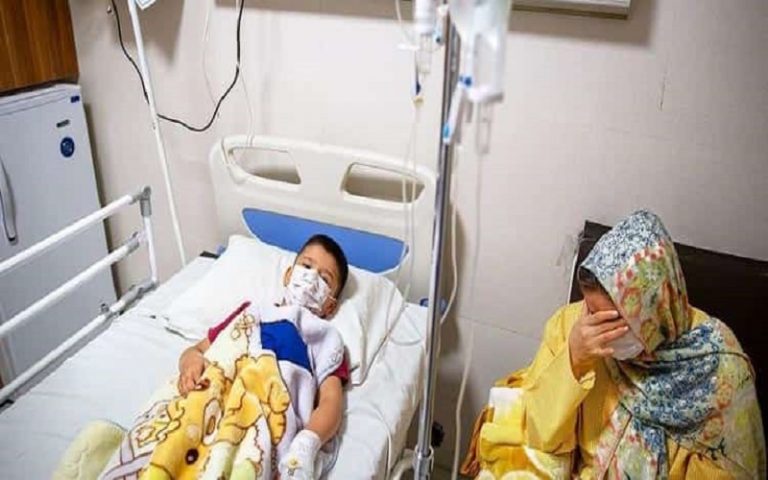
Children and adolescents are the victims of the fourth wave of the Coronavirus in Iran. Reports from Iran indicate the widespread prevalence of the fourth coronavirus wave in Iran. The president of Ahvaz University of Medical Sciences announced the death of two one-year-old and nine-year-old children in Khuzestan province due to the coronavirus.

The coronavirus artillery is active

Farhad Abulnejadian, president of Ahvaz University of Medical Sciences in Khuzestan province, wrote on his Twitter account on February 19: “Unlike previous peaks where more clashes took place in higher age groups, but in the recent peak with the spread of the English coronavirus, children and adolescents are also victims.”

The president of Ahvaz University of Medical Sciences continued his tweet: “Parents should take care of themselves and their children, the coronavirus artillery is active outside the house.”

Iraj Haririchi, the Deputy Minister of Health, also warned about the decrease in the age of the disease and the spread of the new virus among the youth on the evening of February 18, while confirming the outbreak of the coronavirus virus throughout the country.

Read More:

Iran Ranked 95 Among 98 Countries in Coronavirus Response

Haririchi added: “The incidence of the coronavirus has increased at the age of five to 17 years, so that this statistic in Tehran province has increased from 4 to 11 percent. He also admitted that the number of hospitalizations for people under 12 has increased.

218,000 people have died in Iran due to the coronavirus

Deputy Minister of Health Qassem Babakhani also announced a fivefold increase in the number of patients with coronavirus in the country and warned about the exhaustion of hospital capacity of the province’s hospitals.

Meanwhile, according to the Iranian opposition National Council of Resistance of Iran (NCRI), more than 218,000 people across the country have died as a result of the coronavirus.

Government officials put the death toll at less than 60,000, but their numbers are strongly disputed by doctors inside Iran.

Harirchi admitted: “Today we had more than 8,000 new cases. Given that the percentage of positive tests has increased, we must assume that the virus is present everywhere in the country. Young people and children are more likely to get this type of mutated virus. The British coronavirus has been seen more in the provinces of Tehran, Alborz, Khuzestan and Qazvin.”

More deaths as Khamenei bans import of the vaccine

Minoo Mohrez, a Member of the National Taskforce for Combating the coronavirus in Iran, said: “The rate of the disease in the country is increasing. If this continues, we will have to wait for the fourth wave of the disease in the country. Currently, the rate of the disease is rising badly. The mutated virus that has mutated in Britain is on the rise. The speed of transmission of this virus is very, very high. It can increase the number of critically ill patients and the mortality rate by increasing the number of patients per person.”

Meanwhile, government officials are reporting the outbreak of the fourth coronavirus wave, while people around the world are buying and injecting vaccines with astonishing speed. But Iran’s supreme leader Ali Khamenei has increased mortality by banning the purchase of an effective and credible vaccine from the US, Britain or France. In this regard, Mohammad Reza Zafar Ghandi, head of the Medical System Organization, reiterated that vaccination should be free of political issues and a priority for officials.

Iran, Khamenei, Engineered Election and Hard Days

‘Elections’ and ‘people’ are two words that have been transformed from their original concepts under the religious tyranny ruling Iran. What is called elections in the clerical culture is not synonymous with the common definition of the word in democratic societies.

The regime has taken the name of democracy in its political vocabulary and replaced it with ‘religious democracy’. This religious democracy is anything but democracy and the rule of the people. When we explore the concept of this composition, we finally come to the mobilization forces of the Revolutionary Guards, which in the eyes of this government is an excellent example of religious democracy. When this is the fate of democracy, the state of elections in religious tyranny is clear.

Guardian Council and Approved Supervision

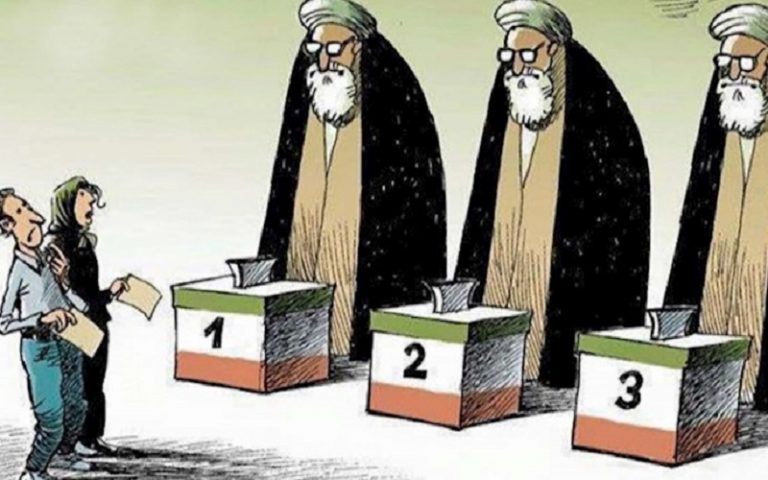
In the medieval tyranny, elections do not take place in the usual sense. Because of the absolute rule of the supreme leader, people are not supposed to be selective and influential. Such a role is not defined for them. The Vali-e-Faqih (Supreme Leader) selects a number from among the surrogates and who have showed themselves loyal to him then pulls one out of the box in an engineered show.

It is interesting that in order to take over this process, the regime by placing a number of clerics in a clerical institution called the Guardian Council and institutionalizing approving supervision, the same hand-picked people are often passed through a filter and the most loyal to the supreme leader are taken out. He who passes through this mechanism must be  “committed in the heart and in practice” to the Velayat-e-Faqih as written in the regime’s constitution.

End the instrumental use of elections

Where are people in this process? Basically, what is the place of their choice among this process? In this medieval view, people are only good at queuing up at the ballot box on election day to portray that the regime has a popular base and that the people accept its authoritarian rule.

Read More:

Iran’s Presidential Election and Intensification of Crises

Iran’s supreme leader Ali Khamenei desperately needs this kind of propaganda to give his government a facelift. He called it ‘the authority of the system.’ The regime has taken many steps in recent years to show itself as democratized and bring a mass of people to the ballots, but all of them have failed.

Because people have realized the nature of this scandalous show and boycotted it. Hence, as the life of this system progresses, its popularity becomes smaller and smaller. What was proved in February 2020 is that such government demonstrations can no longer mobilize even the regime’s supporters.

Weakening the rule of the system and Khamenei’s deceit

Khamenei’s speech on February 17, 2021 is the best evidence of the fact that the clerical dictatorship sees its fall and its rule. In part of his speech, the following parameters are significant.

1- The efforts to democratize and show the prosperity of the election show has failed. This can be seen in his desperate statements as well as his plea to participate in the election show.

“When people participate in the elections and show their revolutionary passion, it causes security and repulses the enemy, and reduces greed for the country. The more passionate and popular the election, the greater the effects on the country and the people. But the enemy does not want this.” (State-run daily Entekhab, February 17, 2021)

At the end of his speech on the elections, he again points out that the cure for the chronic pains of his system is to deal with the sluggishness of the election show.

“I have a lot more to say about the election in the coming months. I am currently saying the same sentence: The cure for the chronic pains of the country is the enthusiasm of the elections and the public presence of the people, and then the selection of the right and appropriate person in the presidential elections.” (State-run daily Entekhab, February 17, 2021)

2- What Khamenei calls ‘choosing the right and appropriate person’ for the presidency is to appoint a loyalist to this position while he is trying to contract his government. The Supreme Leader has repeatedly addressed this ‘suitable figure’ and said that what he meant by “a young government of Hezbollah” is a “person with the characteristics of Qassem Soleimani.” Trying to contract the system and removing the people of the opposite faction from the government is also to achieve such a purpose.

3- Khamenei admits in advance the engineering of the election show and its coldness and sluggishness, so he is preparing the ground for confronting the socio-political consequences of this bankrupt show.

“They always start saying things close to the elections, such as that elections are not free, there is interference, engineering, and so on. In order to discourage people.” (State-run daily Entekhab, February 17, 2021)

Hard days

According to what Khamenei said in the speech about the apathy and defection of the regime forces with the terms ‘do not be afraid, do not get tired, do not despair, do not be lazy, do not knowingly be on the enemy’s plan’, it can be said that difficult days await him and the clerical system. The days when their pulse beats with riots and uprisings on the streets of Iran.

Confident in Its Impunity, Iran Tried to Leverage Multiple Hostages for the Same Terrorist

0

Last November, the Iranian judiciary moved one of its dual-national detainees into solitary confinement to suggest that the implementation of his death sentence was imminent. Ahmadreza Djalali was arrested in 2016 after traveling back to his homeland from his residence in Sweden. He was later issued a capital sentence on unsubstantiated charges of spying, which Djalali himself described as retaliation for his refusal to collaborate with the Iranian Ministry of Intelligence and Security.

The move to implement that sentence in 2020 was evidently retaliation of a different kind, coming right around the time that a Belgian court was putting a high-ranking diplomat, Assadollah Assadi, on trial for his leading role in an attempted bombing on European soil. The target of that plot was a gathering of Iranian expatriates just outside Paris, but two of Assadi’s co-conspirators were arrested before leaving Belgium with the bomb he had provided, and that became the venue for their prosecution.

Read More:

New Revelations Expose Iranian Propaganda After Terrorist-Diplomat’s Conviction

The relationship between Assadi’s and Djalali’s cases stems from the fact that the Iranian-Swedish dual national had previously resided and worked in Belgium, as well. Among the several Western nationals being held hostage in Iran, this made him the closest thing the regime had to a direct source of leverage over the Belgian government. Accordingly, that government did respond to the threat on Djalali’s life, albeit not in the way that Tehran would have hoped.

Far from offering to release Assadi or downgrade his prosecution, Brussels declared that if Djalali’s hanging went forward as planned, diplomatic ties between the two nations would be severed and Iran would be subjected to increased pressure and isolation for the foreseeable future. The Islamic Republic seemingly backed down soon thereafter, announcing that the execution had been delayed and casting Djalali’s case into a different kind of uncertainty.

Little has been heard from the prisoner since then, but it stands to reason that Tehran still views him as a potential source of leverage, even if it doesn’t have a precise new goal in mind. In the meantime, the regime has evidently been looking elsewhere for ways to strong-arm European governments into releasing Assadi.

Tehran’s chances of success grew especially remote on February 4 when the former third counsellor at the Iranian embassy in Vienna was found guilty and sentenced to 20 years in prison for plotting to commit terrorist murder. But just ahead of that sentence, the judiciary set its sights on two new Western nationals, one from Germany and another from France. At least one of these is reportedly a dual national like Djalali, but little else is known apart from the fact that the Franco-Iranian was arrested for flying a drone in the desert.

The circumstances of that arrest were reminiscent of the 2019 case of Jolie King and Mark Firkin, a pair of Australian travel bloggers who were arrested and threatened with national security charges after using a drone to take photos of the Iranian leg of a world tour. The couple was released after several months, but not before the Australian government decided to refuse an American extradition request for an Iranian scientists accused of violating sanctions to obtain sensitive materials for the Islamic Republic.

That decision gave King and Firkin’s release the appearance of a prisoner swap, thereby putting it in the same category of a number of other exchanges that have taken place over the years, such as the 2016 release of four Americans from Iranian custody at the time of implementation for the seven-party Iran nuclear deal. To secure that release, the Obama administration apparently agreed to release or drop charges for 21 Iranians, as well as to deliver 700 million dollars in cash as partial repayment for an outstanding debt for arms sales to the pre-revolutionary Iranian government.

Such incidents have the unfortunate effect of leading Tehran to believe that hostage-taking is a viable means of securing its interests. And this no doubt helped motivate the regime to try using multiple hostages as leverage against the desperate situation faced by their terrorist-diplomat. The threat on Djalali’s life was a sufficiently alarming example of this phenomenon, but the regime’s decision to proceed from that failure to the contrived arrest of two other Western nationals was a sure sign of confidence in its own impunity.

The news of the latest two arrests was only very recently broken, but it came as no surprise to serious critics of the Iranian regime. They have long recognized Western policies as tending toward conciliation and appeasement, and thereby giving rise to an Iranian mentality that lets the regime threaten the West with little fear of reprisal. Imbalanced prisoner swaps are a key example of this appeasement, but they are far from the only example.

In fact, multiple statements from European lawmakers and former government officials have made the case that the European Union’s silence on the Assadi case is a prime example of this trend. The Brussels-based NGO the International Committee in Search of Justice issued one such statement on Wednesday and described that silence as “catastrophic capitulation to the Iranian regime’s attempts to bomb and kill people on European soil.”

The statement also reiterated longstanding calls for more assertive Western policies toward the Islamic Republic, including policies that favor isolation over un-earned diplomatic engagement and potentially lead to the closure of Iranian embassies, pending serious Iranian commitments to dismantling of terrorist networks and disavowal of all terrorist activity on European soil.

Unfortunately, current trends are heading in precisely the opposite direction, as evidenced by the recent announcement that a Europe-Iran Business Forum would be going forward at the beginning of March, less than three months after it was cancelled over the Iranian judiciary’s execution of an opposition journalist, Ruhollah Zam.

None other than Josep Borrell, the EU’s head of foreign policy, is slated to deliver a keynote speech in that online conference, right alongside Iranian Foreign Minister Javad Zarif. In agreeing to the schedule, Borrell signaled his willingness to overlook the fact that Tehran had neither atoned for Zam’s killing nor acknowledged any wrongdoing whatsoever. If he were to go forward with the speech now, he would similarly be turning a blind eye to the recently-announced arrests, which help to demonstrate that the full range of Iran’s malign activities remain as much a concern as they were several weeks ago when Zam was killed, as well as three years ago when Iranian operatives nearly set off a bomb in the heart of Europe.

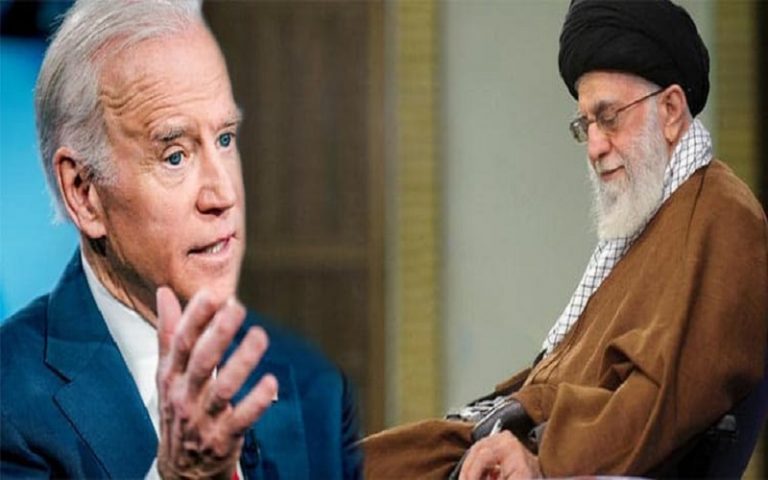
Biden or Khamenei, Who Is the Loser?

Last week was a turbulent week for Iran-US relations. Relations between the United States and the Iranian government have undergone changes. The most sensitive issue on the table right now is the debate over the 2015 Iran nuclear deal, known formally as the Joint Comprehensive Plan of Action (JCPOA). Will this ultimate path come to an end? And what impact will it have on the relationship between the United States and the Iranian government?

As far as the US government as a whole is concerned, from US President Joe Biden to the White House spokesperson to the US Secretary of State, all of them have the same word. They spoke from a specific device. They do this deliberately because they do not want the Iranian government to gain a political concession or make a wrong analysis. The United States has made it very clear that the United States will not enter into negotiations with Iran unless the Iranian government returns to its commitments to the JCPOA and fully complies with the 2015 nuclear deal.

On the other hand, we saw that Iranian government officials also make hopeless maneuvers this week. From Foreign Minister Mohammad Javad Zarif to President Hassan Rouhani and Supreme Leader Ali Khamenei, everyone entered the scene. This shows that the reality of the scene is much heavier for Tehran than for the United States. More importantly, the US Congress made its final say. The Biden administration cannot return to a new nuclear deal with Iran without the consent of the US Congress.

Registration of the resolution of the US Congress

Two things happened last week. One letter was sent to the White House by 120 US representatives on the nuclear issue and the Iranian government’s nuclear threat. They clarified their demands and position for the White House. On the other hand, was US House Resolution 118, which included not only the issue of the nuclear threat but also the US policy as a whole, dealing with the threat of terrorism and human rights abuses in Iran, and more importantly, defending a secular, non-nuclear democratic Iran. And that the Congress insists on Iranian opposition leader Maryam Rajavi’s 10-point plan. This was put on the White House’s table by Resolution 118.

Read More:

We May Produce Nuclear Weapons if We Are Forced To

The position of Senator Robert Menendez, who heads the Senate Foreign Relations Committee, was crucial. The importance of this senator’s position is due to the fact that Senator Menendez will be the decisive senator in the coming months in terms of politics and US foreign relations. He said that he supports a diplomatic solution to the Iranian regime’s nuclear program that is both longer-term and stronger than previous commitments. This position was not only a threat to the Iranian government, but also a warning to the White House. That is, any political debate and political line on negotiations with Iran must go beyond the orbit defined by Senator Menendez, otherwise it will face a fundamental problem in Congress.

Khamenei in a deadlock

The government in Tehran is in an unsolvable impasse. It cannot make an escape for itself. When Zarif tried to return to the JCPOA at the same time last week, the government does not seem to have any interest in resolving this impasse. And they are emphasizing of their position and this is because of Iran’s behavior.

Look at the actions of the Iranian government last week. It announced it would continue atomic enrichment and produce uranium metal. They immediately heard the US position. Khamenei thinks that with the policy of intimidation and blackmail, he will put the United States in trouble and force the United States to return to the negotiating table. But America stands firm. In Biden’s interview with CBS, he heard Biden’s position firmly. All this sends a deadly message to Khamenei. For the political apparatus for which he had prepared himself. Now this policy has failed. All of this causes tensions within the government and the faction war will rise.

Will Khamenei stop blackmailing?

For the past four years, the Iranian government has been under Donald Trump’s policy of ‘maximum pressure’. By using the anti-Trump atmosphere, Khamenei tried to turn the atmosphere in his favor and show himself to be oppressed and portray his regime as a victim of a wrong American policy. He was trying to make some opportunities for himself. He expected that when the Biden government should come, a number of opportunities and privileges would be on the way. But what the Iranian government has been doing since December is that it fears that Biden’s political apparatus will not prioritize Iran. He tried to put himself at the forefront of US policy by pursuing a policy of threatening by capturing a South Korea ship, increasing enrichment to 20 percent, threatening to build an atomic bomb by Iran’s intelligence minister Mahmoud Alavi. But the US response even in the last State Department briefing on Friday was that they do not have a deadline. They do not have a specific schedule. Now the ball is in Iran’s court.

But the Iranian government does not shy away from extortion. They think this is the only way out. Because the pressure of the people and the pressure of the explosive society inside the country and the growth and victories of the resistance abroad have sounded such a death knell for Khamenei that he has been horrified. If these puzzles are put together, it turns out that the government is at a dead end and will not get any points.

Why does Khamenei insist on threatening politics?

Abbas Araghchi, Deputy Foreign Minister of Iran, said:  “If the sanctions are not lifted before February 21, we have no choice but to implement the decision that has been made, referring to the deadline set by parliament. In this way, we can stop the Additional Protocol, and this means that the number of international inspectors in Iran will be reduced.”

This means that they will not back down from the policy of intimidation. Khamenei wants to prove the policy of threatening its survival.

The reason for insisting on the threat policy is rooted in the internal situation of the Iranian government. Widespread social discontent, the role of the Resistance Units of the domestic opposition People’s Mojahedin Organization of Iran (PMOI or MEK).

Looking at this situation, Khamenei sees nothing in the future but destruction and overthrow. So, he wants to use these levers. The lever of intimidation or ransom or nuclear threat, the lever of terrorism, most of all the lever of repression.

Therefore, he cannot lose these levers. Several times this, a debate took place within the government. Several times Khamenei entered the scene, openly saying that he was not willing to give up the levers that kept his regime afloat. Khamenei cannot back down from the levers of repression, executions, arrests, and torture.

What will Biden’s America do?

Biden has repeatedly stated that he will not allow the regime to acquire an atomic bomb. When they talk about new negotiations, they say stronger and longer. They know that the 2015 JCPOA was a weak JCPOA and if they return to the negotiating table, it will have a stronger and longer JCPOA. Biden has said several times that I am ready to defend the United States and my allies.

This is a warning to the regime. It is clear to the Biden administration that the maximum pressure exerted on the Iranian government during the Trump era has provided the Biden administration good opportunities, which are the sanctions. In other words, they see the regime at its weakest point. This is what they are arranging with Tehran.

“Today, the enemy is trying to get the maximum points for what it has not been able to achieve with maximum pressure, with a minimum reduction,” Saeed Jalili, Secretary of Iran’s Supreme National Security Council, said.

The need for decisive policy

This is a process that the Biden government has sufficient authority over. In the last five years, one thing has been specified in the US government’s policy for those who were at the US negotiating table with the regime during the 2015 JCPOA, and who are now in office. The government of Tehran understand one think and that is the decisive policy.

Out of all the political compliments they make to each other, they know that a decisive policy is the answer to the Iranian government. If during the Trump era, when the maximum pressure policy was used against the regime, the regime wanted to attract the press by showing itself the oppressed and using the anti-Trump atmosphere, now that lever is no longer in Iran’s hands. Now the picture is much, much brighter. And for Biden’s government in particular, this picture is very clear.

Is Poverty in Iran the Result of Sanctions or Plundering?

0

The living and economic situation of the Iranian people is so bad that these days it has become the talk of the town in the state media and among government figures and experts.

But when it comes to the causes of this issue, at least within the country’s executive system, the root of the problem is sought outside the system, and specifically the global and US sanctions. Iran’s president Hassan Rouhani has said many times that whatever you shout, shout on the White House.

What is the reality and how much of the problems of the Iranian people are due to sanctions? If there were no sanctions, would the Iranian people not have economic problems? Before these sanctions, where the Iranian people living in luxury?

The issue of the sanctions plan has become so controversial that government officials have repeatedly admitted that the main problem is internal and resulting from looting, because theft and looting is a special feature of the entire clerical system.

In the current situation, that the infightings have escalated before the presidential election, its internal factions expose each other’s thefts every day and shed crocodile tears for the people.

An example of this is a statement by the Speaker of the Parliament, Mohammad Baqer Qalibaf, who himself is one of the richest and corrupt people in Iran.

In a dispute with Hassan Rouhani, he admitted to blatant theft from the annual budget and said: “Our budget structure is flawed. You see, this year the budget structure is as we have made a record in the budget bill, which means that the gap between the increase in revenues is 46 percent, i.e., the costs, and the revenues are 10 percent, that means that there is a gap of 36 percent.” (State TV Channel 5, January 24, 2021)

Qalibaf sheds crocodile tears for the people in a situation where one of his deputies named Issa Sharifi has been sentenced to 20 years in prison these days, but why?

The state-run website Khabar Fori on January 24 wrote: “Issa Sharifi court verdict was issued. The verdict to investigate the financial violations of Issa Sharifi, the deputy of Qalibaf in Tehran Municipality, based on the rejection of property worth 480 billion Tomans and 20 years of imprisonment has been finalized.”

He stole 5 trillion Tomans, but returned only 480 billion Tomans, which means that less than 10 percent of what he stole was taken back from him.

Read More:

Missed Future for Iran’s Children

90 percent of the looted money remains in the hands of this thief, let alone that 10 percent is moved from one thief to another in this government.

Issa Sharifi has been Qalibaf’s deputy for 16 years and has been a senior IRGC Air Force commander for many years. The 5 trillion Tomans that he has stolen is equal to the salaries of 2.5 million workers who receive a monthly salary of 2 million Tomans, or it is equal to a one-year subsidy for all 9.26 million people receiving subsidies in Iran.

But really, how much of the misery of the Iranian people is due to the theft and taking of people’s property by the clerical government, and if we add up these thefts, how much of the economic problems that the people are facing would be solved?

Is it true that 70 percent of economic problems are caused by so-called mismanagement? And if it is real, what is the percentage of it being real?

It is clear that these questions remain unanswered in this regime, but the reality is that the cause of all the economic problems of the people is due to the plundering and the looting of the wealth of the Iranian people.

The issue of mismanagement, which is raised in the factional feuding, is to deprive the integrity of the government from this guilt.

When it comes to the regime’s economic, social, security and other activities, the use of terms such as mismanagement and misconduct reduces the burden of the predatory and criminal actions of the regime’s leaders.

In order to get a small picture of the looting of people’s property by the leaders and members of this system, it is necessary to point out some of the embezzlements and thefts that have been revealed so far.

What has been revealed in the media about these embezzlements so far, sum of these embezzlements since 1993 is an amount of $30.167 billion. But this is not the entire sum and the real number is far more.

Akbar Turkan, a former deputy oil minister, admitted that when oil prices rose, the ninth and tenth governments’ oil revenues reached $531 billion. The media admitted that in 2018 alone, Rouhani sold more than $40 billion in oil. None of this money was spent on the people.

The exact amount of $30.167 billion mentioned is as follows:

  • Embezzlement of 123 billion Tomans by Mohsen Rafiqdoost.
  • Corruption of 3 trillion Tomans by the Minister of Labor of Ahmadinejad’s government and members of parliament.
  • More than 3.25 trillion Tomans of embezzlement and financial corruption of former prosecutor Saeed Mortazavi.
  • Corruption of Mohammad Reza Rahimi, Ahmadinejad’s first deputy.
  • Corruption of 18 trillion Tomans by Babak Zanjani and some of Ahmadinejad’s ministers, whose corruption was also directed at Khamenei’s office.
  • The 8 trillion Toman financial corruption of the Martyr Foundation, as the members of the parliament said about this disgrace, that we cannot raise our heads that so much embezzlement has taken place in the Martyr Foundation.
  • The disappearance of oil rig and the role of the son of Ataullah Mohajerani, former Minister of Culture and Guidance.
  • Embezzlement of 8 trillion Tomans in the Cultural Reserve Fund and the case of the 23 billion Tomans of astronomical loans.
  • Astronomical properties worth 2.2 trillion Tomans.
  • Embezzlement of 100 billion Tomans in the Ministry of Oil of the Rouhani government.
  • Corruption of the Revolutionary Guards and its cover company in concluding contracts of Tehran Municipality in the amount of 52.11 trillion Tomans during the Qalibaf era.
  • Corruption of one trillion Tomans of the Ministry of Industry of Rouhani’s government.

The above-mentioned thefts do not include institutions affiliated with Khamenei’s house, including the Revolutionary Guards. The Revolutionary Guards, through the Khatam al-Anbiya base, has all the important economic projects in the country, and in this regard, it plunders a lot of property from the resources of the Iranian people.

A small example of the corruption of the Revolutionary Guards is its role in the contract of 52.110 trillion Tomans of the municipality in Tehran.

So, in fact, the main cause of the people’s livelihood and economic crises is the government, and if the sighs and groans of the government and its leaders are loud about the sanctions, it is precisely because of the impact of the sanctions on the institutions and foundations, especially those affiliated with Khamenei and the Revolutionary Guards.


Missed Future for Iran’s Children

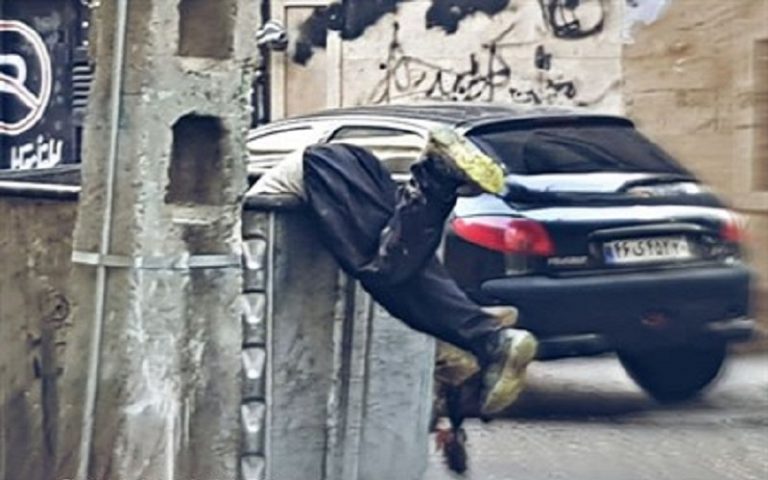
Since the beginning of their rule in Iran, the ayatollahs are responsible for millions of deaths inside and abroad. The high intensity of words and phrases like execution, suicide, immolation, organ selling, and sleeping in cars, roofs, graves, and appliances’ cardboard, as well as ongoing news about the death of children, display how the rulers see the people.

In other words, these realities reveal that not only does the Iranian government violate the opponent’s fundamental human rights, but it does not care about people’s livelihood and welfare. Rampant poverty, high prices, inflation, expanded gap between society and state show the government drives the country to misery and backward.

The Islamic Republic founder Ruhollah Khomeini led millions of people, including teenagers and minors, to an eight-year war of erosion with Iran’s western neighbor Iraq. Khomeini and his eulogists, like current Supreme Leader Ali Khamenei and former President and Propaganda Minister Mohammad Khatami, incited children to sacrifice their lives for opening minefields.

They exploited teenagers’ religious beliefs in order to continue the war. Then-commander of the Islamic Revolutionary Guard Corps (IRGC) Mohsen Rezaei called innocent children “one-time use soldiers.” Once, he spoke about between 360,000 to 400,000 school and college students who the attended war fronts. Since the end of the war in 1988, the Islamic Republic occasionally parades those children’s remaining bones to deceive others and gain a social base.

Read More:

Iran’s Deprived Students: Where Is Their Money Spent?

However, the real number of children who fell victim to the government’s goals is far higher. In addition to the war’s victims, Iranian officials have destroyed the lives of millions of children by spreading poverty and misery among citizens. Dropouts of school and child laborers, vendors, and garbage-collectors are seen in almost all of Iran’s provinces. Furthermore, suicide among minors is the flipside of these social phenomena.

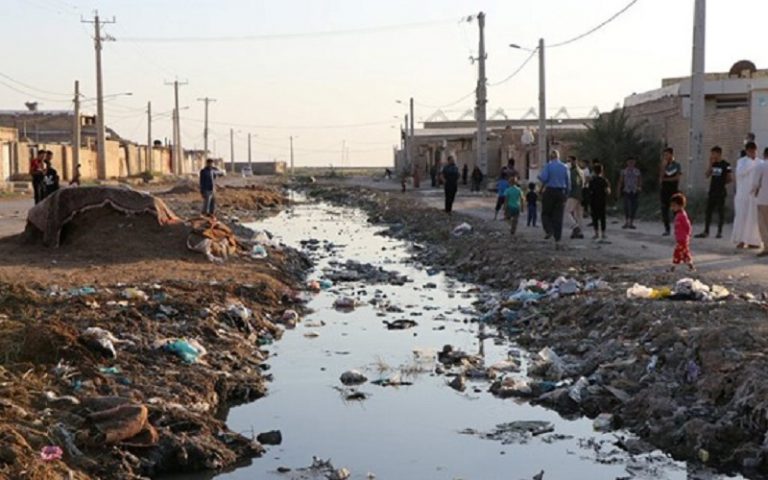
In its February 17 edition, Aftab-e Yazd daily pointed out an ongoing catastrophe in Ahvaz city, Khuzestan province’s capital. “Danial’s death for which sin?” the daily titled, attracting attention to the dire condition of Ahvaz’s infrastructure.

“There is no end for the tragic death of Ahvaz’s children. Children soon bid farewell to their world due to the officials’ indifference about the sewage problem. Two-year-old Danial Navaseri from Darvishieh area in Kut-Abdollah district has just lost his life to fall in open sewage runnel,” wrote the daily.

“There is an open sewage system in this area, and it had not built a standard system for sewage. In August 2020, one-year-old girl Sedigheh Heydari fell into the open sewage system and lost her life. Before her, children like Mohammad Sadegh Zargani, in March 2016, one and half-year-old Mohammad Erfan Abidavi, in May 2018, and three-year-old Ali Baravieh, in August 2018, had died of the same way,” said Gholamreza Safarnejad, chief of Ahvaz’s Water and Sewage Organization.

Social media activists reflected on this ongoing drama. “This boy would be with his family if we had a sewage system,” posted an activist.

“I remember my little brother when his head was tainted with blood and sewage. The pain is that these sewage wells are getting victims after 20 years,” wrote another activist. “Is there anyone to provide four lids for these wells?” posted an activist. “This is the official’s imprudence that kills innocent children,” another activist added. “No one would realize what is going on in Ahvaz and how ridiculously this city is being governed!” wrote an activist.

Notably, President Hassan Rouhani promoted former Khuzestan Governor Gholamreza Shariati as the head of Standard Organization on February 14. This promotion shows a perfect view of the Islamic Republic’s system and how imprudent officials gain significant positions.

Now, Shariati’s standard seems to engulf the country, and Iran would face many more dilemmas under the shadow of Rouhani’s new appointee. Surprisingly, the new Standard Organization’s head was involved in the mass killing of dozens of protesters in Khuzestan province during the gas protests in November 2019, which sounded alarms about more deaths and misery in various cities.

Iran To Further Breach Nuclear Deal

0

Iran has announced plans on Monday to further violate its commitments under the 2015 nuclear deal with world powers or Joint Comprehensive Plan of Action (JCPOA), which the Iranian Resistance says is perfectly in step with the mullahs’ nuclear extortion campaign.

The regime said, according to Reuters, that “it will block snap inspections by the [United Nations] nuclear watchdog from next week if other parties to the 2015 nuclear deal do not uphold their obligations”.

It should be said that the five remaining signatories to the deal have bent over backwards to meet obligations given the international sanctions on Iran, but Iran have been openly violating the deal for over a year and the US pulled out in 2018 citing Iranian non-compliance and the deal’s failure to cover other malign actions by Iran.

The signatories thought that the deal would end Iran’s nuclear ambitions but, in reality, they left some glaring loopholes that the regime could exploit. This led National Council of Resistance of Iran (NCRI) President-elect Maryam Rajavi to say in 2015 that if the world powers had been more forceful that Iran would have no choice but to end its nuclear weapons programmes.

The NCRI actually revealed Iran’s nuclear weapons programme in 2002, prompting international sanctions and leading to the 2015 deal.

In 2017, the US Representative Office of the NCRI revealed that the nuclear programme was continuing at the Research Academy in the Parchin complex, something that Iran’s nuclear chief Ali Akbar Salehi confirmed in an interview with the state-run Fars News Agency.

He said: “Nuclear activities, as well as research and development on the nuclear fuel cycle, uranium conversion, and enrichment are being carried out without any restrictions.  Enriched uranium production and stockpile are now as high as pre -JCPOA period, heavy water storage is being carried out without any restrictions the process of building the Arak heavy water research reactor is advancing in cooperation with foreign parties and the use of related equipment.”

In response to this, Rajavi noted that the regime never gave up on trying to build a nuclear bomb and still “continues the deception and concealment. The regime uses all the facilities and concessions that the nuclear deal has given to pursue terrorism, foreign warfare, and domestic repression”.

The NCRI advised that Europe ends its appeasement policy, which is only encouraging the mullahs, and instead take a firm stance against Iran’s terrorism and nuclear extortion.

New Revelations Expose Iranian Propaganda After Terrorist-Diplomat’s Conviction

0

Early this month, a Belgian court convicted the Iranian diplomat Assadollah Assadi of planning a deadly terrorist attack on European soil. The plot in question was thwarted in the summer of 2018, but the ensuing investigation and trial helped to expose a much larger underlying threat. When Assadi was arrested by German authorities, documents were recovered from his car which showed that he had been in contact with a network of operatives spanning at least 11 European countries. Many of those operatives received cash payments from Assadi while he was serving third counsellor at the Iranian embassy in Vienna.

The nature of those cash payments remains to be determined, and critics of the Iranian regime have urged Western governments and multinational bodies to undertake more serious investigations of the full range of activities that figures like Assadi had been pursuing around the world.

There’s little question that the network associated with Assadollah Assadi has a role to play in both these aspects of Iran’s foreign strategy: direct attacks on its adversaries and disinformation campaigns aimed at smearing it as either ineffectual or dangerous to Western interests. Fortunately, that narrative has been widely rejected within American and European policy circles, as evidenced by the presence of political dignitaries from all major political parties at the event that Assadi attempted to bomb in 2018. Unfortunately, though, it has not been rejected entirely by the governments in which those parties are represented.

We should hope that this situation will not last much longer, now that Assadi and his three co-conspirators have been convicted, and their network exposed. Paying attention to Iran’s propaganda at this point would needlessly downplay the effects of far-reaching infiltration by institutions like the Iranian Ministry of Intelligence and Security (MOIS). It would also lend false credibility to the very claims that motivated the 2018 plot in the first place.

Read More:

State-Run Media Highlights Iran Terrorism

According to the Belgian National Security Service, that plot had not been undertaken on Assadi’s own initiative but had been ordered from high up in the Iranian regime. And according to the NCRI, the decision stemmed from discussions involving both the regime’s Supreme Leader Ali Khamenei and President Hassan Rouhani. It marked a notable departure from the regime’s usual modus operandi, in that the activity was not channeled through proxy groups but was placed directly in the hands of a high-ranking diplomat. This hands-on approach reflected the perceived importance of the operation, which was reportedly intended to kill NCRI President-elect Maryam Rajavi, in particular.

About three months prior to the Free Iran rally at which she delivered the keynote address, Mrs. Rajavi urged activists in Iran to make the just-begun Iranian calendar year a “year full of uprisings.” That in turn was motivated by a protest movement that had broken out in more than 100 Iranian cities and towns at the end of 2017, then continued through much of January 2018. The movement exposed previously hidden vulnerabilities in the clerical regime and, more to the point, revealed the domestic popularity and organizational strength of the MEK, which even regime officials credited with leading the protests.

By the summer of that year, the regime was desperate to counter direct challenges to its rule and also to reassert the propaganda that portrayed the MEK as an ineffectual cult and helped to prevent Western governments and international bodies from supporting those challenges. A devastating attack on the powerfully symbolic Resistance gathering might have accomplished both of these aims, but unfortunately the failure of that attack only thwarts one of them. The regime’s propaganda has not been amplified in its wake, but it has not been uprooted, either.

This is because talking points that target the Resistance have been spreading through international media for many years, as the result of an increasingly sophistication system of international warfare carried out by networks like the one associated with Assadollah Assadi. On one hand, Assadi’s conviction helped to alert Western governments to the existence of these networks, potentially putting them on a path toward confronting them. But on the other hand, the networks’ mere existence is not enough to convince American or European policymakers that they or their colleagues have been deliberately misled about the situation in Iran.

Just this week, the NCRI announced the release of a letter than had been sent to United Nations Secretary-General Antonio Guterres from a former collaborator with the Iranian Ministry of Intelligence and Security, expressing regret over his dissemination of false claims points about the Resistance movement. “For four years I fell into a trap set by the Iranian regime’s Ministry… and its Iranian embassy in Albania,” said the author, Hadi Sani-Khani, before going naming specific agents, tactics, and operations the regime used in an effort to poison the international press against the MEK and forestall any Western support for its democratic aims.

Among other things, the letter explained the genesis of a 2019 article in Der Spiegel that parroted false claims about the MEK’s community in Albania – an article that later became the subject of a lawsuit that resulted in a court order for the retraction of those claims. That article was not the only one of its kind to face a successful legal challenge, and this phenomenon should go a long way toward demonstrating the legitimacy of the Sani-Khani letter and the underlying claims regarding an Iranian influence network dedicated to disinformation and character assassination in Western media.

As the international community sets out to further investigate the contents of the letter, policymakers should also be making plans for how to address the relevant phenomena when they prove to as real and as dangerous as the NCRI claims. No doubt most serious critics of the Iranian regime will offer the same advice they have already offered in response to Assadi’s conviction, namely that European nations should consider closing Iranian embassies, downgrading diplomatic and trade ties, launching investigations into Iranian institutions that currently operate in their territory, and pursuing indictment or other consequences for all those who have contributed to the spread of terrorism or information warfare in the name of the Iranian regime.

Iran Executes Seven on Wednesday

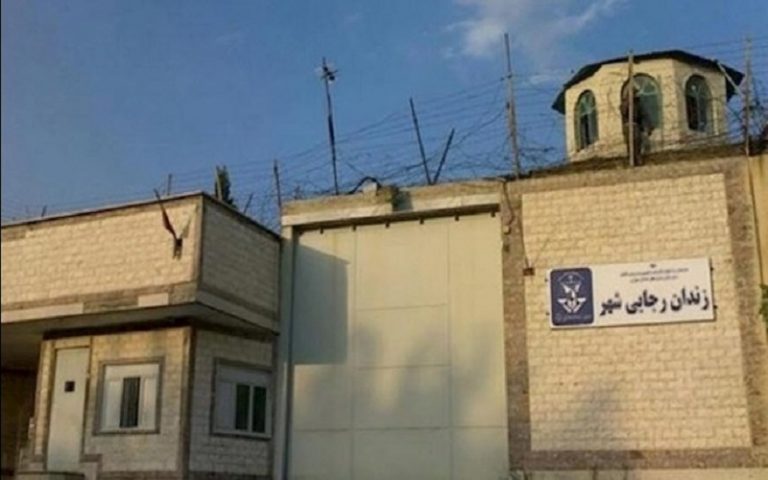
The Iranian regime executed seven prisoners at dawn on Wednesday in Rajai Shahr Prison, a.k.a. Gohardasht Prison, bringing the total number of executions in February to 13. 

This included six men and one woman, all convicted of murder. However, it should be understood that Iran does not separate murder by degrees, so many people convicted of murder may have killed by accident (i.e., manslaughter) or in self-defence. Many women who are victims of abuse may be executed for killing their abuser. 

In fact, the woman executed, Zahra Esmaili, was a domestic violence victim who killed her husband in self-defence. The 42-year-old, who is the 114th woman executed during the presidency of Hassan Rouhani, was regularly beaten by her detective husband. 

On Monday, the mother of two was moved to solitary confinement in Qarchak prison in Varamin, where she’d been serving her sentence, before being moved to Rajai Shahr prison in Karaj on Tuesday.

Read More:

Fundamental Violations of Human Rights in Iran

In recent weeks, the Iranian regime has executed three other women in prisons in Ardabil, Sanandaj, and Karaj. The regime, which is the world leader in executions per capita, is also number one in executions of women. Most of these executions are handed out for offences where international law prohibits the death penalty, including in the many murder cases that should be tried by lesser degrees. 

In the seven-and-a-half-year rule of Rouhani, a supposed moderate, over 4,300 people have been killed. Although, as always, it’s important to note that the regime carries out many executions in secret, so the number many be much higher. 

The Women’s Committee of the National Council of Resistance of Iran (NCRI) has published a list of all the women executed under Rouhani, which is based on reports from the state-run media and the Resistance’s network of supporters inside Iran.  

In a post on Wednesday, they reiterated their call to ban the death penalty in Iran, something that is covered in their 10-point plan for a Free Iran. 

The Iranian regime uses executions and other repressive measures to intimidate the public against taking part in popular protests. 

Th UN High Commissioner for Human Rights, UN Human Rights Council, and other human rights groups should take immediate action to save Iranian prisoners on death row. Human rights organizations such as Iran HRM have also called for the regime’s human rights violations dossier to be referred to the UN Security Council and for regime officials to face justice for crimes against humanity.