


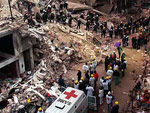
 AFP: The prosecutor investigating the worst terror strike on Argentine soil, the 1994 bombing of a Jewish charities building that killed 85 people, urged Iran Saturday to hand over any suspects in the case.
BUENOS AIRES, July 17, 2011 (AFP) – The prosecutor investigating the worst terror strike on Argentine soil, the 1994 bombing of a Jewish charities building that killed 85 people, urged Iran Saturday to hand over any suspects in the case.
The comments came after an Iranian Foreign Ministry statement said earlier in the day that Tehran, suspected by Argentina of being behind the attack, is “ready for a constructive dialogue” in the case and to cooperate with the Argentine government.
“If the Iranians and their government are ready to cooperate, they should do so once and for all, and the only way possible: by handing over all of those accused in this terrible terrorist attack… and not making statements devoid of content which lead nowhere,” prosecutor Alberto Nisman said in a statement.
Iran said it wanted “to shed all possible light within the framework of the law and to help in preventing the investigation from continuing on an erroneous course.”
Monday will mark 17 years since the strike, which Argentine justice officials believe Tehran ordered. Iran has denied the allegation.
Iran “condemns all terrorist actions, especially the one against the Argentine Jewish center in 1994, and declares its solidarity with the families of the victims,” the Iranian statement added.
Israel has pointed the finger at the Lebanese Shiite militia Hezbollah for carrying out the attacks, which the Jewish state believes were masterminded by Tehran.
Argentina has issued warrants for the arrest of Iranian Defense Minister Ahmed Vahidi along with five other Iranians and a Lebanese accused of planning and carrying out the AMIA bombing.
Both Iran and Hezbollah have consistently denied any involvement in the attacks.
In the 1994 attack, the bomb that leveled the seven-storey AMIA building also wounded 300 people.
Two years earlier, the Israeli embassy in Buenos Aires was hit by a bomb which killed 29 people and wounded 200.
In June, Argentina’s Jewish community was outraged after a visit to neighboring Bolivia by Vahidi, noting that there had been an international arrest warrant out on Vahidi since 2007.
The La Paz government, in a letter to Argentina, said it had been unaware of any charges against Vahidi and said Bolivia “had taken steps to ensure that that Mr Ahmad Vahidi left Bolivian territory immediately.”
But a leader of Argentina’s Jewish community, Aldo Donzis, said the Bolivian government’s actions fell far short of what was required under the circumstances.
“It’s a huge farce that the Bolivian government asked him to leave the country after he had already completed his mission,” Donzis said.
“What was called for was not his expulsion, but his arrest.”
Earlier this year, a press report in Argentina claimed Foreign Minister Hector Timerman had offered to shelve a probe into Iran’s involvement, which he strongly denied.
The March 26 report quoted a “secret” Iranian memo purportedly sent earlier this year from Iranian Foreign Minister Ali Akbar Salehi to President Mahmoud Ahmadinejad which said: “Argentina is no longer interested in solving those two attacks, but would rather improve its economic relations with Iran.”
According to the memo, allegedly written after a meeting in January between Timerman and Syrian President Bashar al-Assad, Buenos Aires was said to be “prepared to drop” the investigation in order to better its financial ties with Tehran.
Timerman said in April that the report was illogical and that Buenos Aires had nothing to gain economically by shelving the investigations.
“Argentina has no embargo against Iran and Iran has no embargo against Argentina, so what am I going to get by forgetting the investigation? What kind of commercial benefit?” he asked.
Argentina’s Jewish community numbers some 300,000 people, the largest in Latin America.


