


Source: THE LONGWAR JORNAL
By: BILL ROGGIO AND CALEB WEISS
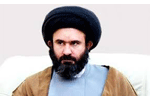
Wathiq al Battat, the leader of the Mukhtar Army and secretary-general of Hezbollah in Iraq, was killed yesterday in the eastern Iraqi province of Diyala. Battat had formed the Mukhtar Army in early 2013 and has received support from Iran’s Qods Force.
Source: THEL ONGWAR JORNAL
By: BILL ROGGIO AND CALEB WEISS
Wathiq al Battat, the leader of the Mukhtar Army and secretary-general of Hezbollah in Iraq, was killed yesterday in the eastern Iraqi province of Diyala. Battat had formed the Mukhtar Army in early 2013 and has received support from Iran’s Qods Force.
The Mukhtar Army said that Battat was “assassinated today [Dec. 21] by accident in northern Diyala during the struggle with his
sons against terrorism,” according to a short statement released by the group. The events surrounding the “accident’ were not immediately made clear. A source in the Iraqi Interior Ministry told al Quds al Arabi that Battat was killed by “unidentified gunmen,” but this has not been independently verified.
The news quickly spread on Twitter, with many Islamic State supporters tweeting that the Islamic State was behind al Battat’s death. The claim that the Islamic State was behind al Battat’s death cannot be independently verified, and so far the jihadist group has not officially taken credit for his death.
Shiite militias, including the Mukhtar Army, have played a key role in battling the Islamic State in the eastern province of Diyala, which borders Iran. Qods Force, the external operations branch of Iran’s Revolutionary Guards Corps, has played a vital role in supporting Shiite militias combating the Islamic State in Diyala and elsewhere in Iraq. Iranian-backed Shiite militias such as the Hezbollah Brigades, Badr Brigades, Asaib al Haq, and the Peace Brigade (formerly the Promised Day Brigade) have all been spotted on the battlefield.
Battat was the secretary-general of Hezbollah in Iraq (the political party, not the Hezbollah Brigades, a dangerous Shiite militia supported by Iran) when he formed the Mukhtar Army in early February 2013. The Mukhtar Army was created to support the Iraqi government as Sunni political protests against the Iraqi government became more prevalent in early 2013. But shortly after it was mobilized, the militia distributed pamphlets in Baghdad threatening to kill Sunni residents.
In November 2013, the Mukhtar Army fired mortar rounds into northern Saudi Arabia. In an interview with Reuters, Battat said the goal of firing the rounds was to “send a warning message to the Saudis to tell them that their border stations and patrols are within our range of fire.” Battat went on to say that the mortar fire was also to get “Riyadh to stop interfering in Iraq.”
Just after creating the Mukhtar Army, Battat issued a prescient statement, warning about the yet-to-come jihadist offensive in Iraq.
“The government is stupid for not heeding our warning that al Qaeda is going to attack,” Battat said, according to Al Arabiya. The Islamic State, then called the Islamic State of Iraq, was al Qaeda’s official branch in the country before a leadership dispute arose with al Qaeda’s General Command.
Battat told The Associated Press that the Mukhtar Army is supported by the Iranian government.
He “described himself as a follower of Iran’s supreme leader, Ayatollah Ali Khamenei. He said his group receives weapons and other support from Iran, but declined to provide details. He has previously said he is advised by Iran’s Qods Force,” AP reported.
The Iraqi government issued an arrest warrant for Battat in February 2013, and he was reported to have been detained in the beginning of January 2014. His release was not announced, but he may have been freed by the Iraqi government to aid in the fight against the Islamic State, which launched its offensive to take control of Anbar that same month.


