


Source: THE HILL
By: Soona Samsami
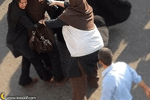
In recent weeks, over two dozen women across Iran have been subjected to a spate of hideous acid attacks, leaving them with permanent burns on their faces and bodies. One victim reportedly died of her injuries in Isfahan after having acid splashed on her face by state-affiliated gangs. But far from being a mark of strength, these cowardly assaults on defenseless women expose the face of a weak and desperate theocracy unable to curb increasing social opposition to its rule – led by women.
Source: THE HILL
By: Soona Samsami
In recent weeks, over two dozen women across Iran have been subjected to a spate of hideous acid attacks, leaving them with permanent burns on their faces and bodies. One victim reportedly died of her injuries in Isfahan after having acid splashed on her face by state-affiliated gangs. But far from being a mark of strength, these cowardly assaults on defenseless women expose the face of a weak and desperate theocracy unable to curb increasing social opposition to its rule – led by women.
The attacks come in the wake of a bill introduced in the regime’s Parliament, which gives greater authority to the “morality police.” The regime’s thugs have been emboldened to brutally attack women in Iran who defy compulsory veiling. This happens just as their sisters in Afghanistan and Pakistan, too, continue to be assaulted by religious extremists and fundamentalists. But the difference in Iran is that the assailants are often state-sponsored and criminal gangs of paramilitary Bassij.
Last month, the regime executed a 26-year-old woman on spurious grounds and what Amnesty International decried as a deeply flawed trial. The young woman, Reyhaneh Jabbari, was hanged at Evin prison accused of killing in self-defense an ex-intelligence official who had tried to rape her. By hanging Reyhaneh, the mullahs wanted to teach women a lesson and terrify them into submission.
But, the fact that it hasn’t worked means that the regime is pathetically weak and the opposition is strong. Over the past week, activists have distributed leaflets in various cities and have organized more protests. In the city of Shiraz, one of the distributed leaflets reads: “My sister is the victim of acid attacks by this regime. Shame on Khamenei [the regime’s supreme leader].”
In order to curb increasingly organized and vocal opposition, the regime has stepped up suppression at home. During Hassan Rouhani’s first year in office, over 1,000 people have been executed, many in pubic. There have been a large number of protests and widespread unrest, including the revolts of Bakhtiaris and Gonabadi Sufis, to complement protests by women. Arrests and imprisonment of lawyers, journalists, authors, bloggers, students and intellectuals are on the rise, prompting both the UN Secretary General and Special Rapporteur on human rights in Iran to express outrage and alarm.
Iranian women have been the unsung heroes in the fight for a democratic, secular, non-nuclear Iran. Young women in Iran find true inspiration in the main opposition that has a philosophy based on gender equality, actively promoted by its President-elect Maryam Rajavi. The widespread rejection of compulsive veiling in Iran is a collective statement against the regime.
The mullahs have turned the voluntary dress code in Islam into a very strict rule. As a consequence, a clear way of expressing opposition against the theocracy, even for Muslim women, has been to defy their misogynist rules. Compulsory veiling and the systematic suppression of women by the Iranian regime shows that they politicized Islamic fundamentalism and extremism in the region long before the Islamic State (ISIS).
In opposition to the mullahs’ misogyny, Rajavi has outlined a Ten Point Plan for Future Iran, which says, “We believe in complete gender equality in political, social and economic arenas. We are also committed to equal participation of women in political leadership. Any form of discrimination against women will be abolished. They will enjoy the right to freely choose their clothing.”
Burning faces of women, hanging opposition figures from cranes in public squares, massacring Iranian dissidents living in Iraq aim to terrify those who agitate for a future democratic Iran. But in fact, each atrocity is a caustic symbol of the regime’s fear of those who flaunt and threaten its authority. The Iranian people—led by women–know this, and bravely face it through escalating acts of civil disobedience. They deserve our praise and support.
Samsami is representative in the United States for the National Council of Resistance of Iran (NCRI), which is seeking the establishment of a democratic, secular and non-nuclear republic in Iran.


