


 New York Times: Even as the United States imposes new sanctions on Iran, one of the biggest gaps in the American strategy is on full display here in Iraq, where hundreds of millions of dollars in crude oil and refined products are smuggled over the scenic mountains of Iraqi Kurdistan every year.
The New York Times
By SAM DAGHER
PENJWIN, Iraq — Even as the United States imposes new sanctions on Iran, one of the biggest gaps in the American strategy is on full display here in Iraq, where hundreds of millions of dollars in crude oil and refined products are smuggled over the scenic mountains of Iraqi Kurdistan every year.
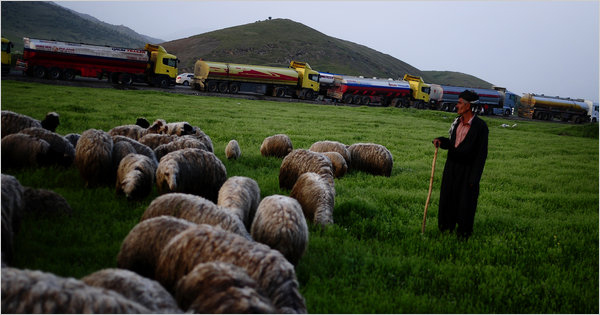
Day after day, without formal authorization from Baghdad, more than a thousand tankers snake through this town on Iraq’s border with Iran, not only undercutting recent American sanctions but also worsening tensions with the Iraqi government over how to divide the country’s oil profits.
The scale and organization of the trade has raised concerns among American officials here, said one senior American official in northern Iraq, who would speak about the Iran oil trade only anonymously, following diplomatic ground rules. They fear that proceeds from the sales could be flowing to corrupt Iraqi politicians and benefiting the Iranian government, even as the United States has approved new unilateral sanctions against Tehran, imposing penalties on foreign entities that sell refined petroleum products to Iran.
A senior Kurdish government official said that the benefits from a business he described as “elaborate” and “huge” went to the region’s two governing parties and affiliated companies, and that officials and politicians in Baghdad were involved as well.
“The people are being scammed, but by whom, we do not know,” said Hamid Mohammed, an Iraqi tanker truck driver waiting to enter Iran recently.
The Kurds have long been allied with the United States. Since the first Persian Gulf war, American and NATO forces had imposed a no-flight zone over Kurdish territory in northern Iraq, protecting the Kurds from Saddam Hussein and helping them to build a semi-autonomous region.
Smuggling of oil and other goods and commodities along Iraq’s porous borders thrived in the 1990s, when Iraq was under international sanctions. But the semiofficial nature of the current trade underscored how business interests had trumped the messy politics of Iraq and the region.
The stream of tankers into Iran continued without interruption during an Iranian military campaign last month against Iranian Kurdish separatists operating at the border. Hundreds of tankers, each with a capacity of at least 226 barrels of crude oil and refined products, enter Iran every day from Penjwin and two other border posts in Iraqi Kurdistan, Kurdish officials say.
While much of the refined product is used in Iran, which sorely lacks refinery capacity, the crude oil is trucked all the way down to the Persian Gulf ports of Bandar Bushehr, Bandar Imam Khomeini and Bandar Abbas, where it is emptied into reservoirs or loaded onto ships, according to drivers.
The trade is supported by an estimated 70 mini-refineries, known in the industry as topping plants, said the Kurdistan region’s oil minister, Ashti Hawrami. They are dotted around the Kurdistan region and Kurdish-controlled areas in nearby Kirkuk and Nineveh Province, he said, and many of them are unlicensed.
Abdul-Karim al-Luaibi, Iraq’s deputy oil minister for production, said he was unaware of oil exports to Iran from the Kurdistan region, adding that all the mini-refineries were illegal.
“They bear responsibility for this,” said Mr. Luaibi, referring to Kurdish authorities.
In a rare interview in May, Mr. Hawrami said only fuel oil and byproducts like naphtha were being sent to Iran after processing the region’s own crude at two privately owned refineries to meet the internal market’s needs and run a local power plant. Mr. Hawrami said that revenue from the Iran business has helped cover costs for foreign oil companies in the Kurdistan region that were hurt when they stopped exporting crude through a pipeline to Turkey in October because of a dispute between Kurdistan and Baghdad. He said any extra revenue that accrued to the region from this business was being kept out of the Kurdistan government’s finances and deposited in a separate bank account to be reconciled with Baghdad in the future, once the two sides resolved their differences.
But Mr. Hawrami also said that it was not just refined products from the Kurdish region that were finding their way into Iran. Crude oil and refined products from Kirkuk and the Baiji refinery to the south were also being smuggled into the region, and some were crossing the Iranian border. He said his ministry had no control over this.
“A truck is a truck — so easy to manufacture a license and say, ‘This is fuel oil and not crude oil’ and they find their way,” said Mr. Hawrami. “Unfortunately, the problem is much broader than little Kurdistan.”
The disclosures about the oil trade with Iran come at a delicate time for the Kurdish region. In May, the central government approved a tentative deal to resume crude oil exports of about 100,000 barrels a day to Turkey through Iraq’s pipeline network. Mr. Hawrami said exports would resume only after a mechanism was worked out to pay the oil companies’ production costs.
He said the companies — Norway’s DNO and a Chinese-Turkish venture called Ttopco — were owed a total of about $1 billion. Together, the two fields they operate can produce up to 200,000 barrels a day, and the region’s overall production will reach one million barrels a day in three to four years when at least six other fields come online, according to Mr. Hawrami.
Analysts say that the Kurdish region’s oil trade with Iran provides a revenue source that it does not have to share with Baghdad, at least for now, diminishing its reliance on exports to Turkey. It also grants them leverage in resolving oil and internal border disputes with Baghdad.
“They can negotiate from a position of strength,” says Ruba Husari, an oil specialist and founder of Iraqoilforum.com. “They are running their own oil kingdom.”
But questions about the legitimacy of the region’s oil activities are increasingly coming from within.
“Kurdistan is like an island with no rule of law when it comes to oil,” says Abdulla Malla-Nuri, a member of the region’s Parliament from the Gorran opposition movement, which broke away from one of the governing parties last year and has accused them of rampant corruption.
Mr. Malla-Nuri wants revenue from the Iran trade to flow into the region’s budget after deducting what is owed to the rest of Iraq — 83 percent, according to current arrangements.
The region’s prime minister, Barham Salih, is also reportedly pushing for this but is being met with fierce resistance, even from his own party, which is headed by Iraq’s president, Jalal Talabani.
Mr. Salih’s task is further complicated by an acrimonious relationship with the regional oil minister, Mr. Hawrami, who is backed by the region’s president, Massoud Barzani.
Mr. Talabani’s party has had a so-called strategic agreement with Mr. Barzani’s party since 2005, allowing them to divide the region’s political, economic and military power. This applied to the oil trade with Iran as well, according to a top Kurdish official who requested anonymity because he belonged to one of the governing parties.


