


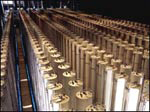
 Washington Post: Why did the centrifuges stop spinning? Only Iran knows – and it’s not saying.
The Washington Post
By Glenn Kessler
Washington Post Staff Writer
Wednesday, November 24, 2010; A07
Why did the centrifuges stop spinning? Only Iran knows – and it’s not saying.
The International Atomic Energy Agency, the U.N. nuclear watchdog, reported Tuesday that on Nov. 16, Iran stopped feeding hot uranium gas into its thousands of centrifuges, and that the shutdown could have lasted as long as seven days.
The disclosure came after intense speculation that a computer worm known as Stuxnet had been manufactured specifically to target the centrifuge machines at the Natanz facility, which Iran says is used to produce fuel for electricity and which the United States suspects is part of a weapons program.
The IAEA report was tantalizing, experts said, but inconclusive, especially because it also indicated that Iran has in recent months brought more than 1,000 new centrifuges on line. The kind of centrifuge used is prone to shutdowns and malfunctions.
Still, a number of researchers have determined that the Stuxnet worm was designed to make the type of centrifuge – a Pakistani copy of an old Dutch design – spin wildly out of control.
“The shutdown is definitely interesting,” said Ivanka Barzashka, research associate at the Federation of American Scientists. “It is consistent with replacing all of the software operating your controls.” She said that the increasing evidence that Stuxnet was aimed at the type of centrifuge Iran primarily uses is “too much of a coincidence, in my opinion.”
Israel and the United States are seen as the most likely sources for the cyberwarfare suggested by Stuxnet – officials in both countries have declined to comment – but Iran has denied that it was harmed by Stuxnet or that it is facing serious technical problems with its uranium-enrichment program.
Iranian Vice President Ali Akbar Salehi, who is also the head of the Iranian Atomic Energy Organization, acknowledged Tuesday that Iran was the subject of a computer attack, but he placed it far in the past.
“One year and several months ago, Westerners sent a virus to [our] country’s nuclear sites,” he said, according to the Islamic Republic News Agency (IRNA).
“They intended to stop the ever increasing progress of Iran in the nuclear field,” Salehi said. “But, with the help of god, we discovered the virus exactly at the same spot it wanted to penetrate and prevented the virus from harming” its equipment.
IAEA reports are highly technical and often deliberately obtuse, so experts said it was difficult to determine whether the Stuxnet worm – if it really reached Natanz – affected Iran’s production of low-enriched uranium. At first glance, the IAEA report suggests that Iran increased its monthly production.
The Institute for Science and International Security in Washington noted that Iran boosted the centrifuges in use at Natanz from 3,772 to 4,816. It also increased the number of centrifuges in six cascades, and the production has appeared to remain steady. Iran’s stock of low-enriched uranium, if enriched to weapons-grade, would produce enough material for at least two nuclear weapons.
But nearly 4,000 centrifuges still sit idle at the facility, and the average monthly production of low-enriched uranium per centrifuge declined by about 10 percent, according to ISIS. Each centrifuge appeared to produce just under an ounce a month, down from 1.1 ounces, but the average number of centrifuges operating during this period is not known.
“The plant seems to be unstable, and that instability seems to worsen when they increase the number of centrifuges enriching,” said David Albright, president of ISIS.


