


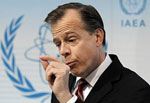
 AP: A senior U.S. envoy on Wednesday backed United Nations assessments that Iran may be continuing secret work on developing nuclear weapons, indirectly contradicting American intelligence estimates in the public domain that such activities stopped eight years ago.
The Associated Press
VIENNA (AP) — A senior U.S. envoy on Wednesday backed United Nations assessments that Iran may be continuing secret work on developing nuclear weapons, indirectly contradicting American intelligence estimates in the public domain that such activities stopped eight years ago.
The comments by envoy Glyn Davies played off recent remarks by International Atomic Energy Agency chief Yukiya Amano, whose attempts to follow up on allegations that Iran had conducted such clandestine experiments have been rebuffed by Tehran.
In a confidential report late last month, Amano expressed concern about the possible existence of “current undisclosed nuclear related activities … related to the development of a nuclear payload for a missile” and other work directly linked to a weapons program.
The comments were significant because they differed from what has been publicly said by American intelligence agencies. The latest information in the public domain is a summary of a National Intelligence Agency Estimate from 2007 that says Tehran apparently abandoned attempts to develop nuclear weapons in 2003.
U.S. officials said last month that a newly drawn up National Intelligence Estimate concludes Iran’s leaders are split over whether to use their nuclear program to develop atomic weapons. But they did not specify whether the new document revised the 2007 conclusion that Iran had stopped direct work on its arms program.
Davies would not be drawn into comparing the two assessments, saying he could not discuss intelligence issues. But he said Washington stands “fully behind the Director General’s assessments,” adding: “The D.G. is on to something.”
He spoke to reporters outside a 35-nation IAEA board meeting focusing on suspicions that both Iran and Syria are hiding past or present nuclear activities that could be used in a weapons program.
Iran is under four sets of U.N. Security Council sanctions, primarily for defying council demands to stop uranium enrichment but also because of a record of nuclear secrecy and its stonewalling of an IAEA probe on whether it has worked on a nuclear arms program.
Syria, too, is resisting an IAEA probe, denying agency requests to revisit a site hit in 2007 by Israeli warplanes. The U.S. later said the building destroyed by Israel was a nearly ready reactor that would have been able to produce plutonium once finished.
Both plutonium and enriched uranium can be used to arm nuclear warheads. While Iran says it is enriching only to make fuel for an envisaged reactor network, its defiance of the Security Council and nuclear secrecy have led to fears it might be expanding the technology for its weapons potential.
Ali Asghar Soltanieh, Iran’s chief IAEA envoy, on Wednesday repeated Tehran’s determination to continue enriching, telling reporters: “Neither the sanctions nor resolutions nor the threat of attack, nothing could stop this (peaceful) enrichment.
In separate comments to the board, he accused the U.S. and its the European Union of unfoundedly “questioning the exclusive peaceful nature of our nuclear activities without presenting any authenticated evidence.”
Davies, the U.S. chief delegate, in turn warned of “increasingly apparently military dimensions to Iran’s nuclear program, including efforts by Iran to develop a nuclear warhead.”
“Iran continues to act very much like a state with something to hide,” he told the board.
Comments on behalf of the five U.N. Security Council members and Germany by chief Russian delegate Grigory Berdennikov were much more low-key. Iran’s compliance with U.N. Security Council resolutions is “mandatory,” he said, alluding to Council demands that Iran stop enrichment.
But the fact that they were delivered by Russia, which along with China is generally reluctant to directly criticize Iran, were significant. With the last six-power statement at the IAEA dating back to 2007, China’s and Russia’s agreement to join in new joint criticism, however oblique, was also noteworthy in reflecting Moscow’s and Beijing’s impatience with Tehran.


