


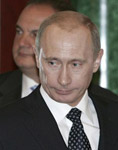
 AFP: President Vladimir Putin faced a coordinated Western push Sunday to shift Russia’s stance on Syria as he hosted EU chiefs for a private dinner ahead of a summit also clouded by rifts on Iran. By Benoit Finck
 SAINT PETERSBURG (AFP) — President Vladimir Putin faced a coordinated Western push Sunday to shift Russia’s stance on Syria as he hosted EU chiefs for a private dinner ahead of a summit also clouded by rifts on Iran.
EU Commission head Jose Manuel Barroso and EU president Herman Van Rompuy will be keen to sound out Putin for any hints of a softening on either crisis following his return to the Kremlin for a historic third term.
However, the ex-KGB agent stuck firmly to his refusal to back further action against Soviet-era ally Syria during a Friday swing through Berlin and Paris, and Moscow signalled clearly on Sunday that it was still in no mood to compromise.
“The only way out of the Syria crisis… involves a cessation of violence and consistent support for the plan of (mediator Kofi) Annan,” Russia’s foreign ministry said as Putin welcomed the EU’s top command to his native city.
“Russia will continue supporting this position and calls on other states to do the same.”
Foreign Minister Sergei Lavrov later fielded a phone call from Annan during which he argued that last month’s massacre in the Syrian city of Houla proved the “lack of an alternative” to a stronger push for dialogue.
Pressure on Russia to concede that no peace talks were emerging and to promote a Syrian compromise in which President Bashar al-Assad cedes power to his inner circle has been building on an almost daily basis.
Secretary of State Hillary Clinton said Sunday that she “made it very clear” to Lavrov in a phone call at the weekend that the focus was shifting to a political transition in Syria rather than talks with Assad’s regime.
“Assad’s departure does not have to be a precondition but it should be an outcome, so the people of Syria have a chance to express themselves,” Clinton told reporters during a visit to Stockholm.
The European Union for its part plans to deliver a similar message to Putin during Monday’s more formal set of meetings that will include EU foreign policy chief Catherine Ashton.
We “expect to have an in-depth discussion over Syria,” said an EU official in Brussels.
Putin has admitted that Syria stands on the brink of civil war despite Russia’s adamant support for Annan’s tattered plan for ending a 15-month conflict in which more than 13,000 are thought to have died.
But he has cited Libya and Iraq — two foreign interventions Moscow also bitterly argued against — as evidence that transitions of power and outside interference do not solve problems in the long term.
Russia’s dispute with the West over Iran also concerns what Moscow sees as attempts by big nations to circumvent its diplomatic sway on the UN Security Council by acting on their own.
The Kremlin has criticised the European Union sharply for imposing an oil embargo on Iran over its nuclear programme and argued that unilateral sanctions only diminish the chances of compromise from Tehran.
Van Rompuy countered in an interview with Moscow’s Kommersant business daily that “whether we maintain, lift or ease sanctions (against Iran) will depend on its own future actions.”
Yet the two sides could still seek out common ground ahead of a crunch third round of talks with Iranian negotiators that world powers have scheduled to hold in Moscow on June 18 and 19.
Moscow has been keen to stress that its ties with the European Union itself — a 27-nation bloc representing Russia’s top foreign trade partner — remained warm and were seen as vital by Putin.
“Overall, we believe that enhanced strategic partnership between Russia and the EU is not only useful, it is essential to all sides,” Russia’s EU envoy Vladimir Chizhov said in Brussels.
Some analysts cautioned however that EU officials who hope to see a more accommodating Putin on his return to the presidency after a four-year spell as Russian premier may be disappointed.
“Based on his recent rhetoric and statements, he has not become any more cooperative than he was (during his 2000-2008 presidency),” said Institute of Strategic Assessment analyst Alexander Konovalov.


