


 New York Times: Western sanctions have succeeded in another way: Most blame for economic distress is directed at Iran’s own leaders, and discontent appears to be growing with the entire political system. The New York Times
By NICHOLAS D. KRISTOF
 BEFORE beginning my road trip across Iran, I stopped at a shopping mall for computer equipment in Tehran. It was brimming with iPads and iPhones — not to mention a statuette of Steve Jobs in a store window — and one shop owner smirked condescendingly at my laptop.
“You have a very, very old computer!” he scoffed. “Is this older than I am?”
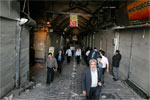
The encounter was a reminder that Iran is a relatively rich and sophisticated country, more so than most of its neighbors. Yet one lesson from my 1,700-mile drive around the country is that, largely because of Western sanctions, factories are closing, workers are losing their jobs, trade is faltering and prices are surging. This is devastating to the average Iranian’s pocketbook — and pride.
To be blunt, sanctions are succeeding as intended: They are inflicting prodigious economic pain on Iranians and are generating discontent.
One factory owner, Hassan Gambari, who makes electrical panels, told me that he had had to lay off 12 of his 15 workers. Another, Masoud Fatemi, who makes cotton thread and textiles, said that Western sanctions had aggravated pre-existing economic problems.
“Prices have gone ridiculously high, so production is almost impossible,” he said. “Everything has become harder, more time-consuming and more expensive because of the sanctions.”
Fatemi said that an electrical inverter blew out a year and a half ago, closing one of his factory lines and costing him $500 a day. Because of sanctions, he said, he has been unable to get a replacement from the West, although he hopes to install one soon from South Korea.
In Tabriz, in the west, I chatted with the owner of a store selling Nike, Adidas and Saucony sneakers, hugely prized as status symbols. If a young man wants to find a girlfriend, the shop owner explained, the best bet is to wear Nikes.
But sales have dropped by two-thirds in the last year, he fretted. He added in disgust that some Iranians are in such penury that they attend parties wearing Chinese-made, fake Nikes.
In March, Iran was pushed out of Swift, a banking network for international payments, so the businessman now pays for his imports through the traditional hawala system. That’s an unofficial global network of money-traders. You lug a briefcase of cash to a hawala office in an Iranian bazaar and then ask for it to be made available in Beijing or Los Angeles. This is more expensive and less reliable than a bank transfer, but it’s now the main alternative.
“We are finding a loophole around sanctions,” a hawala trader told me. “The Iranian nation has no other option.”
Economic frustration is compounded because President Mahmoud Ahmadinejad has been lifting subsidies for everything from bread to gasoline — probably sound economic policy, but very unpopular.
Western sanctions have succeeded in another way: Most blame for economic distress is directed at Iran’s own leaders, and discontent appears to be growing with the entire political system. I continually ran into Iranians who were much angrier at their leaders on account of rising prices than on account of the imprisonment of dissidents or Bahais.
“We can’t do business as we used to, and our quality of life is getting worse,” one man, who lost his job as a salesman, said forlornly. “We blame our regime, not Western countries.”
Economic pressure also may be distracting people from other nationalist issues. For example, many ordinary Iranians side with their government on nuclear issues and are angry at assassinations of Iranian nuclear scientists. But people are much more focused on lost jobs and soaring prices.
“The economy is breaking people’s backs,” a young woman told me in western Iran.
I regret this suffering, and let’s be clear that sanctions are hurting ordinary Iranians more than senior officials. I’m also appalled that the West blocks sales of airline parts, thus risking crashes of civilian aircraft.
Yet, with apologies to the many wonderful Iranians who showered me with hospitality, I favor sanctions because I don’t see any other way to pressure the regime on the nuclear issue or ease its grip on power. My takeaway is that sanctions are working pretty well.
This success makes talk of a military strike on Iranian nuclear sites unwise as well as irresponsible. Aside from the human toll, war would create a nationalist backlash that would cement this regime in place for years to come — just when economic sanctions are increasingly posing a challenge to its survival. No one can predict the timing, but Egypt, Tunisia and Yemen have shown that unpopular regimes that cannot last, don’t.
“People putting bread on the table, bearing the pressure, they have a limit,” said a businessman I chatted with on a beach of the Caspian Sea. “Sooner or later, the limit will come and things will change.”
Insha’Allah. (God willing.)


