


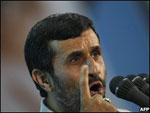
 Bloomberg: Iranian President Mahmoud Ahmadinejad arrived in Venezuela to meet with President Hugo Chavez after talks stalled in Moscow over his country’s nuclear program. Bloomberg
By Charlie Devereux
 Iranian President Mahmoud Ahmadinejad arrived in Venezuela to meet with President Hugo Chavez after talks stalled in Moscow over his country’s nuclear program.
The Iranian leader arrived yesterday from stops in Brazil, where he attended the United Nations Rio+20 conference in Rio de Janeiro, and Bolivia.
Ahmadinejad is making his sixth trip to the region since 2006 as he seeks to capitalize on a surge in anti-American sentiment spearheaded by Chavez and his eight-nation Bolivarian Alliance for the Americas. The visit comes as pressure grows on Iran to cooperate with the international community on its nuclear ambitions.
“We know about the threats against the sovereignty and independence of the Iranian people and government,” Chavez said outside the presidential palace on state television, with Ahmadinejad at his side. “We know about the obstacles imposed by imperialism, blockades, threats, unilateral sanctions that seek to force the surrender of Iran’s Islamic revolution. Count on the support of the Venezuelan people and government.”
Two days of talks between British, Chinese, French, German, Russian and U.S. diplomats and their Iranian counterparts in Moscow this week failed to reach a breakthrough on Iran’s nuclear program. European Union sanctions on oil imports from Iran will start on July 1 as agreed by the bloc’s governments, an EU official in Brussels said yesterday.
Since 2005, Iran has opened six embassies in Latin America and more than doubled trade with Brazil, the region’s biggest economy. Bolivia moved its only embassy in the Middle East from Cairo to Tehran.
Ahmadinejad, speaking tonight, called Chavez “a great revolutionary that is resisting against imperialism by defending the rights of his people, Latin America and the peoples of the world.”
‘Holy Matter’
Chavez, who has visited the Islamic Republic nine times, has said he’ll stand by Ahmadinejad “under any circumstances” and that pursuing ties with Iran is a “holy matter” for Venezuela. Ahmadinejad, in turn, has thanked Chavez for his “brotherly stance” in backing Iran in the face of international sanctions.
The two countries have signed more than 100 bilateral agreements that encompass everything from low-income housing projects to bicycle factories, which Chavez jokingly referred to as “atomic” two-wheelers. Venezuela is making unmanned aerial vehicles, commonly known as drones, with the help of Iran, Chavez said June 13 on national television.
The two countries in 2007 also established in Caracas the Banco Internacional de Desarrollo, which together with its main Iranian shareholder, Bank Saderat, is accused by the U.S. of being a vehicle for the Ahmadinejad government’s funding of Middle Eastern terrorist group Hezbollah.
“The objective is to show that Iran is not isolated, that it has friends in the international community,” said Cynthia Arnson, Latin America program director at the Woodrow Wilson Center for Scholars in Washington. Iran “finds a great deal of comfort in seeking out regimes that have a similarly hostile posture toward the United States.”
Launch Pad
More worrisome for Washington is whether Iran and Venezuela are cooperating in plans to use the South American country as a launch pad for attacks against the U.S. should relations with the Islamic Republic deteriorate further, Arnson said.
The U.S. last year imposed economic sanctions on state oil company Petroleos de Venezuela SA for working with Iran’s energy industry after, according to the State Department, it sent two cargoes of gasoline additive worth $50 million to Iran from December 2010 to March 2011.
The U.S. is monitoring Iran’s ties with the region closely, State Department spokeswoman Victoria Nuland said June 19. Venezuela must comply with international sanctions on Iran or face further penalties, she said
“All countries, including Venezuela, have an obligation to comply with international sanctions against Iran,” Nuland said, according to a transcript of a briefing to journalists in Washington. “We’re committed to ensuring that if we see violations of Iran sanctions that we will call them out and that we will seek appropriate action.”


