


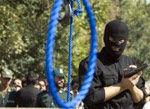
 AFP: A tribunal set up by victims of political crimes committed in the wake of Iran’s 1979 Islamic Revolution began hearings Thursday in a bid to highlight killings ignored by international justice.
By Maude Brulard
 THE HAGUE (AFP) — A tribunal set up by victims of political crimes committed in the wake of Iran’s 1979 Islamic Revolution began hearings Thursday in a bid to highlight killings ignored by international justice.
Top judges and lawyers are taking part in the tribunal, which has no judicial authority, to judge those responsible for killing thousands of political prisoners after Ayatollah Ruhollah Khomeini came to power.
The hope is that the tribunal, held in the library of the Peace Palace in The Hague, will force the United Nations to set up a commission of enquiry into the killings of over 20,000 people that have gone unpunished for over 25 years.
“The world doesn’t investigate what it doesn’t want to investigate,” said Geoffrey Nice, a member of the tribunal and former prosecutor at the UN’s International Criminal Tribunal for the former Yugoslavia (ICTY).
“The most important thing is to leave a record.”
“What we want is to force the UN to set up an enquiry commission because once such a commission says ‘there have been horrible crimes’, they can’t go back and they have to do something,” he said.
“But the (UN) Security Council, and especially Russia would veto that,” he said.
The tribunal’s prosecutor, Payam Akhavan, who also worked for the ICTY, said more than 20,000 political prisoners — men, women and children — were executed in Iranian prisons in the 1980s after the Islamic Revolution.
“In 1988, more than 5,000 apolitical prisoners were executed in a short time throughout Iran,” Akhavan said.
“We say it’s Iran’s Srebrenica (the massacre of almost 8,000 Bosnians in 1995), but here, no one investigates even though families and victims still suffer and cannot forget what happened, even after that time.”
Mehdi Ashough was among the first witnesses to testify on Thursday, recounting the time he spent in Iranian cells between 1981 and 1983.
“There were 60 different forms of torture, they used everything they could think of to torture us,” Ashough said, relating how he witnessed from his cell 44 people, including a 15-year-old boy, being executed on one night in 1981.
The 1979 revolution toppled the monarchy of shah Mohammad Reza, a key US ally in the region, and set up a fundamentalist Islamic republic with little tolerance for opponents.
The tribunal says it was set up through donations from relatives of victims or survivors who live today in exile. The current Iranian regime has been invited to attend the hearings but declined, the tribunal said.
Iran acknowledges people were executed in its prisons after the Islamic Revolution but says the killings were carried out legally in the eyes of international law.
Hearings are to last until Saturday, with 19 witnesses to testify before the judges deliver their unenforceable verdict on Saturday.


