


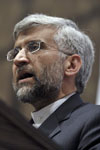
 AFP: Candidates vying for Iran’s presidency clashed on Friday in a heated televised exchange over nuclear talks with world powers, with pointed criticism aimed at top nuclear negotiator and hardline candidate Saeed Jalili.
By Mohammad Davari
TEHRAN (AFP) — Candidates vying for Iran’s presidency clashed on Friday in a heated televised exchange over nuclear talks with world powers, with pointed criticism aimed at top nuclear negotiator and hardline candidate Saeed Jalili.
Jalili is considered to be close to supreme leader Ayatollah Ali Khamenei, who has the final say on Iran’s nuclear programme, which Western powers fear is aimed at producing atomic weapons.
Leading Iran’s nuclear negotiating team, he also represents Khamenei in talks with the P5+1 countries — the United States, Britain, France, China, Russia and Germany.
Friday’s live debate, the last of three before the June 14 election, focused on foreign policy, with the nuclear issue stealing the spotlight.
“The current negotiations that are underway are definitely flawed,” said Ali Akbar Velayati, a conservative candidate who, like Jalili, is seen as close to Khamenei.
“If it was not flawed, we would not be in this situation,” he said referring to tough sanctions imposed by the United States, the European Union and the United Nations Security Council.
Velayati, who was Iran’s top diplomat for 16 years before being made foreign affairs adviser to Khamenei, said the approach had brought unnecessarily damaging sanctions on Iran.
“Diplomacy is not only roughness and hardiness. It is bargaining,” he said.
“The art of diplomacy is that we save the nuclear right, while at the same time, we reduce the sanctions.”
The sanctions have targeted Iran’s ailing economy, leading to raging inflation and high unemployment.
Iran’s currency, the rial, has also lost more than two-thirds of its value since early 2012.
Jalili’s negotiating style was also criticised by another candidate, Hassan Rowhani, who headed a relatively moderate nuclear negotiating team under reformist president Mohammad Khatami in the early 2000s.
“Those with experience who can negotiate with logic should be put in charge” of the nuclear case, Rowhani said.
His call was echoed by conservative hopeful Mohsen Rezai, ex-commander of the Revolutionary Guards, who urged immediate results in talks with world powers.
“World powers delay (the talks) so the effects of sanctions pile up. And then we call this resistance?” he asked, in an allusion to Jalili’s promise of continuing his tactics if elected.
Parallel to diplomatic efforts by world powers to end the standoff with Iran, the UN’s atomic watchdog is investigating Tehran for its past nuclear activities, which the Vienna-based body says might have been aimed at “possible nuclear weapons development.”
Iran denies claims its nuclear programme is aimed at developing weapons, and insists it is peaceful.
In Friday’s debate, Velayati criticised Jalili for his conduct in the last round of P5+1 talks in Almaty in April that failed to produce a breakthrough.
The world powers “wanted to take three steps and asked one in return,” Velayati said. “But you asked them for 100 steps in return for your three.”
“This shows you do not want progress,” he said.
Jalili, known for his tough stance since taking over as Iran’s nuclear negotiator, defended his approach to the talks.
“It would be a source of concern if your other information” were as inaccurate as that on Almaty, he said. “Because it is completely wrong”.
He added that he had proposed “reciprocal steps” by both sides in the talks.
Uniliteral sanctions imposed by the US, Jalili argued, were the result of Iran’s success in breaking consensus among world powers.
Possible solutions to the nuclear issue and sanctions have been a popular topic among the eight candidates approved by Iran’s hardline electoral watchdog, the Guardians Council, from a field of nearly 700 initial hopefuls.
But final decisions on the nuclear issue, as well as other key foreign policy issues, rest with Khamenei.
Another conservative hopeful, ex-speaker of parliament Gholam Ali Haddad Adel, also seen close to Khamenei, conceded that with “better diplomacy” Iran would have faced “fewer sanctions.”
Rowhani, the only cleric in the race, weighed in on the issue, by hinting at the possibility of negotiations with the US, its arch-foe.
“Is negotiation easier with the United States or the European Union?” the moderate asked.
He suggested that the EU would have to consult Washington before coming to an agreement, referring to the US as Europe’s “village chief”.
“The Europeans have a village chief, and it is easier to go and negotiate with the village chief,” than with the EU itself, he said.
The US has had no diplomatic relations with Iran for more than three decades.
Rowhani, alongside the sole reformist candidate in the race, Mohammad Reza Aref, is appealing to the reformist base, as well as moderates whose favourite would-be candidate, ex-president Akbar Hashemi Rafsanjani, has been barred from running.


