


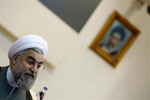
 Reuters: President Hassan Rouhani is still deciding who will lead talks with world powers on Iran’s nuclear program, the Foreign Ministry said on Tuesday, more than two months after the moderate cleric was elected.
By Jon Hemming
DUBAI (Reuters) – President Hassan Rouhani is still deciding who will lead talks with world powers on Iran’s nuclear program, the Foreign Ministry said on Tuesday, more than two months after the moderate cleric was elected.
Rouhani has signaled that Iran is willing to be more transparent over the program and take a less confrontational stance in negotiations with the five permanent members of the U.N. Security Council plus Germany, the so-called P5+1.
Although he has named his cabinet, Rouhani has yet to announce who will be the new head of the Supreme National Security Council, a figure who has also been chief negotiator in 10 years of the on-off nuclear talks.
The delay has led to speculation in Iranian media that Rouhani wants to transfer that role to the Foreign Ministry, traditionally a less hardline institution.
“In the past 10 years … the negotiator has been the secretary of the Supreme National Security Council. This may change, Mr. Rouhani may decide to appoint someone else, maybe the foreign minister or anyone else that he deems necessary,” Foreign Ministry spokesman Abbas Araqchi told a news conference.
“We are still waiting for our president to announce which institution is charged with pursuing the nuclear negotiations and afterward to identify the negotiator and the nuclear team,” Araqchi said.
Given the importance of the post and the urgency with which Rouhani says he wants to restart talks, the time taken to decide who should conduct them suggested a vigorous debate behind the scenes of Iran’s complex and often opaque political system.
Rouhani has already appointed the pragmatic outgoing foreign minister, Ali Akbar Salehi, to replace the hardliner Fereydoun Abbasi-Davani as head of Iran’s Atomic Energy Organisation in what experts see as a signal of a more flexible approach.
Rouhani has stressed that, while there will be a change of style in Iran’s dealings with the world, Tehran will not give up what it says is its right to pursue nuclear technology to generate electricity and for medical research.
Western nations suspect the Islamic Republic is using its nuclear work as a screen for a secret weapons program.
SEASONED DIPLOMAT
The present head of the Supreme National Security Council is Saeed Jalili, an uncompromising hardliner who was resoundingly beaten by Rouhani in the presidential election.
While the president can appoint a new head of the council, the fact that it comprises representatives of government, parliament, judiciary, armed forces and Supreme Leader Ayatollah Ali Khamenei may make it hard to agree a negotiating line.
Giving that responsibility to the Foreign Ministry could speed up progress, even though the approval of the council, and especially Khamenei, would still be needed for any deal.
Rouhani has appointed the respected diplomat Mohammad Javad Zarif as foreign minister, a man involved in a string of secret talks with the United States over three decades and someone well known to U.S. officials including Vice President Joe Biden and Defense Secretary Chuck Hagel.
A diplomat of Zarif’s experience might be a natural choice to lead talks on Iran’s most sensitive foreign policy issue.
At the same time, a message of moderation might erode the unity in the P5+1 between Russia and China on one side and the Western states on the other that Jalili’s intransigence produced.
European Union foreign policy chief Catherine Ashton, who also heads the negotiating team for the world powers, called Zarif on Saturday to congratulate him on his appointment and both agreed to meet soon.
“I told Ms. Ashton that we want the issue to be resolved, not that negotiations be held for the sake of negotiations,” Mehr news agency quoted Zarif as saying.
Zarif was criticized by some lawmakers for his links to purged reformists, for having spent so much time in the United States, both in education or as Iran’s U.N. ambassador, and for having contacts with U.S. politicians during the presidency of George W. Bush, which took a more hawkish line on Iran.
“Some representatives have questioned my communications with some current American officials, but these officials were once opponents of the warmongering government,” Iranian media quoted Zarif as saying in a meeting with parliamentarians last week.
“If I was able to sow differences among the warmongers, then this is a source of pride.”
(Additional reporting by Yeganeh Torbati; Editing by Kevin Liffey)


