


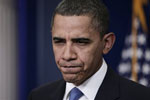
 Bloomberg: Many Obama administration foreign policy decisions, including the reluctance to arm Syrian rebels, the call for former Egyptian President Hosni Mubarak’s ouster, and the tentative engagement with Iran, have unsettled long-time allies, including Saudi Arabia and Israel.
Bloomberg
By Nicole Gaouette
The U.S. government’s partial shutdown poses global risks that American resolve and commitment will come into question, heightening allies’ concerns and boosting opponents’ confidence.
President Barack Obama has emphasized his vision of a U.S. more focused on “nation-building at home.” Many Obama administration foreign policy decisions, including the reluctance to arm Syrian rebels, the call for former Egyptian President Hosni Mubarak’s ouster, and the tentative engagement with Iran, have unsettled long-time allies, including Saudi Arabia and Israel.
Now, doubt about the U.S. ability to meet its basic commitments — funding its government and honoring its debts — is deepening concerns about America’s capacity to act on important foreign policy issues and honor its commitments abroad, said Ian Brzezinski, a senior fellow at the Atlantic Council, a Washington policy group.
“It’s an event that reinforces concern internationally about America’s steadfastness and resolve as an international actor,” said Brzezinski, a former deputy assistant secretary of defense under President George W. Bush. “The shutdown also increases the confidence of some of our rivals or those who want to contest our power.”
In Asia, where Obama is scheduled to travel for eight days beginning Oct. 5, the possibility that the trip that may be canceled or curtailed due to the shutdown would carry symbolic and strategic weight, said Charles Kupchan, a senior fellow at the Council on Foreign Relations in Washington. The president has postponed his Malaysia visit, the official Bernama news service reported today, citing Prime Minister Najib Razak.
East Asia
“It’s particularly important in East Asia, where countries are uncertain about the long-term geopolitical trends and trying to decide whether to tilt toward the United States or toward China,” Kupchan said. “And as a consequence, it’s an important time for Obama to show that Washington has its lights on.”
Japan and South Korea look to U.S. help in balancing China’s power and influence, as do smaller Southeast Asian nations such as the Philippines. Defense Secretary Chuck Hagel discussed the shutdown’s global impact while in Seoul to emphasize an increased U.S. focus on Asia that includes trade agreements and additional allocations of military resources.
“It does cast a very significant pall over America’s credibility with our allies,” Hagel said yesterday. “It does have an effect on our relationships around the world and cuts straight to the obvious question: Can you rely on the United States as a reliable partner to fulfill its commitments?”
Iran Negotiations
Those commitments include new initiatives to negotiate with Iran, which might have reason to doubt Obama’s ability to persuade Congress to reduce sanctions in return for scaling back its nuclear program.
If the president and Congress can’t even agree on a plan to keep government running, Brzezinski said, it might be a stretch to ask foreign powers to trust that they can handle much tougher issues overseas.
At least initially, global investors decided the shutdown “looks more like noise rather than something that makes a fundamental difference for growth,” Nicola Marinelli, who helps oversee $180 million as portfolio manager at Glendevon King Ltd. In London, said by phone. The Stoxx Europe 600 Index added 0.8 percent to 312.86 at the close of trading.
Dollar Index
The Bloomberg U.S. Dollar Index, which the tracks the performance of the greenback against a basket of 10 leading global currencies, fell as much as 0.4 percent on the first day of the shutdown, its biggest intraday drop in two weeks. The gauge has dropped 4.1 percent from this year’s high of 1,054.48, based on closing prices, to 1,011.10 yesterday.
Beyond the markets, reaction ran from dismay to disbelief. In Germany, the news magazine Spiegel Online warned that “a superpower has paralyzed itself,” while the headline on an editorial in the French newspaper Le Monde implored the founder of U.S. democracy, Thomas Jefferson, to “Wake up, Jefferson, they’ve all gone crazy!”
Ben Knight, a reporter for the Australian Broadcasting Corp., told viewers: “The U.S. regards itself as the greatest democracy in the world. But this week in its corridors of power, it’s been anything but.”
Obama, whose signature foreign policy stance in his first presidential campaign was withdrawing from the wars in Iraq and Afghanistan, has been clear about his intent to change the U.S. role in the world, in part because of what he has described as his “war-weary” nation.
Leadership ‘Vacuum’
“The notion of American empire may be useful propaganda, but it isn’t borne out by America’s current policy or by public opinion,” the president said last week at the United Nations.
“The danger for the world is that the United States, after a decade of war — rightly concerned about issues back home, aware of the hostility that our engagement in the region has engendered throughout the Muslim world — may disengage, creating a vacuum of leadership,” Obama said.
Allies already have expressed concern about U.S. global leadership over the course of the administration.
After confirming the administration’s intent to go forward with an Eastern European missile defense system in April 2009, the White House reversed course in September, announcing it would cancel the initiative. “Betrayal!” read one Polish headline. “The U.S. sold us to Russia and stabbed us in the back.”
Another Cancellation
The U.S. canceled another missile defense plan in March of this year, a gesture to Russia, which had expressed anger about the system because it theoretically would be capable of targeting Russian intercontinental ballistic missiles.
In 2011, Saudi and Israeli officials privately expressed anger and discomfort about the administration’s decision to call for Mubarak’s ouster. The dictatorial president had been a stalwart U.S. ally for 30 years, enforcing stability, constraining Islamic groups, and maintaining a cold peace with Israel.
This year, Obama’s decision to cancel plans for a military strike to punish Syria for using chemical weapons and negotiate with President Bashar al-Assad over eliminating his arsenal drew criticism from Persian Gulf supporters of the Syrian opposition and angry denunciations from opposition fighters, who questioned the oft-stated U.S. commitment to their cause.
French President Francois Hollande was “shocked,” according to the newspaper Le Nouvel Observateur, when Obama canceled plans to conduct the strike hours before French fighter jets were to take off, telling Hollande that he’d seek congressional approval for military action instead.
‘A Hesitance’
“There’s been a pattern in Washington that communicates a hesitance, a lack of clear objectives and execution of policies toward those objectives,” Brzezinski said.
He pointed to Syria policy, where “the president drew red lines on chemical weapons use but didn’t enforce them; called for Assad’s ouster but is now pursuing an agreement with him; and said he supported the opposition but hasn’t really provided support” in the form of the heavy weaponry they say they need to oust Assad.
Add to that the increasing polarization of U.S. politics, highlighted by the shutdown, and it “communicates a vision of an America that is no longer as steadfast, as reliable, as clear-sighted as it used to be,” Brzezinski said.
John Bellinger, the top lawyer on the National Security Council when the al-Qaeda attack of Sept. 11, 2001, took place, points to another danger.
Politicians backing the shutdown “should remember that the United States remains a country at war, not only in Afghanistan, but with al-Qaeda and its affiliates around the world,” Bellinger wrote for Lawfare, a blog on national security issues, on Sept. 29.
“They should be gravely concerned about the risks they are taking with the security of the United States, and all Americans, while the country remains at significant risk of terrorist attack,” Bellinger said.


