


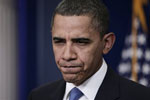
 AFP: The White House warned Thursday that President Barack Obama would veto a bill threatening new sanctions on Iran, because it could sink a final deal to stop Tehran getting a nuclear bomb.
By Stephen Collinson and Michael Mathes
Washington (AFP) — The White House warned Thursday that President Barack Obama would veto a bill threatening new sanctions on Iran, because it could sink a final deal to stop Tehran getting a nuclear bomb.
The legislation, backed by both Democratic and Republican senators, would impose new sanctions on Tehran if it violated a six-month interim nuclear agreement reached last month or if no final deal is reached.
The White House appears alarmed that the move could undermine the Iranian negotiating team or offer the Islamic republic an excuse to walk away from the negotiations.
“This action is unnecessary,” White House spokesman Jay Carney said.
“We don’t think it will be enacted. If it were enacted, the president would veto it.
“It is very important to refrain from taking an action that would potentially disrupt the opportunity here for a diplomatic resolution of this challenge.”
Twenty-six US senators introduced new Iran sanctions legislation earlier Thursday, despite an intense White House lobbying campaign, which has included the president himself and warnings that the alternative to diplomacy is a new war in the Middle East.
The Nuclear Weapon Free Iran Act was introduced by Senate Foreign Relations Committee chairman Robert Menendez, fellow Democratic Senator Chuck Schumer and Republican Senator Mark Kirk.
“Current sanctions brought Iran to the negotiating table and a credible threat of future sanctions will require Iran to cooperate and act in good faith,” said Menendez in a statement introducing the legislation.
It was not immediately clear if or when the bill could see a vote. Action this year is highly unlikely, with the Senate set to recess this week until early 2014.
Senate Majority Leader Harry Reid has indicated he is opposed to bringing such a bill to the floor in January, saying he agreed with the Obama administration’s call to give the delicate negotiations a chance to work.
Should the landmark interim deal collapse, the proposed sanctions would require Iran to reduce its oil production and would apply new penalties to the Islamic republic’s engineering, mining and construction industries.
The new legislation was introduced as negotiations were set to resume Thursday in Geneva between Iran and world powers in the so-called P5+1: the United States, China, Britain, France, Russia and Germany.
Kirk warned that “appeasing” Iran would lead to war and said that any sanctions relief obtained by Iran would be converted immediately to more nuclear components and financing for terrorism.
Republican Senator Lindsey Graham pledged that Congress would amass the two-thirds majority needed to override the veto if Obama wielded it.
He also argued that the threat of new sanctions would strengthen Obama’s hand in diplomatic talks with Iran rather than scupper the process.
“New sanctions tells the international community that we’re serious,” he said.
There were also signs Thursday that Democratic opinion in the Senate is split.
Ten Democratic committee chairs, including Banking panel leader Tim Johnson and Armed Services leader Carl Levin, expressed opposition to more sanctions.
“At this time, as negotiations are ongoing, we believe that new sanctions would play into the hands of those in Iran who are most eager to see the negotiations fail,” the senators wrote in a letter to Reid.
Iran reacted angrily when Washington last week blacklisted a dozen overseas companies and individuals for evading previous sanctions, which have exerted a painful price on its economy.
Under the interim deal reached in Geneva, Iran agreed to freeze parts of its suspect nuclear program in return for some relief from Western sanctions as it negotiates a comprehensive accord to allay suspicions that it seeks a weapons capability.
The United States also agreed to refrain from slapping new sanctions on Iran for the duration of the process.
A report by the International Institute of Finance Thursday said that the benefits of the six-month agreement were already being felt in Iran but that relief was limited.
In particular, the gap between the black market and official exchange rates for the Iranian rial have narrowed, “falling from an average of IR 35,675 per dollar in June to IR 29,700” as of December 16, the report said.


