


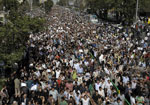
 Forbes: With all eyes on the courageous protesters of Independence Square in Kiev, an interesting parallel with Iran simmers under the surface that you can bet is not lost on President Rouhani and Ayatollah Khamenei.
Forbes
By Andrew K. Davenport
With all eyes on the courageous protesters of Independence Square in Kiev, an interesting parallel with Iran simmers under the surface that you can bet is not lost on President Rouhani and Ayatollah Khamenei.
In a turn of events that seems unexpected only by the Obama Administration, the interim nuclear deal struck with Iran late last year has led to a cavalcade of the world’s most prominent engineering, telecommunications, energy and financial firms lining up to renew business relationships with their Iranian counterparts. Treasury Under Secretary David Cohen and, more recently, Secretary Kerry have been given the near-impossible task of suppressing this enthusiasm, recently lecturing the markets that “Iran is not open for business.”
Critics of the interim agreement fear this market embrace of Iran, as well as other positive economic ripple effects stemming from the deal, is a windfall for Tehran that will undercut the negotiating position of the P5+1 in the current round of negotiations. There is additional concern that this corporate race to Iran will put pressure on allied governments to accept a bad deal for the benefit of corporate profits and job growth.
Although these are legitimate risks, the many corporations now publicly demonstrating their interest in Iran and the “snowballing” spectacle of executives tripping over each other for face time to ingratiate themselves could be more productive than many anticipate. As President Yanukovych of Ukraine is discovering, there is great power in the raised hopes and expectations of a people. The expressed interest of these companies, and the premature victory lap being taken by President Rouhani surrounding it, has created a tantalizing prospect for the long-suffering Iranian people. They see billions of dollars in economic and financial investment almost within reach. If a deal is not achieved and these companies are sent home, the Iranian people’s hopes will have been raised, only to be dashed at the last moment.
A similar intolerably frustrating experience was cast upon the people of Ukraine and awoke in them a revolutionary spirit and, indeed, a popular uprising. After flirting with the EU for years over plans for integration and advertising the game-changing nature of such integration before its population, President Yanukovych’s eleventh-hour decision to move away from a trade agreement with the EU toward Moscow had devastating effect on his ability to govern. Expectations were raised for a brighter, more prosperous tomorrow based on economic and cultural integration with the world and a lesser dependency on the country’s stale relationship with Russia. The people of Ukraine were sold on this agreement, they expected the deal to be signed and now they are demanding much more.
Iran ought to watch Ukraine very closely, lest President Rouhani’s victory lap evolve into an apology tour. Billions of dollars in infrastructure investments, consumer deals, new loans and other economic opportunities are being presented to Iranians – with considerable publicity – in an accidental “road show” of what is available to them on the other side of successful negotiations. On February 3, Iran welcomed a French business delegation that included Safran, Airbus, Total, GDF-Suez, Renault, Alcatel, Alstom, BNP Paribas, Amundi and L’Oréal. This visit came on the heels of other formal business development events, including one held in Vienna in December between Iran and energy giants Royal Dutch Shell, ENI, OMV and Vitol. Lukoil has separately expressed its enthusiasm for returning to Iran, as have many other companies from South Korean industry to the Indian energy sector.
These visits are more than merely relationship-building exercises. Many of these companies have a credible, established track record of large-scale, even multi-billion dollar, investments in Iran ranging from infrastructure construction to consumer goods to upstream and downstream energy projects and petrochemical development. These companies represent the infusion of dynamic, high-tech investment into the Iranian economy, exposure to consumer brands and even cultural integration with the West.
It’s difficult to imagine that the Iranian people are not aware that this “feeding frenzy” of investment is swarming in their direction. After years of economic and diplomatic isolation, shrinking purchasing power and diminishing hopes for their future, it could be a tremendous shock to the domestic population for these companies to be sent home. Although seemingly unintended, the effect of this sequence could be profound on Iran’s domestic political situation if the next phase of negotiations falls short.
If they do fail, it will take considerable effort by the Obama Administration, having unleashed this market enthusiasm, to ensure that it is properly extinguished. In such a scenario, it will be incumbent on allied nations to ensure that the Iranian leadership is forced to confront head-on the frustrations of its people concerning what is likely to be a very unpopular retrenchment by the conservative elite.
President Yanukovych’s decision to take his country to the “water’s edge” of expanded opportunity, before pulling back, sent shockwaves through a fed up population. President Rouhani and Ayatollah Khamenei would be wise to watch and learn. With expectations raised, the Iranian people may also vociferously object to returning to the bleak, isolated outlook they have lived under for so long.
Andrew K. Davenport has worked in Washington for the past 15+ years on policy issues that lie at the intersection of international finance and national security and presently serves as Chief Operating Officer of RWR Advisory Group.


