


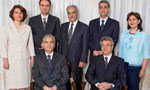
 The Hill: Iranian pastor Saeed Abedini, a U.S. citizen, has been serving an eight-year prison sentence since January 2012 for “threatening national security” through his involvement in Iran’s house church movement. The “Baha’i Seven,” Iran’s Baha’i leaders, have been jailed since 2008.
The Hill
By Robert P. George
Iranian pastor Saeed Abedini, a U.S. citizen, has been serving an eight-year prison sentence since January 2012 for “threatening national security” through his involvement in Iran’s house church movement. The “Baha’i Seven,” Iran’s Baha’i leaders, have been jailed since 2008 for heading a religious movement that contradicts the beliefs of Tehran’s theocratic leaders.
Shabbaz Bhatti, a Christian who was Pakistan’s Minister for Minority Affairs and a friend of the U.S. Commission on International Religious Freedom (USCIRF), of which I am chairman, was murdered by the Pakistani Taliban in March 2011 for opposing his country’s blasphemy law and Aasia Bibi’s death sentence for blasphemy. Two months earlier, Salman Taseer, the Muslim governor of Punjab province, met the same fate for the same reasons. Ms. Bibi remains jailed while her appealed case drags on.
Gao Zhisheng, one of China’s most respected human rights lawyers, is paying a heavy price for his brave defense of fellow citizens, from Falun Gong practitioners to Christians. After disbarring him, China’s government imprisoned and tortured him, and has concealed his whereabouts for nearly two years.
Eritrean Orthodox Church Patriarch Abune Antonios, the leader of Eritrea’s largest religious community, remains under house arrest. He was illegally deposed in 2006 for protesting government interference in church affairs, refusing to excommunicate 3,000 opponents of the Isais Afweki government, and calling for political prisoners to be released. Since 2007, the government has held him at an undisclosed location, denying him family visits and access to medical care despite his being a severe diabetic.
A week before USCIRF’s first visit to Turkmenistan in August 2007, the government finally released former Chief Mufti Nasrullah ibn Ibadullah, a national Muslim leader. USCIRF had called for his release since he was sentenced three years earlier to a 22-year prison term on trumped-up treason charges for refusing to display the Ruhnama, a book of sayings by the country’s ruler, alongside the Qur’an in the nation’s mosques.
Each of these cases represents a clear violation of the bedrock human right of freedom of religion or belief.
On April 30, USCIRF issued its annual report documenting such violations. Reporting on 33 countries, we recommended that the State Department add eight more nations to its list of egregious abusers which deserve being named “countries of particular concern” (CPCs): Egypt, Iraq, Nigeria, Pakistan, Syria, Tajikistan, Turkmenistan, and Vietnam. USCIRF recommended the re-designation of eight countries as CPCs: Burma, China, Eritrea, Iran, North Korea, Saudi Arabia, Sudan, and Uzbekistan.
Our report also commemorated the 15th anniversary of our creation and the enactment of the International Religious Freedom Act (IRFA). Examining international religious freedom policy since enactment, we reviewed what IRFA requires, assessed America’s record on implementing its provisions, and proposed ways to strengthen U.S. promotion of religious freedom.
According to the most recent Pew study on the subject, more than three-quarters of the world’s people lives in countries in which governments or societies significantly restrict religious practice.
Why should we care?
Religious freedom is tied inextricably to our country’s founding and development, is affirmed by international agreements like the 1948 Universal Declaration of Human Rights, and honors the precious right of people to follow their conscience peacefully and without fear.
Equally important, societal well-being tends to suffer when religious freedom is unprotected. Politically, religious freedom abuses are linked with abuses of other human rights. Economically, religious persecution can marginalize the persecuted, causing their talents to go unrealized and robbing affected countries of added productivity and abundance. Civically, whenever religious liberty is violated, nations surrender the benefit religious beliefs may yield through the molding of character which enables the responsible exercise of citizenship. Socially, wherever freedom of religion is abused, peace and security may be threatened, affecting these societies and in some cases the security of the United States and the world. Religious freedom can be a powerful and effective means of countering violent religious extremism.
With the release of our 2014 USCIRF report and the IRFA commemoration, we’re reminded that support for religious freedom is both a humanitarian imperative and a practical necessity. To betray it is to betray human nature and well-being; to affirm it is to affirm our humanity and its thriving. Religious freedom merits our continued defense and a prominent seat at the foreign policy table.
George is the chairman of the U.S. Commission on International Religious Freedom (USCIRF).


