


The U.S. Energy Information Administration says Iran’s crude oil production has hit a 40-year low under US sanctions.
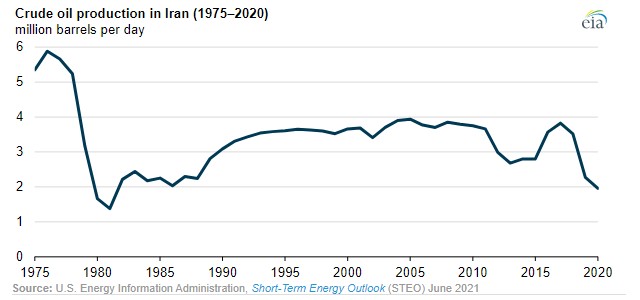
Iran’s crude oil production has fallen to less than 2 million barrels per day under U.S. sanctions specifically targeting the country’s oil industry, as well as the negative impact of the coronavirus pandemic on global crude demand, the Energy Information Administration said in its report which was published on August 12, 2021.
“In 2020, Iran produced less than 2 million barrels per day (b/d) of crude oil, an almost 40-year low in Iran’s production levels according to our analysis, which we updated in July. Several factors contributed to Iran’s low crude oil production in 2020, including the global economic decline that resulted from the COVID-19 pandemic and international sanctions on Iran’s crude oil that limited its crude oil exports.”
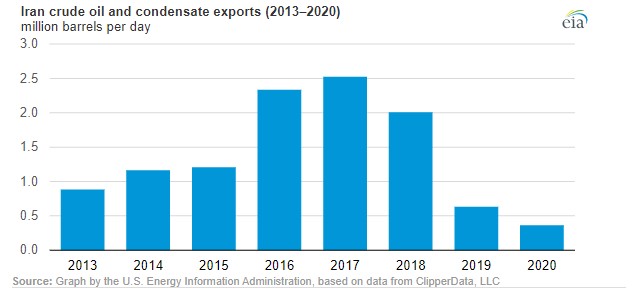
Before the U.S. withdrawal from the 2015 nuclear deal between Iran and world powers and the restoration of sanctions, Iran produced about 3.6 million barrels per day of crude oil and exported 2.5 million barrels of it.
After the U.S. withdrawal from the nuclear deal and after the completion of waivers granted to oil importers from Iran, the country’s average exports in 2020 fell to less than 0.4 million barrels per day.
“We estimate that exports of Iran’s crude oil and condensate fell from more than 2.5 million b/d in 2017, the year before the United States re-imposed sanctions, to an average of less than 0.4 million b/d in 2020.”
Ebrahim Raisi Iran’s new president on August 22, 2021, at the outset of the Parliament’s examination of the competence of the ministers proposed by the Thirteenth Government regarding the sale of oil, stated that “there are people who are concerned about oil sales, there are many possibilities and fields to this issue, so don’t worry.”
Earlier, Javad Owji, the proposed minister of oil in Ebrahim Raisi’s administration, said at a meeting of the Strategic Faction of the Parliament: “We promised Mr. Raisi that the will is to sell oil by using the capable managers present at the ministry and using the methods that exist today in the oil sales debate.”
But the statistics of the country’s budget are saying something else. The details of the performance of the budget resources and expenditures in the spring of this year have a vague point, which is the revenues from oil and petroleum products, which indicates the realization of three percent of the approved rate.
In this year’s budget, exports of 2.3 million barrels of oil per day were priced at $40, which was very optimistic, and given the continuation of the sanctions, it was clear from that time that this figure would not materialize. Of course, oil prices rose and the average price of $60 per barrel of oil was registered this year.
In such circumstances, the realization of 3 percent of projected oil revenues is very strange. Simply put, if the total projected oil revenue in the budget was to be realized in the spring of this year based on $40 oil and exports of 2.3 million barrels of oil per day, that would mean $92 million a day and about $8.5 billion in the entire spring.
When it is said that only 3 percent of spring oil revenues have been realized, the total oil revenue this spring was $256,680,000, considering about $60 per barrel of oil, which means that less than 4.3 million barrels of oil were sold over three months, that is, 46,000 barrels a day.
But it is unlikely that this amount of oil exports is correct, and it seems that these statistics have problems. Part of this statistic is related to the export of petroleum products. Unless the price of Iranian oil exports is much less than $60 and there is a high discount.
This 3 percent figure, given that according to OPEC statistics, Iran’s oil production has increased slightly this year, is the sign of the increase in the volume of Iran’s oil storage this spring in the hope of lifting the sanctions.
What didn’t happen, of course, and it’s unlikely to happen anytime soon. But in any case, the realization of 3 percent of oil revenues is a serious challenge to the budget this year, which necessitates a reform of the budget by the Raisi government if sanctions are not lifted.


 and reinstate sanctions on Iran’s oil exports)