Growing Wave of Professor Migration Poses Serious Challenge To Iran’s Scientific FutureAlthough those with higher education account for 27.3 percent of the total employed population, this proportion has decreased by 0.5 percent compared to the previous year. This comes despite the Iranian regime’s 2024 promise—through the Supreme Employment Council and the creation of a “National Committee for Graduate Employment”—to allocate 25 percent of new job opportunities to university graduates. With the end of the 13th administration last year, the fate of this resolution and the extent of its actual implementation remain unclear. The key question now is what concrete plans the Ministry of Labor under the new government has to address unemployment among university graduates, and to what extent it will focus on resolving this structural crisis in Iran’s labor market.
Iran: Unemployment Rate Among University Graduates Higher Than National Average
While the overall unemployment rate for the active population of Iran, aged 15 and above, was reported at 7.8 percent during the past winter, around 795,000 university graduates remain unemployed.
The latest report by the Iranian regime’s Statistical Center on employment in winter 2025 indicates that the unemployment rate among higher education graduates reached 10.7 percent. Although this figure reflects a 0.9 percent decrease compared to the same period last year, it still exceeds the national average unemployment rate.
Although the general unemployment rate for the active population aged 15 and above stood at 7.8 percent during the past winter, approximately 795,000 university graduates were still unemployed. Women and residents of rural areas make up a larger share of this statistic. Additionally, 38.9 percent of the total unemployed population during this period held university degrees.
Educational Disaster in Iran: 70% of Students Suffering from Learning Poverty
On April 7, the regime-affiliated newspaper Etemad published a report exposing the state of education in Iran. More than 70% of Iranian students lack adequate literacy skills compared to global standards. This figure is an alarming warning for Iran’s future.
Iran at the Bottom of Global Rankings
The Etemad report cites the results of the TIMSS (Trends in International Mathematics and Science Study) and PIRLS (Progress in International Reading Literacy Study), which assess student performance worldwide every four to five years. Iran ranks among the lowest-performing countries in these assessments. In the 2023 TIMSS and 2021 PIRLS, four out of every ten Iranian students failed to meet the minimum learning standards in reading, math, and science, and more than 70% performed below the global average. These statistics reflect a focus on quantitative expansion of education without concern for quality—a policy that has led to widespread learning poverty and educational backwardness.750,000 Students Out of School in IranThe report highlights the widespread nature of educational poverty. The poor quality of education in public schools, lack of resources, and neglect of infrastructure have deprived students of their most basic rights.
Sistan and Baluchestan: A Symbol of Educational Deprivation
In some provinces, the situation goes beyond disaster. In Sistan and Baluchestan, 58.4% of the population under the age of 24 do not hold a high school diploma. While elementary school enrollment exceeds 95%, actual attendance drops to 90.1% in lower secondary and just 80% in upper secondary. Following Sistan and Baluchestan, the provinces of West Azerbaijan (41%) and Golestan (38%) rank next in this crisis. These figures show that as students’ progress to higher levels of education, poverty and deprivation increasingly prevent them from continuing their studies. According to the Ministry of Education yearbook, in the 2020–2021 academic year, over 980,000 students in primary, lower, and upper secondary education dropped out, and another 270,000 officially withdrew. The statistics for the 2019–2020 year were similarly grim. This widespread dropout rate is a direct result of economic poverty and governmental neglect. The chart of average final exam scores (scored between 1 and 20) from June 2024 shows that Sistan and Baluchestan (7.59), Kohgiluyeh and Boyer-Ahmad (8.59), and Khuzestan (9.04) had the lowest performance among Iran’s provinces. These figures not only reflect the failure of the education system but also mirror regional discrimination and systemic injustice rooted in overarching regime policies.A Regime That Condemned People to Poverty and Ignorance
This report reveals only a glimpse of the bitter reality of Iran’s education system—a system that, under the shadow of an incompetent and unrepresentative regime, has condemned students to learning poverty and deprivation. When more than 70% of students lag behind global standards and hundreds of thousands drop out of school, this disaster can no longer be blamed on external factors.The Next Generation at the Edge of a Cliff
The current state of education in Iran is a dire warning for the next generation, which, under the devastating policies of Khamenei’s regime, is being deprived not only of knowledge and skills but also trapped in a never-ending cycle of poverty and backwardness. If this situation persists, the educational and social divide will deepen further, and millions of today’s children and adolescents will grow into illiterate adults, incapable of facing global challenges—a catastrophe that will impact not only Iran but the entire region.Iran’s Escalating Crises in Energy, Water, and Economy Now Deemed National Security Threats
Iran is undergoing a rapid and multidimensional internal collapse. Decades of neglect, mismanagement, and systemic corruption under the mullahs’ regime have crippled the country’s vital infrastructure. From nationwide electricity blackouts and the collapse of agriculture to a worsening water crisis and deepening economic turmoil, the regime’s catastrophic policies are fueling fears of a major social upheaval—one that could be the most severe in decades.
Electricity: A Strangling Crisis Threatening the Economy and Stability
Among the most immediate threats confronting Iran is the intensifying electricity crisis. Regime-affiliated energy expert Mohammad Hossein Didban has warned of a 32,000-megawatt power shortfall—equivalent to 45% of the country’s generation capacity—predicting that 2025 will see even worse outages than previous years.Warnings About Iran’s Drought Crisis Coinciding with World Water DayOn April 7, Javan, a newspaper aligned with the Islamic Revolutionary Guard Corps, acknowledged that “power outages are no longer a mere inconvenience—they’ve become a crisis undermining the economy, industry, and national security.” Estimates suggest that industrial losses due to electricity disruptions exceeded 440 trillion rials in 2024, severely impacting domestic production and employment. On April 8, MP Ali Kord from Sistan and Baluchestan declared: “People are collapsing in darkness. There is no comfort, no livelihood, no stability.” MP Behnam Saeedi from Kerman added that agriculture has become a direct casualty: “Cutting power to farms means wiping out crops. Farmers are left without water, without fuel, without electricity—only ruin and loss.”
Water Crisis: A Resource Seized by Corrupt Elites
In parallel with the energy collapse, Iran is grappling with an intensifying water crisis—one that is increasingly monopolized by corrupt networks. Academic Mohammad Hassan Bablizadeh stated: “A mafia of elites close to the ruling circles controls the water economy, profiting from consumption rather than conservation.” He revealed that 97% of the Energy Ministry’s budget is allocated to surface water projects, with just 3% spent on groundwater resources. In Khuzestan Province, MP Mohammad Amir exposed a secretive plan initiated in March 2025 to divert water from the Karun River, without consulting local communities or conducting an environmental assessment. He warned that this project threatens ecological devastation and poses a grave risk to national food security.Iran’s Economy: Collapsing from Within
On the economic front, all indicators point to impending collapse. Economist Masoud Nili warned: “We’ve reached a critical tipping point… As long as the economy is run with an iron grip and riddled with distortions, its survival beyond this year cannot be guaranteed.” One glaring symptom is the scandal surrounding export revenues. On April 9, MP Mohsen Zanganeh, deputy head of the parliamentary budget committee, revealed that state-owned and semi-governmental companies are hoarding billions of dollars in export income and refusing to repatriate the funds—despite critical shortages of foreign currency. In the metals and petrochemical sectors, repatriation evasion rates skyrocketed in 2024—up to 80% and between 30–40%, respectively. These figures demonstrate that Iran’s economic downfall stems not only from international sanctions, but also from entrenched corruption at the heart of the regime. Insulated power circles are profiting from currency speculation, while ordinary citizens are suffocating under inflation, poverty, and hunger.A Society on the Brink of Eruption
From soaring food prices to crops rotting in fields, from widespread outages to rural flight, Iranians face a daily nightmare in their struggle to survive. In southern Kerman, cucumber and onion harvests are left to rot due to plummeting prices. MP Saeedi asked: “Is it worth harvesting cucumbers that sell for 40,000 rials?” In Sistan and Baluchestan, families endure brutal conditions—no refrigeration, no fuel, and no access to diesel for farmers to operate irrigation pumps. Meanwhile, the regime pours billions into drones and proxy wars abroad, abandoning its own people to darkness, thirst, and hunger.A Regime With No Future… A Nation on the Edge
It has become evident that the regime lacks any long-term strategy. As the economy collapses, water sources dry up, and the power grid fails, these converging crises are forming an unprecedented existential threat for the regime. History shows that such explosive conditions eventually compel people to act.Iran: Text Messages Sent to Families of Girls Regarding Hijab
Although the Iranian regime’s new mandatory hijab law has not yet been officially announced, Mohsen Mazaheri, Secretary of the Enjoining Good and Forbidding Evil Committee in Isfahan (central Iran), defended the practice of sending text messages to the families of women and girls who engage in civil disobedience against the mandatory hijab. He stated that this is a routine action and is done for various issues.
On Tuesday, April 8, Mazaheri told the state-affiliated newspaper Ham-Mihan that he supports sending hijab-related text messages to families of women and girls, saying: “Giving a warning is, above all, about preserving the dignity of individuals. The warnings are given very privately and confidentially, so that no one else finds out.”
He added: “This is a normal action and, according to the law, it is carried out for all issues, not just this one (hijab).”
Amnesty International Condemns Iran’s Mandatory Hijab Law as a Violation of Women’s RightsThis Iranian regime official continued: “This was one of the issues where families were genuinely thankful, saying ‘We didn’t know about our children’s wrong behavior. Now that we know, we’ve taken steps to correct it.’ It doesn’t matter—even messages are sent for boys under the age of 15.” Previously, on April 6, Mazaheri reported that during Nowruz (the Iranian New Year, which began on March 21), the “enjoining good and forbidding evil Committee” in Isfahan issued hijab warnings to over 97,500 people in the province. He added: “The campaign of enjoining good and forbidding evil was implemented at 23 locations in Isfahan city and 50 spots across the province, totaling 9,750 person-days of enforcement.” In another part of his interview with Ham-Mihan, he denied the use of facial recognition cameras to identify women who defy the mandatory hijab, stating that no cameras are used in this matter. Mazaheri also denied that the text messages were sent directly by the Isfahan branch of the “enjoining good and forbidding evil”, claiming: “These messages are sent by the respective committees within each government department—like the “enjoining good and forbidding evil” in the Water Department or the Gas Department—which remind their own employees to comply.” Regarding his earlier statement about the 97,500 hijab warnings during Nowruz, he clarified that the warnings were not sent via text messages. Instead, his colleagues were physically present at 25 locations in Isfahan city and more than 50 points in the province to deliver the warnings in person. Previously, on March 26, the Didban Iran website reported that facial recognition cameras had been installed in some urban areas, and that text messages regarding hijab compliance were being sent to women who do not adhere to the mandatory dress code. On March 3, 2025, Volker Türk, the United Nations High Commissioner for Human Rights, called for the complete and permanent abolition of the mandatory hijab law and other discriminatory laws against women in Iran.
At Least 16 Prisoners Executed in Iran Over Two-Day Period
Reports from human rights sources indicate that from Tuesday, April 8 to Wednesday, April 9, at least 16 prisoners—including five political prisoners and three women—were executed in prisons across Iran.
According to the human rights website HRANA, these individuals were hanged in various prisons across Iran, including in the cities of Gonabad, Mashhad, Karaj, and Shahroud.
Among those executed on April 9, at least four were hanged in Ghezel Hesar prison in Karaj, one in Shahroud prison, and one in Gonabad prison.
The prisoners executed in Gonabad and Shahroud were sentenced to death for drug-related charges, while the four executed in Ghezel Hesar prison in Karaj were convicted of murder.
Additionally, on April 8, at least ten prisoners, including five political prisoners and three women, were hanged in Vakilabad prison in Mashhad.
Execution of 1,050 People and Crackdown on 30,000 Women for Not Wearing the HijabAccording to HRANA, four of these prisoners, including two women, had previously been sentenced to death for drug-related offenses. Another female prisoner was executed for murder. Earlier on April 8, HRANA reported the execution of five political and ideological prisoners in Vakilabad prison in Mashhad, stating that the sentences were carried out without prior notice and without giving the prisoners a chance for a final meeting with their families. Farhad Shakeri, Abdolhakim Azim Gorgij, Abdolrahman Gorgij, Taj Mohammad Khormali, and Malek-Ali Fadaei-Nasab are the five political prisoners who were executed at dawn on April 8 in Vakilabad prison in Mashhad. They had been convicted of “rebellion against the Islamic ruler through membership in the National Solidarity Front of Sunni Iranians.” Isa Eid Mohammadi, another defendant sentenced to death in the same case, remains in Ward 6/1 of Vakilabad prison in Mashhad and is at risk of execution. The death sentences of Hamid Rastbala, Kabir Saadat Jahani, and Mohammad Ali Arayesh, three other defendants in this case, had already been carried out in January 2021. In recent months, the rising number of executions and the issuance and confirmation of death sentences for political prisoners in Iran have sparked waves of protest both inside and outside the country. In one of the latest examples, the “Tuesdays Against Executions” campaign issued a statement on April 8 warning of the increasing risk of executions and called on the international community to condition any relations with Iran’s regime on the complete abolition of the death penalty in the country. On the same day, a group of family members of political prisoners sentenced to death gathered in front of Evin Prison in Tehran, holding photos of the condemned prisoners and placards with slogans such as “No to Execution” and “Immediate Repeal of Death Sentences.” In its annual report on capital punishment released early on April 8, Amnesty International announced that the regime in Iran was responsible for 972 executions in 2024, accounting for over 64 percent of all recorded executions globally.
U.S. Sanctions on Iran Ahead of Bilateral Talks in Oman
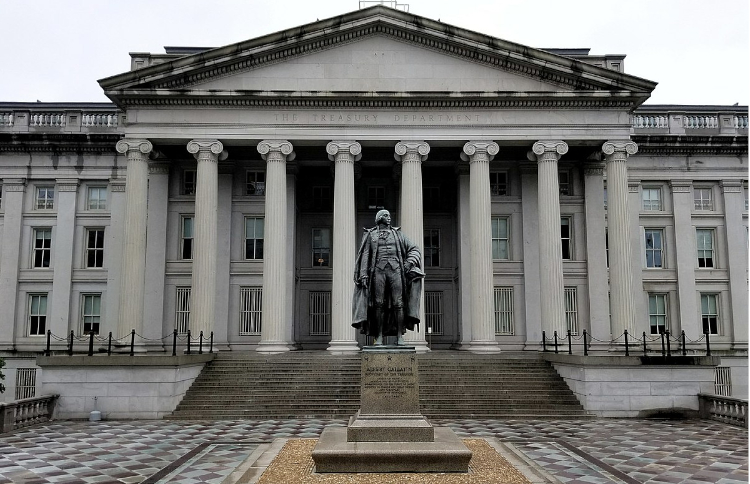
The U.S. Department of the Treasury has imposed new sanctions on Iran’s regime, targeting companies involved in its nuclear program as well as a company executive. These sanctions come ahead of planned bilateral talks between the two countries in Oman.
On Wednesday, April 9, the U.S. Treasury Department announced new sanctions on Iran. According to the department, the sanctions target six Iranian companies and one individual who are “directly involved in supplying parts, manufacturing equipment, and providing technical support for centrifuge production and the development of thorium fuel technology.”
The companies listed under the sanctions include “Atbin Ista (AIT),” “Pegah Aluminum Arak Company,” “Thorium Power Company,” “Pars Reactors Construction and Development Company,” and “Azarab Industries.” An individual named Majid Mosallat, identified as the CEO of AIT, is also among those sanctioned.
In its statement, the U.S. Treasury Department said the sanctions are intended to prevent Iran from advancing toward acquiring nuclear weapons.
IAEA Report: Iran’s Uranium Mining Suggests Much Larger Reserves“The Iranian regime’s reckless pursuit of nuclear weapons remains a grave threat to the United States and a menace to regional stability and global security,” said Secretary of the Treasury Scott Bessent.
Tehran’s Response to Sanctions and the Outlook for Nuclear Talks
These sanctions were issued following President Donald Trump’s announcement of the start of direct negotiations between the United States and Iran’s regime over Tehran’s nuclear program. However, the foreign minister of Iran’s regime stated that the talks in Oman would be conducted indirectly and through mediation. In this context, Trump warned that if the negotiations do not succeed, Iran would face serious consequences. The new U.S. sanctions are being imposed at a time when Ali Khamenei, the supreme leader of Iran’s regime, had previously described American sanctions against Iran as an “opportunity.” Meanwhile, the former governor of Iran’s Central Bank stated in late March that the cost of sanctions on the country’s foreign trade amounted to at least 50 billion dollars.The Objective of the Sanctions and Their Impact on the Iranian regime
These sanctions are part of the United States’ efforts to prevent the development of Iran’s nuclear program. Western countries view this program as a prelude to the production of nuclear weapons.U.S. Treasury Secretary Consults Global Banks on Iranian Oil SanctionsMeanwhile, the sanctions are putting additional strain on Iran’s economy. Given the economic costs involved, the regime is attempting to save face and use indirect negotiations to shift conditions in favor of reaching a nuclear agreement that benefits it. As Iran’s regime approaches nuclear talks with the United States cautiously, regime officials remain skeptical about U.S. intentions and the likelihood of reaching a deal. Talks between the two countries are scheduled to take place in Oman in the coming days, and the United States has threatened to increase pressure on Iran’s regime if an agreement is not reached.
IAEA Report: Iran’s Uranium Mining Suggests Much Larger Reserves
According to the latest data from the International Atomic Energy Agency (IAEA), the Iranian regime is expanding its uranium production and has declared that its reserves of this metal are much larger than previously estimated.
The new statistics, published on Tuesday, April 8, in the “Red Book”—the IAEA’s biennial report on the uranium industry—may raise concerns about the direction of the regime’s nuclear program.
The report states that since 2022, the Iranian regime has been drilling at least 12 new uranium mines, although these resources are not considered economically viable and are far below the amount required to fuel a nuclear reactor.
European Union: The Iranian Regime Must Not Attain Nuclear WeaponsThe authors of the report, who are based in the IAEA offices in Vienna and Paris, wrote that Tehran has demonstrated that Iran’s uranium reserves are significantly greater than previously estimated. The country may nearly quadruple its uranium ore production to 71 tons this year. Unlike other segments of the nuclear fuel cycle—a complex industrial process that converts uranium isotopes into energy fuel—upstream mining activities are not regularly audited. IAEA inspectors track enriched uranium worldwide because it can be used for weapons production, but uranium ore can be extracted and traded under fewer restrictions and regulations. In 2015, global powers reached an agreement with the Iranian regime, known as the JCPOA, which imposed restrictions on Iran’s nuclear activities in exchange for lifting sanctions. In May 2018, U.S. President Donald Trump withdrew from the nuclear deal and reimposed strict sanctions on Iran’s regime.
Is Domestic-Enriched Uranium Production Economically Viable for Iran?
The IAEA has confirmed that the Iranian regime has increased its enriched uranium production rate sevenfold. Since returning to the presidency, Trump has stated his desire for a new nuclear deal with Iran and has threatened military action if Tehran refuses to enter direct negotiations. On Monday, April 7, Iranian officials announced their readiness to negotiate with the United States, provided the talks are mediated by Oman. Nonetheless, Iran’s uranium mining activities have drawn the attention of security analysts, who say the reserves are insufficient for fueling a nuclear reactor, but would be sufficient to produce a nuclear bomb. Iran’s nuclear reactor at the Bushehr power plant requires approximately 160 tons (more precisely, 145.15 tons) of uranium ore annually, but the regime extracts only 21 tons per year. Russia, which built the Bushehr plant, also supplies its fuel. According to IAEA data, Iranian engineers are now producing the equivalent of one nuclear bomb’s worth of 60-percent enriched uranium per month. In a report released in February, the agency stated that Iran’s stockpile of enriched uranium had increased by 50 percent over the past three months, reaching 275 kilograms.Iran’s Regime Sends Long-Range Missiles to Its Proxy Forces in Iraq
The Times has reported that, as Iran’s regime prepares for nuclear negotiations with Washington, the regime has, for the first time, transferred long-range surface-to-surface missiles to its proxy forces in Iraq. Intelligence sources say these missiles are capable of targeting parts of Europe.
In the report published on Tuesday, The Times, citing regional intelligence sources, stated that the missiles were transferred to Iraq last week by the Aerospace Force of the regime’s Islamic Revolutionary Guard Corps (IRGC).
According to The Times and quoted analysts, this move could be interpreted as an effort by the Iranian regime to strengthen its bargaining position ahead of upcoming negotiations with the United States.
According to the report, two other shorter-range missiles—the Quds-351 cruise missile and the Jamal-69 ballistic missile—were also smuggled into Iraq. The Times’ intelligence sources emphasized that the missiles transferred have ranges sufficient to threaten targets in Europe.
IRGC Once Again Announces the Unveiling of a “Missile City”A regional intelligence source told The Times that the Iranian regime has recently provided missiles—including longer-range models—to Shia militias in Iraq, which had never before received such weapons. This was described as a desperate move by Iran’s regime that endangers Iraq’s stability. Experts told The Times that the Iranian regime is scrambling to reclaim its position in the region, which has been significantly weakened in recent years. According to these experts, the loss of air defense systems around nuclear sites following clashes with Israel in October 2024, the defeat of Tehran’s proxy forces such as Hamas in Gaza and Hezbollah in Lebanon, and the fall of Bashar al-Assad’s regime in Syria are among the developments that have weakened Iran’s regional standing. On Monday, April 7, at the White House, U.S. President Donald Trump, in a meeting with Israeli Prime Minister Benjamin Netanyahu, stated that if the negotiations are not successful, “I actually think it will be a very bad day for Iran.” These negotiations are scheduled to take place in Oman. The Houthis in Yemen and Iranian regime-backed militias in Iraq are recognized as the last effective proxy forces of the regime in the region. In recent weeks, the United States has targeted key Houthi positions. A Shia politician close to the Iraqi government told Reuters that several Iran-backed groups intended to respond positively to Washington’s request for disarmament in order to avoid confrontation with the United States. However, shortly after those remarks were published, a political source in Iraq told Al Arabiya that, in reality, the armed groups had refused to disarm. A diplomatic source in the region also said that the recent efforts over the past 48 hours to project an image of militia disarmament were a deception. According to The Times, analysts believe the Iranian regime has resorted to its remaining proxy forces to preserve its influence in the Middle East, though some of these groups are reassessing their strategies. However, the Iranian regime has no incentive to abandon its proxy tools, as it benefits from them both in destabilizing the region and in exploiting opportunities that arise in ungoverned areas—such as smuggling and organized crime. Since its inception, the Iranian regime has fueled regional instability by escalating and supporting terrorism, using it as a tool to maintain its own grip on power. It now appears that, after 20 years of fruitless negotiations with the Iranian regime, the West has concluded that the only effective response is a policy of firmness—not appeasement.
Five Political-Religious Prisoners Executed in Iran
Human rights sources in Iran reported on Tuesday, April 8, that five political-religious prisoners were executed at Vakilabad Prison in Mashhad.
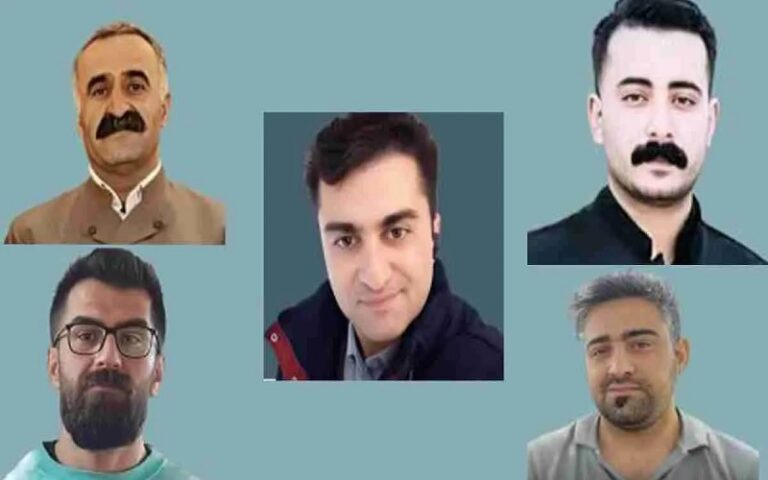
The names of the executed prisoners were announced as: Farhad Shakeri, Abdulrahman Gorgij, Abdolhakim Azim Gorgij, Malek Fadaei-Nasab, and Taj Mohammad Khormali.
According to reports from human rights activists, the executions were carried out abruptly and without prior notice.
These five political-religious prisoners, along with another inmate named Issa Eid Mohammadi, had been sentenced to death in 2019 on charges of “armed rebellion” (Baghi or revolt) through membership in opposition groups.
Subsequently, the death sentences for all six prisoners were overturned by Branch 41 of the Iranian regime’s Supreme Court, headed by Judge Ali Razini, and the cases were referred to an equivalent branch for retrial.
In early August 2023, following a retrial, Branch 4 of the Revolutionary Court in Mashhad once again sentenced each of the prisoners to death.
In January 2025, these prisoners had published a letter exposing the violence and beatings inflicted by prison guards and called on the United Nations and international human rights organizations to hold the Iranian regime accountable for these inhumane acts.
Referring to the “violence, inhumane behavior by prison officials, and harsh conditions faced by inmates,” they wrote: “The guards delete footage from surveillance cameras to hide evidence of these actions.”
Iranian Women Selling Hair Amid Growing Poverty
As the Iranian regime continues to fail in addressing poverty and improving the economic situation of its people, reports from Iran indicate that due to worsening living conditions and low incomes, the market for buying and selling natural women’s hair has grown in Tehran.
The state-run Mehr News Agency reported on Monday, April 7, that due to economic hardship and low-income levels among Iranians, the market for buying and selling women’s natural hair in Tehran is thriving.
This outlet noted that buyers are encouraging women to sell their hair both on city sidewalks and through online platforms.
Mehr quoted one hair buyer as saying: “The price of hair varies depending on its length, thickness, and color—from 200 million rials (approximately $190 USD) for short hair to 600 million rials (approximately $570 USD) for long, healthy hair per kilogram.”
The issue of selling hair to cover living expenses in Iran has made headlines multiple times in recent years.
Over 80% of Iranian Households Below the Global Poverty LineIn March, the Iranian watchdog site Didban Iran reported on the booming market for natural hair, stating: “On social media and apps like Sheypoor and Divar, ads for buying and selling hair have listed prices such as 300 million rials (approximately $285 USD) for 60 centimeters of hair.” (Sheypoor and Divar are popular Iranian online marketplaces.) In November 2021, Khorasan newspaper also covered the buying and selling of women’s hair due to poverty, writing that girls as young as 10 and women up to age 50 have turned to selling their hair to cover expenses such as buying mobile phones or paying medical bills.