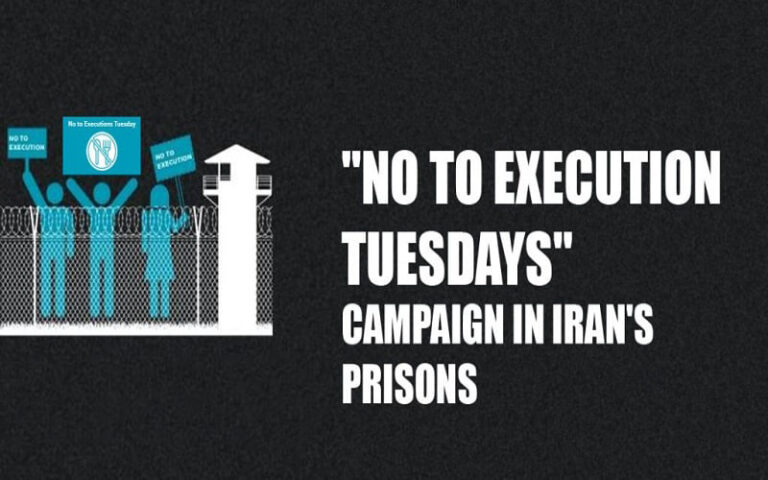
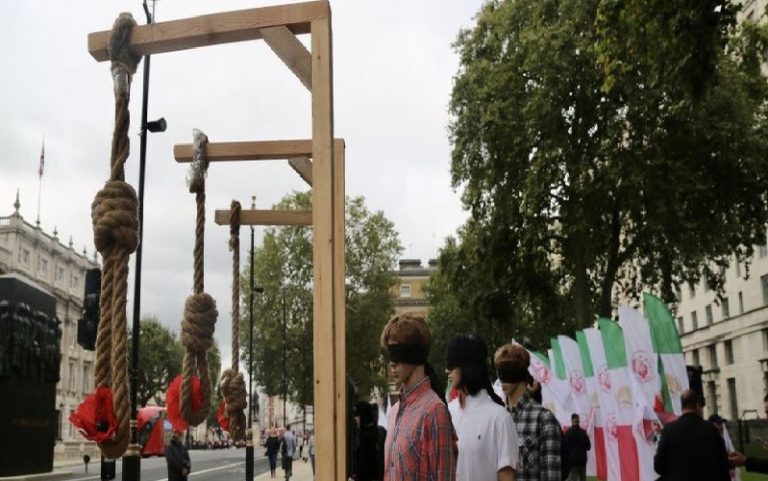
While the international community has repeatedly warned about the rising number of executions in Iran, new statistics reveal that in the Iranian year 1403 (March 21, 2024 – March 21, 2025), over 1,150 prisoners were executed in Iranian prisons.According to a statement issued by the “No to Execution Tuesdays” campaign, among those executed, 135 were Baluchi citizens, and 104 were Kurdish citizens. Additionally, 38 women were among those executed last year. Alongside these figures, five political and ideological prisoners were executed, and eight public executions were carried out.This campaign, which has been active for over a year, announced in its 61st week that on Tuesday, March 25, prisoners in 38 prisons across the country will go on a hunger strike.
The “No to Execution Tuesdays” campaign emphasized in its report that 85% of last year’s executions took place during the presidency of Masoud Pezeshkian. This highlights once again that different factions within the Iranian regime make no distinction in repression and carrying out executions, and the policy of mass executions continues.Activists of this campaign, emphasizing their resistance against the death penalty, have called on all human rights organizations, civil institutions, political parties, and activists to take more concrete actions against this practice in the new year. They hope that the year 1404 (beginning on March 21, 2025) will mark the end of executions and repression and be a step towards freedom.The “No to Execution Tuesdays” campaign, which operates weekly, has recently announced that prisoners in 38 different prisons across the country, including Evin, Ghezel Hesar, Greater Tehran, Adelabad in Shiraz, Urmia, Tabriz, and Mashhad, will join the hunger strike.The mass execution of prisoners in Iran continues amid ongoing protests against harsh judicial rulings and the increasing execution rate. Many international organizations, including the United Nations and Amnesty International, have repeatedly called for an end to these repressive policies, yet the Iranian authorities persist in carrying them out.With the continuation of the regime’s repressive policies and the rising wave of executions, concerns about escalating violence and the continuation of this trend in the new year have grown even more.In their statement, they emphasized: “We, the members of the ‘No to Execution Tuesdays’ campaign, stand united, with one voice and with all our strength, against the inhumane death penalty. We call on all political parties, organizations, unions, activists, human rights defenders, civil groups, and justice seekers who care about ‘the right to life and human rights’ and oppose executions to take more practical and effective measures against executions in the new year. We hope that the year 1404 will mark the end of repression and executions and the beginning of freedom for Iran.”
The U.S. House Committee on Education and the Workforce has launched an investigation into Seyed Hossein Mousavian, a former Iranian regime diplomat and a professor at Princeton University.According to Fox News, 12 Republican members of the committee have sent a letter to Christopher L. Eisgruber, the president of Princeton University, requesting an explanation regarding the Iranian regime’s influence through Mousavian’s activities at the institution.Lisa McClain, a Republican representative from Michigan, who co-authored the letter with Jim Banks, stated:“Higher education has bowed down to the radical left and enemies of America for far too long, and the mere fact that a former member of the Iranian regime is given a platform at Princeton is proof.”Hossein Mousavian, a former Iranian regime diplomatConcerns about Mousavian intensified after he attended the 2020 funeral of Qassem Soleimani, the commander of Iran’s Quds Force, and spoke about Soleimani on Iranian television in 2022. In that program, he claimed that an American official told him that the wife of Brian Hook, then U.S. Special Representative for Iran, had lost sleep for several nights out of fear of Iranian retaliation.In response, Mousavian said, “The 10-second clip from my two-hour interview with Iranian TV was taken out of context.”
Republicans in Congress have accused Mousavian of advancing Iranian interests in the U.S., a concern that grew after it was revealed that he had spoken at a symposium hosted by the U.S. Strategic Command (STRATCOM) in August 2023.Republican lawmakers have also pointed to Mousavian’s background as the Iranian regime’s ambassador to Germany in the 1990s. They recalled that a Berlin court, in the case of the assassination of four Iranian dissidents at the Mykonos restaurant, identified the Iranian embassy as the center of planning for the attack. Mousavian has denied these allegations, stating that his name was not mentioned in the court ruling.Republicans are now calling for action against Mousavian and others linked to the Iranian regime within the U.S. education system. Jim Banks, one of the signatories of the letter, has demanded Princeton University sever ties with Mousavian and also with Robert Malley, the former Biden administration’s envoy for Iran. Banks claimed:“Mr. Mousavian is a longtime Iranian propagandist who only knows how to teach anti-Israel, antisemitic lies.”However, Mousavian defended himself in an interview with Fox News, stating: “My work is just academic, and I have nothing to do with the U.S., Iran, or any other government.”Despite multiple requests, Princeton University has so far refrained from commenting on the matter.
Iraqi Oil Minister Hayyan Abdul Ghani stated that Iranian oil tankers have been using fake Iraqi documents to circumvent sanctions, and that this matter has been reported to the U.S.Speaking on a television program, the Iraqi oil minister, without providing details, said that Baghdad had received reports about U.S. naval forces seizing tankers in the Persian Gulf that were carrying Iraqi documents.He emphasized that Washington had been informed that these documents were fraudulent.Over the years, there have been reports about Iran’s regime exporting oil using forged Iraqi documents.For instance, in 2019, Reuters reported that the tanker Grace-1 transported Iranian oil under documents claiming it was loaded in Basra.On December 3, 2024, Reuters also reported that a complex fuel smuggling network in Iraq, benefiting the Iranian regime and its proxy groups, had generated between $1 billion and $3 billion annually since the start of Prime Minister Mohammed Shia’ Al-Sudani’s tenure in 2022.On March 19, the Iraqi Navy announced the seizure of an Iranian vessel in the Persian Gulf for fuel smuggling, stating that the ship’s Iranian captain, eight Indian crew members, and two Iraqi crew members had been arrested.
On February 4, former U.S. President Donald Trump signed an order to resume the maximum pressure policy against the Iranian regime and eliminate Iran’s oil exports to pressure Tehran into halting its nuclear program.Meanwhile, on March 17, Fatemeh Mohajerani, spokesperson for the government of Iranian regime President Masoud Pezeshkian, responded to Washington’s decision to sanction Iran’s oil minister by stating that eliminating Iran’s oil exports is impossible.Iran’s Foreign Ministry also condemned the U.S. attempt to halt Iran’s oil exports, calling it “a violation of international legal principles.”Although sanctions against Iran-linked oil tankers began in October 2024, their intensity and precision have increased in recent months.Since December 2024, the U.S. Department of the Treasury has placed special focus on targeting Iran’s covert fleet of Very Large Crude Carriers (VLCCs).These tankers, with a capacity of 300,000 tons—equivalent to two million barrels of crude oil—play a key role in Iran’s oil exports.
Ali Farhadi, the spokesperson for the Iranian regime’s Ministry of Education, warned that repeated school closures in Iran have had a negative impact on students’ learning quality.On Saturday, March 22, in an interview with the official IRNA news agency, Farhadi stated that each day of school closure costs approximately 10 trillion rials, and online education cannot be an effective substitute for in-person learning.He added that frequent school closures and reduced in-person teaching time have significantly harmed students’ learning quality and have prevented them from achieving satisfactory educational outcomes.
In its report, IRNA highlighted the frequent school closures in 2024 due to air pollution, cold weather, and the energy crisis. Citing education officials and experts, the report stated that online education has caused serious academic and developmental setbacks.Some provinces declared school closures for 72 out of 291 working days last year due to gas or electricity shortages. This figure does not include additional closures caused by the death of Ebrahim Raisi, natural disasters, and other incidents.The Ministry of Education spokesperson emphasized in his interview that frequent school closures are not endorsed by the ministry.Farhadi added, “The Ministry of Education has even opposed school closures in the Emergency Air Pollution Task Force, but final decisions are made collectively, and the ministry only has one vote.”This is not the first time warnings have been issued regarding weak remote learning infrastructure, learning poverty, and declining student achievement in Iran.Masoud Kabiri, a faculty member at the Iranian regime’s Education Research Institute, warned in January 2025 that two out of every five Iranian students lack effective learning, and 70% of boys in rural schools fail to reach the minimum expected learning level.Rezvan Hakimzadeh, Deputy Minister of Primary Education, stated in November 2024 that 40% of students suffer from learning poverty, significantly reducing their chances of academic and professional success in the future.He described learning poverty as a situation in which some students, despite attending school, fail to properly acquire basic literacy skills, including reading, writing, arithmetic, and speaking.Gholam-Ali Afrooz, a professor at the University of Tehran, stated in November last year that only 70% of Iranian students who start elementary school complete high school.
The Iranian regime hanged at least 104 people in prisons across the country between February 19 and March 20. According to these figures, nearly four executions took place per day on average last month.On March 21, the human rights website HRANA released its latest monthly report on human rights violations in Iran, stating that at least 98 instances of the right to life violations (executions) were recorded between February 19 and March 20.The news agency of the Human Rights Activists in Iran (HRA) added that, in addition to executing 104 prisoners, the Iranian regime issued death sentences for at least 22 individuals and confirmed the death sentences of at least five others during this period.
HRANA highlighted the public hanging of a prisoner in Esfarayen and the death sentence issued for Sasan Shadman, an 18-year-old juvenile offender from Yasuj who committed murder at the age of 16, as some of the most significant cases of the right to life violations in March.The issuance and execution of death sentences for individuals under 18 violate international human rights standards, including the Convention on the Rights of the Child, to which Iran is a signatory.Iran is one of the few countries in the world that continues to issue and carry out death sentences for individuals under 18.On March 19, HRANA published another report on human rights violations in Iran, stating that in the Iranian year 1403 (March 21, 2024 – March 20, 2025), the regime executed at least 1,050 people, including 29 women and five juvenile offenders.According to this report, five of those executed were put to death in public.Additionally, last year, 189 more individuals were sentenced to death, and the Supreme Court upheld the initial death sentences of 55 others.
The rise in the issuance, confirmation, and execution of death sentences in Iran in recent months has sparked widespread protests both domestically and internationally.In the latest example of such reactions, Mai Sato, the United Nations Special Rapporteur on Human Rights in Iran, expressed concern in her first report about the Iranian regime’s use of executions as a tool for repressing the population.On March 18, a group of families of political prisoners sentenced to death gathered in Sarab Park in the town of Sonqor, Kermanshah province, to protest the death sentences issued against their loved ones and other prisoners.
As the Iranian regime continues to struggle with the challenge of supplying electricity, Abbas Aliabadi, the regime’s Minister of Energy, called on the public to invest in Iran’s electricity industry projects as a way to escape the power crisis.On Saturday, March 22, Aliabadi referred to the Iranian New Year’s theme designated by Ali Khamenei, the regime’s Supreme Leader, as the “Year of Investment for Production.” He stated that the Ministry of Energy is implementing “a specific program to attract small-scale public investments alongside large-scale investments.”He added that with the establishment of an investment fund in the electricity industry, people will be able to participate in implementing electricity projects, including “major and strategic renewable energy projects,” by purchasing shares in the fund.
In his Nowruz (Persian New Year) message, Khamenei, without offering New Year greetings, described the past year as “strange and eventful” and named the new year the “Year of Investment for Production.”Following this, vice president Mohammad Reza Aref established a special task force to implement this slogan, in line with previous administrations. Iranian media reported that this task force will consist of “executive agencies and related institutions.”Last year, Khamenei had designated the year as the “Year of Production Leap with Public Participation.” However, economic indicators in Iran declined, the rial depreciated, and rampant inflation severely impacted the lives of citizens, particularly low-income groups.Overall, the past year (from March 21, 2024, to March 21, 2025) had 291 working days, but some provinces declared 72 days of closures due to gas or electricity shortages.Masoud Pezeshkian, the Iranian regime’s president, stated on March 15 in a meeting of Tehran Province’s Planning and Development Council regarding energy-related closures: “Only six days of the closures were due to energy shortages. The rest were unrelated, but we shut down industries more frequently.”A review of regional and national regulations indicates that, contrary to Pezeshkian’s claim, 72 working days in various parts of the country were either fully or partially suspended. This figure does not include additional closures due to the death of Ebrahim Raisi, natural disasters, and other factors.In recent months, many citizens have staged protests in various parts of the country against the Iranian regime’s inefficiency in energy supply and the frequent power outages.
Several Iranian media outlets, marking World Water Day, reported a significant decline in groundwater resources and reservoir levels, as well as the ongoing water crisis and drought. The Minister of Energy warned of a water crisis in the provinces of Isfahan, Tehran, Razavi Khorasan, and Yazd.Abbas Aliabadi, Iran’s Minister of Energy, stated on Saturday, March 22, that five consecutive years of drought have led to a decline in the country’s water reserves.He emphasized the importance of implementing water consumption management programs and water recycling initiatives, which are currently on the Ministry of Energy’s agenda.Nearly three decades ago, the United Nations designated March 22 as World Water Day to raise awareness about sustainable water resource management and addressing water-related crises.
“Preserving Glaciers” has been chosen as the theme for World Water Day in 2025.Mohammad Javanbakht, Iran’s Deputy Minister of Energy, stated that 93 permanent rivers in Iran are fed by natural glaciers. However, the volume and surface area of these glaciers in the Alborz and Zagros Mountain ranges—such as Alam-Kuh, Damavand, Sabalan, Zard-Kuh Bakhtiari, and Takht-e Soleyman—have been decreasing.Citing statistical data, he noted that over the past decade, snow accumulation in Iran’s glaciers has decreased by approximately 30%, while snow production across the country declined by about 20% during the 2010s.
Iran’s Challenges in the Global Arid Belt
For Iran, which lies in the world’s arid and semi-arid belt, water management remains a critical issue, even without the additional impact of climate change.The state-run ISNA news agency reported on Saturday, March 22, citing Reza Shahbazi, Director General of the Geological Hazards Office at the Geological Survey of Iran, that since 1998, Iran has entered a prolonged period of drought, with all water balance levels in continuous decline.
Over Extraction of Groundwater and Drought Crisis
Ezzatollah Raeesi Ardakani, a professor at Shiraz University, told ISNA that since 1966, the number of water extraction wells has increased, leading to the drying up of wells, qanats, and rivers.According to him, Iran has entered years of critical drought.According to conducted studies, 11 provinces—Isfahan, Razavi Khorasan, South Khorasan, Khuzestan, Sistan and Baluchestan, Fars, Kerman, Mazandaran, Hormozgan, Hamedan, and Yazd—are experiencing the highest levels of water stress in Iran.Official statistics indicate that approximately 80% of the country’s groundwater resources have been consumed, and dam reserves are in a critical state.Previously, some experts warned that Iran’s thousand-year-old groundwater reserves have been depleted over the past three decades.
Repeated Warnings About Dam Reserves
On March 22, ISNA, in another report, referred to the condition of the Zayandeh Rud River, stating that in the current water year, inflows to its dam were 19% lower than last year and 53% below the long-term average, leading to a sharp decline in water reserves.Previous reports have suggested the possibility of water rationing, particularly in the provinces of Tehran and Isfahan.Hamid Ehsani, CEO of the Semnan Regional Water Company, described the water crisis in the province as severe on March 22, stating that half of the province’s dam reservoirs are empty.In recent weeks, warnings about water shortages, emptying dam capacities, and the worsening drought crisis have intensified.Isa Bozorgzadeh, spokesperson for the water industry, warned on March 18 about the significant drop in reservoir water levels and the critical condition of key dams in Iran. He stated that the usable volume of the Karaj Dam reservoir has been reduced to nearly half, with a large portion consisting of dead volume and sediment.According to him, the Lar Dam has nearly dried up, while the Latyan, Taleqan, and Mamloo dams have experienced a 46% decrease in rainfall compared to the normal level and a 25% decrease compared to last year.
Moscow defended what it called the Iranian regime’s right to “a peaceful nuclear program” and stated that Tehran is acting in accordance with international law. The United States and Israel are set to hold a meeting soon regarding Iran’s nuclear program.Reuters reported on Friday, March 21, that Russia has stated its willingness to mediate between the Iranian regime and the administration of U.S. President Donald Trump.Moscow maintains security and military cooperation with Tehran while also working to improve its relations with Washington.
The issue of Iran was among the topics discussed during a recent phone call between Trump and Russian President Vladimir Putin on Tuesday.Following the call, the White House announced that the two presidents agreed that Iran must never be in a position to destroy Israel.Kremlin spokesperson Dmitry Peskov stated in a press conference on Friday that Russia is convinced that the Iranian regime’s nuclear issue must be resolved exclusively through peaceful political and diplomatic means.He added that everything necessary for this resolution is available, with the only requirement being political will.
Kremlin Accepts Iran’s Claims Regarding Its Nuclear Program
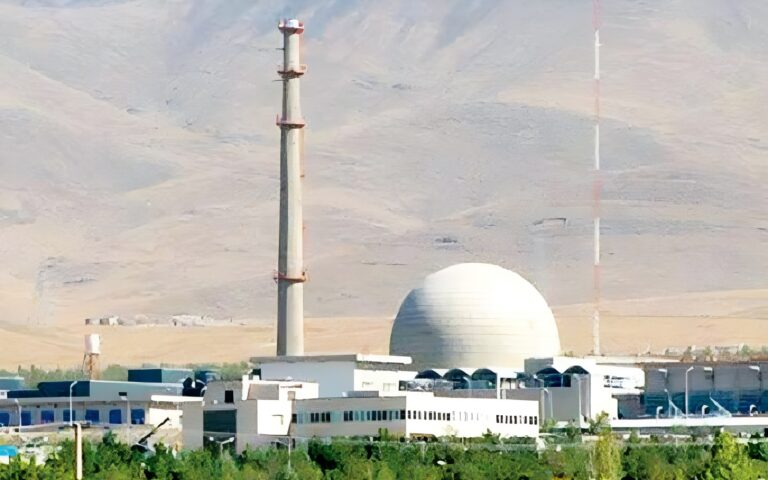
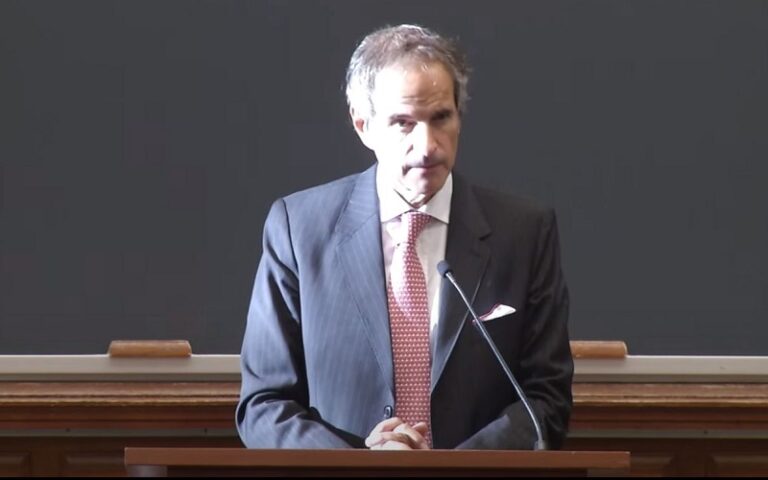
Peskov stated that, like all other countries, Iran has the right to develop its peaceful nuclear sector and energy. He added that Tehran has taken significant steps in this direction, all in strict compliance with international law.He said that Moscow has accepted Tehran’s repeated claims that it has no intention of acquiring nuclear weapons.In March, Trump sent a letter to Ali Khamenei, the Supreme Leader of Iran’s regime, warning that Iranian officials must choose between a nuclear agreement with the U.S. or facing potential military action.The Iranian regime responded by stating that it would consider both the opportunities and threats mentioned in Trump’s letter.Rafael Grossi, Director-General of the International Atomic Energy Agency (IAEA), warned on March 15 that Tehran is very close to crossing the “nuclear threshold.”
U.S.-Israel Talks
Western officials are concerned that if Iran, despite its claims, acquires nuclear weapons, it could threaten Israel and oil-producing Gulf states, potentially triggering a regional arms race.Israel has clearly stated that it wants to align with the United States in any action against the Iranian regime.On Thursday, March 20, the news website Axios, citing two Israeli officials and one U.S. official, reported that Israeli and American delegations would hold strategic talks next week at the White House regarding Iran’s nuclear dossier.According to the report, Israeli officials see a low likelihood of reaching an agreement with Tehran and are therefore seeking coordination with the U.S. on potential actions if tensions escalate, including military options.
According to the state-affiliated news outlet Etemad Online, on March 19, legal expert Kambiz Norouzi strongly criticized the Planning and Budget Organization’s refusal to publish the 2025 budget tables, calling it a sign of deliberate secrecy.In a harsh statement directed at the government, he said: “It is astonishing that the Planning and Budget Organization or the Presidential Office refuses to publish the budget tables. Secrecy is usually not unrelated to wrongdoing. Those who are confident in the correctness of their actions never resort to concealment.”
Norouzi stressed that the budget law, unlike military or security information, is not classified and that there is no justification for hiding it.
Fear of Exposure or Violation of People’s Rights?
The state-affiliated Khabar Online website also quoted Norouzi as saying, “Keeping the budget tables confidential during the review stage is a blatant violation of the fundamental rights of the people.”He described this move as contrary to the Constitution, the right to free flow of information, and the citizens’ right to access public data. He added: “This secrecy strengthens suspicions that the budget tables contain figures that the government fears will provoke public outrage.”Norouzi called on the government to explain why it has refused transparency at this critical stage.
Who Benefits from the Budget Tables’ Secrecy?
In response to the question of who benefits from the secrecy surrounding the budget tables, the legal expert bluntly stated: “The people certainly do not benefit. The real winners are individuals within the hidden layers of power, whose actions are never reported to the public.”He cited examples such as the illegal transfer of land belonging to a seminary in Ozgol, northern Tehran, to Kazem Sedighi, Tehran’s Friday prayer leader, a case about which no report was ever provided to the public.Norouzi also mentioned institutions linked to figures such as the late Mohammad-Taqi Mesbah-Yazdi, a Mullah close to the regime, and asked: “Why should the people bear the cost of these organizations while having no knowledge of how these budgets are spent? Why is this money taken from the public while schools and universities in the country lack basic facilities?”
Why Does Khamenei’s Government Engage in Secrecy?
The secrecy surrounding budget tables cannot simply be considered an administrative oversight; rather, it is part of a long-standing pattern aimed at preventing transparency and avoiding accountability to the public.It appears that the primary reason for this secrecy is the fear of exposing wasteful expenditures and the allocation of massive budgets to institutions and individuals that provide no benefit to the general public.These expenditures, which often end up in the pockets of those close to power or fund unnecessary projects, could, if revealed, spark public outrage and even lead to larger uprisings.The Iranian regime is well aware that in the current economic crisis, any transparency regarding the misuse of public resources could completely destroy the remaining trust of the people.Therefore, secrecy is not just a tool for maintaining power but also a shield against potential protests.But how long can this strategy prevent the eruption of accumulated discontent?
Abbas Araghchi, the Iranian regime’s foreign minister, stated during a Nowruz television program on state TV that Donald Trump’s letter was more of a threat but that “he claims there are also opportunities.” Araghchi added that the Iranian regime would consider both the threat and opportunity aspects of the letter and would respond accordingly.Araghchi further stated: “Under pressure, threats, and increased sanctions, we will certainly not engage in direct negotiations. We will respond to Trump’s letter in the coming days and send it through the appropriate channels.”Minutes before Araghchi’s remarks, the state-run ILNA news agency quoted Fatemeh Mohajerani, spokesperson for Masoud Pezeshkian’s government, as saying that Trump’s letter to the Iranian regime’s supreme leader, Ali Khamenei, was “under review” and that a “substantive response” would be provided at an appropriate time and in a manner deemed suitable.
On March 20, Mohajerani stated: “There is currently no plan to disclose the content of Trump’s letter.”Previously, on March 17, Esmaeil Baghaei, the Iranian regime’s Foreign Ministry spokesperson, said that there was no decision yet to publicly release Trump’s letter to the Supreme Leader and that a response would be given “through the appropriate channels after a full review.”Baghaei also stated: “The tone of Trump’s letter does not differ significantly from his public statements and has been structured along the same lines.”Hours before Araghchi’s and the government spokesperson’s remarks about Trump’s letter, the news website Axios, citing a U.S. official and two informed sources, reported that the letter had a “strict and tough tone” and included a two-month deadline to reach a new nuclear agreement.The letter was recently delivered to Abbas Araghchi, the Iranian regime’s foreign minister in Tehran, through Anwar Mohammed Gargash, diplomatic advisor to the President of the United Arab Emirates.Axios wrote that it is unclear whether the two-month deadline given to Tehran is counted from the time the letter was sent or from the start of potential negotiations.According to the report, if Tehran rejects Trump’s proposal and continues its nuclear program, the likelihood of U.S. or Israeli military action against Iran’s nuclear facilities will significantly increase.Axios also reported that before sending the letter, the White House had shared its contents with Israel, Saudi Arabia, and the United Arab Emirates.Although the details of Trump’s letter to Khamenei have not yet been officially released, Sergey Lavrov, Russia’s foreign minister, stated on March 12 that the U.S. demands the dismantling of Iran’s proxy groups in the region as part of reviving the JCPOA (Iran nuclear deal).On March 7, the U.S. President told reporters at the White House that confronting the threats posed by the Iranian regime had reached its final stages and that the issue would either be resolved through negotiation or military action.