In recent months, the violence of the Iranian regime’s border guards against Kurdish kolbar (porter)has increased, and in May alone, six kolbars were killed.
Kolbars are individuals who carry goods and merchandise from neighboring countries into Iran. Due to the difficult routes, these loads are carried on their backs, and each kolbar receives a very small amount that barely sustains their survival. This work is very common in the border areas of Iran because the Iranian regime does not provide any facilities or jobs for the youth in these regions, and instead, the share of the people in these areas is the bullets of the regime’s security forces.
Most of these individuals are found in the western and southeastern regions of Iran.
The issue of “illegal” import and export of goods in Iran is not limited to a specific border or region. According to the officials of the Iranian regime, smuggling of goods occurs not only through illegal borders but also through official gates, docks, and even airports. The type and volume of smuggling depend on many factors. It is unclear what the share of Kurdish border kolbars in the volume of smuggled goods is, but officials have often described it as “insignificant.” Nevertheless, it is evident that they, along with Baluchi fuel carriers, bear the highest human cost of “goods smuggling.”
However, the Iranian regime and the Islamic Revolutionary Guard Corps (IRGC) are considered some of the largest smugglers of drugs, oil, and other goods both inside and outside Iran. And they are never held to account for their smuggling activities.
According to human rights networks, in recent months, the level of violence by the Iranian regime’s border guards against kolbars and traders has increased significantly.
The Kurdistan Human Rights Network reported that in just the three months of March, April, and May, 17 kolbars were killed in the border areas of Iran and Iraq from gunfire by the Iranian regime’s border guards, and dozens of people, including several child kolbars, were injured.
The shooting of kolbars and border traders by Iranian border guards is not a new occurrence. Over the past two decades, the rate of shooting by the Iranian regime’s forces towards kolbars and border traders has increased significantly.
Ahmed Shaheed, the former UN Special Rapporteur on Human Rights in Iran, described the killing of kulbars by the Iranian regime as “systematic” in 2013. He stated in his report that the agents shoot kulbars without any warning, a practice that continues to this day, as confirmed by human rights networks.
Many of the individuals engaged in kolbar activities are educated people who cannot find any jobs.
According to a report by Kolbar News, in 2023, at least 44 kolbars were killed, of which 31 kolbars lost their lives due to shootings by the police and border guards.
In recent years, kolbars of all ages have been seen, including children as young as 14 or 15, women who are heads of households, and the elderly. The only response of the Iranian regime to these individuals is bullets, a regime that itself is one of the largest smugglers.
The Iranian Minister of Economic Affairs and Finance stated that the government’s tax revenues have reached 8,000 trillion rials, equivalent to $13.5 billion. According to Ehsan Khandouzi, the Tax Organization achieved 108% of the projected revenue for 2022, setting a new record in the country’s tax collection history.
Khandouzi did not mention the annual growth rate of tax revenues but said the government had 4,700 trillion rials in tax revenues last year, indicating significant growth.
Oil exports are considered the main source of budget revenue for Iran, which is still under sanctions by the United States.
Although Tehran sells approximately 1.3 million barrels per day to China, it is unclear how much cash it receives in return due to international sanctions.
Since 2023, the government has exerted significant pressure to raise taxes and increase their collection. Over the past three years, budget tax revenues have increased by more than 162%.
The government’s goal for the current fiscal year is to collect over 13,000 trillion rials in tax revenue, reflecting a 62% increase from the previous fiscal year. These figures indicate a 326% increase in tax revenues compared to 2021.
As a result, the share of tax revenues in the government’s budget has increased from 25% to 53% during this period. Iran’s government tax revenues have increased by 326% since Ebrahim Raisi became president in 2021.
The surge in tax revenues during Raisi’s presidency, from July 2021 to May 2024, coincided with an increase in poverty among Iranian citizens.
According to the United Nations Food and Agriculture Organization (FAO), per capita meat consumption decreased by one-third between 2020 and 2023.
Why is the government increasing taxes?
Before the US sanctions against Iran in 2018, about 40% of the government budget relied on oil revenues, but due to oil sanctions, this amount has decreased to 21% this year.
The Iranian government has projected total domestic sales and export revenues from oil and gas in the budget to be 6,414 trillion rials which is about half of the tax revenues or approximately $11 billion at the current exchange rate.
Officially, the government’s budget share is less than 50% of oil export revenues. Of the total oil dollars, 14.5% is allocated to the National Iranian Oil Company, 2.5% to deprived areas, and the rest to the National Development Fund.
In recent years, the government has also used the National Development Fund’s share of oil revenues to cover its budget deficit. Despite this, the government budget still faces a 30% deficit each year because oil revenues are much lower than the pre-sanctions period.
OPEC has not yet released its annual report for 2023, but Iranian customs statistics show that the country’s oil export revenue was $37 billion in the previous fiscal year.
The actual cash revenue from crude oil exports to China remains a secret. Many observers believe that the Iranian regime directly uses its oil revenues. Accordingly, part of the regime’s export revenues is kept in China to be used later for paying the costs of importing goods to Iran. Another reason for the increase in tax revenues is inflation.
According to estimates by the International Monetary Fund (IMF), Iran’s annual inflation rate has averaged over 42% since 2020.
Therefore, even considering the inflation rate, the Iranian government should have increased taxes by a maximum of 160%, not 326%.
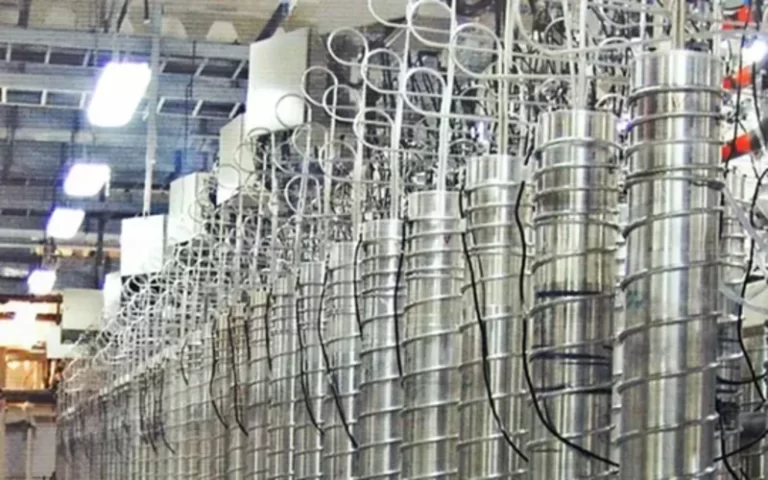
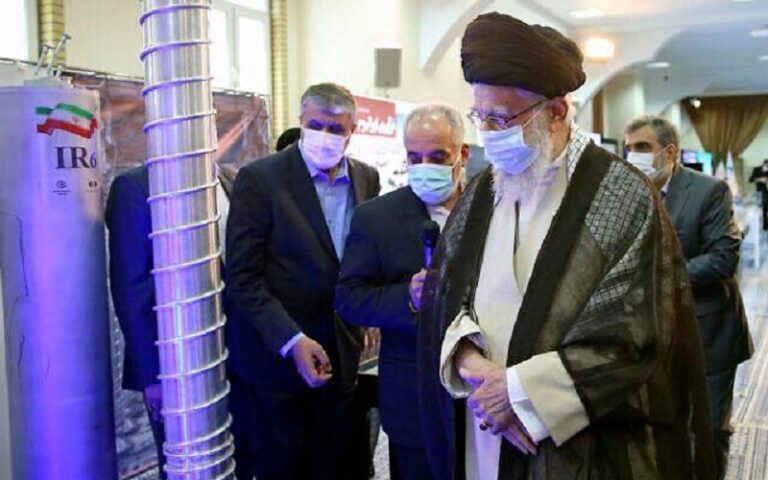
Reuters, citing a confidential report from the International Atomic Energy Agency (IAEA) seen by the news agency, wrote that the Iran’s regime informed the IAEA on June 10 and 11 that it would install eight cascades, each consisting of 174 IR-6 centrifuges, within three to four weeks at the Fordow facility.
According to the report, the IAEA confirmed on June 11 that the Iranian regime had completed the installation of IR-6 centrifuges in two cascades at Fordow and that installation in four other cascades was ongoing.
The confidential report on the Iranian regime’s nuclear program has been sent to the members of the organization.
The report also indicates that Iran, in a letter to the IAEA on June 11, announced its intention to install 18 cascades of IR-2m centrifuges at the underground Natanz enrichment facility.
According to Reuters, the Iranian regime has not specified the timing for this activity at Natanz.
Tehran’s new move comes a few days after the Board of Governors passed a resolution proposed by Britain, France, and Germany, known as the E3, on the Iranian regime’s nuclear program with 20 votes in favor, 12 abstentions, and two votes against.
The resolution calls on the Iranian regime to improve its cooperation with the IAEA and lift the ban on the entry of “experienced inspectors” from the agency.
On September 17, 2023, the Iranian regime revoked the licenses of a group of IAEA inspectors to operate in Iran.
Mohammad Eslami, head of the Atomic Energy Organization of Iran, defended Tehran’s decision in October 2023, stating that the reason for this action was the inspectors’ political maneuvering.
Earlier, on June 12, Reuters, citing five IAEA diplomats, reported that the Iranian regime had increased its uranium enrichment capacity at Fordow and Natanz in response to the Board of Governors’ resolution.
Amir Saeid Iravani, Iran’s ambassador and permanent representative to the United Nations, criticized the Board of Governors’ action on June 6, stating that Tehran has adhered to its commitments under the Non-Proliferation Treaty of nuclear weapons (NPT).
In a letter to the UN Security Council, Iravani wrote: “The claim that Iran’s nuclear program has reached a critical and irreversible point, along with claims that Iran’s peaceful nuclear activities pose a threat to international peace and security, are completely false and baseless.”
Ali Shamkhani, political advisor to the Supreme Leader of Iran, Ali Khamenei, and a member of the Expediency Discernment Council, also called Britain, France, and Germany “misguided” on June 1 and threatened that Tehran would give a “serious and effective response” to their proposed resolution.
Some media outlets in Iran had previously reported that the responsibility for the regime’s nuclear negotiations had been assigned to Shamkhani.
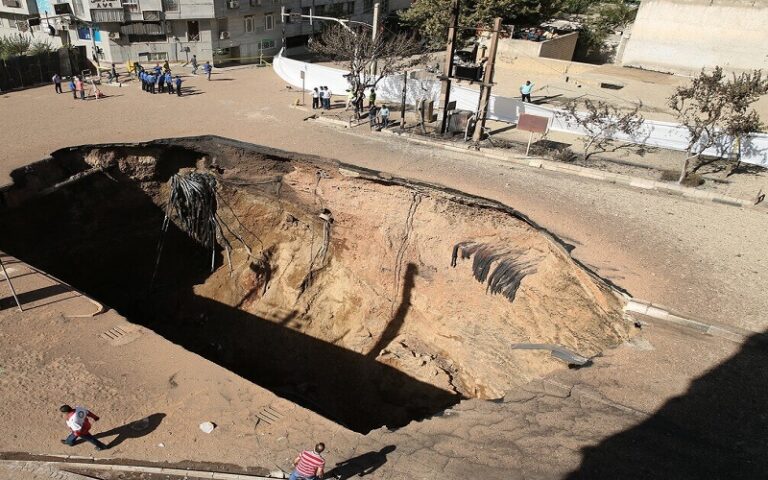
An Iranian regime official warned that the rate of land subsidence in Razavi Khorasan Province, eastern Iran, is 20 centimeters per year, and the subsidence has now reached “northwest of Mashhad.”
According to the state-run news agency ILNA, Ali Beitollahi, the secretary of the National Task Force on Earthquakes and Ground Displacement, stated that based on “studies” on the subsidence situation in Razavi Khorasan Province, “the subsidence areas in this province are five times larger than the subsidence areas in Isfahan.”
He said that currently, this province “holds the national record for the extent of subsidence areas” and warned that if human-induced subsidence continues at this rate, “the entire area of Mashhad will also be affected.”
Previously, Masoumeh Amighpey, the head of the Precise Leveling and Radar Interferometry Department of the National Cartographic Center of Iran, mentioned the creation of a comprehensive database on land subsidence and stated that the range of land subsidence has infiltrated 16 metropolitan areas in Iran, with 800 cities also located in subsidence zones.
According to Iranian media, during a webinar, she identified the worst risk of land subsidence as the threat to food security and explained that land subsidence causes soil loss and rapidly destroys agricultural lands, such as the Varamin plain, where some areas are no longer suitable for farming.
Salinization of groundwater, creation of sinkholes, and surface fissures are among the consequences of land subsidence, leading to devastating environmental damage.
According to this government official, the provinces of Semnan, Qazvin, Tehran, Alborz, Razavi Khorasan, and Kerman are in a critical situation regarding land subsidence.
Meanwhile, the director of the Earthquake and Risk Management Department at the Road, Housing, and Urban Development Research Center of Iran announced that of the 63 globally registered sites, 27 are at risk of land subsidence. Additionally, 16 centers and 18 active oil storage facilities are located in subsidence areas.
According to several critical experts, misguided policies, lack of proper planning, and mismanagement by the Iranian regime in the water sector are significant factors contributing to land subsidence and the environmental crisis in Iran.
Reuters news agency reported on Wednesday, June 12, citing diplomats, that the Iranian regime has expanded its uranium enrichment capacity at two of its underground sites in response to a resolution by the Board of Governors of the International Atomic Energy Agency (IAEA).
On June 5, the IAEA Board of Governors passed a resolution calling on the Iranian regime to “immediately” answer the questions from IAEA inspectors about the origin of uranium particles found at its undeclared sites.
The Iranian regime has previously responded to IAEA Board of Governors’ resolutions and following the passage of the previous resolution in 2022, it increased its uranium enrichment level to 60%, which is close to the level required for producing nuclear weapons.
Five diplomats, who requested anonymity, told Reuters that this time the Iranian regime intends to install more centrifuge cascades, uranium enrichment devices, at one of its underground facilities.
Three of these diplomats added that IAEA inspectors monitoring Iran’s progress are scheduled to present a report to IAEA member countries on Thursday regarding this matter.
Reuters, citing these diplomats, wrote that it is unclear why the scale of Iran’s response was less than expected, but “perhaps they are waiting for the new administration to take office.”
However, these diplomats said it is necessary to wait for the IAEA report to see a more detailed account of the expansion of enrichment capacity in Iran.
The IAEA Board of Governors’ resolution against Iran was passed on June 5 with 20 votes in favor. Additionally, two countries, China and Russia, opposed it, and 12 countries abstained.
The resolution considers the presence of experienced IAEA inspectors to monitor Iran’s nuclear activities to be “vital” and calls on Iran to lift the ban on these inspectors.
Officials from the Iranian regime’s Ministry of Foreign Affairs called the adoption of this resolution an “unconstructive” action. The spokesperson for the Iranian Atomic Energy Organization also stated that they would not yield to pressure.
The Iranian Ministry of Foreign Affairs stated that it is committed to continuing technical cooperation with the IAEA “within the framework of its international rights and obligations under the Non-Proliferation Treaty and the Safeguards Agreement.”
According to the Iranian Ministry of Foreign Affairs, the issuance of this resolution “has no impact on the determination to continue the peaceful use of nuclear energy” in accordance with the country’s rights under relevant international treaties.
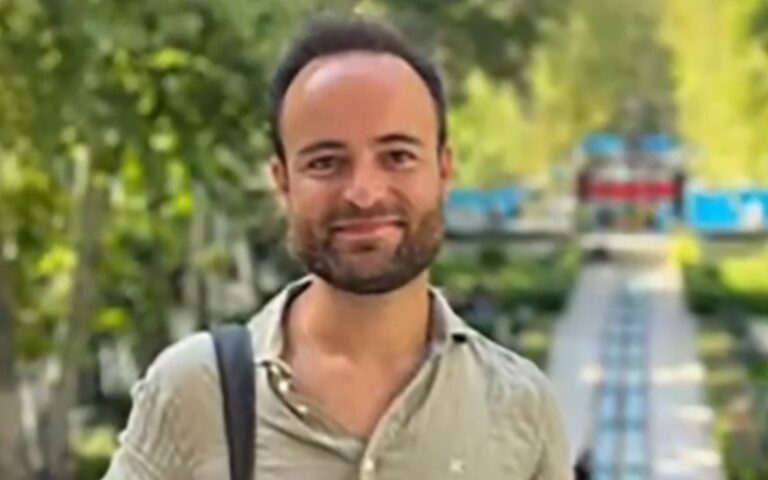
Louis Arnaud, a French citizen imprisoned in Iran who had been sentenced to five years on security charges, returned to Paris on Thursday after being released from prison.
According to images broadcast on French television, Louis Arnaud, tired but smiling, disembarked from a small plane at Le Bourget Airport in the suburbs of Paris, shook hands with Stéphane Séjourné, the French Foreign Minister, and then embraced his parents.
Holding hands with his relatives, Arnaud entered a private room at the airport, away from the cameras.
Stéphane Séjourné expressed happiness over the return of the French hostage.
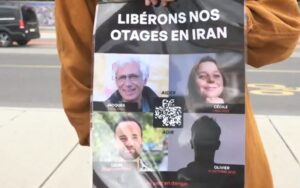
He added that our diplomatic service is still working to free three other French citizens: Jacques Paris, Cécile Kohler, and a man known only as Olivier, who are being held in Iranian prisons.
Arnaud, a 36-year-old consultant, began a world tour in July 2022, which brought him to Iran.
His mother, Sylvie, said a few months ago that it was a country he had long wished to visit because of its rich history and hospitable people.
But on September 28, 2022, he was arrested along with other Europeans accused of participating in protests over the death of Mahsa Amini in the custody of the Morality Police.
While Arnaud’s companions were soon released, he was held in prison until his November sentencing on charges of propaganda and harming Iran’s national security.
French President Emmanuel Macron on Wednesday, June 12, thanked Oman for its mediation and all those who played a role in Louis Arnaud’s release.
Louis Arnaud est libre. Il sera demain en France après une trop longue incarcération en Iran.
Je remercie nos amis omanais et tous ceux qui ont œuvré à cette issue heureuse.
Ce soir, je pense aussi à Cécile, Jacques et Olivier. J'appelle l'Iran à les libérer sans délai.
The French President also called on the Iranian regime to unconditionally release the other French citizens imprisoned in Iran.
4 French citizens imprisoned in Iran
Cécile Kohler, a teacher and union activist, and her partner Jacques Paris, who had traveled to Iran on tourist visas, were arrested in Iran on May 1, 2022.
Earlier, Bernard Phelan, a 64-year-old French-Irish citizen, and Benjamin Brière, a 38-year-old French tourist, both detained in Vakilabad Prison in Mashhad, were released on May 11, 2024.
Fariba Adelkhah, an Iranian-French researcher who had been released last winter but had been barred from leaving the country for months, was finally able to leave Iran and return to France.
Tehran has long used hostage-taking as a major component of its foreign policy to pressure its counterparts to give it concessions.
Human rights activists have consistently condemned this “hostage-taking” policy of the Iranian regime, calling these detentions “arbitrary.”
In its latest report on the global economic situation, the World Bank states that Iran’s GDP has been higher in recent years due to increased oil exports. However, this year and in the coming years, it will follow a downward trend.
According to this report, published on Wednesday, June 12, Iran’s GDP grew by 5% last year, but it is expected to decrease to 3.2% this year, 2.7% next year, and 2.4% in 2026.
The International Monetary Fund (IMF) had previously published a similar assessment of the deceleration in Iran’s GDP growth.
The World Bank attributes Iran’s 5% economic growth in 2023 to the country’s exemption from the OPEC oil production cut agreement, which led to increased oil exports and production, along with a relative improvement in the service sector.
Reports from Iran’s Central Bank and the Statistical Center of Iran also indicate that the relatively high economic growth last year was due to a 21% increase in the oil sector and a 17% increase in government spending (at constant 2011 prices).
Data from the commodity information company Kpler shows that Iran’s oil exports reached 1.5 million barrels in mid-winter last year, which is 50% more than the same period in 2022. However, there has been no growth since then.
OPEC statistics indicate that from the beginning of the current Iranian year (March 21), Iran’s daily oil production reached 3.207 million barrels, which is 23% more than last March. However, it has only grown by 20,000 barrels since then.
According to the World Bank, Iran’s economic growth is expected to be only 3.2% in 2024, but this growth is also facing challenges such as sanctions, global oil demand, and domestic energy shortages.
Iran faces severe power shortages in the summer, forcing power cuts in the industrial sector, which affects the country’s industrial production.
In winter, the country also faces a severe gas deficit, and the government restricts gas supply to the cement, steel, and petrochemical sectors.
The annual loss due to electricity and gas outages in Iran’s industrial sector is estimated to be around $5-$8 billion.
The World Bank also predicts that global economic growth this year will be around 2.6%, which is unchanged from last year, and will be around 2.7% for the next two years.
The United States Department of Justice announced that a court in the country has tried and sentenced two men from the state of Texas to 45 months in prison on Tuesday, June 11, for attempting to sell Iranian oil and violating U.S. sanctions.
According to the department, 43-year-old Chinese citizen Zhenyu Wang and 42-year-old Daniel Ray Lane from McKinney, Texas, tried to sell Iranian oil from July 2019 to February 2020, evading U.S. sanctions against Iran.
The U.S. Department of Justice’s announcement states that the two defendants concealed the origin of the oil and sold it to a refinery in China.
Daniel Ray Lane is the director of the Texas-based private company Stack Royalties, which is an intermediary investment company for private equity groups and investment funds in the oil and gas sector.
Previously, a U.S. court jury found Genevieve Wang and Daniel Ray Lane guilty in November. At the time, Paul Hetzenker, Lane’s attorney, stated that the case was based on the claims of a U.S. government undercover agent who had offered Lane the prospect of “millions of dollars in profits” if he participated in the scheme.
These two, along with three others, were accused in 2020 in a U.S. District Court in the Eastern District of Pennsylvania of evading U.S. sanctions against Iran’s regime. Court documents show that they had pleaded guilty at the time.
After the U.S. imposed sanction on Iranian oil exports in 2018, China became the only major importer of Iranian oil.
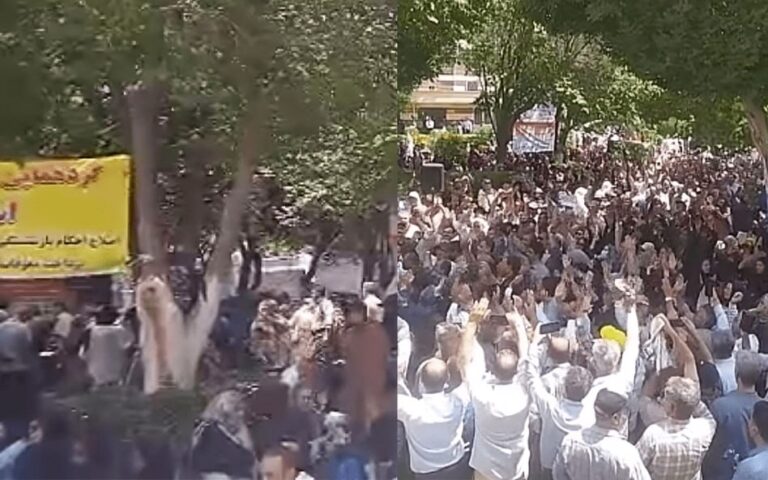
A group of retirees gathered on Tuesday, June 11, in Tehran and Kermanshah to protest against poor living conditions and the lack of attention to their demands. Simultaneously, contract workers at Isfahan Petrochemical and Firuzabad Sodium Carbonate went on strike.
According to reports from professional sources, a number of retirees from the National Pension Fund, Social Security, and Medical Sciences held a protest in front of relevant institutions, including the Organization of Planning and Budget.
In these protests, which coincide with the Iranian regime’s preparations for elections to determine Ebrahim Raisi’s successor from the Guardian Council’s approved candidates, the retired protesters chanted: “Lying candidate, where are your promises?”
At the large gathering of retirees in Tehran in front of the Organization of Planning and Budget, slogans were also chanted: “Whoever opposes the teachers, will fall; where are the officials?”
The retired protesters also chanted: “Our strength is our unity; ranking is our right.”
Reports indicate that in the Kermanshah gathering, slogans included: “Scream, scream about all this oppression,” “Let go of the headscarf, think of us,” “Unemployment, inflation, the scourge of the people,” “Imprisoned teacher must be freed,” and “Imprisoned worker must be freed.”
At the same time, workers at Kaveh Sodium Carbonate Company in Firuzabad, Fars Province, went on strike for the third consecutive day, protesting “wage and benefits conditions.”
Earlier, the regime’s ILNA news agency quoted “a labor source” in Semnan Province saying: the main demands of the workers are “the formation of an Islamic labor council, a wage increase with overtime pay, bonuses, and other job benefits emphasized in their protest last week.”
One of the workers at this factory told ILNA: “In March, we held several labor protests, requesting the management to form a labor institution and increase wages. With the intervention of officials, the employer promised to fulfill this within a few months, but except for the formation of an Islamic labor council, the rest of the workers’ demands were ignored.”
Additionally, a group of contract workers employed at Esfahan Petrochemical went on strike and held a protest on Tuesday, objecting to not receiving their wages.
Moreover, a number of laid-off workers from the Ilam Arghwan Gostar Petrochemical Company project held a protest in front of the entrance to the complex on Tuesday.
These workers, most of whom worked in connections, installation, and equipment, became unemployed with the completion of the project.
According to ILNA, they said that after years of effort on this project, it is their right to be employed after the Ilam Arghwan Gostar Petrochemical starts operations.
Economic protests in Iran continue as news sources have announced that the Iranian regime’s government has not only failed to control inflation but has also broken an 80-year record, with the inflation rate exceeding 52%.
According to the decree of the Supreme Labor Council, the minimum wage for workers subject to the labor law, who are married and have children, with an increase of about 20 million rials (approximately $33), is about 110 million rials (approximately $184) this year. However, this wage is not paid to workers who are not subject to the labor law.
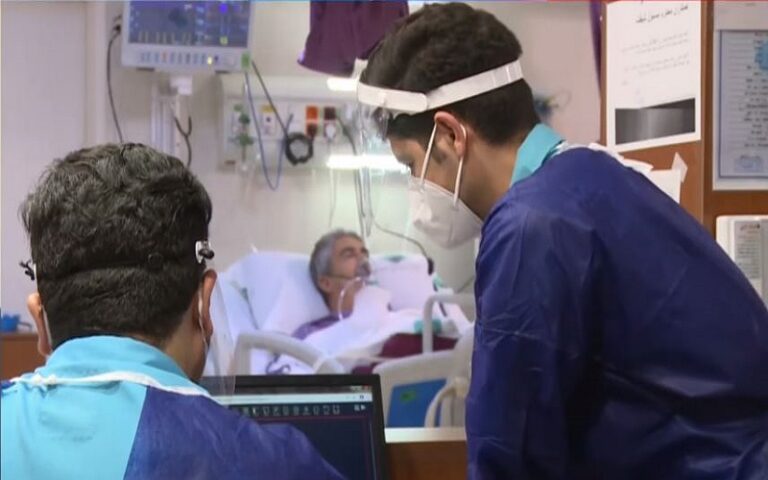
The exact statistics on the migration of Iranian doctors are not publicly announced; however, the trend of healthcare staff migrating is on the rise, with the main destinations being Oman and other Arab countries.
Ramezan Sharif, the spokesperson for the Islamic Revolutionary Guard Corps (IRGC), recently described the statistics on doctor migration as a “media attack against the Islamic Republic.”
The issue of doctor and healthcare staff migration was declared a “crisis” in 2022 when Mohammad Raeiszadeh, the head of the Iranian Medical Council, stated that over 4,027 doctors had requested “Good Standing” certificates for migration the previous year.
At that time, he expressed concern that if this trend continued, Iran would either have to import foreign doctors or go to neighboring countries for even simple surgeries.
Dissemination of Information or Enemy Psychological Warfare?
In March 2024, the regime’s official news agency, IRNA, citing leaked information from the Medical Council, reported that the number of its members who had obtained Good Standing certificates for migration had increased from 750 in 2018 to over 6,000 in 2022.
Officials from the Nursing Council have also stated that approximately 3,000 nurses obtain Good Standing certificates annually for migration.
Last year, the Donya-e-Eqtesad newspaper reported that the latest official statistics on doctor migration were from 2019, when 3,000 migrations were recorded. At the same time, Dr. Reza Laripour, spokesperson for the National Medical Council, estimated the number of departures to be double this figure. The newspaper also quoted an “informed source” stating that “around 5,000 doctors migrated in 2021.” Considering the claim that doctor migration figures have doubled, it can be said that around 10,000 doctors left Iran in 2022.
To this crisis, the suicides of doctors must also be added; factors that have already cast a gray shadow over the future of the country’s healthcare system.
With the increasing desire to migrate in Iran, migration agencies have developed a specialized focus, with some specifically working in the field of doctor and healthcare staff migration. Some agencies also secure job opportunities for their clients. According to one such agency, Canada, Germany, Denmark, Sweden, the United Kingdom, Oman, and the United Arab Emirates are among the best destinations for healthcare staff migration.
In February 2024, the Etemad newspaper, quoting an “informed source” in the National Medical Council, wrote that by the first half of the year, the number of doctors applying for CGS (Certificate of Good Standing – professional and scientific competency) had increased by about 200% compared to 2018. In 2021, over 4,000 doctors, in 2022 over 6,000 doctors, and in the first half of 2023, over 3,000 doctors received CGS certificates, with a prediction that the total number of certificates issued would reach 10,000 by the end of the year.
Confidential Seal on Doctor Migration Records
The statistics on doctor migration are not announced precisely and are confidential; therefore, the media have approximate figures, and publishing them is considered “blackening” by the government.
Avaz Heidarpour, an anesthesiologist and former parliament member, described the doctor migration situation as “horrific” in October 2023, stating: “Every year, 10,000 people from the medical staff migrate from the country.”
Another concern about the migration and departure of doctors is the emptying of universities for teaching and the disruption of the knowledge and experience transfer cycle. Meanwhile, the medical community is experiencing the “forced evacuation” of universities from professors who disagree with the government.
Reza Malekzadeh, a faculty member at Tehran University of Medical Sciences who was forcibly retired, announced in March 2024 that about 40 faculty members of this university had been dismissed or retired over the past two years. Many professors have stated that the reasons for these dismissals or