

Why Are Iran’s Looted Creditors Protesting Again?
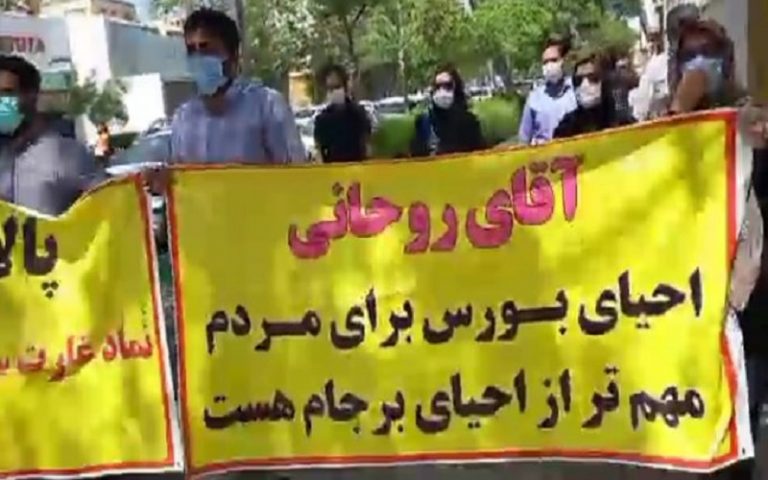
Protests and gatherings of looted creditors have become a common occurrence in the Iranian economy. From time to time, a group of creditors that have lost their money, or better said have been looted by government officials and Iran’s Revolutionary Guards officers which have captured many parts of the country’s economy in various economic spheres, gather to protest, and this time it is the turn of the stock market.
Iran’s stock market is extremely dependent on the global economy. According to government officials, it has faced a sudden downward trend due to international sanctions. In reality, the government itself has manipulated the statistics and numbers to pull the people to the stock market for investments and finally looting them.
On Wednesday April 21, the Tehran Stock Exchange fell 4,000 units in the first minutes of the week, and this decline continued to 12,527 units, and the total stock index reached 1,207,062, which is not far away from the 1.2 million units from the critical channel limit.
State media reported, “the Tehran Stock Exchange is not happy these days, and its officials are refusing to comment on the market. (State-run website Ghatreh-e-Aval, April 21)
And nothing can control the downward trend of capital market indicators anymore. Following the continuation of this negative trend, a group of small shareholders gathered in front of the Stock Exchange and Securities Organization. These demonstrators have been looted. Because by applying wrong policies such as the distribution of Edalat shares and the government’s ETF, has been unknowingly invited to the stock exchange, and by this way the government brokers have empty their pockets.
Protest rallies have become the mainstay of Iran’s ailing economy. One day, the creditor losers of Samen Al-Hojjaj gather in front of the Central Bank; the next day, the investment losers of the car importing companies gather in front of the Ministry of Industry, Mine and Trade. One day, angry poultry farmers block the Taleghani Street, because of the wrong policies of regulating the agricultural jihad market; the next day, people take to the streets worried about rising gasoline prices.
After the government asked people to invest their capital in the stock market instead of just spending it on the coin and gold market, many came to this market and thereby lost their capital.
Some shareholders gathered in front of the Stock Exchange and Securities Organization. As reported by ILNA, this group of protesters were real and small shareholders who protested the government’s policies during the index decline and the non-fulfillment of promises of support.
In an interview with the state-run daily Shargh, Mehdi Souri, a stock market expert, said: “People were invited from the highest government officials to the stock exchange. It is not customary to invite someone and empty their pockets instead of entertaining them.”
Then, to the question of who invited people to the stock exchange, he answered: “The government and parliament invited them. Everyone who has been a decision-maker in our officials has asked these people to put all their capital in the stock market. Some people were invited, and some people were pushed into the market with non-standard tools such as government ETFs or the Edalat stocks, without knowing where they are stepping into. Even the banking network has directed them to this direction.”
About the situation of Iran’s stock market, he added: “The stock market we are witnessing now in Iran is not a standard financial market, because the first condition of a standard financial market is market liquidity. This means that you can take your money out of that market whenever you want.
“This is the biggest advantage of a standard stock market, but when in our capital market people’s money stays in line for a month and people cannot withdraw their capital, so, it is not a standard market that we can talk about it on an analytical basis.”
About misuse and corruption by officials, he added: “The unprofessional intervention of the officials and the use of incorrect tools have made this market non-standard. From the very beginning, when the Edalat stocks were created and there was talk of government ETFs, we strongly warned that these tools were substandard and could mislead the stock market.”
Then he asked these officials which of course is a hopeless thing in Iran: “We expect the authorities to allow the stock market to follow its standard path. Do not push anyone, do not build a barrier, and do not turn the main road, for which all its tools have been worked in practice in the world for years, into a side detour.”
About the Edalat shares, he said: “The person who distributed the Edalat shares among the people did not estimate how these people would sell this volume of shares. In the world, stocks belong to someone who has extra money. While the Edalat share was given to the weak who have no extra money and need money liquidity.
“I am against social subsidies and charity. If such a thing is to be given, it is possible only through cash. Because with these administrative and economic conditions in the country, any action is prone to corruption and creates problems. The crises that have arisen in the country are due to the fact that we have not made the things right from its roots.”
How Can Workers in Iran Live With a Monthly Salary of $160?
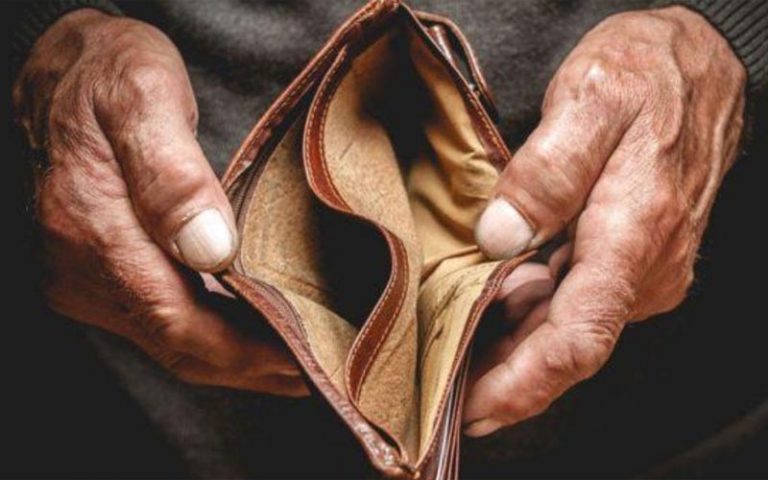
On Friday, April 16, and while less than a month has passed since Nowruz, the new year in the Persian calendar on March 20, the semi-official website Bartarinha pointed to workers’ dire conditions in Iran. “Can someone live with a salary of $160 per month?” the website titled.
According to the semi-official ILNA news agency, until March 2021, the inflation chart had been ascending. The economy’s shock-therapy, which began from March 2018 and continued until March 2021 with a high acceleration, has severely increased basic expenditures.
In such circumstances, the Central Bank of Iran (CBI) has announced that it proposes to achieve a 22-percent inflation rate from March 2021 to March 2022. Back in June 2020, the CBI had set a 22-percent inflation rate with positive and negative amplitude of percentage points for the next Persian year.
“However, the question is, can the CBI obtain an inflation rate of 20 or 24 percent in the current year?” ILNA asked, replying, “Data shows, ‘no, it cannot.’ In response to such question, we should easily say, ‘The coming events have cast their shadows in advance.’”
Official figures provided by the Statistics Center show a growing rate in prices from February 20 to March 20. Also, unofficial and field data obtained by media and local reports show that the inflation rate was continued since March 20 until now.
Inflation Statistics in Iran (February 21 – March 21)
“In March 2021, the point-to-point inflation rate has reached 1.8 percent; In other words, the country’s families have spent on average 48.7 percent more than in March 2020 to buy a ‘set of identical goods and services,’” the Statistic Center reported on March 21. The report also says, “The monthly inflation rate for urban families is 1.8 percent… and it is 1.6 percent for rural families.” This means that the prices have grown this amount in comparison to the last month. On the other hand, the Statistics Center announces that in the major section of “Foods, Drinks, and Tobacco,” people have experienced the most increase in prices of red meat, chicken, sugarcane, sugar, sweets, edible oils, and vegetables like tomatoes, onions, and cucumbers, in comparison to the previous month. “The amplitude of changes in the annual inflation rate in March 2021 for different deciles was 34.6 percent for the first decile—the richest class of society—and 43.5 percent for the tenth decile—the poorest people,” the report added.Inflation Statistics in Iran from March 21
Since March 21, unofficial indicators show a growing rate in prices. For instance, on April 10, the CEO of Tehran Urban and Suburban Railway Operation Company Farnoush Nobakht acknowledged a 25-percent increase in Metro ticket prices in Tehran. “These prices would take effect from April 21,” he said. This is while taxi fares had already increased by 25 to 35 percent in different cities according to relevant city councils’ approvals. For example, taxi fares were increased by more than 35 percent in Mashhad, Iran’s second major city and the capital of the northeastern province of Razavi Khorasan. “Since Nowruz, an average of a 35.2-percent increase in taxi fares has been applied. Of course, these amount will depend on the type of cars,” Mehr News Agency quoted the chief of Mashhad Municipality Taxi Organization Ahmad Mohebbi as saying on April 13. Therefore, the expenditures in transferring sector have on average increased by 30 percent. In the foodstuff sector, citizens witnessed a minimum increase of 25 percent in the price of essential goods. For instance, on April 1, the official IRNA news agency reported, “The Base for Organizing the Chicken Price raised the official price of chicken from 204,000 rials [$0.81] per kilo to 249,000 rials [$1.00], meaning a 25-percent increase for the first month in the Persian calendar.” In such circumstances, the government has increased workers’ minimum salaries by 39 percent, which reaches 40 million rials [$160] per month, and 42 million rials [$168] when calculating the child cost allowance. However, regarding the 100- to 130-million-rial [$400-520] poverty line for a family of four, workers can only cover a quarter of their monthly expenditure in the best-case scenario. Furthermore, they are not optimistic to save this status quo given the accelerating rate of inflation, let alone improving their living conditions.Workers in Iran Forecast a Tougher Year
To have a better view about working families’ livelihood in Iran, it is useful to take a look at what has been reflected in the state media. However, this is not the whole story, and Iranian media try to portray an acceptable image of the present conditions, deterring the spark of public disappointment. “in the best-case scenario, it is supposed that 10 million rials [$40] be added to workers’ salaries. We cannot be satisfied with this $40. In the past two weeks after Nowruz holidays, the price of all items of the product basket has been raised. Every time officials add for instance 20 percent to salaries, inflation turns out at 40 percent, which means workers are still losing out by 20 percent. Still, workers could never be satisfied with their salaries after any increase,” said labor activist Abdollah Vatankhah to ILNA. Meanwhile, given the massive population of unemployed people in Iran, the increase in salaries would not remove any problem. Because there are always a massive number of unemployed people who are ready to gain a job even with a low salary. In such circumstance, workers have to acquiesce to employers’ exploiting rulings or lose their careers. On the other hand, government officials can never feel workers’ hardships and difficulties, because they receive stellar salaries which increase several times the inflation rate. Therefore, all economic components have been adjusted to frustrate workers from a better future. In reality, a manager with an official monthly salary of $1,000 to $1,400 does not care about a 25-percent increase in taxi fares or chicken prices. Instead, workers must constantly calculate how they can overcome inflation rate with meager salaries. Of course, if they won to receive their salaries. “Even managers of the Social Security Organization, which belongs to workers and its managers should receive salaries like workers’ salaries, receive multi-million and stellar salaries. They benefit from our work, but their salaries are multiple times larger than ours,” said Vatankhah. Meanwhile, in an interview with ILNA, Khosro Zargarian, a social activist from Markazi province, underscored workers’ main dilemma. “In fact, inflation is the most important issue for workers. Workers are struggling with inflation every day and night. They are always concerned about the increase in prices. In the past three years, everything was against workers,” he said. “If we reviewed prices from March 2018, the price of all goods has increased by at least five to ten times. I feel high prices very strongly because my product basket is dwindling every day. With such salaries, a worker with a family of three or four needs a miracle to live,” Zargarian added. Furthermore, the increase in official prices would severely impact other prices. “When officials themselves permit a 25- to 30-percent increase in prices, what can we expect from grocers or hairstylists?” he explained. In such circumstance and while the government issues permissions for increasing essential goods’ prices, raising workers’ salaries would not ease any dilemma. In practice, a giant monster named inflation has ambushed millions of workers, and they would lose in a repeated game with such figures. Therefore, workers are the losers, and employers, who benefit from their strong ties with high-ranking officials, win again. Speaking in a debate, Mirhossein Mousavi’s economic advisor during the 2009 Presidential election Hossein Raghfar recently pointed to the high rate of emigration and suicide in society, describing it as a kind of protest. “It is impossible that such society would survive in the long run, and it would definitely collapse whether we admit it or not. Such an emigration wave is unprecedented. The youths prefer to emigrate anywhere, refusing to stay in their homeland. So why? Why do youths believe that they can obtain a good future anywhere except their own homeland? Because these policies have destroyed the entire society,” he said on February 20, 2019. “I think sooner or later, people will voice their protests in different manners. Today, we witness various kinds of insurgents. Suicide is a kind of insurgent. Addiction is a kind of insurgent, which has unfortunately expanded in our country. And emigration is a kind of insurgent. However, these are not sole kinds of insurgent, and an insurgent may appear by taking the people to the tarmac,” Raghfar said. “High-ranking officials should decide whether they prefer this state to remain or not. It seems that many of officials, who use bulletproof cars and bodyguards, do not feel people’s difficulties,” he added.The Unknown Fate of Iran’s Retirees
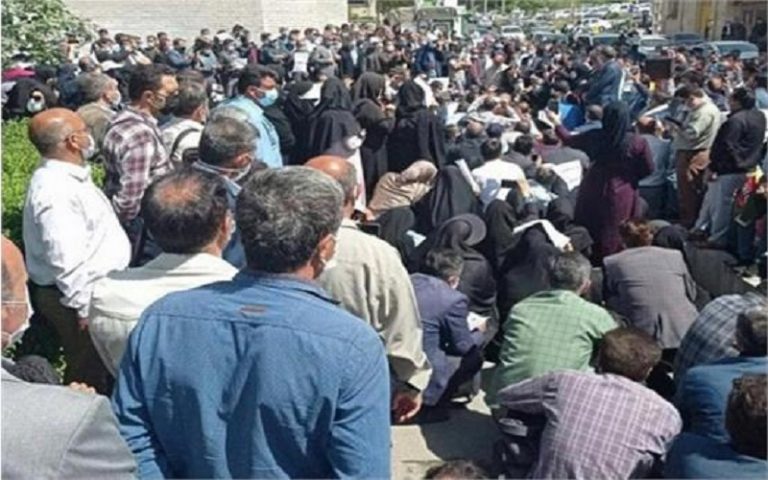
For weeks, the social security retirees of Iran have been protesting their bad living condition and lack of money and insurance. Social security retirees complain about the government’s delay in raising their pensions, but the question that many of them ask is, in principle, why should the increase in the pension of social security retirees depend on the government?
A retiree under the sponsorships of the Social Security Organization has generally paid 30 years of insurance premiums to this organization, and in principle, these premiums should be stored in the pension fund of this organization, and the pensions and pension increases of retirees that must be paid are also from the funds and investments accumulated in this fund.
A report prepared by the state-run daily Eghtesad Online on the status of the Social Security Organization’s pension fund shows that 70 percent of the resources of the Social Security Pension Fund are through premiums that it receives from individuals, and only 12 percent of its resources are provided from the income of investments. In other words, the fund is heavily dependent on the premiums it currently receives from insured workers, and the previous capitals and investments have not yielded much for the fund.
The finger of blame is pointing at the government
There are various analyses on the cause of this situation, but they all have one thing in common: By withdrawing the resources of the Social Security Fund, the government had the largest share in weakening the fund and did not pay its debts to the fund. On the other hand, part of the government’s debts to the Social Security Fund have been paid with the liquidation of loss-making state-owned companies, which has practically not benefited the fund.
Interestingly, the Social Security Fund, despite its unfavorable situation, still receives the least assistance from government sources, and according to the Eghtesad Online’s report, the State Pension Fund and the Steel Fund are in a much worse situation than Social Security Fund and provide most of their resources from the government’s assistance.
One of the government’s officials Mohammad Assadi from the General Department of Public Relations of the Social Security Organization said about the government’s delay and inaction providing the funds for the retirees:
“Last year’s resolution of the Islamic Parliament to transfer 32 trillion tomans of shares of state-owned companies to social security should be implemented so that this organization can provide desirable and needed services to the covered society with the support of reliable financial resources in addition to implementation.” (Jahani press, April 19, 2021)
He added: “This organization spends more than 15 trillion tomans a month this year, and in order to fulfill its obligations, in addition to receiving insurance premiums on time, which is the most important source of social security funding, it must also receive claims from the government through a precise and effective mechanism.” (Jahani press, April 19, 2021)
From these sentences it can be understood that the government is not just supporting the retirees but is stealing their money. And according to the cognition that we have from this regime, this capital is used for the regime’s malign activities like its nuclear and missile program and its meddling in the Middle East.
Although nationwide rallies have been held regularly and weekly for months by the retirees, the demands of retirees have not yet been met. The protesting retirees, in addition to increasing the level of pension to the level of the poverty line, which is now 10 million tomans, demand the repeal of Article 69 of Social Security, increase in their annual pensions and free medical treatment.
At their protests, they also chanted: “Officials, Give us back our rights”, “Expensiveness, inflation, the scourge of people’s lives.”
There are also slogans that the government fears the most like, “We will not vote anymore, because we heard so many lies.”
In recent months, social security retirees have been among those who have held regular weekly rallies to protest the lack of adequate pay. With the poverty line reaching nearly 10 million tomans, officials, including members of parliament, acknowledge the huge gap between workers and retirees’ incomes with the living expenses.
Trafficking In Iran; A Major Concern
The trafficking of women in Iran is a real problem, with most of the victims smuggled out of the country from the provinces of Hormozgan, Sistan and Baluchestan, and Khuzestan.
Lawyer Hossein Komeili said: “In Sistan and Baluchestan, where forced marriages are common, women are given to men in Afghanistan and Pakistan. [It’s a form of] organized trafficking [where] corruption in the bureaucracy [and cooperation between] “smugglers and the police” [make the issue worse].”
Of course, the government hides the relevant statistics, so it’s impossible to know for sure how many victims there are, but the state-run ROKNA News Agency says that the women are moved under the pretext of finding employment, smuggled into countries, and forced to become sex workers because their identification documents are stolen before they even leave Iran.
Despite its opacity, the government is still considered tier 3 by the US State Department for failing to make the minimum effort to combat human trafficking and the US said that the domestic Iran trafficking networks appear to enjoy anonymity.
One Iranian strategist, Hassan Abbasi, publically exposed the trafficking of women to other Middle Eastern countries as far back as 2008, condemning the President, the Information Minister, the Expediency Discernment Council, the Revolutionary Guards, the Bassij, the Judiciary Chief, the commander of the State Security Force, and Tehran’s mayor for failing to address the issue.
But, of course, one of the main reasons for the increased rate of trafficking is poverty because people are desperate to escape the hardships in Iran, tricked with thoughts of a better life. This is worse in more deprived areas.
Komeili said: “The University of Tehran has a law clinic in the Oudlajan area of Tehran. A woman came to the clinic and said, ‘My daughter has been missing for 2 weeks! Her friends said she went abroad.’ We asked, ‘What did you do in these 2 weeks?’ I did nothing. I thought she was going abroad to earn money and send it to us,” the mother replied. Therefore, the principal reason for human trafficking is poverty, and victims fall into traffickers’ traps thinking they are finding jobs. Laws must be changed, and the victim must not be seen as a criminal.”
While sex trafficking is a major part of this criminal industry, we shouldn’t forget about the nasty blood and organ trafficking business, whereby victims (including children) are held for some time abroad before they are killed for their blood and organs.
Iranians Want the COVID Vaccine, so Why Can’t They Get It?

The Iranian people desperately want the government to purchase the safe coronavirus vaccines, approved by the World Health Organisation, and begin to roll out the vaccination program in order to save hundreds of thousands of lives.
But, of course, that’s not going to happen. Back in January, after months of lies about sanctions preventing them from buying the vaccines, supreme leader Ali Khamenei actually banned the import of vaccines made in the US or UK, which most approved ones were at the time. Then, they promised that Iranians would get an as-yet-untested Cuba vaccine over the next two years.
Now, it’s the survival of the richest as Coronavirus Task Force Committee spokesperson Alireza Raisi announced that imported vaccines would not be covered by the government, which means that anyone who cannot afford to be vaccinated will have to wait months for their shot. This was confirmed by the Red Crescent, which said that the vaccines would not be free.
This is the culmination of the authorities’ policy to use the pandemic as a means of control, hoping to stop protests that could overthrow them just weeks after the November 2019 protests rocked the system to its core. The mullahs relied on a high death toll to cull potential protesters and terrify the rest. Now, they want to reduce the people’s anger through the import of a fraction of vaccines.
Not to mention that the vaccine money will end up in the hands of the Revolutionary Guards (IRGC) and Khamenei, extorting from the people, who are in such dire financial straits that they cannot afford poultry, bread, and eggs and live below the poverty line.
Even the state-run media is questioning this decision, with the daily Javan saying on April 19 it would create “corruption, distrust, discrimination, and… black markets”, while the Mardom Salari said that high costs were putting many poorer people off, especially when they were first told it would be free.
The Iranian opposition wrote: “The regime’s criminal measures will have social consequences. Many factions warn of the “ticking social bomb” of the Iranian society and the public outrage that has already manifested itself in five major uprisings in the past two-and-half years. But at this point, it seems that the regime is in a deadlock, and no matter what path it chooses, waiting at the end will be the wrath of the Iranian people and their demands of regime change.”
Treating Stagflation, Only by Restructuring Iran’s Economy
For the past century, revenue from the sale of Iran’s oil has filled the pockets of the dictatorships in this country, especially that of the theocratical rule. What has been ignored and neglected is the scientific, economic, technical, and educational development of the country and its people.
Every time the rulers faced a problem or challenge, they have chosen the simplest way which is further opening the oil valves.
Knots that could be untied with the main source of the country which are the people and helping the development, welfare and prosperity of the country have become more blind, and the benefits of the oil money flowed in the pockets of the rulers, and its consequences becoming the chains of poverty and misery of the people.
Now after one hundred years of corrupted rulers, the country’s economic and social damages are unsolvable.
One of the biggest challenges and gaps in Iran’s economy which are now becoming visible, because the government has lost its main source of income which is oil, are inflation and the stagnation of the economy.
The government and the mullahs’ rule are no longer capable to solve both the social and economic crisis at the same time and are forced to choose between them.
But whichever has priority, the other will act like an unstoppable wildfire which will hurt the country and people. Even the government’s specialists are confessing that the rule has lost the time in these 40 years to solve the country’s economic problems. And they are not able to reverse that time anymore unless heavy changes are made in the future.
Controlling inflation and creating a recession or economic boom with money printing has reached a dangerous stage. Iran’s economy is at a difficult juncture this year, with rising inflation, especially in the last three years, while many officials fear Iran’s fate will that of Venezuela. On the other hand, any boom requires a lot of money to be injected into the market, which in turn will further increase inflation.
“Iran’s economy is in a difficult situation. Recession and inflation are the most important economic problems that Iran is facing in 2021, and if it (Government) does not have a plan for it, this situation will be transferred to the following years, in which economic development plans will no longer make sense.” (State-run daily Arman, April 17, 2021)
Mehdi Karbasian, a government economist, said: “Iran’s economy has been suffering from stagflation for years and this procedure is one of the rare economic diseases in the world. That is, countries are either in recession or inflation and stagflation are very rare. But unfortunately, over the past decades, we have also had serious stagflation at times.” (Mashregh, April 17, 2021)
He points to inflation above 40 percent, which is felt in the items and food of the weak strata of society, i.e., the fourth and fifth deciles, close to 70 percent of the society, and on the other hand, the recession has reached a point where GDP has been negative for several years and we see that the economy has shrunk over the past year or two, and in one year in 2019 the country’s economy shrank by 12 percent.
The inevitable result of this situation is dissatisfaction.
“There has been a fundamental change in the context of Iranian society that can no longer be denied. This event is the turning point of society in the satisfaction curve and the flow of satisfaction.
“The twelfth government no longer has the money to give to the higher institutions and the regulatory bodies, and they fall from the satisfied rank to the line of the dissatisfied. It no longer has the money to give to the workers, so the workers are also dissatisfied.
“Iran’s education and health personnel are dissatisfied because of the government’s inability to increase wages and salaries due to a lack of welfare funding.
“There is no money left to pay farmers to buy wheat. Journalists, footballers, writers, intellectuals, as well as government employees, and more importantly, actors and key players in politics and economics, are also dissatisfied.” (Jahan-e-Sanat, April 17, 2021)
And now the sweet dreams of all officials and experts of this regime in returning the situation to a previous state are fade away and “now, at the beginning of 2021, we are facing a society full of all kinds of problems, and it seems that Iran’s economy is falling apart, and the consequences of this event will sooner or later affect other sectors such as politics, culture and social affairs.” (Jahan-e-Sanat, April 17, 2021)
And these phrases are evidence enough: “As in 2020, there is no empty capacity of stock exchanges and debt securities to compensate for this deficit and prevent the monetization of this deficit.
“How is the stock market and the debt market (capital market) supposed to finance a total of about 300 trillion Tomans of the government’s budget of 840 trillion Tomans in 2021, which is equivalent to 35 percent?” (Kayhan, January 26, 2021)
Iran’s Suicide Cases on the Rise

As more Iranians, particularly women, feel increasingly helpless in the face of so many crises and societal issues, suicide rates in Iran are going up because they feel detached from friends and family, as well as from fulfilling lives outside of their personal relationships.
In fact, since 2017, 60 people, mostly women, have died from suicide in the city of Dishmuk alone, which suicide rates in the provinces of Kurdistan, Kermanshah, and Ilam were highest.
Sociologist and university professor Amanullah Gharaee-Moghadam said that one of the main reasons for suicide of a lack of trust in the authorities overall and discrimination inherent within the mullahs’ laws.
He said: “They say, ‘give birth to more babies!’” They have told girls that their hair was seen. Did they become religious? The structure in Iran is sick. You cannot force society to observe rules from 100 years ago. Today, young people see, hear, and read. They observe the world through their computers.”
Indeed, one of the problems is forced marriage, which is more common in girls under 15. Most of the time, it causes irreparable damage as girls drop out of school to get married and then if their husband dies or divorces them, they are left without the means to get a good job to support themselves.
Here are some of the most recent examples of suicide due to forced marriage:
- Anahita Shahidi, 18, killed herself on January 23 to avoid a forced marriage to her cousin
- Sahar Fakheri, 20, committed suicide on March 18 so that she wouldn’t be married off
- An unnamed 15-year-old girl, who was a victim of child marriage, killed herself just after getting married
80,000 Iranian Nurses Have Had Coronavirus
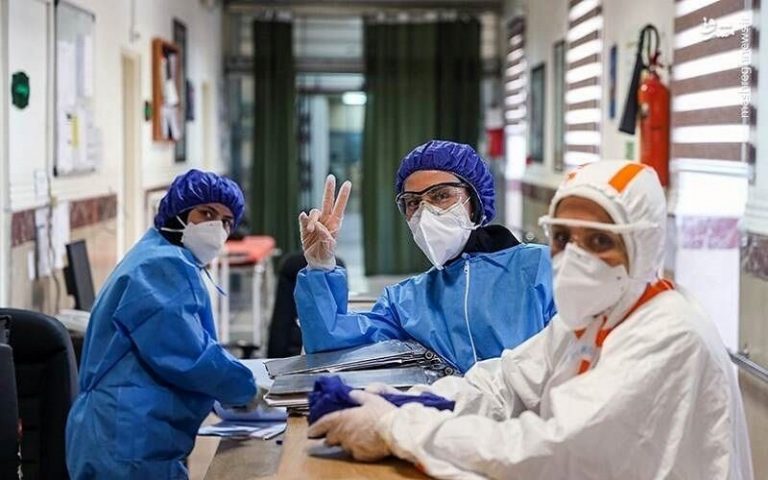
Over 251,000 Iranians have now died from coronavirus in Iran, according to the Iranian Resistance, while the Head of Iran’s Nursing Organization Mohammad Mirza Beigi reports that 80,000 nurses were infected and 8,000 cannot work right now because of it.
All of this displays the authorites’ cruelty in refusing to buy the vaccines to protect healthcare workers and the public.
Beigi told the Entekhab website on April 6 that four nurses are needed for every 1,000 citizens of a country, according to international standards, but there is less than one nurse per 1,000 citizens in Iran.
The nursing shortage isn’t a new thing. In 2018, Hossein-Ali Shahriari, the head of the Parliamentary Health Committee, said that across the public and private healthcare sectors, there was a “shortage of 80,000 to 150,000 nurses”, but it has been made worse because of the pandemic, with 10% of the staff out of commission and 110 nurses having died from COVID-19, according to Beigi.
Of course, since Beigi made these comments, the death toll for nurses has risen to 130 and may have increased since, according to the General Director of the Nurse’s House, who said that the delay in purchasing and distributing the vaccine is “massacring” nurses in hospitals.
On April 13, Mohammad Sharifi Moghadam said: “Unfortunately, in the past week, eight nurses in various cities died from COVID-19 and in light of the delay in the vaccination of nurses, it can be said that nurses are being massacred in hospitals. Unfortunately, with 130 dead nurses who were fighting COVID-19, we are among the countries with the most number of infections and deaths among nurses.”
Horrifically, the true number may be much higher because of the government secrecy surrounding COVID-19 deaths and infection.
Officials refuse to get the vaccines already approved by the World Health Organisation, with Supreme Leader Ali Khamenei expressly banning several of them in January, and is blaming the public for rising infections, saying that they don’t follow health protocols but now even the state-run media is pushing back.
The Jahan-e Sanat state-run daily wrote on April 8: “Everyone knows that during the past 14 months, the government has put preference over the economy to the lives and health of people, although the people are always the ones who are sacrificed.”
Hamid Emadi, a member of the COVID-19 Taskforce said on April 9, that the county would face “at least three difficult weeks filled with death” because conditions in hospitals were so bad.
Iran: Civil Disobedience and Conflict With the State Norms
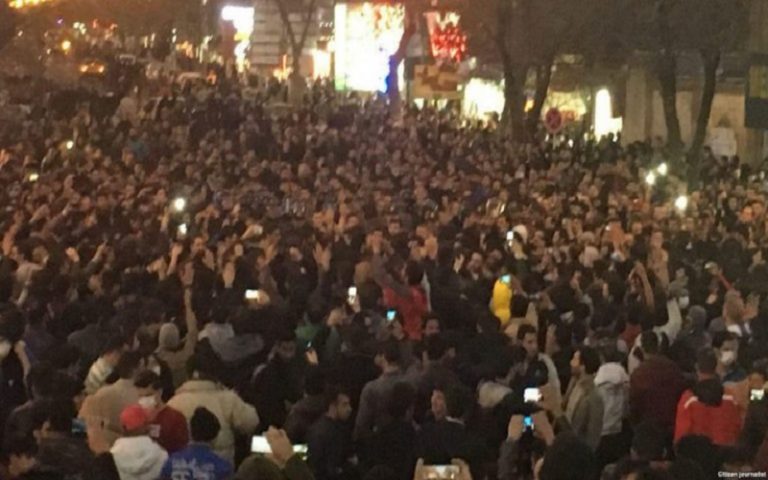
Corruption and fear of the people’s fury and protests are factors that Iranian officials and state media are warning each other about daily. The ruling factions blame each other for the spread of the coronavirus warning about the consequences of such an inhuman policy, not considering the necessary resources for the vaccination of the people.
The state-run daily Arman in an article with the title, “Do not blame people in crises” on April 18, warned the state about the consequences of its policy on the coronavirus and wrote: “’When the class gap expands so much that even mountains and hills are unable to fill it, how can we talk about the confrontation of life and bread?
“Civil disobedience and abnormalities are the main products of economic pressures in society, and we must also pay attention to the logical point that people‘s patience has its limits.” (Arman, April 18, 2021)
“Not trusting people” is the title of one the articles of the Jahan-e-Sanat daily, which pointed to the hollow promises of the government about the coronavirus and wrote: “This has made people angry about the current situation. When a spark hits these people, they enter the field with the utmost violence, and then the people become uncontrollable.” (Jahan-e-Sanat, April 18, 2021)
Then the state-run daily Resalat dashes cold water of the government’s fake hope and wrote: “We will fail in the face of coronavirus, and the fate of the vaccines we need will be unknown.” (Resalat, April 18, 2021)
Other factors like the social and economic crisis are causes for concern for the government affiliates too, warning each other, which is uncomplimentary confess about their institutional corruption.
“The reasons for the endless cycle of underdevelopment” is the title of one these warnings an article in the Iran daily, which is belonging to the president’s faction, attacked the rival faction and wrote: “they (Supreme leader’s faction) have converted the political wings of Iran to soup kitchen, then warned: “This is the path that will lead to a very dangerous impasse.” (Iran daily, April 18, 2021)
“I wish we did not have mines” is the title of an article in the Mostagel daily pointing to one of the corruption cases and wrote: “The government receives about $400 trillion a year in pre-mining revenue without spending a return on mining protection or beneficiary villagers.” (Mostagel, April 18, 2021)
“The stock market seeks to build trust” is another article pointing corruption written the state-run daily Vatan-e-Emrooz who wrote: “The government earned about 2000 trillion tomans by selling two negotiable investment funds called ‘Dara One’ and ‘Palayesh One’. The government also earned about 1700 trillion tomans from the tax on stock transfers. These figures show that the capital market in 2020, if not favorable for real shareholders, was sweet for the government.” (Vatan-e-Emrooz, April 18, 2021)
The state-run daily Setareh-e-Sohb analyzed the root of the government’s corruption and wrote: “The country’s economy has been a victim of the country’s oligarchy for the past few decades, and now the government is in the service of the same oligarchy’s pocket, and if this path and trend does not change, Iran’s situation will worsen in the future.” (Setareh-e-Sohb, April 18, 2021)
The state-run daily Etemad also warns of years of looting from the pockets of the people, citing ‘sociologists, economists, politicians and economic activists’ within the system and wrote: “The increasing and continuous decline of the purchasing power of the citizens is like a time bomb, and if we do not neutralize it at the right time, we do not know how much damage it will cause to the (system) with its explosion.” (Etemad, April 18, 2021)
Who’s in the Iran Presidential Race and Does It Matter?
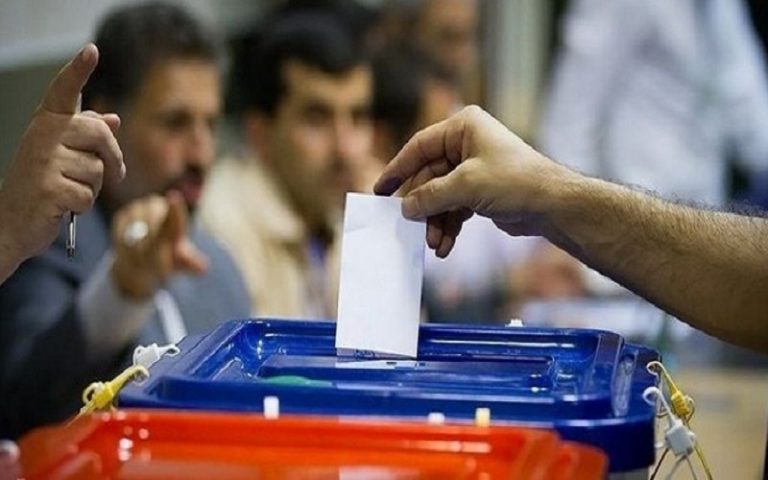
Iranian supreme leader Ali Khamenei has long expressed his support for a “young and hezbollahi” government with a president in the mould of Quds Force commander Qassem Soleimani.
With the Presidential elections coming up in June, the state media is focusing on possible candidates, as various officials have already put their names forward, but as the decision is ultimately in the hands of Khamenei, which one is looking most promising?
Probably Hossein Dehghan. This former Revolutionary Guards (IRGC) official and Defence Minister is currently the most important candidate, but the state-run IRNA news agency warns that “military figures” will not help ease the growing tensions that could see the clerical system swept from power.
Other important candidates are:
- current judiciary chief Ebrahim Raisi, known for his role in the 1988 massacre of 30,000 political prisoners
- Mullahs’ founder’s grandson Hassan Khomeini, although Khamenei asked Khomeini to withdraw his candidacy with the hopes of preventing protests
- former parliament speaker Ali Larijani, who Khamenei has also tried to block coverage of
