Three Dams in Iran Dried Up, Eight More Near CollapseAccording to official statistics, the total water storage in the country’s dams has now reached 17.66 billion cubic meters, compared to 23.31 billion cubic meters during the same period last year — showing a 24% decline this year. The average filling rate of Iran’s dams is estimated to be only 34%. On September 22, Mohammad Reza Kavianpour, head of the Water Research Institute, warned that rainfall this fall would be “below normal” and that the water crisis in the country would persist. That same day, the state-run IRNA news agency reported that only 36% of Iran’s total dam capacity had been filled. Reports indicate that 22 dams across the country are in a critical condition, with less than 15% capacity. Among the dams supplying water to Tehran, Amir Kabir Dam is at 11%, Lar at 2%, Taleghan at 38%, and Latyan-Mamlu at 9% capacity. In other regions of the country, the severe decline in water reserves continues. Dams in the Lake Urmia basin have fallen by 40% compared to last year, while in Khuzestan Province, the Karkheh, Marun, and Jarreh dams have experienced declines of 49%, 70%, and 26%, respectively. In Hormozgan Province, the Esteghlal and Shamil-Niyan dams have experienced up to 100% depletion of their reserves, while in Golestan Province, the Voshmgir, Boostan, and Golestan dams have virtually dried up.
Water Inflow into Dams in 21 Iranian Provinces Down 39% Compared to Last Year
According to the latest data on Iran’s dam reservoirs, the volume of water inflow into dams from September 23 (the start of the current water year) to October 18 has decreased by 39%, and rainfall in 21 provinces has been recorded as zero. Currently, Iran’s dams are on average only 34% full.
The state-run ILNA news agency reported on Friday, October 24, that the total volume of water entering Iran’s dams from September 23 to October 18 was 780 million cubic meters — a 39% drop compared to 1.29 billion cubic meters during the same period last year.
Water discharge has also decreased by 29% due to management restrictions.
Amnesty International Reports Over 1,300 Executions in Iran in 2025
Amnesty International announced that more than 1,300 people have been executed in Iran during 2025 and called on the international community to take immediate action to “stop this horror.”
In a statement on Friday, October 24, the organization described the execution of over 1,300 people in the current year as “the highest figure recorded in decades.”
Amnesty International: More Than One Thousand People Executed in Iran in 2025The human rights organization warned that thousands of others are at risk, as Iranian authorities continue to use the death penalty as a “weapon.” On Thursday, October 23, Amnesty International had also reported that more than 1,000 executions had taken place in Iran since the beginning of 2025 and called for an immediate halt to the killings. The organization stressed that executions in Iran are carried out “after unfair trials and with the aim of suppressing protests and minorities.”
In response, political prisoners in various prisons have protested the wave of executions through sit-ins, issuing statements, and participating in “No to Execution” campaigns.Scores of people in Iran, including university student Ehsan Faridi, are at grave risk of execution after unfair trials & convictions on politically-motivated charges by Revolutionary Courts. Iran's authorities must halt all executions now! #نه_به_اعدام https://t.co/bBOgDIYUWW pic.twitter.com/Xmg6nslB49
— Amnesty Iran (@AmnestyIran) October 9, 2025
At Least 236 Prisoners Executed in October
On Thursday, October 23, the human rights website HRANA reported in its latest monthly update on human rights violations in Iran that the Iranian regime’s judiciary executed at least 236 people between September 23 and October 22 in prisons across the country. These figures show that in the past month, an average of eight people were executed every day—equivalent to one execution every three hours. According to HRANA, in addition to the executions carried out, at least 12 new death sentences and seven confirmations of execution verdicts were issued for prisoners in Iran. Among those executed were two individuals, Ali Aghajeri and Mohammadreza Shiheki, who were under 18 years old at the time of arrest and alleged offense. Currently, in addition to inmates convicted of general crimes who are executed daily in Iran’s prisons, about 70 prisoners nationwide with political charges are at risk of having their death sentences confirmed or carried out, while over 100 others face the possibility of receiving death sentences on similar charges. In this context, United Nations Secretary-General António Guterres, in his latest report to the General Assembly published on Tuesday, October 21, expressed concern over the surge in executions, torture of detainees, suppression of minorities, and increasing restrictions on civil liberties. According to the report, in the first half of 2025, at least 612 people were executed in Iran—a 119% increase compared to the same period last year. Guterres expressed regret over the Iranian regime’s disregard for international recommendations to halt executions and to limit death-eligible crimes, describing public executions as “contrary to the prohibition of torture and inhuman treatment.”Iranian Worker at Risk of Execution
Milad Panahipour, an attorney, announced that his client, 42-year-old laborer and political prisoner Manouchehr Fallah from Gilan Province, currently held in Lakan Prison in Rasht, has been sentenced to death on the charge of “destruction with intent to confront the government.” According to the lawyer, the charge is based on the explosion of a small firecracker outside the Gilan courthouse.
On Thursday, October 23, Panahipour told the state-run news website Emtedad that Fallah lost his father in childhood and that the incident leading to his death sentence caused only about 150 million rials (approximately $130) in damages. Despite this, the court issued a death sentence.
Iran: 88 Public Executions In 12 YearsThe lawyer explained that since childhood, after his father’s death, Fallah had made a living as a laborer and constantly struggled with poverty and hardship. During more than two and a half years of imprisonment, he was allowed only a few visits and, due to his mental state, preferred not to see his young daughter in the prison environment. Referring to his client’s mental and economic condition, Panahipour said issuing such a sentence for a man who neither possessed a weapon nor harmed anyone represents “the height of injustice.” The only basis used by the Revolutionary Court judge to accuse him of “enmity against God” (moharebeh) was the minor financial damage to the door and façade of the Rasht courthouse. Lawyers argue that the ruling is riddled with flaws and that the case file lacks any evidence that could justify charging Fallah with moharebeh or issuing a death sentence.
The Basis for the Death Sentence
Panahipour explained that the cited legal article concerns the destruction of vital public facilities; however, in Fallah’s case, no such facilities were damaged, no one was injured, and no public service was disrupted—the only damage was a minor dent in a metal door. He stressed that the case involved merely the explosion of a very small sound firecracker at midnight with no bystanders present, yet the court wrongly interpreted Article 687 of Iran’s Penal Code as “destruction of vital facilities.” The lawyer added that the Gilan courthouse operated normally the very next day, with no disruption of services or harm to citizens, asking: “So what destruction or confrontation with the government are they talking about? Is this what justice demands?” According to him, despite legal and technical flaws, the Supreme Court rejected the appeal, and his client, after more than two and a half years in prison, is now on the verge of execution. During his last visit, Fallah said, “My life is for the people of Iran.” Panahipour called the ruling a clear violation of the principle of proportionality between crime and punishment.Arrest and Sentencing
Fallah was arrested in July 2023 by agents of the Ministry of Intelligence at Rasht Airport and charged with “propaganda against the regime,” “insulting Ali Khamenei, the regime’s supreme leader,” “membership in the People’s Mojahedin Organization of Iran (PMOI/MEK),” “destruction of public property,” and “manufacturing and using a homemade sound bomb.” In November 2023, this political prisoner was sentenced by Branch 3 of the Rasht Revolutionary Court to one year, three months, and one day in prison for “insulting Khamenei,” and seven months and 16 days for “propaganda against the regime.” After he accepted the verdict, one-quarter of his sentence was reduced, and his prison term for that case ended in May 2024. In another case, on December 11, 2024, he was tried via video conference at the Rasht Revolutionary Court presided over by Judge Mohammad Ali Darvish-Goftar and, in February 2025, was sentenced to death by hanging on the charge of moharebeh (“enmity against God”). In February 2025, Fallah wrote a letter to his daughter Asal on her 16th birthday anniversary: “On the eve of your birthday, Judge Mohammad Ali Darvish-Goftar delivered my death sentence, perhaps thinking it would make me surrender. But he is unaware that the path I have chosen was not learned from books, but from life itself and from the suffering of the people.” Currently, in addition to prisoners convicted of common crimes who are executed daily in Iran’s prisons, about 70 political prisoners nationwide face the risk of their death sentences being confirmed or carried out, while more than 100 others face the possibility of new death sentences on similar charges.U.S. Treasury Identifies $9 Billion in ‘Iranian Shadow Banking’ Activity
The U.S. Department of the Treasury announced that financial networks linked to Iran conducted approximately $9 billion in suspicious transactions through U.S. bank accounts in 2024. The report is part of President Donald Trump’s renewed “maximum pressure” campaign against Tehran.
According to the U.S. Treasury, its Financial Crimes Enforcement Network (FinCEN) has uncovered an extensive network of Iranian shadow banking in its latest financial trend analysis. The network consists of domestic exchange houses, front companies, and foreign intermediaries that operate to evade sanctions, launder money, sell oil illegally, and finance Tehran’s regional proxy forces.
U.S. Treasury Sanctions Financial Network Supporting IRGC And Defense Ministry of Iranian Regime“Identifying Iran’s complex financial lifelines and shadow networks is an essential part of cutting off the funding for their military, weapons programs, and terrorist proxies,” said FinCEN Director Andrea Gacki. “By issuing this public analysis, we hope to draw attention to Iran’s shadow banking activity and encourage financial institutions to be vigilant.” The report emphasizes that Iran has conducted billions of dollars in transactions through shell companies and intermediaries based in the United Arab Emirates, Hong Kong, and Singapore. According to FinCEN’s findings, foreign shell companies were responsible for about $5 billion in transactions in 2024, while Iran-linked oil companies handled another $4 billion. In addition, companies suspected of supplying sensitive technologies to Iran engaged in over $413 million worth of financial exchanges during the same year. The report comes as President Donald Trump, since February 2025, has launched a new phase of his maximum pressure campaign against Tehran. Its objectives include preventing Iran from acquiring nuclear weapons and intercontinental ballistic missiles, curbing its military activities, and cutting off the financial networks of the Islamic Revolutionary Guard Corps (IRGC) and the regime’s regional proxy groups.
Iran’s Regime Remains on FATF Blacklist
Despite the Iranian regime’s approval of the Countering the Financing of Terrorism (CFT) convention, the Financial Action Task Force (FATF) announced in its latest statement that Iran remains on the list of high-risk countries for money laundering, terrorist financing, and the proliferation of weapons of mass destruction.
The organization urged all countries to continue their effective countermeasures against Tehran.
In the FATF statement released on Friday, October 24, it said that since February 2020, the Iranian regime’s reports submitted in January, August, and December 2024, as well as August 2025, have shown no substantial progress in Iran’s situation.
Financial Action Task Force (FATF): A New Wave of Disputes Among Iranian Regime FactionsFATF reminded that Iran had committed in 2016 to address deficiencies in its anti-money laundering and counter-terrorism financing systems; however, this plan expired in January 2018, and most of it remains unimplemented. In October 2019, FATF called on its members to apply enhanced supervision, more precise reporting, and broader financial inspections for Iranian financial institutions. On October 1, the Iranian regime’s Expediency Council conditionally approved Iran’s accession to the Countering the Financing of Terrorism (CFT) convention. According to the council’s resolution, Iran’s accession to the convention would only be possible if it “does not contradict the country’s constitution or domestic laws.” The law for Iran’s regime to join the CFT treaty was finally communicated to relevant executive agencies on October 21 by Masoud Pezeshkian, the regime’s president. The CFT convention complements the United Nations Convention Against Transnational Organized Crime (known as the Palermo Convention), which was adopted to prevent the financing of terrorist activities and to facilitate international cooperation in identifying and cutting off sources of terrorist funding. In May, the Expediency Council had also conditionally approved Iran’s accession to the Palermo Convention.
Iran’s Broad Reservations Incompatible with FATF Standards
FATF continued in its statement that although Iran had announced the ratification of the Palermo Convention, this action was insufficient. According to FATF, Tehran’s extensive reservations regarding the provisions of the Palermo Convention have rendered its domestic implementation inconsistent with FATF standards. Referring to UN Security Council resolutions concerning Iran’s non-compliance with its nuclear non-proliferation obligations, FATF reminded all countries that, according to its standards, they are obligated to identify and mitigate the risks arising from Iran’s financing of weapons proliferation. FATF also, citing the ongoing threats related to terrorist financing from Iran and the incomplete implementation of Tehran’s action plan, once again called on its members to take effective measures against the Iranian regime. The Financial Action Task Force, emphasizing the need for Iran’s immediate cooperation, urged Tehran to swiftly advance in fully implementing its action plan and to address its remaining deficiencies. Full criminalization of terrorist financing, identification and freezing of terrorist assets, establishing an effective and binding system for customer identification and verification, and proving the capability of supervisory institutions to identify and punish unauthorized money transfer service providers are among FATF’s demands from the Iranian regime. Meanwhile, on October 24, FATF removed South Africa, Mozambique, Burkina Faso, and Nigeria from its special monitoring list.Iranian Regime Hacking Group Targets Over 100 Entities in Espionage Operation
The Singapore-based cybersecurity company Group-IB announced that a hacking group affiliated with the Iranian regime, known as “MuddyWater,” has targeted more than 100 organizations across the Middle East and North Africa in a sophisticated phishing campaign.
In a report published on Wednesday, October 22, Group-IB wrote that the attackers used a compromised email account to distribute malware among various organizations, including government institutions.
The main objective of the operation was identified as gathering political and security intelligence from international organizations.
Iran-Linked Hackers Intensify Attacks on U.S. Financial and Military InfrastructureIn this campaign, the hackers used NorthVPN to access victims’ email inboxes and sent emails containing malicious attachments. These emails included Word documents that, once “macros” were enabled, executed harmful code and installed version four of the Phoenix backdoor malware on victims’ systems. According to the company’s findings, the malware was executed using an injection tool known as “FakeUpdate,” after which it connected to a command-and-control (C2) server to collect target data and receive new commands. Experts from the company stated that the code structure, control servers, and tools used in this operation match previous MuddyWater campaigns, identifying the group with “high confidence” as the main actor behind the recent attacks. The report added that the group’s control infrastructure includes remote management tools and a password-stealing software designed to extract stored credentials from browsers such as Chrome, Brave, and Opera. The malware was disguised as a calculator application to avoid suspicion. On October 22, Israel’s National Cyber Directorate also reported detecting a wave of cyberattacks against Israeli IT service companies, which are believed to be linked to the Iranian regime. The agency stated that a failed cyberattack on Shamir Medical Center during Yom Kippur, which led to the exposure of emails containing sensitive patient information, was an attempt by Iran to disrupt the hospital’s operations. However, the attack was contained before the hospital’s central medical record system was affected. Group-IB emphasized that MuddyWater, attributed to the Iranian regime, remains one of the most active cyber-espionage actors in the region, with its operations expanding beyond the Middle East to Europe, Africa, and North America. The report stated: “MuddyWater demonstrated an enhanced ability to integrate custom code with commercial tools for improved stealth and persistence.” Experts warned that given the group’s focus on government targets and the ongoing geopolitical tensions in the region; similar operations are expected to continue in the future.
Iran: 88 Public Executions In 12 Years
The state-run daily Shargh, citing “collected statistics,” reported that “between 2011 and 2023, at least around 88 public executions were carried out in the country.” Quoting two legal experts and a psychologist, the newspaper emphasized that public executions no longer have a deterrent effect.
On Wednesday, October 22, Shargh published a report titled “Public Display of Harsh Punishments,” writing that “Fars, Khorasan, and Kermanshah provinces have the highest share of public executions.”
According to the report, other cities such as Yasuj, Arak, Ahvaz, Marvdasht, and Isfahan also have smaller shares.
UN Fact-Finding Mission Expresses Concern over Unprecedented Rise in Executions in IranThe newspaper added: “According to the news, public executions have mainly been carried out in provincial centers with large populations or areas with high-profile criminal cases.” Shargh did not provide further explanation. Referring to the fact that “the peak of executions occurred in the early 2010s, with over 30 cases in the first three years before declining,” the paper added: “In 2021, the number dropped to zero. However, since 2022, public executions have once again appeared in the news.” The report mentioned the public execution of two people “for murder” in August this year in “Larestan County and Golestan Province.” In another part of the report, Shargh emphasized that after reviewing the news from these years, it appears that the implementation of public executions “has had no impact in reducing violent crimes.” Quoting social science and psychology experts, the newspaper wrote that public executions contribute to the “normalization of violence” and that “the public nature of punishment not only fails to promote deterrence or social calm but has an entirely opposite effect.”
Public Executions No Longer Have a Deterrent Effect
According to Shargh, attorney Abdolsamad Khorramshahi stated that under Iran’s judicial principles and criminal laws, executions should generally not be carried out publicly. He explained that according to Article 4 of the regime’s so-called Islamic Penal Code, public execution is permissible only under special circumstances and with the proposal of the prosecuting attorney and the approval of the attorney general. Khorramshahi emphasized that public executions can have widespread negative effects on society — they are not deterrents but instead reinforce violent behavior and harm the mental health of children and adolescents. Shargh further wrote that in today’s conditions, with the expansion of social media, public executions have lost their deterrent power and have become a form of public spectacle for some segments of society.Public Execution Does Not Lead to a Sustainable Reduction in Violence
Social psychiatrist Amir Hossein Jalali Nadooshan told Shargh that the presence of spectators at the scene of executions might evoke fear or a sense of social order in the short term, but in the long term it does not reduce violence because it is inconsistent with the cultural structure of society. He added that repeating such scenes desensitizes the public to human suffering and fosters a kind of emotional indifference in society — where violence becomes normalized. According to Jalali Nadooshan, when violence is used as a public display, it creates imitative behavior that seeps from public spaces into family and social relationships. No Country Has Managed to Curb Crime Through Executions or Corporal Punishment Quoting Ali Najafi Tavana, a legal expert and former head of the Central Bar Association, Shargh wrote that despite harsh punishments for drug traffickers, thugs, and other criminals, crime has not decreased but rather increased. He noted that prisons are overcrowded, forcing the government to release some inmates from time to time. Najafi Tavana stressed that no country has been able to curb crime through executions or corporal punishment, and the path to crime control lies in prevention, respect for the people, and observance of civil rights. He added that reducing crime requires meeting people’s basic needs, such as employment, housing, marriage, social security, and mental peace. He said that in a society dominated by poverty and discrimination, where the powerful enjoy lavish lives using the people’s wealth, “people, seeing such injustice, distance themselves from the law and no longer fear punishment.”The Number of Executions in October Reached 280
Coinciding with Shargh’s report on public executions, the Iran Human Rights Society reported on Wednesday, October 22, that at least 28 prisoners were executed across prisons in Iran on October 21 and 22. According to the report, with these executions, the total number recorded for October has reached 280, indicating that, on average, more than eight people per day — or one prisoner every three hours — were executed in Iran that month. The executions of these 28 prisoners took place in the prisons of Birjand, Shiraz, Isfahan, Tehran, Kermanshah, Taybad, Yazd, Zanjan, Qazvin, Ghezel Hesar (Karaj), Gorgan, and Qom. The organization described this October as “the bloodiest month for prisoners since the mass executions of 1988.” Among those executed were Ebrahim Azizi in Birjand Prison; Nader Abdi and Alireza Keshavarz in Adelabad Prison, Shiraz; Saman Talebi and Habib Haqshenas in Dastgerd Prison, Isfahan; Sasan Lorestani and Shahram Mirzaei in Dizelabad Prison, Kermanshah; Khosro Vafadar in Qom Prison; and Mansour Iravani in Ghezel Hesar Prison, Karaj. The executions were mostly on charges related to drug offenses, and in some cases, murder. Among those executed were several Afghan nationals, including Serajuddin Abitalebi, Mohammad Shams, and Mohammad Ebrahimi, all convicted of drug or murder charges. The Iran Human Rights Society reported that some of the executions were carried out without informing the families or allowing a final visit. UN Secretary-General António Guterres, in his latest report to the UN General Assembly on Tuesday, October 21, warned about the rise in executions, torture of detainees, suppression of minorities, and increasing restrictions on civil freedoms in Iran. According to the report, in the first half of 2025, at least 612 people were executed in Iran — a 119% increase compared to the same period last year. Guterres expressed regret over the Iranian regime’s disregard for international recommendations to halt the death penalty and limit capital offenses, calling public executions “inconsistent with the prohibition of torture and inhuman treatment.” Amnesty International also announced on Thursday, October 16, that over 1,000 executions have been reported in Iran since the start of 2025 and called for an immediate halt to executions. The international human rights organization reported that executions in Iran “follow unfair trials and are used to suppress protests and minorities.” Earlier, on the occasion of the World Day Against the Death Penalty (October 10), the human rights website HRANA had reported that at least 1,537 people were executed in Iran over the past year.Iran’s Healthcare System Faces Shortage Of 165,000 Nurses
Ghasem Abutalebi, head of Iran’s regime Nurse Council, announced that the country is facing a shortage of 165,000 nurses. At the same time, Abbas Ebadi, the regime’s deputy minister of nursing at the Ministry of Health, attributed the delay in paying nurses’ arrears to two main reasons: the failure to allocate budget bonds and the delay of insurance companies in fulfilling their financial obligations.
On Wednesday, October 22, during Nurses’ Day ceremonies in Shiraz, Abutalebi said: “The nurse-to-hospital-bed ratio in Iran is 0.9, while it was supposed to reach 1.8 by the end of the Sixth Development Plan.”
Around 70,000 Iranian Nurses Have No Desire to WorkHe said that the global standard is an average of three nurses per hospital bed and added: “Currently, 165,000 nurses are working in the country, and with this shortage, we need to recruit an equal number to address the deficit in healthcare centers.” According to Abutalebi, a plan to hire 15,000 nurses annually has been drafted by the Ministry of Health and is in the approval process. Earlier, on October 6, Mohammad Sharighi-Moghaddam, secretary-general of Iran’s Nurses’ House, stated that harsh working conditions, psychological pressure, and wage inequality have caused many nurses to become disillusioned with their profession and seek ways to leave hospitals. Sharighi-Moghaddam described the state of nursing in Iran as critical, saying that while the healthcare system is suffering from a severe shortage of staff, more than 60,000 nurses in Iran are unemployed, and nursing school capacities continue to increase each year.
Nurses’ Protests in Kermanshah and Khuzestan
The state-run ILNA news agency reported on Wednesday, October 22, that nurses from Kermanshah University of Medical Sciences held a protest over unpaid wages and low salaries, saying their nursing tariffs had not been paid for more than nine months, and many earn less than 20 million tomans (approximately 1.8 million rials or about $180) per month. At the same time, nurses in Khuzestan also gathered in front of the provincial governor’s office, stressing the need to pay their back wages and improve working conditions, and demanding that officials address their livelihood and legal grievances. Abbas Ebadi, deputy minister of nursing, told ILNA that the delay in payments to nurses in Kermanshah and Khuzestan was due to delayed insurance reimbursements and the failure to allocate 800 trillion rials (approximately 696 million dollars) in bonds to the Ministry of Health under the 2025 budget. Over the past several years, nurses and other healthcare workers across Iran have repeatedly held protests, sit-ins, and strikes in response to the government’s failure to address their demands. The severe shortage of nurses and the government’s continued neglect of professional demands come despite international health standards requiring at least three nurses per 1,000 people or at least two nurses per hospital bed. However, reports indicate that Iran has reached at most half of these minimum standards — a gap that manifests itself in long shifts, occupational burnout, and declining quality of services, particularly in emergency rooms and intensive care units.The Painful Story of School Dropout Caused by Poverty in Iran
The alarming situation of students dropping out of school in Iran stems from structural factors such as severe poverty, economic inequality, and a lack of funding for educational infrastructure. This growing phenomenon is threatening the future of millions of children and adolescents and requires a serious review of the country’s educational and economic policies.
Statistical dimensions and structural causes of school dropouts
Alireza Kazemi, the education minister of Iran’s regime, recently announced that there are nearly 950,000 children who have dropped out of school. He stated that economic poverty, illnesses, migration, and poor educational conditions are among the contributing factors.Iran’s Statistical Center Reports Rise in School Dropout RatesAli Zarafshan, advisor to the education minister, cited structural crises, poverty, inequality, migration, marginalization, lack of budget for developing educational infrastructure, and child labor as the main reasons for school dropout. These factors combined have contributed to the rising dropout rate.
Geography of inequality and the impact of cultural factors on school dropout
According to the 2023–2024 Statistical Yearbook, Khuzestan Province, with 1,087,050 students, ranks fourth nationwide in total number of students. However, Rezvan Hakimzadeh, the deputy minister for primary education, had earlier stated that the highest dropout rates in Iran belong to the provinces of Sistan and Baluchestan, Tehran, Khorasan Razavi, Khuzestan, and the suburban areas of Tehran. According to Hakimzadeh, economic and cultural problems, migration, distance from school environments, and family prejudices are among the key factors contributing to school dropouts. Other major reasons include illness or even death of children, lack of accurate contact information or addresses for families, and unregistered children attending unofficial educational centers. Even in urban areas, dropout rates are significant. One of the main reasons for urban dropouts is uncertainty about future employment.Education quality and unprofessional policies: a threat to school retention
Beyond poverty and infrastructural issues, another concern is the unprofessional conduct of teaching staff. Previously, Farhangian University guaranteed that every graduate would be qualified to teach in schools. However, in recent years, mass and unqualified hirings, such as the employment of clerics in the education system, have driven schools toward unprofessionalism.950,000 Iranian Children Deprived of EducationMohammad Davari, spokesperson for the Teachers’ Organization of Iran, recently stated that in the process of selecting teachers, “mental health is sidelined while ideological and political scrutiny is extreme.” He said this imbalance in recruitment is entirely legitimate to protest against. He gave an example of a top-ranking applicant whose acceptance was revoked simply because local investigations claimed her hijab was “a bit loose.”
Shocking dropout statistics and the ministry’s conflicting priorities
The dropout statistics are staggering. The deputy minister for primary education announced that according to the Mahmoudvand system’s latest data as of May 12, 2025, a total of 152,287 out-of-school children aged 6 to 11 had been identified in Khuzestan Province. Of this number, more than 130,000 had never been registered in any school. According to the Ministry of Education’s data, in the 2022–2023 academic year, 902,188 children across different educational levels dropped out of school. The breakdown shows that 156,835 were in elementary school, 195,568 in lower secondary, and 549,785 in upper secondary. The overall dropout rate for the 2022–2023 school year was 1.97%, equivalent to 287,617 students. In the 2023–2024 school year, it was estimated at 1.65%, equal to 247,242 students.Worsening educational inequality and academic decline among students
Mohammadreza Sabaghian, a member of parliament representing Bafq, recently remarked that the current diversity of schools in Iran resembles “the caste and class system of the Sassanid era, which history condemns.” He noted that the children of wealthy families and government officials easily separate themselves by attending private schools charging hundreds of millions of tomans (billions of rials) in tuition, while 80% of the nation’s students study in public schools. Ehsan Azimirad, spokesperson for the Education and Research Committee of the parliament, recently stated that the national average student grade point is between 9 and 12 out of 20. For mathematics majors, the average is 9–10; for experimental sciences, about 10–11; and for humanities, 11–12, though he admitted these figures sometimes vary. Finally, the state-run Etemad daily reported on September 23 that with the start of the new academic year, many unregistered children in Sistan and Baluchestan Province have been unable to enroll in schools.Political Prisoners in Iran Enter 91st Week of Hunger Strikes as ‘No To Executions Tuesdays’ Campaign Spreads to 52 Prisons
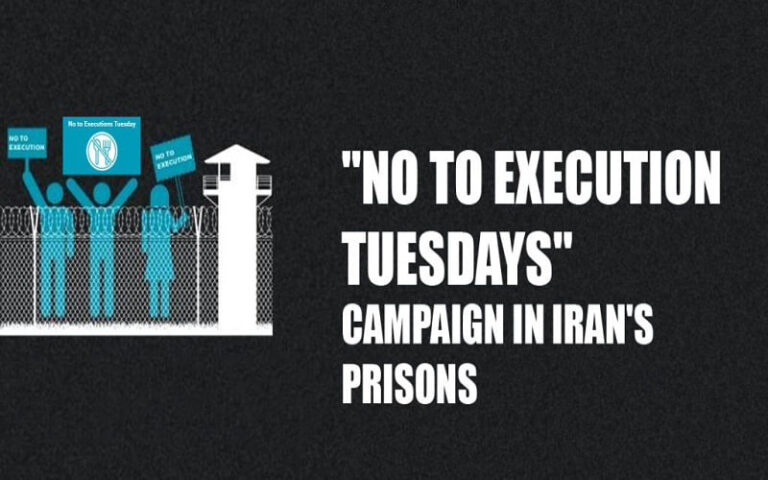
The “No To Executions Tuesdays” campaign praises the successful strike at Qezelhesar Prison that saved inmates from the gallows.
The “No to Executions Tuesdays” campaign is entering its 91st consecutive week, a powerful testament to the relentless resistance inside Iranian prisons against the regime’s policies of oppression and capital punishment. This week’s action follows a heroic hunger strike by prisoners in Ghezel Hesar Prison, who successfully saved several of their fellow inmates from imminent execution amid a brutal wave of state-sanctioned killings aimed at quelling popular dissent.
The Prisoners’ Statement
Organizers of the campaign praised the steadfastness of prisoners in Unit 2 of Ghezel Hesar Prison, who held a week-long hunger strike under the slogan “No to Execution Tuesdays.” Their resilience forced authorities to return six of their fellow inmates from solitary confinement, where they had been taken in preparation for their executions. The statement described the strike as a “defiance of death,” as the regime could have easily expedited the sentences in retaliation for their resistance.Juvenile Offender Executed in Sepidar Prison of AhvazIn a continuation of this mobilization, prisoners’ families held a protest on Sunday, October 19, outside the regime’s parliament to condemn the ongoing policies of repression and execution. The campaign’s statement frames the struggle as a confrontation with an “anti-human” regime that carries out brutal mass executions. The statistics cited are grim:
- In the past week alone, the regime executed 59 people, including two women and an individual who was a minor at the time of the alleged crime.
- The total number of executions during the Iranian month of Mehr (late September to late October) reached 232.
- This brings the total number of executions since the start of the current Iranian year (March 2025) to over 1,087.