

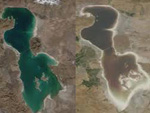
 Reuters: As a child, Mohammad Rahmanpour spent his summers swimming in Lake Orumieh in northwestern Iran – then the largest in the Middle East. In less than two decades, the saltwater lake has almost disappeared, leaving behind a hole in the ground. “My friends and I would go on the top of trees in our neighbourhood. We could see the lake clearly from that point,” said the 32 year-old farmer who grows wheat and beets.
Iran’s water crisis
Iran denies agreement on Arak, Fordow nuclear sites
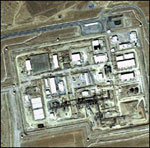
TwoCircles.net: Tehran and the six world powers have not made any agreement on Iran’s heavy water nuclear power plant of Arak and the underground bunker of Fordow, a senior Iranian negotiator said. “In principle, no agreement has been made on any topics pertaining to the nuclear issues of Iran yet. And the difference over Arak heavy water reactor and Fordow uranium enrichment are still in place,” said negotiator Abbas Araqchi.
Just a hint of Iran sanctions risk stalls bank transactions
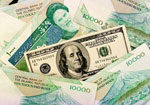
Wall Street Journal: As negotiations over Tehran’s nuclear program continue, the U.S. is encouraging some companies to go to Iran to give its leaders an incentive to stay at the bargaining table. But it could be a tough sell. Billions of dollars in fines have conditioned banks to see any Iran deal as toxic, sanctions experts say. Even the appearance of a connection to Iran could delay bank transactions for months or years.
Lawmakers voice skepticism on Iran nuclear deal
New York Times: The Obama administration officials engaged in nuclear negotiations with Iran ran into a wall of skepticism at two congressional hearings on Tuesday, with members of both parties insisting on a vote on any final agreement with the Tehran government and administration officials strongly hinting that they have little intention of complying.
A rudderless administration in a dangerous world
The Hill: What does the world look like without American leadership in some form, when necessary, or a risk possibly worth taking? The headlines tell the daily story. Our foreign policy must be pragmatic, not of immediate convenience or wishful projection, as the Obama administration has employed for the past five years. President Obama’s precipitous withdrawal in policy approach and militarily has consequences.
Former Iran hostage demands compensation

Marine Corps Times: Paul Lewis arrived as a Marine Corps security guard at the U.S. Embassy in Tehran on Nov. 3, 1979. The next day, Iranian protesters took over the embassy and held Lewis and 51 other Americans hostage for 444 days. During that time, he endured beatings, mock executions, forced Russian roulette and other forms of torture. Lewis is advocating that the Iranian government compensate the surviving hostages.
Asian buyers take 25 percent more Iran oil in first half
Reuters: Iran’s biggest clients took in a quarter more oil in the first six months of 2014 than in the same period of last year, with China and India holding to the higher volumes they started after the agreement that relaxed Western sanctions on Tehran. Iran’s exports to its top four oil buyers – China, India, Japan and South Korea – may keep rising even though a deadline for a final deal on its disputed nuclear programme had to be extended.
US negotiator gives no hard deadline for Iran deal

AP: The Obama administration’s chief nuclear negotiator refused Tuesday to provide a hard deadline for a deal with Iran to prevent it from developing nuclear weapons. She vowed to consult with Congress before suspending more economic sanctions on Tehran, but said the administration won’t necessarily seek lawmakers’ approval.
Iran rejects State Dept.’s Religious Freedom Report

UPI: Iran has fired back at the U.S. for its characterization of Iran in the State Department’s newly released ‘International Religious Freedom Report for 2013’ as restrictive. Foreign Ministry spokeswoman Marzieh Afkham said that “Such reports are instrumental, prepared and broadcast with the mere goal of piling up pressure on other countries.” It seems the State Department would agree.
US concerned by Iranian arrests of journalists
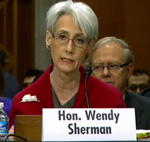
AP: The top U.S. nuclear negotiator says she is concerned by reports Iran has arrested four journalists, including three Americans. Wendy Sherman says Tehran should release them immediately. Iran confirmed last week it detained the journalists. The Washington Post said its correspondent, Jason Rezaian, and his wife were detained in the Iranian capital. The newspaper said Rezaian, 38, holds both American and Iranian citizenship.
