


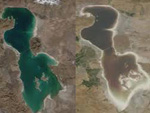
 Reuters: As a child, Mohammad Rahmanpour spent his summers swimming in Lake Orumieh in northwestern Iran – then the largest in the Middle East. In less than two decades, the saltwater lake has almost disappeared, leaving behind a hole in the ground. “My friends and I would go on the top of trees in our neighbourhood. We could see the lake clearly from that point,” said the 32 year-old farmer who grows wheat and beets.
By Michelle Moghtader
DUBAI (Reuters) – As a child, Mohammad Rahmanpour spent his summers swimming in Lake Orumieh in northwestern Iran – then the largest in the Middle East. In less than two decades, the saltwater lake has almost disappeared, leaving behind a hole in the ground.
“My friends and I would go on the top of trees in our neighbourhood. We could see the lake clearly from that point,” said the 32 year-old farmer who grows wheat and beets.
“Now, there is no water left and our whole ecosystem is messed up,” he told Reuters by telephone from his home, which once stood one km (half a mile) from the lakeshore.
Water shortages have long been a problem for countries across the Middle East, where a high birth rate, rising consumption and poor management has strained already scarce resources. But Iran has fared among the worst.
The country of 76 million has survived an eight-year war with Iraq, U.S. sanctions imposed over its disputed nuclear programme and violence on its borders. But experts say the main threat it faces today is dwindling water resources that have prompted some cities to consider rationing.
“Water scarcity poses the most severe human security challenge in Iran today,” said Gary Lewis, United Nations Resident Coordinator for Iran.
Excessive damming of rivers, bad irrigation practices, drought and climate change have all contributed to Iran’s water crisis. On top of this, low water prices encourage wasteful consumption while some farmers and organisations have been accused on stealing precious supplies for their own purposes.
Such factors have combined to drain Lake Orumieh, a UNESCO biosphere reserve that was home to about 200 bird species and 40 kinds of reptile. A few decades ago the lake measured 140 km by 55 km (90 by 35 miles) but now only five percent of its water remains.
“How it happened so fast is an ecological disaster of monumental proportions,” said Lewis.
Over the past few months, 12 major cities including Tehran and Shiraz have threatened to implement water rationing should residents fail to cut their use. The Ministry of Energy has called on people to reduce consumption by 20 to 30 percent, but this has fallen on deaf ears.
Water usage increased 10 percent in cities such as Tehran between May and the start of summer in June, the state news agency IRNA quoted city officials as saying.
A PIONEER SEEKS HELP
The cause of the crisis is not in residential use; agriculture accounts for about 90 percent of water consumption, with much of it being used inefficiently.
Iran takes pride in being founder of a sophisticated irrigation system during the first millennium BC. Tunnels called qanats carry water from aquifers in the hills to the fields below, and remain in use today.
“If you linked all of these intricate tunnels, it would stretch around the earth nearly eight times,” said Lewis.
But outside the tunnels, much irrigation water is lost to evaporation, leakage and theft, while farmers persist in using chemical fertilisers which require use of much more water than organic fertilisers.
Government figures show that only a third of agricultural water use is efficient, say U.N. officials. This inefficient management stretches across Iran and other countries in the region, including neighbouring Iraq and Afghanistan where wars make it difficult to tackle environmental issues.
Major rivers in the cities of Isfahan and Shiraz, and on Iran’s border with Afghanistan, have dried up. The depletion of the Tigris and Euphrates rivers in Iraq has contributed to other environmental problems such as dust and sand storms.
Historically, the seasonal Sistan wind in eastern Iran and western Afghanistan would cause 120 days of sand and dust storms each year. But due to the drying conditions, their frequency has increased to 220 days, say U.N. experts, leading to respiratory and eye problems among residents.
SOLUTIONS
President Hassan Rouhani has identified water as a national security issue, but experts say some solutions offered by government officials may be too costly.
“Transferring water from the Caspian Sea to Lake Orumieh doesn’t really make sense,” said Ali Nazaridoust of United Nations Development Programme (UNDP).
With government policies mired in bureaucracy, the U.N. has offered to help. In 2012, the world body launched a pilot programme to work with farmers near Lake Orumieh.
Farmers learned how to make compost, switched to organic-based fertilisers and attended weekly classes on water management which led to a 35 percent drop in consumption.
The new techniques have also allowed farmers to reduce costs and increase variety of crops from just wheat and beets to add maize, squash, onions and tomatoes.
“It wasn’t difficult,” said Rahmanpour, who participated in the pilot programme, but he added that some of the farmers had trouble believing the change would make any difference.
“They thought the U.N. was just talk. But, we tested them out and they help our land and provide benefits for our soil,” he said. Improved soil conditions will help to prevent salt particles from the dried out basin being blown to adjacent crop lands, slowly degrading the quality of farmers’ soil.
The U.N. has since expanded the programme to 41 other villages with about 13,000 farmers benefiting from it. In May, the Japanese government donated $1 million to save Lake Orumieh.
“God willing, not just my children, but I will see Lake Orumieh filled again,” said Rahmanpour. (Editing by Sami Aboudi, David Stamp and Peter Graff)


