Day 6: Escalating Strikes and Missile Barrages Push Israel-Iran Conflict to New Heights

Israel-Iran Tensions Surge on Day 6 Amid Heavy Airstrikes and Missile Attacks

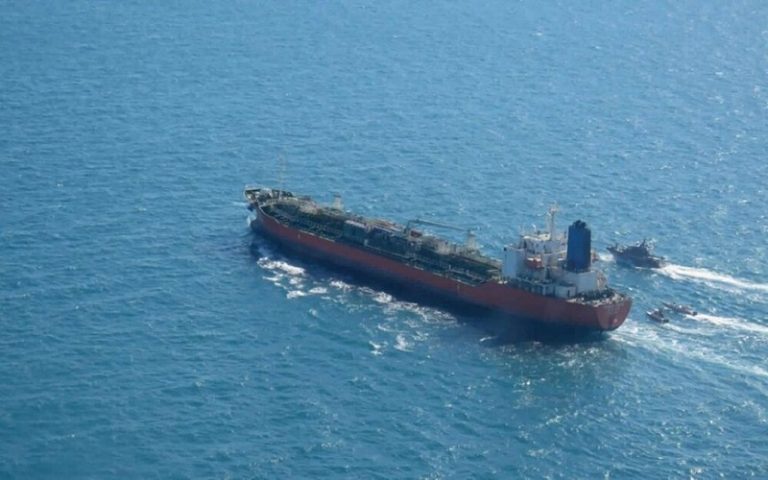
Regime’s Former Economy Minister Ehsan Khandouzi: “Starting Wednesday, for 100 days, no oil tankers or LNG shipments should pass through the Strait of Hormuz without Iran’s approval. Any delay in implementing this means enduring more war within Iran’s borders. Trump’s battle must be ended with a combination of economy and security.” State-run Nour News Website: An explosion rocked Tehran’s outskirts, with flames and smoke rising. State-run Tasnim News Agency, Early Wednesday Morning: Iran conducted its 11th wave of missile attacks against Israel, with explosions reported in Jerusalem, Tel Aviv, and Modi’in. Sky News, Wednesday Morning: The Israeli military announced it targeted Iran’s nuclear and missile facilities overnight.
A look into the background of Ali Shademani, commander of the IRGC Central Headquarters
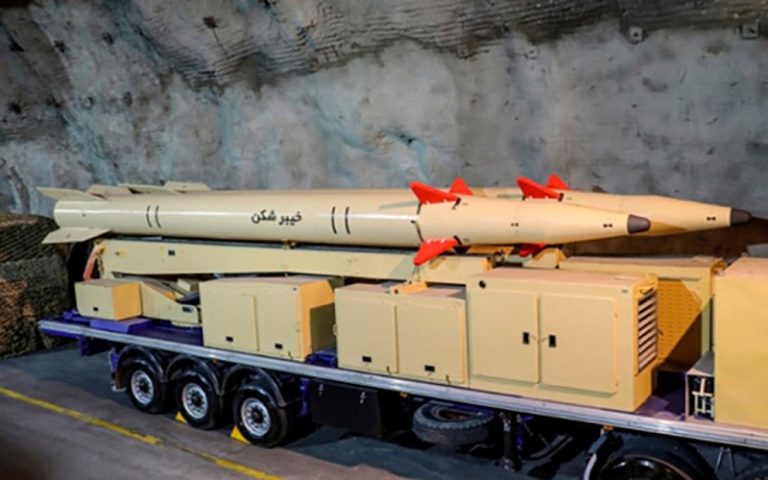
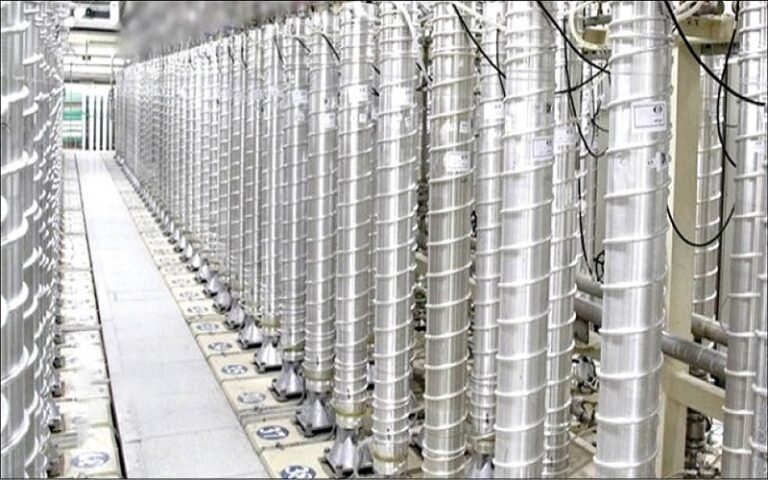
Sky News, Early Wednesday Morning: The Israeli military conducted a series of attacks across Tehran, with massive explosions shaking eastern Tehran. Sky News, Citing Iranian Sources: The death toll in Iran from Israeli attacks has risen to 585, with 1,326 injured. Reuters: The Israeli military reported targeting a centrifuge production center and several weapons manufacturing sites in Iran overnight. Al Arabiya, Citing Israeli Military: Israel targeted facilities at Parchin. Al Arabiya: The daily cost of Israel’s air defenses against missiles fired at the country is $285 million. Al Arabiya, Citing Israeli Military Statement: Israeli attacks after midnight Tuesday targeted multiple Tehran locations, including Mehrabad Airport, Tehran Refinery, Parchin facilities, and sites in Tabriz and Shiraz. Al Arabiya: The Khajir missile production complex in southeast Tehran and a special forces center were directly hit by Israeli airstrikes. Al Arabiya: If Iran’s missile attacks continue at the current volume, Israel could sustain defense for 10 to 12 days. U.S. State Department Spokesman: “As the conflict between Israel and Iran continues, President Trump has clearly stated that the Iranian regime must not acquire nuclear weapons.” Al Arabiya: An Iranian missile fell in the “Hasharon” region in central Israel. Al Arabiya, Citing Israel’s Emergency Services: No injuries were reported from the recent Iranian missile attack. Al Arabiya, Citing Israeli Media: Israeli Air Force jets are conducting strikes on targets deep within Iran. Regime’s Chand Sanieh Telegram Channel: Air defense activity reported in Dezful, Andimeshk, Parand, Robat Karim, and Rudehen in Tehran. Regime’s Chand Sanieh Telegram Channel: Intense clashes between air defenses and Israeli drones continue in western Tehran. Regime’s Chand Sanieh Telegram Channel: Sounds of air defense engagements and five explosions were heard in the capital. Regime’s Chand Sanieh Telegram Channel: An explosion occurred near eastern Tehran. Regime’s Chand Sanieh Telegram Channel: The IRGC issued a warning for settlers in Tel Aviv’s Neve Tzedek area to evacuate. Regime’s Chand Sanieh Telegram Channel, Citing Israel’s Channel 12: An Iranian missile attack caused approximately 20 vehicles to burn in a parking lot in central Tel Aviv. Sky News: Severe explosions reported in Parand, Mehrshahr, and Karaj, as well as Kianabad and Kianpars in Ahvaz, early Wednesday due to Israeli attacks. Reuters: The IRGC claimed its Fattah missiles bypassed Israel’s air defenses, giving Iran “complete dominance” over Israeli airspace. CNN: A White House official said Trump and Netanyahu spoke by phone before the Situation Room meeting. CNN: A military official said Iran fired approximately 10 ballistic missiles toward Israel, most of which were intercepted. CNN, citing a Houthi Official: The Houthi group stated it will intervene to support Iran against Israel. CNN, citing a Houthi Official: The Houthi group stated it will intervene to support Iran against Israel. Israel’s Channel 12: Israel bombed an IRGC-affiliated university. Israel’s Channel 12: A missile manufacturing plant near Tehran was attacked. Israel’s Channel 12: In less than one hour on the sixth day of the war, approximately 25 missiles were fired from Iran toward Israel in two barrages. No casualties were reported, but several shrapnel pieces were identified in central and northern Israel. Israeli Military: Issued an evacuation warning for Tehran’s District 18, including the Fath Industrial Square near Mehrabad Airport. Israeli Military: Announced airstrikes on a centrifuge production site and multiple weapons manufacturing facilities in Iran, including missile component plants, involving over 50 aircraft. A severe explosion was reported in eastern Tehran. Israeli Military: Reported new airstrikes on Tehran, with multiple explosions across the capital and near Karaj. Israeli Military: Air raid sirens sounded in northern Israel due to airspace breaches, with a map of affected areas shared on social media. Israel announced earlier missile attack warnings but later allowed citizens to leave shelters. EL AL Israel Airlines: Will start flights on June 18 from Rome, Milan, Paris, Athens, and Larnaca to repatriate Israeli citizens. Flights from Israel remain suspended until June 23. Approximately 150,000 Israelis are abroad, with 50,000 seeking to return. Washington Post: The U.S. stance on joining the war has shifted, with Trump now seriously considering an attack on Iran. State-run Nour News Website, Citing Khamenei: “The terrorist Zionist entity must be dealt with severely.” Reuters: As the Israel-Iran war escalates, the U.S. is deploying fighter jets to the Middle East. Reuters, Citing Three U.S. Officials: The U.S. military is deploying additional fighter jets to the Middle East and expanding the presence of other warplanes to bolster U.S. forces in the region. Reuters, Citing One U.S. Official: The deployments include F-16, F-22, and F-35 fighter jets. Regime’s IRGC General Mousavi, Head of Armed Forces General Staff: “Operations conducted so far have been a warning for deterrence; punitive operations will be carried out soon.” IAEA Chief: Stated that centrifuges at Iran’s underground Natanz site were likely heavily damaged or destroyed by Israeli airstrikes. Regime’s IRGC: Announced the use of first-generation hypersonic “Fattah” missiles and warned Tel Aviv residents to evacuate ahead of a large-scale attack. Iranian Regime Reports: Israeli airstrikes targeted Imam Hussein University, a key IRGC command training center near eastern Tehran, with bright explosions near Khajir National Park and Sorkheh Hesar hills. Iranian Regime Reports: A powerful explosion occurred in Hakimiyeh, Tehranpars, with witnesses claiming Imam Hussein University was hit. Iranian Regime Reports: Simultaneous with Iranian missile attacks on Israel, explosions were heard in western Tehran and near Karaj. Videos showed Iranian regime missiles flying over Israeli cities, with Israeli air defenses responding. U.S. Embassy in Israel: Will temporarily close from June 18 to 20 due to security concerns, with staff and families advised to shelter in place. Israel’s main airport and ports are closed, with no plans to evacuate U.S. citizens. UAE: Will not fine Iranians overstaying visas due to the Israel-Iran war. UAE flights to and from Iran are suspended until June 30. US President Donald Trump, scheduled to meet Chief of Army Staff of Pakistan Asim Munir at the White House. Munir, considered Pakistan’s most powerful figure, held talks with Iranian military leaders before the conflict. US President Donald Trump Held an emergency White House meeting on whether the U.S. should join Israeli attacks on Iran’s nuclear program, with no consensus among advisors. Later spoke with Netanyahu by phone; details undisclosed. U.S. Military: Deployed refueling aircraft and F-35 jets to Europe. Bombers and F-35s took off from RAF Lakenheath, eastern England, amid speculation of U.S. involvement in the conflict. Legal Experts: Noted the U.S. president cannot declare war without Congressional approval but can order military action if national security is threatened. Some U.S. lawmakers are proposing bills to limit Trump’s authority to attack Iran without Congress.

A look into the background of Ali Shademani, commander of the IRGC Central Headquarters

Major General Ali Shademani, a senior commander of the Islamic Revolutionary Guard Corps (IRGC), has a long history of suppressing the Iranian people and committing human rights violations. Ali Shademani joined the IRGC in 1979. He was an active member during the Iran-Iraq war and served as the commander of the Ansar al-Hossein Division 32 from 1986 to 1988. Shademani first met Hossein Hamedani—an IRGC commander who was killed in Syria in 2015 as part of the Iranian regime’s intervention in the country—shortly after the 1979 revolution in the city of Hamedan. This relationship eventually led to terrorist operations outside Iran’s borders, including in Syria and Iraq. After the revolution, Ali Shademani accompanied Hamedani to the city of Paveh to suppress the people of Kurdistan. Shademani then spent six months in Sanandaj and Saqqez engaged in violent crackdowns and killings of Kurds in the region.

Continued repression and Ali Shademani’s role in the Khatam al-Anbiya Headquarters and the Quds Force

In late 1983, Ali Shademani went to Tehran for a command training course. Afterward, he became the commander of the IRGC’s Saheb al-Zaman Division. Some time later, he was assigned to the IRGC’s external operations base known as “Ramazan Headquarters.” He was appointed head of operations at this base. The Ramazan Headquarters was the IRGC’s sole extraterritorial base and was responsible for terrorist operations outside Iran’s borders, particularly targeting Iranian dissidents. After the death of regime founder Ruhollah Khomeini, this base became the foundation for forming the IRGC’s terrorist Quds Force.
IRGC Intelligence Chief Mohammad Kazemi Killed in Israeli Strike
In 2016, amid structural changes within the IRGC’s Khatam al-Anbiya Central Headquarters and the General Staff of the Armed Forces, Ali Shademani was appointed as the coordinating deputy of the IRGC’s Khatam al-Anbiya Central Headquarters.

Ali Shademani’s views on proxy groups and regional expenditures

In September 2019, Ali Shademani stated regarding the regime’s proxy groups: “Today, apart from our army and IRGC, we have five other armies with us in the axis of resistance, in terms of belief and spirit.” He openly defended the use of Iranian public wealth to support regional dictators and the regime’s allied militias. Shademani said: “Some people sat down and claimed that we spent all the country’s money in Syria! Look at how much foreign currency revenue the country had in the past ten years and what portion of it was spent on the resistance front, which primarily served sacred goals and the nation’s interests?” In response to a question about the threat of war against the clerical regime, Shademani had stated: “Some people have spread a truly ridiculous rumor that some of these countries… have asked our enemy to take action against us. The same thing Israel does by asking America to attack us. They know that if a war starts in this region, nothing of them will remain. Some think that if a certain country has a few aircraft, it holds power—those planes will be destroyed on the runway before they even take off. So this is more like a joke.” He also spoke about the IRGC’s posturing and the Khatam al-Anbiya Headquarters, saying: “One of our essential needs is not to be surprised. As much as we focus on our own capabilities, we also devote attention to monitoring the enemy. If we don’t monitor their behavior, we may get hit.” From June 13 to June 17, he served as commander of the IRGC’s Khatam al-Anbiya Central Headquarters. It was reported that he was killed in an Israeli strike, but this news has not yet been confirmed by the regime.  

IRGC Intelligence Chief Mohammad Kazemi Killed in Israeli Strike

A look at the background of IRGC Intelligence Organization Chief Mohammad Kazemi, who was killed in an Israeli strike On Thursday, June 23, 2022, Brigadier General Mohammad Kazemi was appointed as the head of the Islamic Revolutionary Guard Corps (IRGC) Intelligence Organization by IRGC commander Hossein Salami. Now, two days after Salami’s death, the IRGC has confirmed that Mohammad Kazemi, along with his deputies, was killed in an Israeli strike. Kazemi had replaced Hossein Taeb in 2022.

Who is Brigadier General Mohammad Kazemi?

State-run media have made little mention of Mohammad Kazemi’s background, as he was never meant to be a public figure. In reality, he had served since 2009 as the head of the IRGC’s Protection and Intelligence Organization—a body focused on internal affairs of the IRGC, rather than external operations. For this reason, Kazemi was not a well-known figure even within regime media, which also lacked consensus over publishing his photos.
A Look into the Background of Mohammad Bagheri, The IRGC Commander Who Was Killed in the Recent Attacks
Mohammad Kazemi, also known as “Sardar Kazem,” was a senior security figure within Iran’s regime and a former head of the IRGC Protection and Intelligence Organization. He was known for playing key roles in the regime’s intelligence and security structure, especially in surveillance operations, suppression of dissent, and extraterritorial missions. In a leaked audio recording from IRGC command meetings, his name was repeatedly mentioned by then-IRGC commander Mohammad Ali Jafari and his deputy Sadegh Zolghadrnia using the code name “Kazem”—a detail highlighting his influential position in high-level security decision-making.

Sanctions

In response to the regime’s violent crackdown following the death of Mahsa Amini and the 2022 uprising, the U.S. Department of the Treasury and Department of State sanctioned Mohammad Kazemi on Wednesday, October 26, 2022, along with 13 other regime officials and three affiliated institutions. These sanctions froze all assets under U.S. jurisdiction and prohibited all financial dealings between them and U.S. citizens or companies. The New Zealand government also sanctioned Kazemi on December 12, 2022, for his role in suppressing protests. The sanctions ban him from entering or temporarily residing in New Zealand.

Kazemi’s Role in IRGC Intelligence and U.S. Sanctions Over Hostage-Taking

In another move, on Thursday, April 27, 2023, the United States sanctioned Mohammad Kazemi along with several other senior IRGC members for their involvement in the unlawful detention of U.S. citizens abroad. This action was aimed at countering the Iranian regime’s hostage-taking policy used to gain political leverage. The heads of the IRGC’s Protection and Intelligence Organization rarely appear in public, and it is extremely difficult to find photos or detailed media coverage of them.

What is the IRGC Protection and Intelligence Organization?

There are three distinct and independent organizations within the IRGC:
  1. IRGC Intelligence Organization
2. IRGC Protection Organization 3. IRGC Protection and Intelligence Organization All three IRGC bodies operate directly or indirectly under the supervision of regime supreme leader Ali Khamenei and the IRGC commander.

IRGC Intelligence Organization

This organization was established after the 2009 election and reports directly to Ali Khamenei, the supreme leader of Iran’s regime.

IRGC Protection Organization

This organization is led by IRGC Brigadier General Ali Asghar Gorjizadeh and is responsible for protection and security—not intelligence. Sometimes referred to as the “Protection Corps,” it is in charge of safeguarding key individuals and sensitive locations, as well as ensuring security for civilian flights.

IRGC Protection and Intelligence Organization

The Protection and Intelligence arm of the IRGC was established in 1983 and rapidly expanded. This intelligence-focused body operates independently from the IRGC General Command and answers directly to Khamenei. It functions as the IRGC’s internal security unit and is tasked with countering espionage within the force, preventing infiltration by dissident elements, blocking the leakage of classified information, and conducting political and security oversight over IRGC commanders and personnel. The head of this organization is selected from among individuals trusted by Khamenei and is appointed or dismissed by order of the IRGC commander-in-chief.

Iran: Dizel Abad Prison Massacre After Israeli Strike

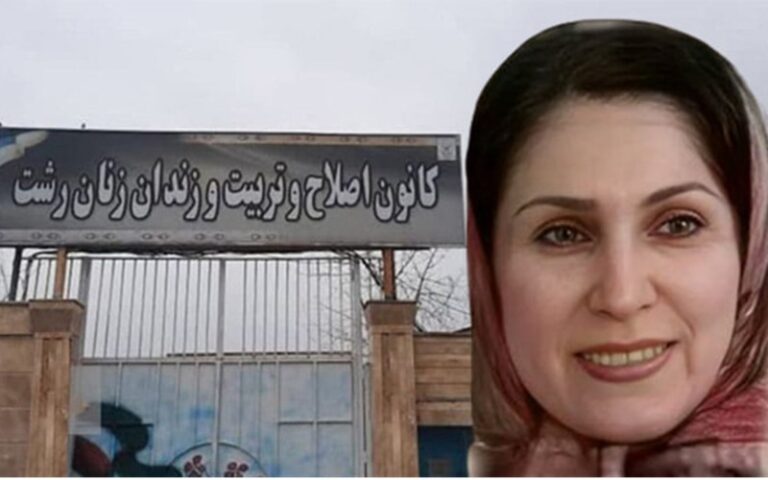
The killing of ten prisoners and injury of more than 30 inmates at Dizel Abad Prison in Kermanshah due to a barrage of bullets by the regime’s anti-riot special forces. On June 16, following an Israeli attack targeting missile launchers at a car exhibition in Dizel Abad—which caused the prison to shake and shattered its windows—prisoners were forced to attempt to leave the facility. Units 2, 3, and 8 of the prison began protesting, demanding to be evacuated from the danger zone to a safe location, as there was a constant risk of another strike and potential impact. According to a report from inside the prison, the anti-riot special forces blocked the prisoners and began beating them.
A Look into the Background of Mohammad Bagheri, The IRGC Commander Who Was Killed in the Recent Attacks
The prisoners resisted and insisted on leaving the hazardous area, which already had broken glass. At that point, the criminal anti-riot forces opened indiscriminate fire on the defenseless, handcuffed prisoners. According to a preliminary report from within the prison, which is still under investigation, ten prisoners were killed and more than 30 were injured. The massacre has been condemned by Iranian opposition groups. The Social Committee of the People’s Mojahedin Organization of Iran (PMOI/MEK) called for immediate international intervention. “We urge the UN and the Special Rapporteur on Human Rights in Iran to immediately investigate the Kermanshah prison massacre, identify the victims, and hold perpetrators accountable,” the PMOI said in a statement. It also called on locals in Dizel-Abad to report names and details of victims to raise international awareness.    

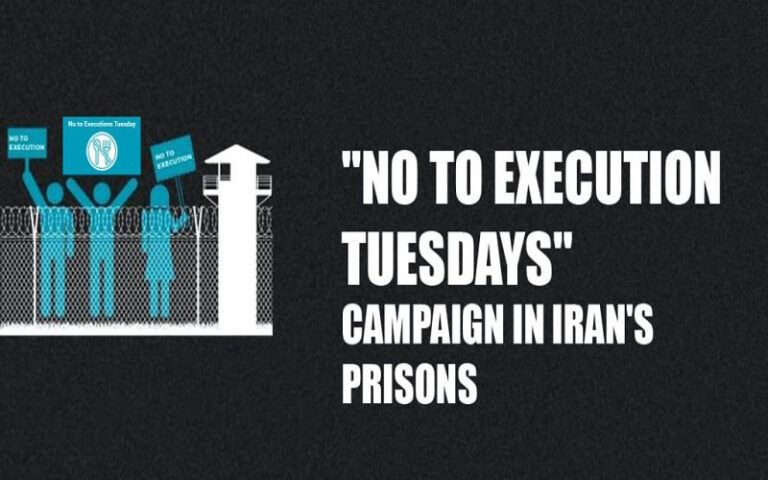
Week 73 of “No to Execution Tuesdays” Campaign Spreads to 47 Prisons

Political prisoners in Iran condemned death sentences in the 73rd week of the “No to Execution Tuesdays” campaign. In their statement, they said: The people of Iran have become entangled in a war they never sought. War and execution are two sides of the same coin, both stripping people of their right to life. We express our solidarity with all civilian victims and stress collective unity under the extraordinary circumstances imposed on us by two warmongering regimes. Despite the ongoing war and crisis, the machinery of death continues relentlessly, as the oppressive regime keeps executing citizens. Since the beginning of Khordad (May 21), at least 126 people have been executed, including 12 prisoners who were hanged on June 10 alone.
Iranian Regime’s Judiciary Announces Execution of 9 Prisoners
On Monday, June 16, security prisoner Esmaeil Fekri was secretly hanged in Ghezel Hesar Prison on espionage charges. These shocking execution statistics are not just numbers—they tell the tragic story of lives unjustly taken. Most of these executions occur without transparency, without fair legal process, and in total media silence. Many of the victims are the impoverished, religious minorities, and political prisoners—people whose only “crime” was seeking justice, freedom, or the right to survive. One of them was PMOI political prisoner Mojahed Korkor, who was arrested during the 2022 nationwide uprising and, after two and a half years of imprisonment and torture, was tragically executed last week. We, the members of the “No to Execution Tuesdays” campaign, once again emphasize in this 73rd week: “Execution is not a punishment; it is a crime, and we strongly condemn all death sentences regardless of the charges. These executions are state-sponsored murders. We will never forget the victims, we will not stay silent, and we will not retreat.” To the people and the international community: in these perilous times of war, the lives of many political and civil prisoners are under threat—just as seen last night in Dizel Abad Prison in Kermanshah, which was both bombed and assaulted by the prison’s brutal repressive guards. Now more than ever, public presence and solidarity matter. You, the informed and free people, are our only support and voice. The release of all political and ideological prisoners and the immediate abolition of all death sentences must become a public demand. The lives of political prisoners and those on death row are in serious danger, and there is a real fear the regime will continue using executions to intensify repression and spread terror. In its 73rd week, the “No to Execution Tuesdays” campaign will include hunger strikes in 47 prisons across the country on Tuesday, June 17.  

A Look into the Background of Mohammad Bagheri, The IRGC Commander Who Was Killed in the Recent Attacks

Major General Mohammad Hossein Afshardi, known as Mohammad Bagheri, served as the Chief of the General Staff of Iran’s armed forces from 2016 to 2025. After the 1979 revolution, Bagheri participated in the takeover of the U.S. Embassy in Tehran. He joined the Islamic Revolutionary Guard Corps (IRGC) that same year. According to his own claims, Mohammad Bagheri took part in all military operations during the eight-year Iran-Iraq war.
A Look at the Criminal Background of Amir Ali Hajizadeh, One of the Killed IRGC Commanders in Iran
On June 28, 2016, Bagheri was appointed by regime supreme leader Ali Khamenei as the successor to Hassan Firouzabadi in the General Staff of the Armed Forces.

Military and Intelligence Background of Mohammad Bagheri

From 2002 to 2014, Bagheri served as the deputy of intelligence and operations at the General Staff of the Armed Forces. Concurrently, from 2007 to 2016, he held the position of coordinating deputy at the Khatam al-Anbiya Central Headquarters, a key strategic military command under the IRGC. From 2014 to 2016, he also served as deputy for general affairs and joint operations. Before assuming leadership roles in the IRGC, army, or General Staff, Bagheri was promoted to the rank of Major General.

Mohammad Bagheri’s Role in Domestic Repression

A few days after the 1999 Tehran University dormitory unrest, the state-run newspaper Kayhan published a confidential letter. This letter, signed by several IRGC commanders, was addressed to then-president Mohammad Khatami. The commanders wrote at the end of the letter: “We declare that our patience has run out and we do not consider further tolerance permissible if the situation is not addressed.” IRGC commander Bagheri was among the signatories of this threatening letter. As Chief of the General Staff and a member of the Supreme National Security Council, Mohammad Bagheri was directly responsible for issuing orders to use lethal force against protesters. This includes the protests of December 2017, the nationwide uprising of November 2019, and the countrywide protests of 2022. Bagheri was one of the key decision-makers and staunch advocates of a military crackdown on internal dissent in Iran.

Mohammad Bagheri’s Admission of the Ineffectiveness of Repressive Approaches

On May 26, 2025, during a speech, Bagheri acknowledged the ineffectiveness of the Iranian regime’s repressive methods. He said: “Our highly complex and evolving society requires scientific work. If the police command seeks to act with a hard approach and batons, it will lead nowhere.” In the case of repression and human rights violations, Mohammad Bagheri held the following positions: Head of Intelligence and Operations for the IRGC Ground Forces. Head of Intelligence for the Karbala Headquarters and the Khatam al-Anbiya Central Headquarters. Coordinating Deputy of the Khatam al-Anbiya Central Headquarters (national level). Head of the Intelligence Department of the General Staff of the Armed Forces. Deputy for General Affairs and Joint Operations of the General Staff of the Armed Forces (national level). Faculty Member of the Supreme National Defense University. In addition, Iranian state media describe Mohammad Bagheri as “one of the main architects of the concept of ‘preemptive defense’ in Iran’s military doctrine.” This indicates his role in orchestrating terrorist operations abroad.

International Sanctions Against Mohammad Bagheri

On November 4, 2019, Mohammad Bagheri was added to the U.S. Treasury Department’s sanctions list. According to the U.S. government, he and eight other sanctioned individuals were involved in terrorist attacks in Lebanon and Argentina. The U.S. Treasury’s statement noted that Bagheri was appointed by Ali Khamenei as the Chief of the General Staff of Iran’s Armed Forces, the highest military institution in the country. Also on November 4, 2019, the Canadian government sanctioned Mohammad Bagheri for human rights violations in Iran and “blatant disregard for human life.” On October 20, 2022, the European Union sanctioned Mohammad Bagheri, along with two others senior IRGC officials and several Iranian regime-linked industries. The sanctions were imposed due to Iran’s supply of drones to Russia for use in the war in Ukraine. In November 2022, the Swiss government also sanctioned Mohammad Bagheri, along with one company and two other officials, for Iran’s support of Russia in the Ukraine war. These sanctions further highlight the international scope of Bagheri’s responsibilities.  

Iranian Regime Concerned Over Potential Cyberattacks Amid Rising Tensions with Israel and The West

Following escalating tensions between the Iranian regime and Israel, as well as the U.S. decision to evacuate some of its facilities in the Middle East, AFTA—the Strategic Center for the Security of Information Production and Exchange, affiliated with the office of the Iranian presidency—issued a warning to critical infrastructure and government facilities about the risk of cyberattacks. The Strategic Center for the Security of Information Production and Exchange (AFTA) issued a cyber alert to executive branch managers in a letter published in the media on Thursday, June 12. According to the letter, the likelihood of cyberattacks targeting the regime’s organizations and infrastructure has increased. Therefore, the regime ordered that security offices, IT managers, and technical staff remain on-call from June 11 to 21 and strictly implement all security protocols. Established in 2007, this center is tasked with regulation, cybersecurity oversight, issuing security certifications for software and tech products, and coordinating with government agencies and the private sector to counter cyber threats.
Iran and Hezbollah’s Cyber Attacks on Israel Have Tripled Since October 7 Attack
Currently, AFTA is the primary authority overseeing the cybersecurity of critical infrastructure in Iran, and its directives and announcements are binding for all government and regime-affiliated organizations. This letter was issued amid intensifying tensions between the Iranian regime on one side and Israel and Western countries on the other. Previously, the United States had taken precautionary measures at several of its military and diplomatic facilities across the Middle East in response to the rising tensions. In recent years, cyberattacks against the Iranian regime’s critical infrastructure have increased, particularly by Israel or groups affiliated with it. One of the most notable incidents was the 2010 Stuxnet virus attack that targeted the Natanz nuclear facility. It has been widely attributed to a joint operation by Israel and the United States. This operation, aimed at destroying centrifuges at Natanz, is recognized as one of the first cyberattacks to cause physical damage on an international scale. In the following years, additional attacks occurred, including a widespread hacking of gas stations in November 2023 by the group “Predatory Sparrow,” which disrupted about 70% of the country’s fuel pumps and was once again attributed to Israel. Other hacker groups also attacked systems belonging to the judiciary, SMS platforms, the Press TV network, the state-run Fars News Agency, and other institutions in 2022 and afterward. These attacks point to a complex cyberwarfare campaign that has targeted the Iranian regime’s vital infrastructure, including energy, transportation, and government institutions.  

Saeed Borji, Mastermind Behind Atomic Bomb Trigger Design in Iran’s Nuclear Weapons Program, Killed

Saeed Borji, a senior member of SPND (the Organization of Defensive Innovation and Research) and an explosives trigger expert who played a pivotal role over the past two decades in developing technologies related to nuclear bomb detonation, was among those killed in the recent Israeli strike on Iran. Borji, who held a Ph.D. in mechanical engineering from Malek Ashtar University of Technology, remained an obscure but crucial figure in the Iranian regime’s military nuclear program for years. His collaboration with the Islamic Revolutionary Guard Corps (IRGC) began in the 1980s during the Iran-Iraq war and continued actively over the subsequent decades in sensitive projects related to nuclear weapons development.
Iranian Regime Close to Building Nuclear Bomb
According to nuclear documents obtained from Iran, Borji was one of the core members of the secret “Amad” project—a program aimed at designing and building nuclear weapons, which was launched in the early 2000s and, according to Iranian claims, halted in 2003. However, numerous sources indicate that Borji and his colleagues continued their work covertly beyond that date through organizations like SPND.

Development of Advanced Trigger Technologies

For years, he headed the Center for Research on Explosion and Impact Technology, one of the subdivisions of SPND. He played a central role in developing advanced detonation technologies, such as multi-point initiation (MPI) triggers and exploding bridgewire (EBW) detonators, which are used in implosion-type nuclear bombs. Borji, in cooperation with foreign experts, including Vyacheslav Danilenko—a Ukrainian scientist and former specialist in the Soviet nuclear program—underwent training in explosive chamber design and participated in designing large explosion test chambers at the Parchin military site. These chambers were used to simulate the internal explosion mechanism of a nuclear bomb.
NCRI-US Reveals Iran’s Secret Nuclear Weapon Program – The Kavir Plan
According to intelligence assessments, the Abadeh site in Fars Province was also one of the locations used by Borji for explosive trigger tests. The U.S. Department of the Treasury placed Saeed Borji on its sanctions list due to his central role in Tehran’s nuclear weapons efforts. In a statement issued alongside sanctions against 13 other individuals and 17 entities linked to SPND, Borji was identified as an explosives and metals expert working for the Shahid Karimi group. In addition to his scientific activities, Borji also managed front companies connected to nuclear projects. Until his death in the Israeli airstrike, he served in recent years as chairman of companies such as “Azar Afrooz Saeed” and “Arvin Kimia Abzar.” These companies ostensibly operated in the oil and petrochemical sectors, but according to intelligence reports, they functioned as covers for military research into nuclear detonation triggers.

Conducting Explosive Tests

Leaked documents from the Iranian regime’s nuclear program show that Borji was also involved in moving explosive tests to highly secured sites such as “Sanjarian” in eastern Tehran and collaborating on classified projects inside “Parchin Project 6,” which intelligence files identify as a location for conducting highly sensitive and top-secret nuclear-related tests. Borji’s role in post-Amad projects was particularly significant in preserving and expanding Iran’s ability to rapidly resume its nuclear weapons program. He was one of the few individuals capable of advancing nuclear trigger know-how from theoretical development to actual testing and implementation. Borji was in effect “Iran’s nuclear trigger man”—a figure who bridged the early circles of the Amad Project with its secret successors, consistently acting as a conduit between the old generation of scientists and the current structure of military nuclear research. According to reports, the technology developed under his leadership enabled Iran to domestically produce synchronized explosive triggers and elevate them to an operational level.

A Look at the Criminal Background of Amir Ali Hajizadeh, One of the Killed IRGC Commanders in Iran

Brigadier General Amir Ali Hajizadeh, the former commander of the IRGC’s Aerospace Force, was directly involved in widespread human rights violations. He was particularly responsible for violations of the right to life and the deaths of civilians. The downing of Ukraine International Airlines Flight 752 on January 8, 2020, occurred during his tenure as commander. This tragic incident resulted in the deaths of all 176 people on board. As the commander of the IRGC’s Aerospace Force, Amir Ali Hajizadeh was responsible for the downing of the Ukrainian passenger plane in January 2020. The plane was shot down only hours after the IRGC launched a missile attack on the Ain al-Asad airbase in Iraq, which hosts U.S. forces.

Denial and Cover-up of the Truth by Amir Ali Hajizadeh

Despite the fact that the Ukrainian airliner was shot down by surface-to-air missiles from the IRGC’s Aerospace Force, officials of Iran’s regime denied the truth for three days, claiming the cause was a technical failure. This was despite the fact that images and videos from the crash site clearly showed missile impact, and footage of the moment the missile struck the plane had also been made public. Even one day after the incident, regime officials continued to deny a missile strike. However, Canadian Prime Minister Justin Trudeau held a press conference and confirmed that the definite cause of the crash was a missile strike. In addition to his role as commander of the forces that shot down the Ukrainian plane, Amir Ali Hajizadeh was also directly involved in the regime’s efforts to deny and conceal the truth. Despite knowing the cause of the crash within hours after the incident—as he later admitted—he took no action. While many Iranian citizens were seeking the truth, Amir Ali Hajizadeh held a press conference on January 9 to celebrate the missile strike on the Ain al-Asad base. At this press conference, Hajizadeh made no mention of the Ukrainian passenger plane being shot down. He called the strike on the Ain al-Asad base a “victory” and spoke about the operation’s success. Eventually, after three days of denial and once it was confirmed that the plane had been brought down by IRGC air defense missiles, the General Staff of Iran’s Armed Forces accepted responsibility. On the morning of January 11, 2020, the General Staff released a statement, describing the downing of the plane as the result of an “unintentional human error.”

Confession by Amir Ali Hajizadeh and Lack of Legal Accountability

Following the statement, the Iranian regime’s state-run IRINN news network aired a press conference with Amir Ali Hajizadeh. In that broadcast, Hajizadeh accepted responsibility for the downing of the Ukrainian airliner by forces under his command. In the pre-recorded report, Hajizadeh admitted that he had been informed of the incident within hours of the crash. He had also informed higher-ranking commanders of the incident. According to Hajizadeh, the air defense operator had mistaken the passenger aircraft for a cruise missile and fired at it. Despite Amir Ali Hajizadeh’s direct role as the commander of the forces responsible for shooting down the Ukrainian airliner, the judiciary of Iran’s regime never recognized him as a defendant in the legal case opened on the matter. On the first anniversary of the downing of the Ukrainian plane in January 2021, Hajizadeh appeared in a detailed television report. In the program, without any mention of the downed aircraft, he referred to the day of the incident and the missile strike on Ain al-Asad base as “a day of God and a great victory.”
Canada: Iran Must Take Full Responsibility for Downing Ukrainian Flight

Background and Victims Associated with Amir Ali Hajizadeh

Amir Ali Hajizadeh’s record includes: 1980: Joined the Islamic Revolutionary Guard Corps (IRGC). 2006 to October 2009: Commander of IRGC Air Defense. October 2009 to June 13, 2025: Commander of the IRGC’s Aerospace Force. He was killed on June 13, 2025, during an Israeli strike. Amir Ali Hajizadeh was placed under U.S. sanctions on July 14, 2019. The sanctions were imposed due to his “malign role and involvement in provocative missile programs and sabotage of commercial ships in international waters.”  

Tensions in Iranian and global markets following Israeli attack; sharp rise in currency and gold prices

Following Israeli airstrikes targeting commanders and military infrastructure of Iran’s regime, the prices of foreign currencies and gold are rapidly rising. Global markets have also experienced volatility. The prices of oil, gold, and gas have increased, while global stock indices declined, although these effects eased somewhat later in the day. In Iran’s domestic markets, although today—Friday, June 13—the official markets are closed, the dollar experienced an unusual surge, rising by more than 100,000 rials and reaching around 938,000 rials by Friday afternoon. On Thursday, June 12, the dollar was about 837,000 rials. The euro and the British pound also saw similar increases. By Friday afternoon, the euro, which was about 969,000 rials on Thursday, rose to approximately 1,081,500 rials in the open market.
Iran’s Economy in Freefall: A Looming Hunger Crisis
The pound also increased from around 1,140,000 rials to approximately 1,270,000 rials. The price hikes in these assets continued until 2:30 PM Tehran time, even though Iran’s official markets had not yet opened.

Global Markets

In the initial hours following Israel’s attack on Iran, Brent crude oil prices surged by more than 7%, even reaching up to 13%, although they later gave up some of those gains. Even before the attack, the oil market had already reached its highest level in the past two months. At the same time, natural gas prices in Europe experienced their highest increase in more than five weeks. The main concern was the Strait of Hormuz, a strategic waterway through which about one-quarter of the world’s oil and all of Qatar’s liquefied natural gas exports pass. Although physical delivery of gas has not yet been disrupted, delays could occur if ships begin avoiding the strait. Gold, regarded as a safe-haven asset, rose by up to 1.7% before slightly declining. As of Friday morning, gold was trading about $90 below its all-time high of $3,500 per ounce, recorded in April. In contrast, stock markets reacted negatively, with U.S. indices seeing steeper declines compared to other markets. Some analysts attribute this to concerns among American investors about the possibility of a wider conflict in the Middle East. These developments are unfolding while Iran’s regime has yet to deliver its final response, and it remains unclear whether the conflict will escalate beyond limited aerial strikes.