


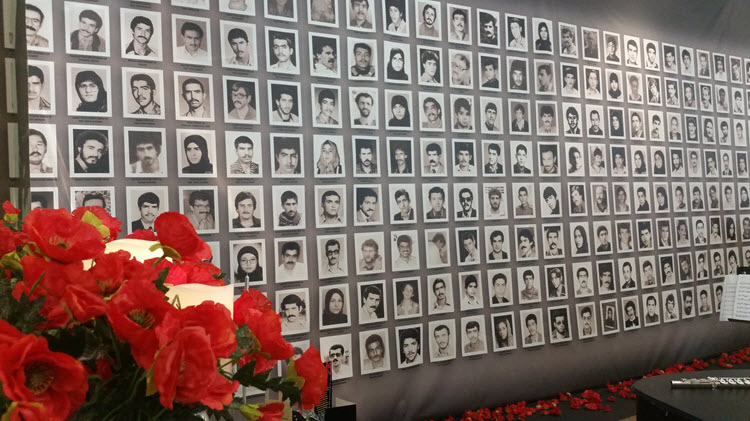
London, 26 Aug – The Iranian resistance has forced the regime to comment on the 1988 massacre of 30,000 political prisoners four weeks into its campaign for justice for the victims, mostly members of the People’s Mojahedin Organization of Iran (PMOI or MEK).
On Wednesday, August 24, 2016, the regime’s Supreme Leader, Ali Khamenei, said, “Unfortunately, some people are trying to provide an atmosphere of oppression for Mojahedin (PMOI/MEK) members, and tarnish the image of Imam (Khomeini), but they will not be successful.”
On August 9, 2016, relatives of Hossein-Ali Montazeri, Khomeini’s former heir, published an audio tape in which Montazeri can be heard telling members of the “Death Committee” in August 1988 that they were committing a crime against humanity and that history would judge them as “criminals.”
The tape provided, to use the words of Maryam Rajavi, “irrefutable evidence” of the responsibility of current regime members in the atrocity. Those members include Rouhani’s Minister of Justice, Mostafa Pour-Mohammadi, who was a member of the Death Committee.
Rouhani himself was Deputy Commander-in-Chief of the regime’s armed forces at the time, and, since 1982, a member of the Supreme Defense Council. In those positions, he was fully cognizant of the atrocity.
Far from being a “moderate,” he is implicated in the killing of 30,000 defenceless prisoners many of whom had served their sentences. Teenagers and pregnant women were not spared in the slaughter: “Annihilate the enemies of Islam immediately,” Khomeini’s fatwa decreed.
Although Amnesty International has said the massacre was “one of the worst abuses,” and called for those responsible to be held accountable, international governmental pressure has been lacking.
Public protest brought Khamenei to acknowledge both what had happened to the MEK in 1988 and what is currently besetting the regime, namely unrest at economic and political conditions.
“Today, economic problems and bottlenecks are the foremost problem of the country,” he said.
Reflecting the centrality of force in maintaining the regime, Khamenei went on to praise the security services “for their role in safeguarding the Islamic Republic’s security at a time when insecurity is rampant in regional countries.”


