


By Pooya Stone
As the price of the dollar rose again against Iran’s national current, the rial, the impact of the recent gasoline price hike on Iranian society was raised again, as Iranian President Hassan Rouhani and his ministers were very confident that the price level would not rise or would be controlled or restricted after the price rise of gasoline.
Only Abdul Naser Hemmati, the head of Iran’s central bank, was negligent and spoke of a 4% inflation rate. He was convinced that the dollar had stayed stable for several months and that was because of his management, but within a few days, the dollar gained 20% growth.
Iranian state television brought him on television so that he could explain the situation himself. In response to a question posed in this regard, he said:
The reason for the currency price jump in the Iranian market is the ‘gasoline price shock’, ‘mentality prevailing in the economy of the country’, ‘spatialization of next year’s budget bill’, ‘interference of overseas networks’ and ‘instability in Iraq’. (State television, 9 December 2019)
‘Instability in Iraq’ is the keyword used by Iranian officials in lieu of ‘uprising in Iraq‘.
The uprising, sparked by protests against corruption and widespread poverty in Iraq since 1 October, quickly took a political target, and this was reflected in the slogans of the Iraqi people against the rule of the regime in Iraq affiliated with the Iranian regime.
When asked about the reasons for the uprising, former Iraqi Prime Minister Ayad Allawi said, as a result of Iran’s dominance and influence in Iraq, administrative and financial corruption in government institutions has expanded so that not only agricultural and industrial projects have not started, but the economic situation is getting worse and the education and health care sectors are at their lowest levels.
Iran’s Regime May Have Been Behind Attack on #Iraq‘s Balad Base: U.S. Official https://t.co/92vTLnHdjk#IraqProtests #IranRegimeChange
— NCRI-FAC (@iran_policy) December 7, 2019
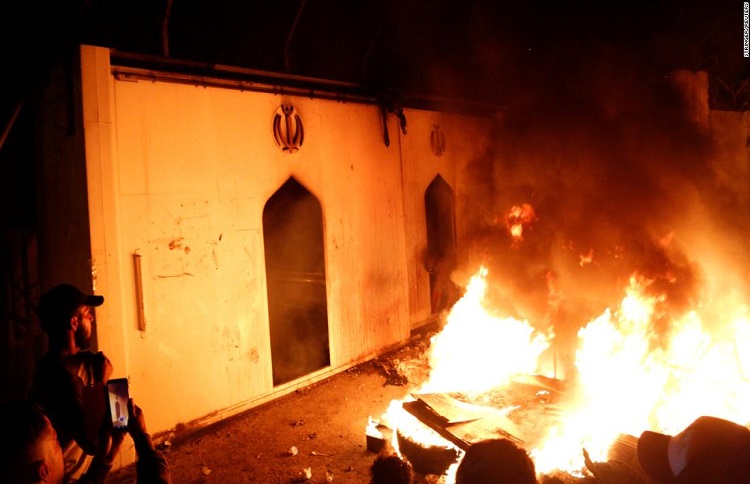
After the Iranian regime was recognized as the main problem in Iraq, a wave of the expulsion of Iranian elements from that country, along with Iranian export goods, began rapidly. The occupation and burning of Iran’s consulates and the boycott of Iranian goods were factors that had a major impact on relations between Iraq and Iran.
Overview of Exports to Iraq
An examination of Iranian customs statistics shows that Iran’s non-oil exports to Iraq have increased from $2.762 billion in 2008 to $6.424 billion in 2017.
Nasser Behzad, Iran’s trade adviser, said in October this year about Iranian exports to Iraq: Iran is on the top of the list with about 24% of total exports to Iraq among competitors such as China, Turkey, Jordan, India, Saudi Arabia, and the United States.
He noted that 20% of this share was held by China, 19.5% by Turkey and below 10% by the US. He pointed out that about 25 percent of Iran’s exports were amounted to $4.5 billion to China and 22 percent equivalent to $4 billion to Iraq. (ILNA, 12 October 2019)
Other sources estimate that exports to Iraq amounted to $8.961 billion in 2018, with an increase of 37% compared to 2017.
The price of Iran’s electricity exported to Iraq was about $630 million in 2018 (approximately 5 terawatts). And the price of Iran’s gas exports to Iraq was about $2.4 billion (about 11 billion cubic meters). (Iran – Iraq Joint Chamber of Commerce, 24 April 2019)
According to these numbers, Iran’s non-oil, gas and electricity exports to Iraq had an income of $11.721 billion for the Iranian side.
According to Al-Ishaq (head of the Iran-Iraq Joint Chamber of Commerce), Iran exported nearly $6.5 billion to Iraq during the first six months of this year, and that trend continued in September. (Tejarat News, 1 December 2019)
After the second Iraq war, Iran tried with its Iraqi mercenaries to take the hegemony in Iraq overall, by eliminating all its opponents, making Iraq its own backyard, making Iraq as the main bridge of its strategic influence in the Middle East and of course of taking over the Iraqi market.
That’s the main reason why Tehran is trying to calm down Iraq’s protests. Ali Shariati (Member of the Iranian Chamber of Commerce) said that if the unrest in Iraq continues, it will overshadow all our businesses.
Another sense of the overshadow that Ali Shariati speaks about is the fact that Tehran’s losses are the result of the current protests in Iraq. The signs of this loss can now be seen in the following:
- One of the first results of the uprising in Iraq is the decline in the value of the Iranian rial in the Iraqi market and the willingness of Iraqi businessmen to use the dollar, dirham and dinar for trading instead of the rial, and therefore the dollar’s value in Iran has risen and demand for the dollar has increased in the Iranian market.
- The boycott of Iranian goods in Iraq has now become a nationwide movement.
- The Iraqi government has banned the import of 17 agriculture products from Iran. Iraq declared that the reason for the ban is achieving ‘self-sufficiency’, which is blocking another part of Iran’s export resource.
- The closure of the port of Om al-Qasr after its capture by the protesting people disrupted the Iranian export business. The uprising is taking place in most of Iraq’s major cities, and the existence of a climate of hatred for the Iranian regime has also created an atmosphere of insecurity for Iranian trucks.
- The head of the Iran-Iraq Joint Chamber also said: One of Iran’s exports to Iraq was electricity, something which the United States was trying to block; therefore the Americans are building a separate power plant in Iraq, which would be ready for production in the next two years and prevent Iranian electricity from being exported to Iraq. Pressures have now begun to limit electricity imports from Iran. (Tejarat News, 1 December 2019)


